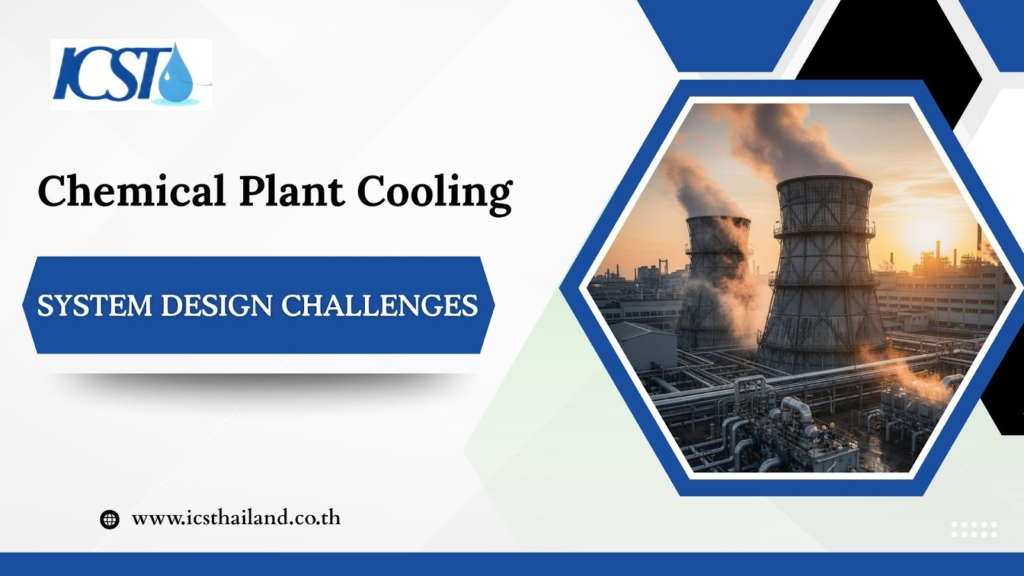
Chemical processing facilities face a fundamental paradox. The very reactions that drive production generate heat that could destroy the process itself. Cooling systems serve as the critical safeguard between successful operation and catastrophic failure.
However, cooling in chemical plants extends far beyond simple heat removal. These systems must withstand aggressive chemicals, prevent contamination, and maintain precise temperature control while operating continuously for months at a time. A single cooling failure can trigger thermal runaway, equipment damage, and costly unplanned shutdowns.
The stakes have never been higher. New regulatory requirements for 2025 demand enhanced process reliability and environmental compliance. Chemical manufacturers must now design Chemical Plant Cooling systems that meet stricter water conservation targets while maintaining the thermal precision required for consistent product quality.
This guide explores key design challenges in chemical plant cooling systems and offers actionable solutions to ensure compliance with the 2025 reliability mandate. We will explore material selection strategies and process control requirements.
Section 1: The Corrosion Tax and Material Integrity
1.1. The Corrosion Tax: Why Metal Fails
Corrosion represents one of the most significant operational costs in chemical plant cooling systems. Traditional carbon steel components face constant attack from process chemicals, high-temperature water, and aggressive cleaning agents.
The most dangerous forms of corrosion occur locally and often remain hidden until failure occurs.
- Pitting corrosion creates deep, narrow holes that can penetrate pipe walls in months rather than years.
- Crevice corrosion develops in areas where oxygen access is limited, such as gasket interfaces and connection points.
- Stress corrosion cracking combines mechanical stress with chemical attack to create sudden, catastrophic failures.
1.2. Design for Survival: Beyond Galvanized Steel
Modern chemical plants require materials that can withstand both thermal cycling and chemical exposure. The selection process must consider the entire system rather than individual components.
- Cooling tower structures benefit from fiber-reinforced plastic (FRP) or high-density polyethylene (HDPE) construction.
- These materials resist chemical attack while providing structural strength.
- FRP offers superior strength-to-weight ratios for large installations, while HDPE provides excellent chemical resistance for smaller systems.
- Heat exchangers and piping systems demand even more careful consideration.
- Stainless steel 316 (SS316) provides the minimum acceptable corrosion resistance for most chemical applications..
The critical principle in material selection is simple: the entire system operates only as reliably as its weakest component.
Section 2: Process Control and Fouling
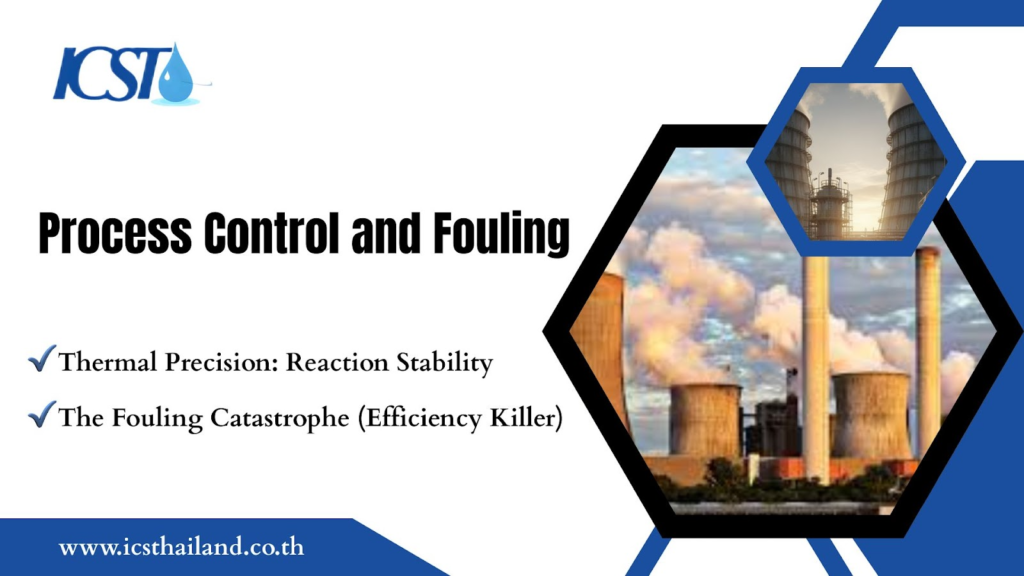
2.1. Thermal Precision: Reaction Stability
Chemical reactions exhibit extreme sensitivity to temperature variations. A deviation of just 2°C can alter reaction kinetics, reduce product yield, or create unwanted byproducts. The cooling system must maintain precise temperature control under varying heat loads and ambient conditions.
- Process reliability depends on three critical elements: responsive heat exchangers, accurate temperature sensors, and properly tuned PID controllers.
- Plate-and-frame heat exchangers provide the fastest response to temperature changes due to their high surface area and low thermal mass.
- Shell-and-tube designs offer durability but respond more slowly to control signals.
- PID controllers require careful tuning to prevent thermal runaway while avoiding excessive cycling.
The integration time must account for the thermal mass of both the reactor and the cooling system. Poorly tuned controllers can create temperature oscillations that reduce product quality and increase energy consumption.
2.2. The Fouling Catastrophe (Efficiency Killer)
Fouling represents the gradual loss of heat transfer efficiency as deposits accumulate on heat exchange surfaces. Two primary mechanisms drive this process: mineral scale formation and biological growth.
- Mineral scale develops when dissolved solids precipitate onto hot surfaces.
- Silica and calcium carbonate create the most problematic deposits because they possess low thermal conductivity.
- Even thin scale layers can reduce heat transfer coefficients by 25% or more.
Biofilm formation occurs when microorganisms establish colonies on wetted surfaces. These biological deposits not only reduce heat transfer but also accelerate under-deposit corrosion. Legionella bacteria pose additional health risks for personnel working near cooling towers.
Section 3: Efficiency and Regulatory Compliance (2025 Trends)
3.1. The Water-Wise Plant: Balancing Concentration Ratios
Water conservation regulations require chemical plants to minimize consumption while maintaining cooling system performance. The key metric is cycles of concentration – the ratio of dissolved solids in cooling water compared to makeup water.
- Higher concentration ratios reduce water consumption but increase fouling and corrosion risks.
- Most chemical plants operate between 4-6 cycles of concentration, balancing water savings with system reliability.
- Plants processing highly corrosive materials may be limited to 2-3 cycles to prevent equipment damage.
- Side-stream filtration systems enable higher concentration ratios by continuously removing suspended solids and some dissolved minerals.
- These systems typically process 2-5% of the total circulation flow, providing significant water savings with minimal energy penalty.
Water pretreatment becomes increasingly important as concentration ratios increase. Ion exchange softening, reverse osmosis, or specialized filtration may be required to remove scale-forming minerals before they concentrate in the cooling system.
3.2. System Choice: Hybrid and Closed-Loop Reliability
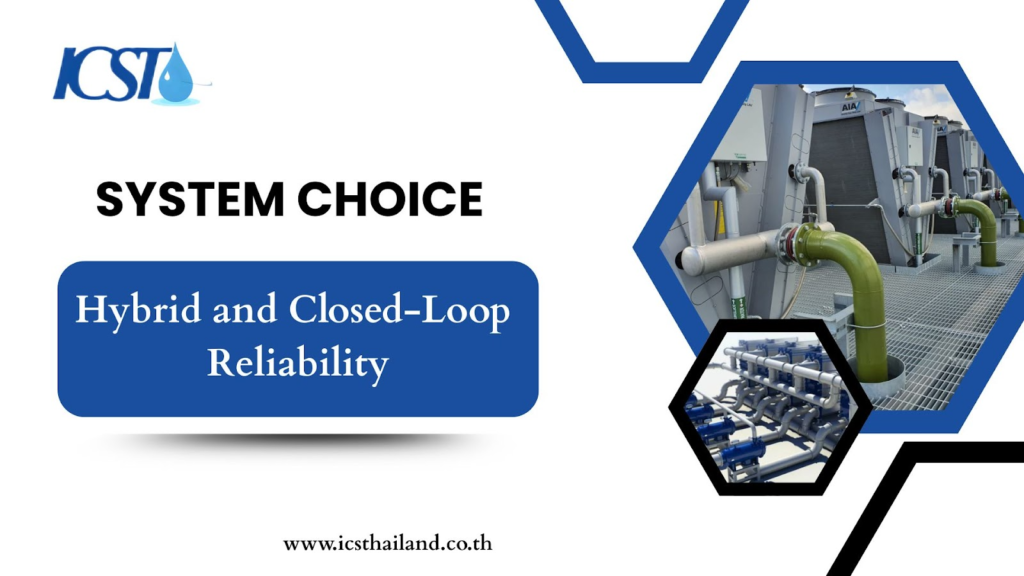
Closed-loop cooling systems provide the highest reliability for critical processes. These systems isolate the process cooling circuit from environmental contamination and enable precise chemistry control.
- Hybrid cooling systems combine wet cooling towers with dry or adiabatic coolers to achieve water conservation goals.
- During cool ambient conditions, the dry section handles the full cooling load without water consumption.
- Wet cooling provides additional capacity during peak demand periods.
This approach can reduce water consumption by 40-60% compared to conventional wet cooling while maintaining the capacity needed for summer operation.
3.3. Smart Controls and Compliance
Internet of Things (IoT) sensors enable continuous monitoring of cooling system performance and water chemistry. Real-time data collection allows operators to optimize blowdown rates, chemical addition, and equipment operation.
- Automated blowdown control based on conductivity measurements ensures optimal water usage while preventing excessive mineral concentration.
- These systems can reduce water consumption by 10-15% compared to manual control while improving chemistry stability.
- Predictive maintenance algorithms analyze sensor data to identify developing problems before they cause failures.
- Vibration analysis, thermal imaging, and chemical trending can predict heat exchanger fouling, pump bearing wear, and other maintenance needs with remarkable accuracy.
Chemical Plant Cooling Specification Matrix
| Challenge/Area | Design Requirement | Recommended Technology/Material |
| Process Control (High Precision) | Maintain ±0.5°C for reactor | Closed-Loop System with Plate-and-Frame HX & PID Control |
| Severe Corrosion Risk | Resistance to acid carryover and high TDS water | Cooling Tower: FRP/HDPE. Piping: SS316 |
| Silica & Hardness Fouling | Minimize mineral scale and prevent efficiency loss | Side-Stream Filtration and Automated Blowdown (Conductivity) |
| Energy Efficiency Goal | Reduce water consumption/pump energy | Hybrid Cooling System (with Adiabatic/Dry section) |
| Microbial Control | Effective management of biofilm/Legionella | Alternating Biocides (Oxidizing and Non-Oxidizing) |
Actionable Takeaway: Your Cooling System Audit Checklist
How do you evaluate whether your current chemical plant cooling system meets the demands of modern chemical processing? These critical questions will help assess the reliability and compliance of your current or proposed chemical plant cooling system design:
What specific process chemicals could your cooling system encounter, and are all wetted materials rated for these exposures? Many plants underestimate the corrosive potential of trace chemicals or upset conditions.
Key evaluation points:
- Is your tower structure rated for the process chemicals present?
- Are your heat exchangers fully SS316 or equivalent for your specific chemical environment?
- Do you use automated conductivity control for blowdown to optimize water usage?
- Do you have a hybrid solution to meet water conservation targets while maintaining reliability?
- Is your control system responsive enough to prevent thermal runaway during process upsets?
Final Thoughts
Inadequate cooling systems can lead to costly downtime, regulatory penalties, and lost competitive advantage. With the 2025 reliability mandate approaching, investing in a well-designed cooling system is essential to ensure efficiency, compliance, and long-term profitability.
Success in chemical plant cooling requires more than just selecting equipment; it demands expertise in corrosion, fouling, and process control tailored to your plant’s unique needs.
At ICST, our specialists provide comprehensive audits to evaluate your cooling system and recommend improvements aligned with industry best practices and regulatory standards..
Don’t let your cooling system become a liability. Enhance reliability, reduce costs, and stay ahead of compliance requirements. Visit our website, learn more, and schedule your system reliability audit today.
Frequently Asked Questions
What is chemical plant cooling, and why is it important?
Chemical plant cooling removes excess heat from processes to maintain safe operating conditions, ensure product quality, and prevent equipment damage or shutdowns.
What are the main challenges in chemical plant cooling systems?
The biggest challenges include corrosion, scaling, fouling, microbial growth, water scarcity, and maintaining precise temperature control under varying loads.
Why is corrosion a major issue in chemical cooling systems?
Corrosive chemicals, high temperatures, and water impurities attack metal surfaces, leading to leaks, failures, and costly downtime if materials are not properly selected.
What materials are best for chemical plant cooling systems?
FRP and HDPE are ideal for cooling tower structures, while SS316 stainless steel is commonly used for heat exchangers and piping in corrosive environments.
How can fouling in cooling systems be prevented?
Fouling is minimized by side-stream filtration, smart blowdown control, alternating biocides, and regular monitoring of scale-forming minerals and biofilm growth.