What if the biggest threat to your industrial cooling system isn’t a malfunction, but the very air around it? Industrial cooling systems constantly battle against efficiency drains and soaring operational costs. The culprits? Fouling, scaling, and corrosion in your critical equipment often stem directly from open cooling towers.
To combat these challenges, advanced engineering offers a superior solution. The Closed Circuit Cooling Tower (CCCT) provides a robust defense by using a dual-loop design. Inside a CCCT, the critical process fluid circulates within a sealed coil loop, completely isolated from the outside environment.
In this blog post, we’re going to explore how hydraulic separation is the key to a CCCT’s effectiveness. We’ll dive into why investing in a CCCT is a strategic decision for ensuring long-term system protection, maintaining fluid purity, and enhancing operational reliability, making it an essential solution for applications where these factors matter most.
Core Advantages: Why the Sealed Loop Matters
What makes the sealed loop design so critical for industrial applications? Its primary benefits stem from protecting the process fluid and, by extension, the entire cooling system.
Uncompromising Fluid Purity
The most significant advantage of a closed-circuit cooling tower is its ability to maintain the purity of the process fluid. Because the fluid circulates within a completely sealed coil, it never comes into contact with the atmosphere.
- This design eliminates the risk of introducing contaminants like dirt, debris, and biological growth into the system.
- As a result, sensitive downstream components such as chillers, heat exchangers, and compressors remain clean.
- This cleanliness ensures they operate at peak design efficiency, preventing the performance degradation and premature failure associated with contaminated fluid.
Reduced Operational Costs
How does a sealed loop translate to lower operating expenses? The internal process fluid loop requires minimal chemical treatment. Since the fluid is not exposed to oxygen or external contaminants, the primary need is for corrosion inhibitors to protect the internal surfaces of the coil and piping.
- This greatly simplifies water management.
- The maintenance burden shifts from the complex and continuous monitoring of process water quality to managing the less critical external spray water loop.
- This reduction in chemical usage and labor lowers the total cost of ownership over the system’s lifespan.
Fluid Versatility and Freeze Protection
The sealed design of a Closed Circuit Cooling Tower offers flexibility with coolants. In freezing winter regions, it supports glycol-based antifreeze, ensuring freeze protection without the need for drain-down cycles or external heat exchangers.
Furthermore, this design is ideal for cooling specialized process fluids other than water. It can effectively manage oils, chemicals, and brines that are incompatible with open-loop systems, expanding its application to a wider range of industrial processes.
Mandatory Applications: When a CCCT is Essential
While a CCCT offers benefits in many scenarios, certain applications demand the level of protection it provides. When is this technology not just an option, but a necessity? The answer lies in the criticality of the process, the value of the equipment, and the environmental conditions.
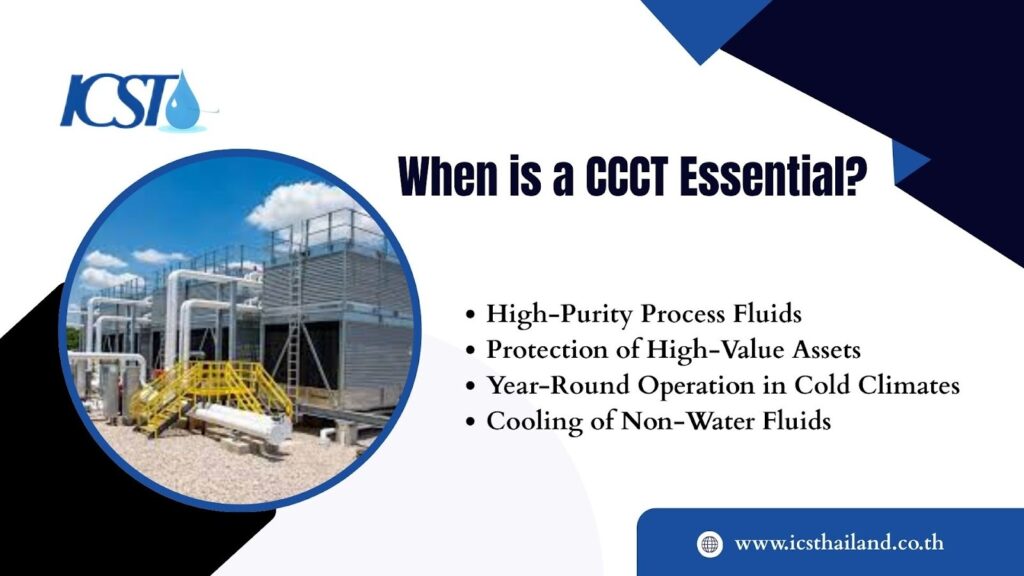
Here are the key situations where a Closed Circuit Cooling Tower is essential:
High-Purity Process Fluids:
In industries like electronics manufacturing, pharmaceuticals, and food production, the process fluid must remain pristine. Any level of contamination can compromise product quality or lead to batch failure. A CCCT is mandatory here because it guarantees the fluid never encounters external impurities.
Protection of High-Value Assets:
When the downstream equipment is exceptionally expensive or difficult to service, a CCCT is a critical investment. Think of medical imaging equipment like MRI machines, specialized industrial compressors, or data center servers. The cost of cleaning or replacing these assets far outweighs the initial investment in a closed-circuit cooling tower, making it an essential protective measure.
Year-Round Operation in Cold Climates:
For facilities that must operate continuously through sub-freezing temperatures, freeze protection is non-negotiable. A CCCT with an integrated glycol solution provides reliable, year-round operation without the efficiency losses or maintenance complexities of external heat exchangers or system draining.
Cooling of Non-Water Fluids:
Many industrial processes use fluids like oil, chemicals, or brine as coolants. These fluids cannot be exposed to the atmosphere and are often incompatible with the materials used in open cooling towers. A CCCT provides the necessary sealed environment to cool these specialized fluids safely and efficiently.
The Maintenance Reality: Specialized Care for Closed Systems
While a CCCT protects the internal process fluid, it presents a unique maintenance challenge. How do you ensure the long-term reliability of a system designed for cleanliness? The focus shifts from internal water quality to the condition of the external coil.
The External Coil Paradox
The internal process fluid remains pristine, but the external surface of the coil is constantly wetted by the spray water loop. This water is open to the atmosphere and, just like in an open cooling tower, is prone to concentrating minerals and contaminants.
- As water evaporates, it leaves behind dissolved solids that form scale on the coil surface.
- If left unmanaged, scaling can lead to higher energy consumption, reduced cooling capacity, and eventually, corrosion that compromises the integrity of the entire system.
Specialized ICST Coil Maintenance
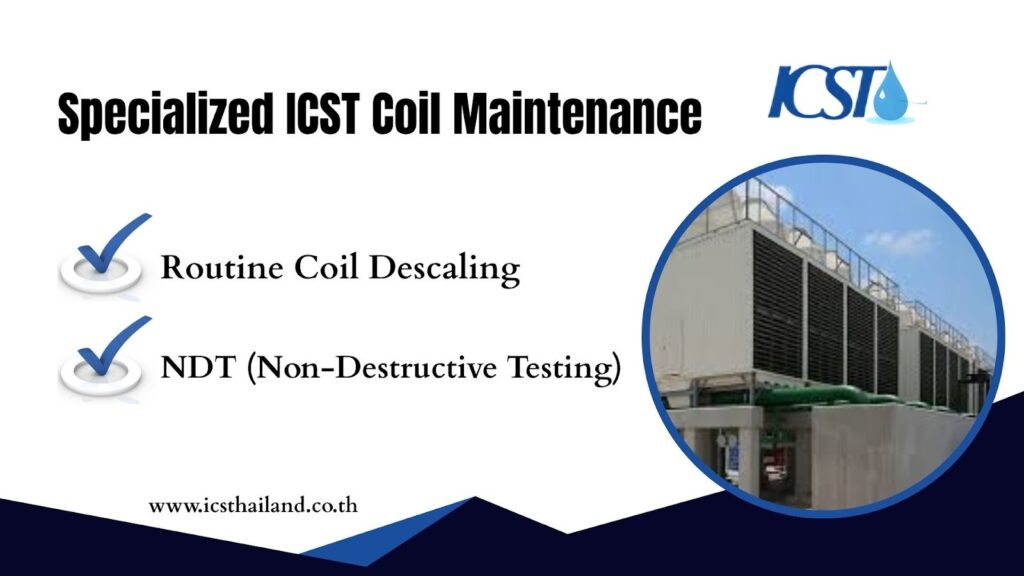
Proper maintenance of the external coil is crucial to realizing the full benefits of a closed circuit cooling tower. At ICST, we provide unique service offerings tailored specifically for these systems. What does this specialized care involve?
Routine Coil Descaling:
We employ specialized cleaning procedures and chemical treatments designed to safely remove scale and biological fouling from the external coil surfaces. This process restores heat transfer efficiency and ensures the system operates at its design capacity, keeping energy costs in check.
NDT (Non-Destructive Testing):
How can you identify a problem before it leads to failure? We use advanced non-destructive testing methods, such as eddy current testing, to inspect the coil tubing from the inside.
This technology allows us to detect corrosion, pitting, or thinning of the tube walls long before a leak occurs, enabling proactive repairs and preventing catastrophic failures.
Glycol and Fluid Management
For systems using glycol or other specialized fluids, maintaining the fluid’s integrity is just as important as maintaining the equipment. Our cooling tower maintenance service includes professional fluid analysis to ensure its properties remain within specifications. What does this analysis cover?
- Glycol Concentration Testing: We test the glycol concentration to verify that it provides the required level of freeze protection for your climate.
- Corrosion Inhibitor Analysis: We analyze the condition and concentration of the corrosion inhibitors in the fluid. Over time, these inhibitors deplete, and failing to replenish them can lead to internal corrosion of the sealed loop. Our service ensures the fluid is properly conditioned for long-term asset protection.
Conclusion
Choosing a Closed Circuit Cooling Tower is more than an equipment purchase; it is an investment in the long-term reliability and efficiency of your entire facility. By isolating your critical process fluid from harmful contaminants, a CCCT protects high-value downstream assets, reduces operational costs, and ensures consistent performance.
However, the promised longevity and efficiency of a Closed Circuit Cooling Tower are only achievable with specialized and consistent maintenance. The external coil and the process fluid need expert attention to prevent scaling, corrosion, and degradation. Proper care and expertise are crucial to protecting your investment.
Protect your critical assets and secure your operational efficiency. Contact ICST today for a consultation on selecting and maintaining the right heat rejection solution for your facility.
Frequently Asked Questions
What is a Closed-Circuit Cooling Tower?
A Closed Circuit Cooling Tower (CCCT) is a cooling system where the process fluid circulates inside a sealed coil. It never contacts outside air, preventing contamination, scaling, and fluid degradation.
How is a closed-circuit tower different from an open cooling tower?
In an open tower, the process water is exposed to air, causing fouling and contamination. In a closed-circuit tower, the process fluid stays enclosed in a coil, keeping it clean while heat is rejected through an external spray loop.
Can a closed-circuit cooling tower operate in cold climates?
Absolutely. CCCTs work reliably in freezing temperatures when combined with glycol-based fluid. This prevents freeze-ups and eliminates the need for draining or extra heat exchangers.
How long does a closed-circuit cooling tower last?
With proper maintenance, CCCTs can last 15–25 years. Regular coil descaling, corrosion control, and fluid management significantly extend system lifespan.
Are CCCTs suitable for data centers?
Absolutely. Data centers rely on consistent, contamination-free cooling. CCCTs protect expensive servers and cooling equipment from fouling, making them ideal for mission-critical environments.