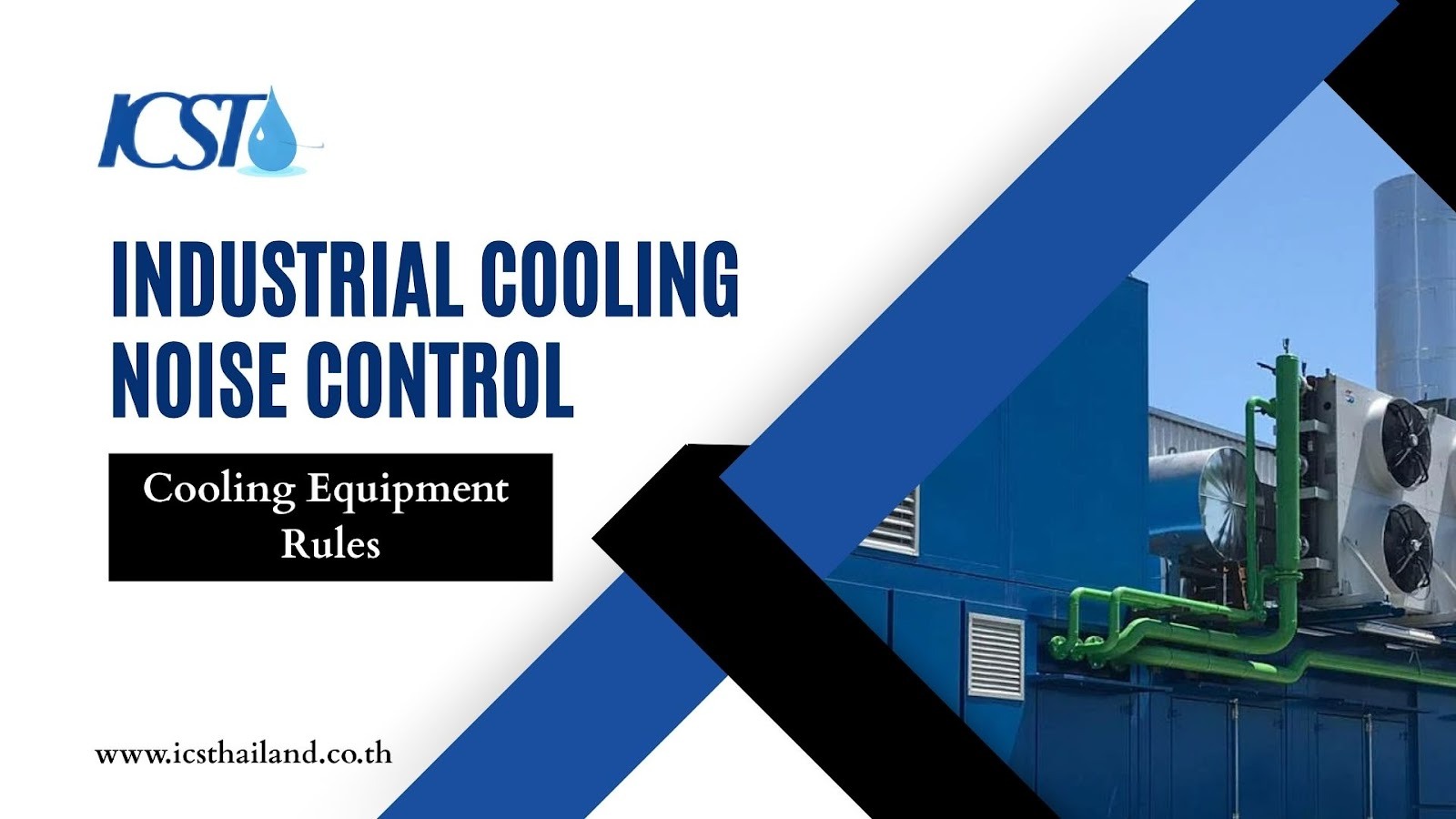
Noise pollution from industrial cooling equipment is more than just a nuisance; it’s a significant hidden liability. The constant hum of cooling towers and chillers can lead to regulatory non-compliance, expensive fines, community conflict, and even employee health risks.
Many operators assume that high-performance cooling and acoustic compliance are mutually exclusive, but that isn’t the case. Ignoring noise is often far more expensive than proactively managing it.
A powerful industrial cooling system can also be a quiet one. The key to reducing industrial cooling noise is addressing it at its source, rather than relying on costly external fixes after a complaint is filed.
This comprehensive guide breaks down the key regulatory rules you must know and introduces a phased, budget-friendly strategy to effectively reduce noise. With this expert-backed approach, you can safeguard your property line while keeping your operational costs in check—proven solutions designed to give you peace of mind and compliance confidence.
Navigating the Regulatory Landscape
Understanding the rules that apply to your facility is the first step toward compliance. Noise regulations for industrial equipment typically fall into two main categories: occupational limits for worker safety and environmental limits for community peace.
Occupational Noise Limits (Internal Compliance)
These regulations are designed to protect your employees’ hearing and overall health. The primary metric is the Time-Weighted Average (TWA), which sets a maximum permissible noise exposure level over a standard workday.
For example, many jurisdictions enforce a limit of 85 decibels (dB(A)) over 8 hours. Exceeding this limit can put your team’s long-term health at risk and expose your company to significant liability.
Environmental and Community Noise (External Compliance)
Industrial Cooling Noise is often the most common and challenging area for facilities with large cooling equipment. These rules govern the amount of noise that can cross your property line and affect neighboring areas.
The General Limit (Leq):
This regulation sets a maximum average sound level (Leq) at the property line. These limits are almost always stricter at night, when background noise levels are lower and residents are more sensitive to industrial sounds.
The Annoyance/Tonal Rule:
This rule often trips up facilities because it goes beyond just overall loudness. Regulators understand that certain types of sounds can be far more disruptive and annoying, even if they aren’t the loudest. For example, specific cooling tower parts like motors and fans can produce distinct tones. Ignoring these specific noise characteristics can lead to unexpected compliance issues.
- Tonal Noise Penalties: Regulations specifically penalize “tonal” noise—these are constant, single-frequency sounds like humming or whining, common with motors and fans.
- Violation Despite Decibels: Even if your equipment’s overall decibel level is within the general limit, a prominent tonal sound can still result in a violation.
- Ambient Noise Limitations: This rule may also set limits on how much louder your facility’s noise can be compared to the surrounding ambient background noise.
The High Cost of Non-Compliance
Failing to meet these standards is not a minor issue. The consequences can include substantial fines, mandatory and expensive installations of external acoustic barriers, and even legal injunctions that restrict your operational hours. Proactive noise management is always a more cost-effective strategy than reactive damage control.
Phase 1: Attacking Noise at the Source
The most effective and budget-friendly way to control noise is to address it where it originates: within the machinery itself. Mechanical noise is often a symptom of inefficiency or wear. By optimizing your equipment, you not only reduce decibels but also improve performance and energy consumption.
Fan System Optimization
In many industrial and HVAC systems, particularly cooling towers and air-cooled chillers, fans are the dominant noise generators. Their continuous operation and the sheer volume of air they move inevitably produce significant levels of both broadband and tonal noise, making them a critical area for noise reduction efforts.
- Aerodynamic Blades: Upgrading from standard metal or older fiberglass blades to modern, low-noise fan designs can dramatically reduce noise levels. These aerodynamically advanced blades are engineered to move air more efficiently, often lowering energy use while cutting sound output.
- VFD Implementation: Installing Variable Frequency Drives (VFDs) allows you to adjust fan speeds based on real-time cooling demand. During cooler weather or periods of low production, you can slow the fans down. Even a small reduction in fan speed yields a significant decibel decrease, providing a powerful tool for managing noise.
Mechanical Noise Reduction
A key source of industrial cooling noise, specifically tonal noise, often stems from worn or misaligned mechanical components. Over time, heavy usage and insufficient maintenance can cause parts like fans, bearings, or belts to degrade, leading to vibrations and unwanted noise.
Misalignment during installation or regular operation can further amplify these sounds, potentially impacting both equipment performance and workplace comfort. Identifying and addressing these issues early is crucial to maintaining efficiency and reducing noise pollution in industrial environments.
- Vibration Control: Ensure all motors, gearboxes, and fans are mounted on properly specified and maintained anti-vibration isolation pads. Over time, these pads can degrade, transferring vibrations directly into the equipment structure and amplifying noise.
- Precision Maintenance: A thorough maintenance program is essential. Replacing worn bearings and correcting misaligned driveshafts can eliminate the high-frequency tonal noises that are most likely to trigger compliance fines under the “annoyance” rule.
Water Noise Control
The sound of water splashing into the cooling tower basin can also be a significant noise contributor. Regular inspections to ensure the fill media and water distribution system are intact and functioning correctly will minimize this splashing effect and reduce overall sound levels.
Phase 2: External Acoustic Mitigation
In some cases, source control alone may not be enough to achieve full compliance, especially in facilities located very close to residential areas. When additional measures are needed, you can turn to targeted external acoustic treatments.
Acoustic Barriers and Enclosures
- Sound Walls/Barriers: These are standalone walls strategically placed between the noise source and the property line. By blocking the direct line-of-sight path for sound, they can provide substantial noise reduction for sensitive receivers.
- Full or Partial Enclosures: For maximum noise control, the equipment can be surrounded by a full or partial enclosure built from specialized acoustic panels. These panels are designed to absorb sound waves and prevent them from escaping into the environment.
Acoustic Louvers and Silencers
Acoustic louvers and silencers are essential for equipment requiring significant airflow, like chillers and air-cooled heat exchangers. They allow air to pass freely while internal baffles absorb sound, quieting the system without affecting performance.
Main advantages:
- Airflow Retention: Allows essential air movement without obstruction.
- Effective Noise Reduction: Significantly lowers sound levels.
- Performance Preservation: Maintains equipment cooling efficiency.
- Versatile Installation: Can be fitted at intake or discharge points.
Conclusion
Achieving noise compliance is not about simply building a wall around your equipment. It’s a strategic process that starts with mechanical optimization and is supplemented by targeted acoustic treatments only when necessary. This two-phase approach ensures you achieve your goal in the most cost-effective and operationally efficient way.
Remember, industrial cooling noise often points to a deeper mechanical issue. By addressing the root cause, you can create a quieter, more efficient, and more reliable cooling system.
Contact ICST today to schedule an Acoustic and Efficiency Audit. Our experts will help you identify mechanical noise sources and develop a compliant, cost-effective mitigation plan that works for your facility and your budget.
Frequently Asked Questions
What causes excessive noise in a cooling tower?
Excessive noise usually comes from fan blades, falling water, and mechanical vibration. Poor maintenance and high airflow velocity can also amplify sound levels.
How can I reduce fan noise in a cooling tower?
Fan noise can be reduced by using low-noise blade designs and balancing the fan assembly. Regular lubrication and optimizing fan speed also help maintain quieter operation.
Do cooling towers need acoustic barriers?
Yes, acoustic barriers help block mechanical and airflow noise, especially in noise-sensitive zones. They are commonly used near hospitals, schools, and residential areas.
What is the acceptable noise level for cooling towers?
Most regions set cooling tower limits between 55–75 dB(A) depending on zoning and time. Industrial zones allow higher limits, while residential areas have stricter requirements.
Why do cooling towers produce tonal noise?
Tonal noise happens when fans or motors generate a specific dominant frequency. Worn bearings or unbalanced blades can increase this characteristic humming sound.