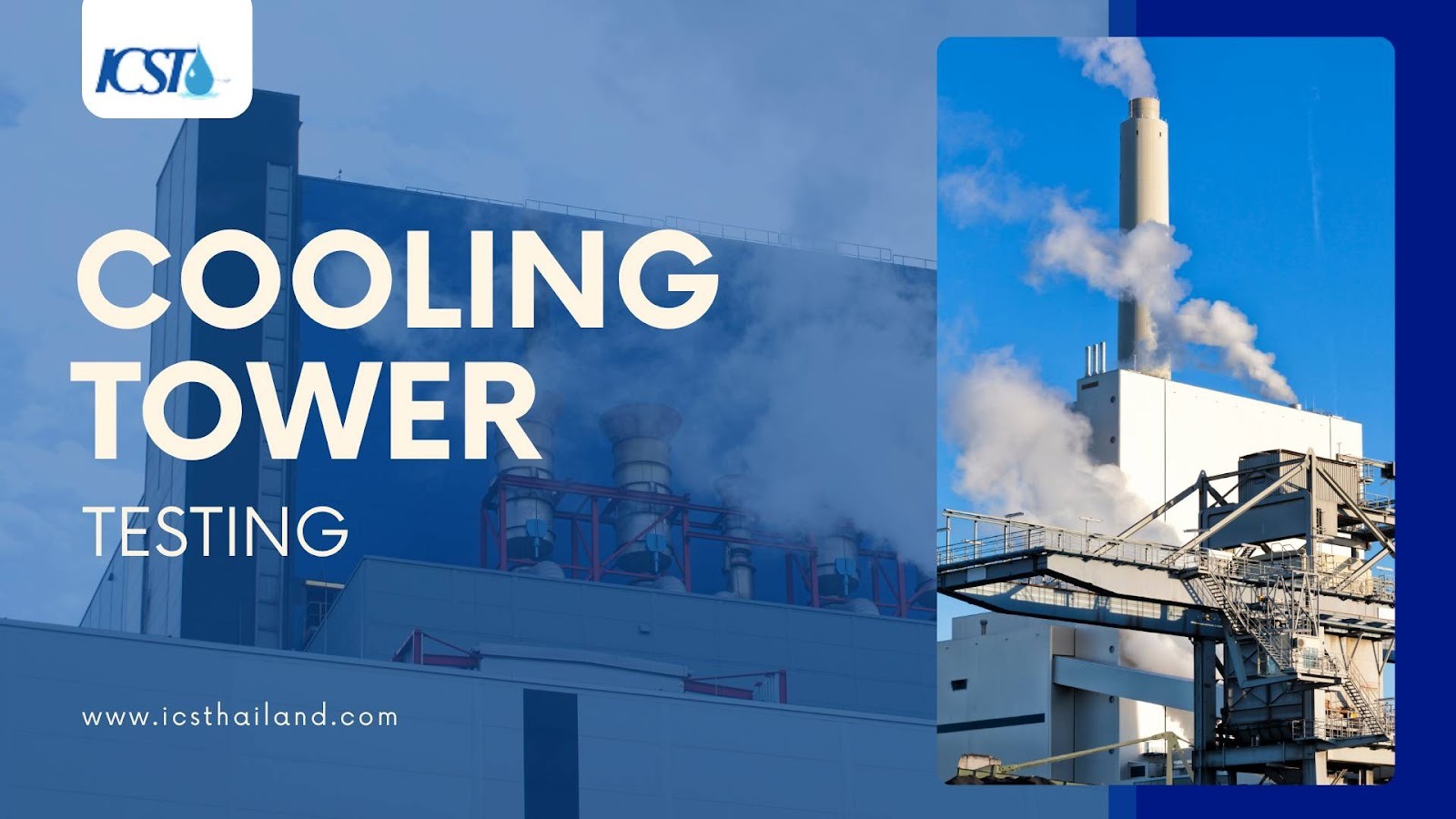
Cooling tower testing is essential for ensuring your facility operates at peak efficiency. A cooling tower is the unseen heart of your facility. Water cooling towers work silently in the background, but when their thermal performance drops, energy costs can spike by 5% to 15% without any obvious warning. This decline is a hidden saboteur, draining your operational budget and pointing to the need for regular tower testing.
Effective cooling tower tests are not just about meeting cooling technology institute (CTI) standards or regulatory compliance. They are the key to unlocking precise, actionable test data that restores peak efficiency and guarantees a return on investment.
We will introduce a comprehensive approach that moves beyond standard test procedures to provide a clear financial roadmap for your system’s overall performance.
The Detective’s Toolkit: How Cooling Tower Testing Works
The core principle of cooling tower testing revolves around a simple but critical measurement. Understanding these test parameter limits and the design and test values will show why comprehensive testing is so valuable for mechanical draft towers and natural draft towers alike.
The Golden Rule: Approach is Everything
The most important metric in thermal performance testing for a cooling tower is the Approach. It refers to the temperature difference between the cold water temperature leaving the tower and the inlet wet bulb temperature of the surrounding air. Achieving a smaller Approach value indicates a more efficient water cooling tower.
A common mistake is to rely solely on the manufacturer’s nameplate test values. Instead, focus on the CTI Performance Index from actual tests. This key value is determined through rigorous tower testing that uses psychrometric and hydraulic calculations, and simulates design conditions regardless of current weather.
The First Piece of Evidence: Acceptance Testing
For new or rebuilt towers, the Acceptance Test, governed by the acceptance test code CTI ATC-105, is a critical requirement. This testing ensures mechanical equipment operates as promised and the cooling tower delivers the rated performance before final payment.
During an acceptance test, certified CTI Test Agents follow a structured test procedure. They calibrate all equipment, measure fan motor power, evaluate water flow rates, and record both water temperatures and wet bulb temperatures.
The process uses accurate test equipment, including pitot tube traverses and pressure gauges. This approach ensures test results confirm the design and test values, offering concrete proof that the tower meets contractual obligations for cooling tower maintenance.
The Full Performance Audit: What a Test Looks Like
A full audit of cooling tower maintenance requires a systematic investigation of the tower’s thermal capability, mechanical components, testing conditions, and other equipment. All of this is determined by a rigorous and clearly defined process.
The Thermal Investigation
The core aim of any performance test is the thermal investigation. This process uses high-quality test equipment and robust methods to measure and capture every parameter affecting performance, water distribution, and water quality.
- Instrumentation: Utilize calibrated thermocouples, mercury in glass thermometers, and pressure gauges to accurately determine the range (hot water minus cold water temperature), wet bulb, and dry bulb temperatures, as well as the system’s airflow and heat load.
- Data Collection: Test data must be synchronized from various points: the hot water distribution system, cold water basin, ambient air, and the multi-cell tower. Such comprehensive water temperatures and system data ensure reliable analysis of the cooling tower’s performance during the test run and test period.
Identifying just a 5% reduction in performance can yield immediate cost savings. Properly conducted tests help determine when tower maintenance or mechanical equipment repair is necessary.
The Specialized Gear
Precision is only possible using the right test equipment.
- Anemometers: Measure air volume at varying wind speeds to assess fan motor power and its effect on thermal performance.
- Pitot Tube & Manometers: Used for pitot tube traverse and pressure gauges in piping to verify hydraulic performance and water flow rate.
- Aspiration Psychrometers: Far superior to standard thermometers, these instruments, alongside shielded wet bulb temperature sensors, deliver the most accurate ambient and inlet wet bulb temperature readings, key for defining test parameter limits.
The Hidden Risks: Sound, Drift, and Compliance
Beyond a cooling tower’s basic thermal performance, many testing conditions require additional procedures to address drift emissions and environmental compliance, sound testing, and water quality.
Unmasking the Noise Threat
Cooling towers can introduce significant noise issues for the surrounding areas. Sound testing, according to acceptance test code and industry standards, ensures noise levels are within defined test parameter limits.
Such testing is especially crucial for regulatory compliance in hospitals, data centers, and urban multi-cell tower installations.
- Low-Frequency Noise: Fan pitch and speed adjustments are used for low-frequency sound reduction.
- High-Frequency Noise: A frequency analysis helps position sound barriers and silencers for optimal effect, meeting the cooling technology institute and regulatory compliance.
Stopping Microbial Spread with Drift Testing
Tower drift, consisting of small water droplets escaping the cooling tower, can transport solids, chemicals, and microorganisms such as Legionella. Poorly managed drift can threaten water quality, corrode other equipment, and cause regulatory infractions.
Advanced drift emissions testing, including the use of laser-based technologies, measures particulate matter (PM10 and PM2.5) to demonstrate a tower’s emissions are well below the threshold values.
Such testing conditions and processes not only prove regulatory compliance but also help facilities refine water distribution and minimize blowdown flow.
The Master Strategy for Optimization

The main goal in cooling tower maintenance is to use findings from ongoing tests to drive predictive maintenance, improve overall performance, and optimize water system operation.
Best Testing Strategies
Opt for proactive and regular testing to optimize water cooling towers and system performance.
- Scheduled Degradation Monitoring: Conduct annual or biennial performance tests, particularly for older towers, to establish long-term trends in mechanical components and thermal capability.
- Post-Modification Verification: Any modification to fill media, drift eliminators, distribution system, or mechanical components warrants a new test to ensure results align with design and test values.
A stable heat load and steady water flow are crucial during any performance test period to ensure that results remain valid and you can accurately gauge thermal lag time.
The Verdict: Industry Improvement and Unmatched Advantages
Implementing a robust testing strategy for cooling towers across both natural draft towers and mechanical draft towers brings measurable advantages.
Benefits of a 360° Strategy
- Guaranteed Energy Reduction: Direct improvements in overall performance drive down utility costs.
- Chemical Optimization: Accurate water quality data ensures minimal blowdown flow and avoids over-application of water treatment agents.
- Risk Mitigation: Systematic testing identifies compliance gaps and mechanical issues before they affect system or regulatory compliance.
How Different Industries Benefit from Cooling Tower Testing
Every industry focuses on specific performance goals for titstowers.
| Industry | Primary Testing Focus | Key Advantage |
| Data Centers | Thermal Performance (Approach) | Achieve low Power Usage Effectiveness (PUE) through rigorous thermal performance testing. |
| Power Plants | Acceptance Test (ATC-105) | Optimize turbine back-pressure with a precise, standards-based performance test. |
| Chemical/Refining | Drift Emissions Testing (ATC-140) | Reduce corrosion and prove environmental compliance via drift emissions testing. |
| Hospitals/HVAC | Sound Testing (ATC-128) | Maintain positive community relations and ensure regulatory compliance through sound tests. |
Conclusion: Stop Guessing, Start Guaranteeing
Cooling tower testing and adherence to industry standards, such as those set by the Cooling Technology Institute, are vital for mechanical equipment reliability and financial planning. Testing, using accurate test equipment and valid test conditions, ensures each tower and system is performing to its rated design and test values.
Conducted properly over greater than five minutes or less than one hour, these tests confirm whether your cooling tower, its mechanical components, and associated water system are optimized.
Ready to deploy a detective’s toolkit for your cooling tower testing with International Cooling Solutions? Shift from uncertainty to guaranteed results with regular testing, predictive strategies, and high-quality test data for all types of towers.
Frequently Asked Questions
How do you inspect a cooling tower?
Check for debris, corrosion, and scaling. Inspect the fill, drift eliminators, fan, and water distribution, and make sure water flow and access are safe.
What is the performance test for a cooling tower?
It’s a test that measures thermal performance by checking Range and Approach using accurate instruments under design conditions.
How do you check cooling tower performance?
Measure Range, Approach, water flow rate, and wet bulb temperature, then compare the results to design specs.
What is the standard effectiveness of a cooling tower?
Most cooling towers operate at about 70–75% effectiveness.
What is the TDS range for cooling towers?
TDS usually falls between 1,500–2,500 ppm, depending on system design.
How do you calculate cooling tower efficiency?
Efficiency = [(Hot Water Temp − Cold Water Temp) ÷ (Hot Water Temp − Wet Bulb Temp)] × 100.