Industrial Cooling System Requirements are no longer just a line item on an expense report. They have evolved. Today, robust environmental monitoring is a critical asset for managing risk and enhancing Environmental, Social, and Governance (ESG) performance. This shift demands a more sophisticated approach.
The scope of modern environmental monitoring extends far beyond simple pH and conductivity tests. It now encompasses a comprehensive analysis of water discharge, air quality, drift emissions, and even indirect emissions from energy consumption. To navigate this complex landscape, organizations need an integrated, proactive monitoring system.
Such a system must align with stringent regulatory mandates, including Best Available Techniques (BAT), while actively minimizing risks to the community and public health. Achieving compliance is not merely about avoiding penalties; it is about demonstrating a commitment to responsible operations and sustainable growth, which is central to meeting today’s Cooling System Requirements.
Tier 1: Public Health and Water Quality Monitoring
This tier represents the most critical and highly regulated area of environmental monitoring. It directly addresses the immediate impact of cooling system operations on public health and local water resources. Failure to comply here can result in severe legal and financial consequences.
A. Legionella Monitoring and Control
Controlling Legionella is a non-negotiable public health duty for any facility with a cooling system. Outbreaks can lead to severe illness and fatalities, making it imperative to maintain a robust water treatment program. Effective and consistent management is key to mitigating these risks and ensuring the safety of both building occupants and the surrounding community.
- Requirement: Regulations demand routine sampling and analysis for Legionella and Heterotrophic Plate Counts (HPC) by an accredited laboratory. The frequency of these tests is often mandated by local health authorities to ensure public safety.
- Monitoring: Effective control relies on continuous monitoring of the water treatment program. This involves using sensors to track biocide dosing levels, often measured by Oxidation-Reduction Potential (ORP), and pH to confirm the chemical treatment is actively preventing biofilm formation, where Legionella thrives.
B. Water Discharge Regulations (Blowdown)
Cooling tower blowdown, also known as bleed-off, is a critical environmental consideration in industrial operations. Managing this discharge effectively is not only key to meeting cooling system requirements but also essential for maintaining the longevity of various cooling tower parts. Proper blowdown management helps reduce water waste, prevent contamination, and ensure regulatory compliance.
Requirement:
Local and national regulations impose strict limits on the contents of discharged water to protect ecosystems and public health. Key parameters include Total Dissolved Solids (TDS), temperature, and the concentration of specific chemicals like heavy metals, phosphorus, and nitrogen compounds.
These limits ensure that industrial and municipal wastewater does not harm aquatic life or contaminate drinking water sources, emphasizing the importance of proper treatment processes before discharge.
Monitoring:
Compliance is achieved through automated systems. Conductivity meters and flow meters linked directly to the blowdown valve allow for precise control, ensuring discharge only occurs within permissible limits. This automation also helps optimize the Cycles of Concentration (COC), which measures how many times water can be recycled before it must be discharged.
BAT Standard:
- To meet the highest standards, facilities should implement water pre-treatment, such as softening or reverse osmosis (RO).
- This process removes dissolved solids from the makeup water, allowing the system to achieve higher Cycles of Concentration.
- Maximizing COC significantly reduces the total volume of blowdown, thereby minimizing the system’s impact on local water bodies and simplifying compliance with water discharge regulations.
Tier 2: Atmospheric and Physical Emissions
This tier connects a cooling system’s physical performance directly to its environmental footprint. These emissions can affect air quality and the surrounding community, making them a key part of comprehensive environmental monitoring.
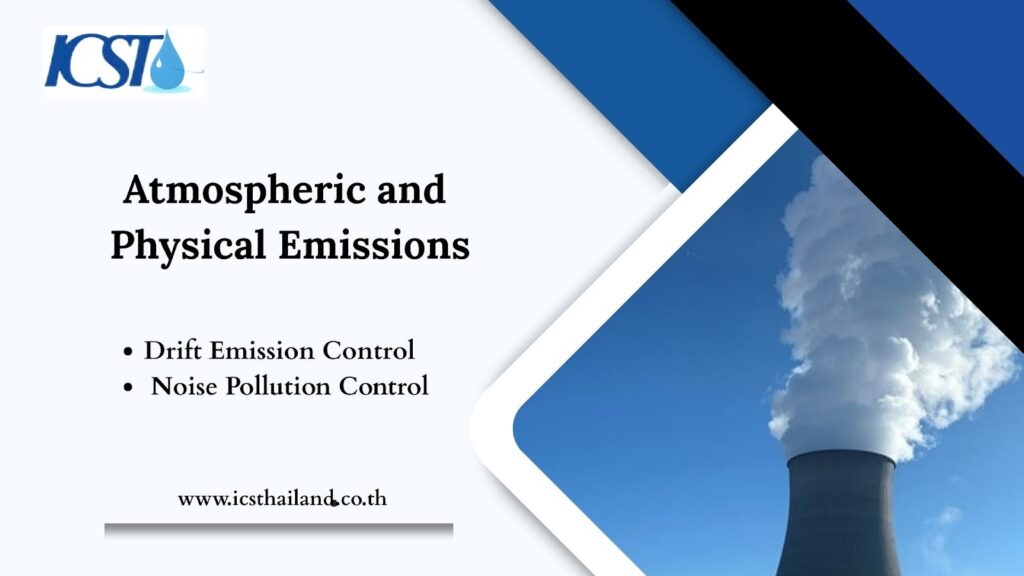
A. Drift Emission Control (Atmospheric Risk)
Drift consists of small water droplets that escape the cooling tower and can carry chemicals, minerals, or biological contaminants. Controlling this emission is essential to prevent environmental pollution, ensure compliance with regulatory standards, and maintain the efficiency of the cooling system. Proper drift control measures also reduce water loss, saving resources and operational costs.
Requirement:
Environmental regulations often specify a maximum drift rate, such as 0.001% of the total circulating water flow. This rule is in place not only to conserve water but, more importantly, to contain biological contaminants like Legionella and prevent them from becoming airborne.
Monitoring:
- Adherence to performance standards relies heavily on the mechanical integrity of drift eliminators, which are crucial components in maintaining system efficiency and compliance.
- Routine inspections and regular performance certifications are vital to ensure these components are functioning optimally and effectively reducing drift.
- Poorly maintained drift eliminators can lead to increased water loss, reduced system efficiency, and potential regulatory non-compliance.
- ICST provides certified, high-efficiency drift eliminators designed to meet stringent industry standards, ensuring reliable performance and long-term durability.
B. Noise Pollution (Community Environmental Monitoring)
Noise is an often-overlooked emission that can have a significant impact on surrounding communities. Many industrial facilities generate noise from heavy machinery, fans, and motors.
These sound emissions are a critical component of environmental compliance, with specific regulations governing their intensity and characteristics.
Requirement:
Local ordinances establish specific limits on acceptable sound levels at a facility’s property line to minimize noise pollution and protect nearby communities. These regulations often target “tonal” noise, which refers to noise concentrated at a specific frequency that is particularly disruptive and noticeable.
For example, many municipalities set limits such as a maximum of 55 decibels (dB) during the day and 45 dB at night at the property boundary. Facilities are required to monitor and control noise levels to stay within these limits, ensuring compliance and reducing the impact on surrounding areas.
Monitoring:
Compliance requires periodic acoustic surveys performed by specialists. Additionally, continuous vibration monitoring of fans and motors can proactively identify mechanical issues that often cause excessive noise, which is formally classified as an environmental emission.
Tier 3: Efficiency and ESG Reporting (Best Available Techniques)
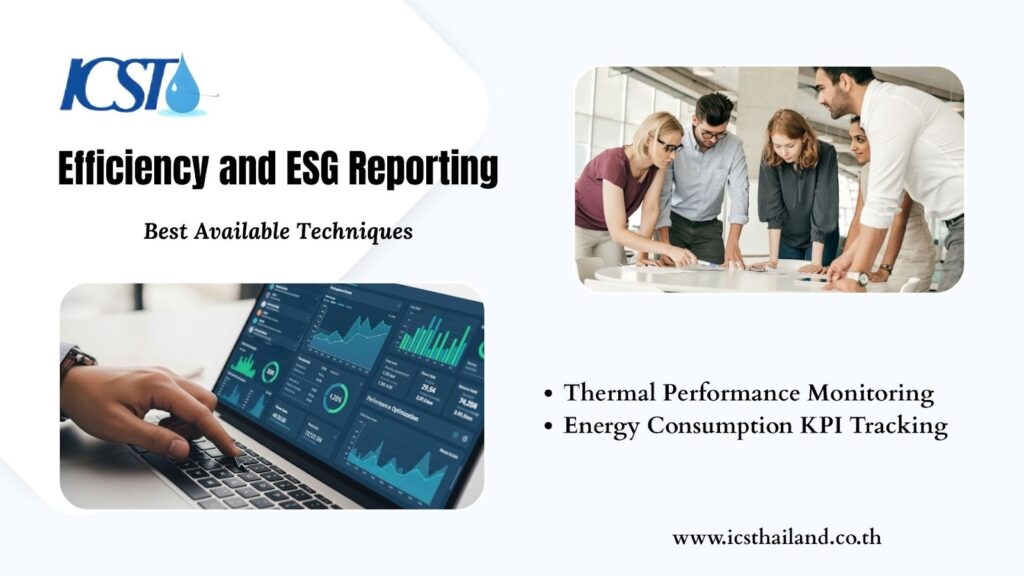
Monitoring for operational efficiency is a vital form of environmental monitoring. An efficient system consumes less energy, which reduces the indirect greenhouse gas (GHG) emissions associated with power generation. This data is fundamental to modern ESG reporting.
A. Thermal Performance Monitoring
Thermal efficiency has a direct impact on emissions. Monitoring performance plays a crucial role in reducing environmental harm by identifying inefficiencies and minimizing waste. Poor thermal transfer, typically caused by fouling or scale buildup on heat exchange surfaces, forces chillers and other system components to work harder.
Monitoring:
Facilities must consistently track key performance indicators to ensure the cooling system is running at peak efficiency. Here’s what to monitor:
- Approach Temperature: This is the difference between the cooling tower’s leaving water temperature and the wet-bulb temperature. A lower approach temperature indicates better performance. An increase often signals issues like fouling, scale, or poor airflow.
- Range Temperature: This is the temperature difference between the water entering and leaving the cooling tower. Monitoring this helps verify that the tower is removing the correct amount of heat from the system as per its design specifications.
- Water Flow Rate: Ensuring the correct flow rate is crucial. Too little or too much flow can significantly reduce thermal efficiency and lead to system imbalances.
B. Energy Consumption KPI Tracking
Demonstrating sustainability requires hard data, especially when aligning with ESG goals. Key metrics like energy efficiency, water usage, and greenhouse gas emissions are crucial in proving a cooling system’s impact.
How does your system contribute to reducing carbon footprints or optimizing resource consumption? Clear, measurable results are essential to showcase genuine progress toward sustainability.
BAT Standard:
- A core component of the Best Available Techniques is the detailed monitoring and reporting of energy consumption.
- A key performance indicator (KPI) is the kilowatt-hours of energy consumed per ton of cooling produced (kWh/ton).
- Tracking this metric provides verifiable proof of the cooling system’s efficiency and its positive contribution toward the organization’s ESG objectives.
C. Reporting and Data Integrity
For data to be valuable, it must be trustworthy. Accurate and reliable data is the backbone of informed decision-making. Facilities can ensure their reporting is credible by implementing robust data collection processes, regular audits, and leveraging advanced analytics tools to eliminate errors and biases. Transparency and consistency in reporting also play a key role in building trust.
Main Requirement:
- External audits and regulatory submissions require flawless data.
- Tamper-proof automated data logging systems are crucial.
- These systems provide a continuous, verifiable record.
- Ensures uninterrupted compliance with Cooling System Requirements.
- Offers proof of compliance to regulators, investors, and stakeholders.
Conclusion
Effective environmental monitoring is not a collection of separate tasks. It is a fully integrated system that connects critical regulatory mandates, like Legionella control and water discharge regulations, with operational efficiency goals outlined by Best Available Techniques.
A well-designed monitoring strategy safeguards public health and provides the validated data needed for credible ESG reporting. It connects vital regulatory mandates like Legionella control with operational efficiency goals.
Use tamper-proof, automated data logging to ensure accurate audits and continuous compliance with Cooling System Requirements. Protect your business from penalties and reputational damage with verifiable proof for regulators and investors.
Don’t risk non-compliance. A proactive monitoring strategy is the only way to stay ahead. Contact ICST today for a comprehensive environmental and efficiency audit. We can help ensure your cooling systems meet today’s strictest standards and prepare you for tomorrow’s sustainability goals.
Frequently Asked Questions
What are the key environmental requirements for a cooling system?
Key requirements include Legionella control, water discharge management, drift emission control, noise pollution limits, thermal performance monitoring, energy consumption tracking, and accurate ESG reporting.
How do you monitor Legionella in cooling towers?
Legionella monitoring requires routine sampling and testing by accredited laboratories, continuous chemical treatment monitoring (ORP, pH), and proper maintenance of water treatment systems to prevent bacterial growth.
What noise levels are acceptable for industrial cooling towers?
Acceptable noise levels vary by local regulations, often around 55 dB during the day and 45 dB at night at the facility boundary. Continuous vibration monitoring helps prevent excessive noise.
What role does ESG reporting play in cooling system management?
ESG reporting tracks energy use, emissions, and sustainability metrics, providing transparent, verifiable proof of compliance and environmental responsibility.
What is the BAT standard in cooling systems?
BAT includes advanced water pre-treatment, thermal performance monitoring, energy efficiency tracking, and automated data logging to minimize environmental impact while maximizing operational efficiency.