Imagine arriving at your facility on a Monday morning to discover your critical cooling tower failed over the weekend, halting production and costing thousands in lost revenue. In industrial environments, downtime is not merely an inconvenience; it is a financial disaster.
Always-on remote monitoring transforms how facilities manage cooling infrastructure. Instead of reacting to catastrophic failures after they happen, operators can now leverage real-time data to predict issues before they impact operations.
This guide provides a comprehensive look at how remote cooling system monitoring works, why it is essential for modern industrial plants, and exactly how you can implement a robust system to protect your assets.
What is Remote Cooling System Monitoring?
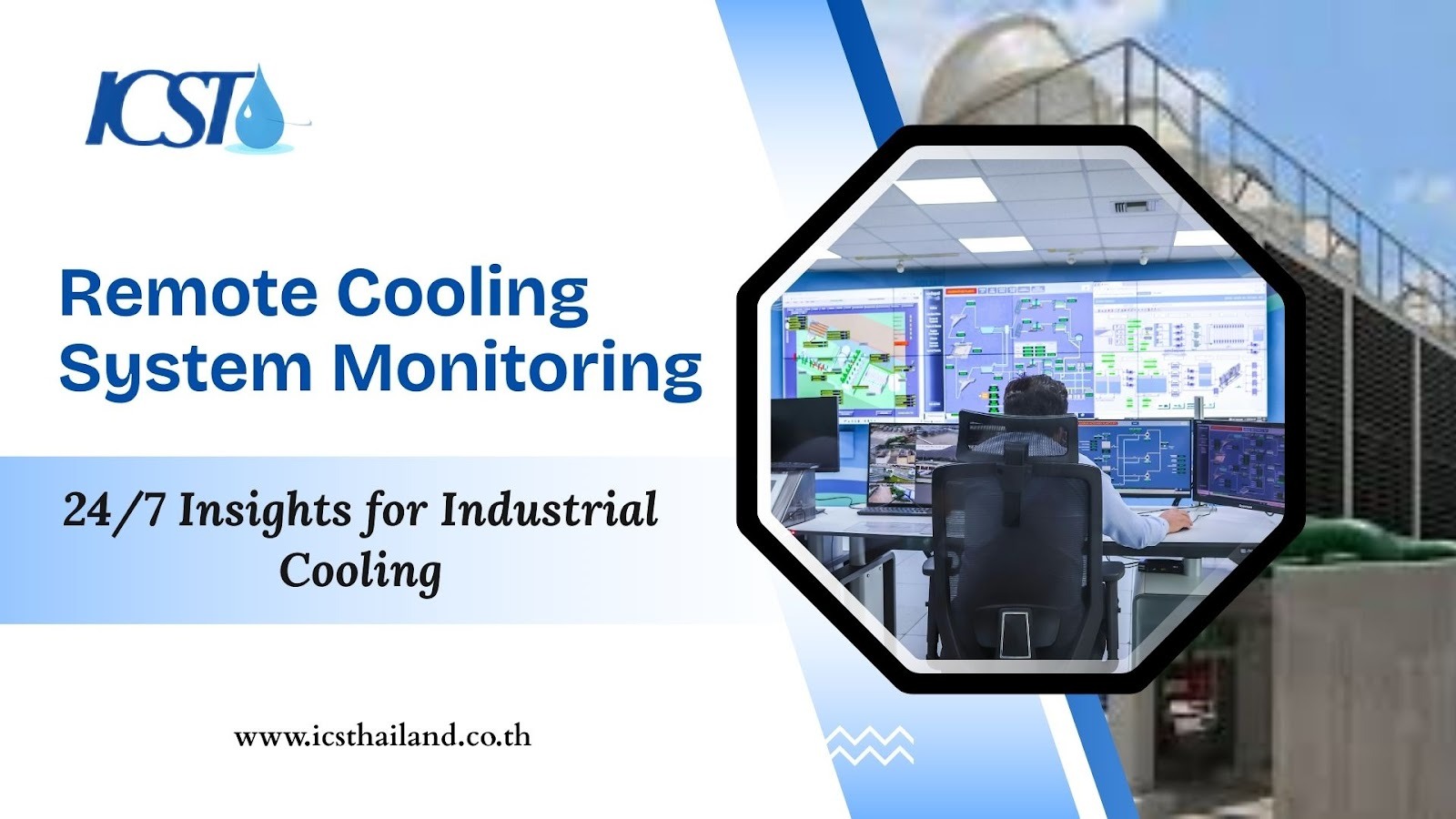
Remote cooling system monitoring is the continuous collection and analysis of performance data from cooling infrastructure without the need for physical presence. It utilizes sensors and connectivity technology to transmit vital statistics to a central location for analysis.
This technology covers a broad range of equipment, including chillers, cooling towers, circulating pumps, heat exchangers, and chemical dosing systems. By digitizing these assets, facility managers gain visibility into the health of their entire cooling loop from anywhere in the world.
Why Remote Monitoring Matters for Industrial Cooling

Reliance on manual rounds and reactive maintenance is a strategy of the past. Modern facilities require constant vigilance to maintain efficiency and uptime. Here is why implementing a monitoring solution is critical for your operations:
24/7 surveillance and early fault detection:
Manual inspections only capture a snapshot of system health. Automated systems provide 24/7 surveillance, catching anomalies the moment they occur, whether it is 2:00 PM on a Tuesday or 3:00 AM on a Sunday.
Faster diagnostics and reduced mean time to repair (MTTR):
When an alarm triggers, technicians can review historical data immediately. They arrive on-site knowing exactly what failed and why, significantly reducing the Mean Time To Repair (MTTR).
Improved maintenance scheduling and spare parts planning:
Data trends reveal wear patterns over time. Managers can schedule maintenance based on actual equipment condition rather than arbitrary calendar dates, ensuring spare parts are ordered only when necessary.
Key Components of a Remote Monitoring System
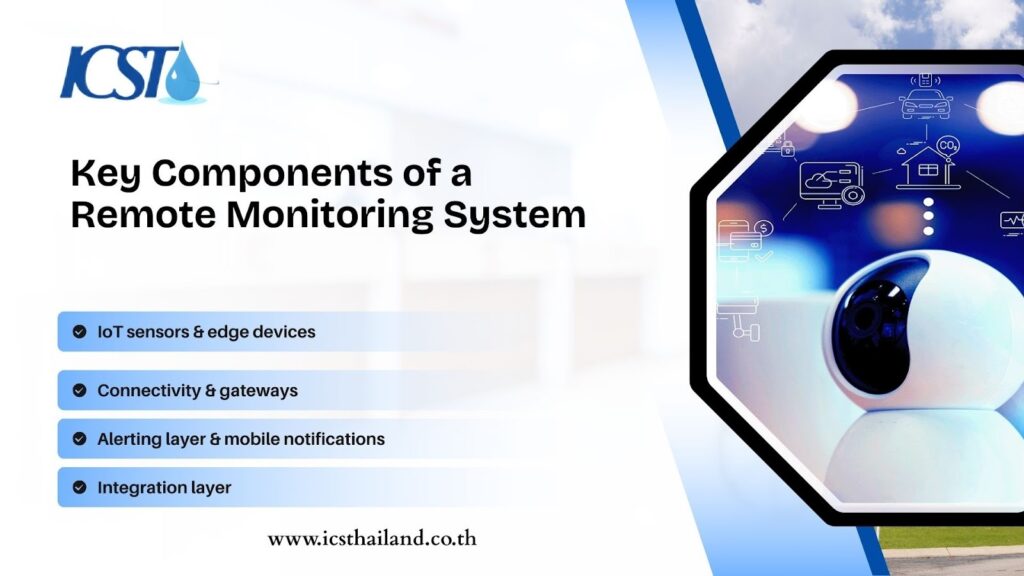
Building a reliable monitoring architecture starts with choosing the right hardware and software. To ensure an effective system, it’s crucial to understand the five key layers that make it all work together seamlessly: data collection, data transport, data storage, data analysis, and visualization.
- IoT sensors & edge devices: These are the eyes and ears of the system. For cooling applications, you need industrial-grade sensors capable of measuring temperature, pressure, vibration, and flow.
- Connectivity & gateways: Data needs a pathway to the cloud. Options include cellular (4G/5G) for remote sites, wired Ethernet for stability, or LoRaWAN for long-range, low-power wireless communication within large plants.
- Alerting layer & mobile notifications: A system is only effective if it notifies the right people. This layer manages SMS, push notifications, and emails to ensure critical alarms are never missed.
- Integration layer: To maximize value, the monitoring system should talk to other platforms, such as Computerized Maintenance Management Systems (CMMS), Building Management Systems (BMS), or SCADA.
How Remote Diagnostics Work: From Sensor to Action
Understanding the data flow is crucial for trusting the system. The journey from a physical change in the plant to a technician taking action involves several sophisticated steps.
The workflow typically follows this path:
- Data Collection: Sensors measure a physical parameter (e.g., water temperature).
- Edge Preprocessing: Local gateways filter noise and compress data.
- Cloud Ingestion: Data is transmitted securely to the cloud server.
- Analytics: Algorithms compare incoming data against established baselines.
- Alert Generation: If a threshold is breached, the system triggers a notification.
- Technician Dispatch: Maintenance teams receive mobile alerts and review off-site diagnostics.
- Feedback Loop: The technician resolves the issue and logs the fix, refining future analytics.
For example, if a chiller’s Coefficient of Performance (COP) drops unexpectedly, the system detects the anomaly. It generates an automated health report and sends it to the facility manager, who schedules an inspection before the chiller fails.
Designing the System: Sensor Selection & Placement
Placing sensors haphazardly will result in noisy, useless data. Strategic placement ensures you capture the most relevant indicators of system health without overspending on hardware.
Consider these guidelines for sensor deployment:
- Temperature: Install sensors at the inlet and outlet of chillers and cooling towers to measure Delta T (temperature difference), which indicates heat transfer efficiency.
- Vibration: Place accelerometers on pump motors and fan bearings. High vibration is a leading indicator of misalignment or bearing failure.
- Flow Meters: Install these on main supply and return lines to verify circulation rates and detect blockages.
- Conductivity: Place probes in the cooling tower basin to monitor dissolved solids and manage bleed-off cycles effectively.
Sampling frequency matters. Temperature changes slowly, so sampling every 5–15 minutes is often sufficient. Vibration, however, requires high-frequency sampling to detect harmonic issues.
Alert Strategy & Avoiding Alarm Fatigue
The fastest way to kill a monitoring project is to overwhelm operators with nuisance alarms. A smart alert strategy filters out noise and elevates only genuine issues.
Effective alarm management relies on a tiered approach:
- Warning: A parameter is drifting but is not critical. Log it for review.
- Action Required: Performance is degraded. Schedule maintenance soon.
- Critical: Immediate failure is imminent. Dispatch a technician now.
Avoid setting simple static thresholds where possible. Use aggregated health scores or time-delay triggers (e.g., “Temperature > 80°F for more than 10 minutes”) to account for normal fluctuations.
Predictive Diagnostics & Analytics
Moving from reactive to predictive maintenance is the ultimate goal of remote cooling system monitoring. Predictive analytics uses data to forecast future failures, allowing you to fix problems before they stop production.
While simple rule-based detection works for clear limits, machine learning models offer deeper insights. They can analyze complex correlations to predict:
- Pump Failure: By correlating increased power draw with rising vibration levels.
- Fouling: By tracking a gradual decline in heat exchanger efficiency over weeks.
- Refrigerant Leaks: By detecting subtle drops in pressure, combined with increased compressor cycling.
Accuracy depends heavily on historical data. You need a baseline of “normal” operation and labeled events of past failures to train the models.
Integration with Maintenance Processes & CMMS
Data without a workflow is just noise. To drive operational readiness, your monitoring system must integrate seamlessly with your existing maintenance processes.
Automating the administrative side of maintenance speeds up response times significantly:
- Ticket Automation: When a critical alarm triggers, the system should automatically create a work order in your CMMS.
- SOP Templates: Attach specific troubleshooting steps to the work order based on the alarm type.
- Feedback Loops: Technicians should close the loop by reporting the actual root cause. This data helps validate the accuracy of remote diagnostics.
Training the maintenance team is vital. They must trust the data provided by the centralized dashboard. Regular review meetings to discuss “wins” (failures avoided) help build this culture of trust.
Visual Tools: Using Video Feeds & Remote Inspection Smartly
Sometimes, data points are not enough. Visual confirmation adds a layer of certainty that sensors cannot provide, enabling true off-site diagnostics.
Video feeds are particularly useful for:
- Remote Walkthroughs: Inspecting the general condition of the site without travel.
- Safety Checks: Ensuring no personnel are near dangerous equipment before remote startup.
- Leak Detection: Visually confirming water accumulation in unexpected areas.
Strategic camera placement focuses on key areas like control valves, the cooling tower basin, and the fan deck. However, operators must balance the benefits against bandwidth costs and storage requirements. Privacy is also a consideration; ensure cameras focus on equipment, not people, whenever possible.
KPIs, Reporting & ROI
You cannot manage what you do not measure. Defining clear Key Performance Indicators (KPIs) allows you to track the success of your monitoring program and prove Return on Investment (ROI) to leadership.
Suggested KPIs include:
- Uptime: The percentage of time cooling is available for production.
- MTTR: The average time taken to repair a failed asset.
- MTBF: Mean Time Between Failures.
- Energy Efficiency: kW consumed per cooling ton.
To calculate ROI, consider a scenario where remote cooling system monitoring prevents a major failure. If downtime costs $10,000 per hour and you avoid a 12-hour outage, the savings are immediate and substantial.
Build distinct dashboards for different stakeholders: executives need high-level financial summaries, while technicians need detailed real-time telemetry.
Implementation Roadmap: Pilot to Full Rollout
Launching a monitoring system across an entire enterprise at once is risky. A phased approach ensures you iron out technical issues and secure team buy-in before scaling up.
Follow this step-by-step roadmap:
- Discovery & Asset Inventory: Catalog all cooling assets and identify the most critical ones.
- Pilot Selection: Choose one site or one specific cooling loop for the trial.
- Platform Setup: Install sensors and configure the centralized dashboard.
- Pilot Run: Operate the pilot for 4–8 weeks, tuning alert thresholds to reduce noise.
- SOP Creation: Develop standard procedures for responding to mobile alerts.
- Scale Rollout: Expand to other assets and sites once the pilot proves value.
- Continuous Improvement: Regularly retrain predictive models with new data.
Common Pitfalls & How to Avoid Them
Even the best technology fails if implemented poorly. Awareness of common traps helps you navigate the deployment successfully.
Watch out for these frequent mistakes:
- Poor Data Quality: Using cheap, uncalibrated sensors leads to false conclusions. Invest in quality hardware.
- Over-Alerting: If phones buzz constantly with non-critical info, technicians will ignore mobile alerts. Be ruthless in filtering alarms.
- Ignoring Workflows: Alerts that do not generate work orders get forgotten. Integration is key.
- Underestimating Costs: Budget for ongoing data plans and cloud storage fees, not just the initial hardware purchase.
Conclusion
Remote monitoring of cooling systems has become essential in the competitive industrial landscape. With IoT sensors providing real-time insights, round-the-clock surveillance, and predictive analytics, businesses can move from reactive fixes to proactive optimization.
This approach not only prevents costly downtime by identifying potential failures early but also enhances operational efficiency and safety. We’ve explored how these systems provide real-time data, enable off-site diagnostics, and even pave the way for autonomous, self-healing operations through digital twin simulations.
Ultimately, embracing remote monitoring is key to building resilient, efficient, and competitive industrial operations.
Ready to move from firefighting to optimizing? Start your journey today and take control of your cooling operations. Visit Industrial Cooling Solution Thailand to learn more and get started!.
Frequently Asked Questions
How long before a pilot shows measurable ROI?
Most facilities see actionable insights within the first 4 weeks of collecting data, often identifying energy waste or hidden faults immediately.
What is the difference between remote monitoring and full remote control?
Remote monitoring focuses on observing data and receiving alerts (off-site diagnostics), whereas remote control allows operators to change setpoints or start/stop equipment from a distance.
Can remote monitoring work with legacy cooling equipment?
Yes. Retrofit sensors clamp onto pipes or wires, allowing you to enable remote cooling system monitoring on machines that are decades old without replacing them.
What happens if connectivity is lost?
Edge devices typically store data locally during outages and upload it to the centralized dashboard once the connection is restored, ensuring no data loss.
Are video feeds necessary for all sites?
No. Video feeds consume high bandwidth and are best reserved for critical, high-risk assets where visual confirmation is mandatory before dispatch.