Keeping industrial and commercial facilities running smoothly takes more than basic cooling systems; it’s a high-stakes operation. From massive chillers to intricate networks of towers and heat exchangers, these cooling giants are the backbone of operations, product preservation, and safety.
Consequently, the demand for highly specialised talent in this sector continues to rise, placing a premium on a specific, robust cooling system technician skill set. A technician in this field must act as a mechanic, an electrician, a chemist, and a safety officer all at once. From understanding the intricacies of mechanical repair to mastering PLC basics, the modern technician needs a holistic education.
In this expert guide, we’ll uncover the essential technical and soft skills you’ll need to master to build a successful career in this demanding but rewarding field. We’ll break down the core competencies, from the hands-on technical abilities to the crucial soft skills that set the best technicians apart.
What is a “Cooling System Technician”?
A cooling system technician is a specialised professional responsible for the installation, maintenance, and repair of large-scale industrial and commercial cooling systems. While a residential HVAC tech might focus on a home’s air conditioning unit, a cooling system technician operates on industrial cooling towers, massive centrifugal chillers, and complex water-cooled systems found in power plants, data centres, and manufacturing facilities.
- Key Responsibilities: Installing and maintaining industrial-scale cooling equipment, troubleshooting system malfunctions, and ensuring compliance with safety standards.
- Industries Served: Power generation, data centres, manufacturing, and large commercial facilities.
- Skills Required: Expertise in refrigeration systems, electrical systems, and mechanical troubleshooting.
Understanding the Role of a Cooling System Technician
This role is far more than just changing filters or topping up refrigerant. Cooling System Technicians are the custodians of critical infrastructure, including industrial cooling towers, chillers, large-scale water-cooled equipment, and complex HVAC systems.
In these environments, any system downtime can lead to huge financial losses and serious safety risks. A key part of their job is to keep these systems running at peak efficiency, which helps to cut down on energy use and prolong the life of expensive equipment.
Key Differences: Industrial vs. Residential Technicians
It’s crucial to distinguish between an industrial cooling specialist and a residential HVAC technician, as the scale and complexity of their work are worlds apart.
- Residential HVAC: These technicians typically work with standardised forced-air systems. The designs are relatively simple, and the main goal is comfort.
- Industrial Cooling: Specialists in this field manage far more complex systems. This often includes advanced hydronics (using water to transfer heat), open-loop systems that interact with the environment, and intricate control systems. They must also adhere to strict regulations for things like water discharge and chemical handling.
The stakes are much higher in an industrial setting. Maintenance routines are more intense, safety protocols are far more stringent, and a deep understanding of automation and system logic is essential for success.
Core Mechanical Skills Every Technician Needs
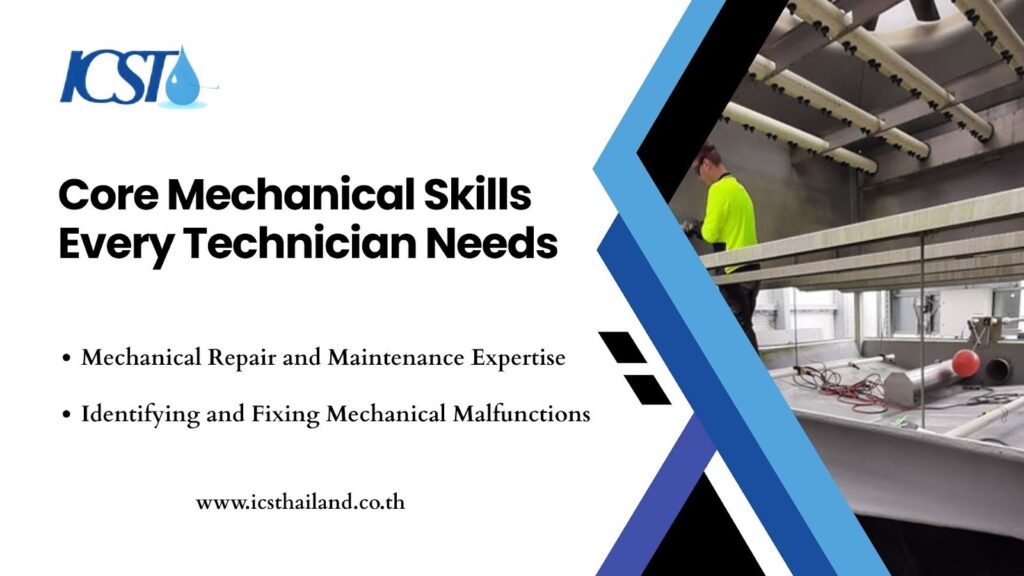
At the heart of any cooling infrastructure lies a beast of moving parts that requires constant vigilance and expert care. Without a solid foundation in mechanics, a technician cannot hope to keep these systems running smoothly for the long haul.
Mechanical Repair and Maintenance Expertise
Industrial cooling systems rely on heavy-duty components that endure immense stress during continuous operation. A proficient technician must demonstrate mastery in mechanical repair, ensuring that pumps, fans, motors, and heat exchangers function within their design parameters.
To maintain these components effectively, technicians must develop specific competencies:
- Component replacement and alignment: Technicians must know how to replace bearings and seals, and precisely align shafts to prevent premature wear.
- Vibration analysis: Understanding how to interpret vibration data helps technicians identify misalignment or imbalance before catastrophic failure occurs.
- Preventive maintenance protocols: Rigorous inspections and lubrication schedules are necessary to prevent friction and heat buildup in moving parts.
Identifying and Fixing Mechanical Malfunctions
When a cooling tower fan seizes or a pump creates cavitation, the technician must diagnose the root cause immediately. Effective troubleshooting requires a systematic approach to identify whether a failure stems from wear, improper installation, or an external environmental factor.
Technicians optimise system reliability by focusing on these diagnostic areas:
- Diagnosing common inefficiencies: Identifying issues such as airflow restrictions or heat exchanger fouling that reduce the system’s ability to reject heat.
- Root cause analysis: Going beyond the symptom to determine why a breakdown occurred, ensuring the fix is permanent rather than temporary.
- Diagnostic tool usage: utilising thermal imaging cameras and stethoscopes to detect internal mechanical issues without dismantling the equipment.
Essential Electrical Skills for Technicians
Modern cooling equipment is not just mechanical; it is powered and regulated by sophisticated electrical grids. A technician who cannot navigate a control panel or trace a short circuit will find themselves unable to service the majority of modern industrial equipment.
Inside Electrical Systems: What You Need to Know
A large portion of cooling system downtime stems from electrical rather than mechanical faults, making electrical troubleshooting a non-negotiable skill. Technicians must possess the ability to read complex wiring diagrams and understand the flow of high-voltage power to heavy machinery.
Mastery of electrical systems involves several key capabilities:
- Schematic interpretation: The ability to read wiring diagrams and schematics is essential for tracing circuits and locating faults in relays or contactors.
- Component repair: Identifying and repairing faults in electric motors, variable frequency drives (VFDs), and capacitor banks ensures continuous operation.
- Testing and measurement: Using multimeters and amp clamps allows the technician to verify voltage, current, and resistance to ensure components operate safely.
- Safety protocols: Adhering to lockout/tagout (LOTO) procedures and wearing appropriate Personal Protective Equipment (PPE) is critical when working with high-voltage systems.
- Power quality analysis: Understanding and diagnosing issues like voltage sags, swells, and harmonic distortion helps prevent premature failure of sensitive electronic components.
Essential Control System Concepts and PLC Knowledge
In modern industrial cooling, automation is key to efficiency, making manual operations a thing of the past. Technicians now need a strong grasp of PLC basics (Programmable Logic Controllers), the brains behind the system that uses real-time data to make automated decisions.
Understanding control systems is crucial for technicians, who perform tasks such as:
- Troubleshooting with ladder logic: Technicians must be able to read and interpret ladder logic to diagnose why a PLC isn’t performing as expected. This skill is vital for tracing faults, understanding operational sequences, and identifying incorrect commands.
- Interpreting sensor data: Monitoring inputs from temperature, pressure, and flow sensors is essential. Technicians verify that the PLC is responding correctly to environmental changes and system demands.
- System calibration and tuning: Regularly calibrating sensors and tuning PID loops (Proportional Integral Derivative) ensures that automated responses, like adjusting a valve or ramping up fan speed, are precise, efficient, and stable.
- Integrating predictive maintenance: Advanced control systems provide data that can predict component failure. Technicians use this information to schedule proactive maintenance, preventing costly unplanned shutdowns.
Water Chemistry and Treatment Skills
In water-cooled systems, the water itself is a working component that requires as much maintenance as the steel and copper it flows through. Neglecting water quality leads to rapid destruction of the equipment through corrosion and biological hazards.
Importance of Water Chemistry in Cooling Systems
The efficiency of a cooling tower or chiller is directly tied to the chemical balance of the heat transfer medium. Technicians must understand how factors like pH, hardness, and conductivity impact the physical integrity of the system.
Poor water management leads to catastrophic outcomes:
- Scale formation: High mineral content causes scale buildup on heat exchange surfaces, acting as an insulator and destroying energy efficiency.
- Corrosion control: Improper pH levels or oxygen content eat away at metal piping and components, leading to leaks and structural failure.
- Biological control: Cooling towers are breeding grounds for bacteria like Legionella; understanding biocide application is critical for public safety.
Performing Water Analysis and Treatment
A technician must frequently perform water chemistry analysis to ensure the water remains within safe operating limits. This involves onsite testing and the precise application of chemicals to correct imbalances.
Effective water treatment requires discipline and precision:
- Chemical testing: Regularly sampling water and performing tests for alkalinity, chlorides, and biological activity.
- Dosing application: Calculating and applying the correct amount of corrosion inhibitors, dispersants, and biocides based on system volume and test results.
- Record keeping: Keeping accurate logs of chemical usage and test results to maintain compliance with environmental regulations.
Blueprint and Schematic Reading Skills
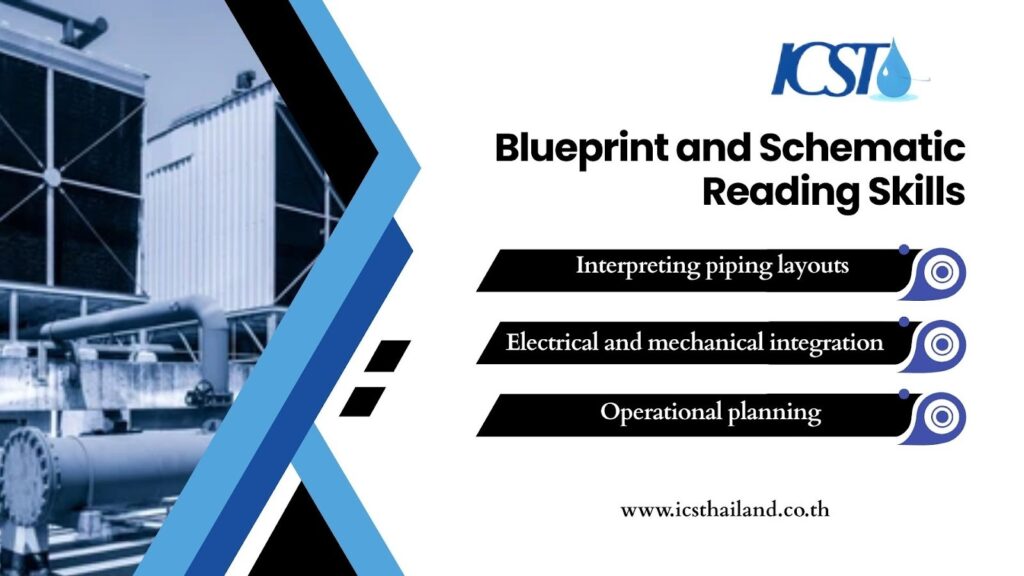
When walking into a new facility or addressing a system renovation, a technician relies on technical drawings to understand the lay of the land. Blueprint reading is the roadmap that connects the physical equipment to the engineering design.
This skill is fundamental for accurate installation and maintenance:
- Interpreting piping layouts: Understanding 2D and 3D drawings helps technicians locate isolation valves, sensor ports, and drainage points quickly.
- Electrical and mechanical integration: Schematics show how mechanical pumps interact with electrical controls, providing a holistic view of the system logic.
- Operational planning: Translating technical drawings into actionable tasks ensures that repairs or upgrades align with the original engineering specifications.
Safety, Compliance, and Soft Skills
Technical prowess means little if the technician cannot work safely or communicate effectively with the facility manager. The “soft” side of the job is often what distinguishes a good technician from a great one.
Safety Awareness
Industrial environments present lethal hazards, from high-voltage electricity to toxic chemicals and confined spaces.
Safety mastery includes specific protocols:
- PPE and chemical handling: Wearing appropriate personal protective equipment when handling water treatment chemicals or working near high-heat sources.
- Working at heights: adhering to fall protection standards when servicing cooling towers located on rooftops or elevated platforms.
- Confined space entry: Following strict procedures when entering tower basins or other enclosed areas where oxygen deprivation is a risk.
Documentation and Reporting
If a repair is not documented, in the eyes of a regulator or a client, it essentially did not happen. Maintaining detailed logs constitutes a critical part of the cooling system technician skill requirement, ensuring a historical record of system health.
Documentation responsibilities include:
- Maintenance logs: accurately recording dates, tasks performed, and parts replaced during service calls.
- Water treatment records: Keeping precise records of water chemistry analysis results to prove compliance with health and safety standards.
- Incident reporting: clearly detailing any accidents or near-misses to improve future safety protocols.
Conclusion
The role of a cooling system technician is demanding, requiring a unique convergence of mechanical aptitude, electrical knowledge, and chemical understanding. As industrial systems become smarter and more efficient, the cooling system technician skill set must evolve to include PLC basics and advanced diagnostics alongside traditional mechanical repair.
Aspiring technicians should view this not just as a job but as a career requiring dedication to continuous improvement. For employers, recognising the value of a well-rounded technician who can read a blueprint as well as they can wire a motor is the key to maintaining resilient and efficient facility operations.
By mastering these diverse skills, technicians ensure they remain indispensable assets in the modern industrial landscape. Visit the ICST website to learn more.
Frequently Asked Questions
What skills does a cooling system technician need?
Mechanical repair, electrical troubleshooting, water chemistry analysis, blueprint reading, and basic PLC/control knowledge.
Do technicians need water chemistry knowledge?
Yes. They test water, monitor pH/conductivity, apply chemicals correctly, and prevent scale, corrosion, or microbial growth.
Is PLC knowledge useful for technicians?
Absolutely. Understanding PLCs helps manage automated systems, sensor readouts, and control logic efficiently.
How is industrial cooling different from residential HVAC?
Industrial systems are larger, more complex, often automated, involve chemical treatment, and require strict safety and regulatory compliance.
What does preventive maintenance involve?
Regular inspections, cleaning, lubrication, vibration checks, and water quality monitoring to prevent breakdowns.