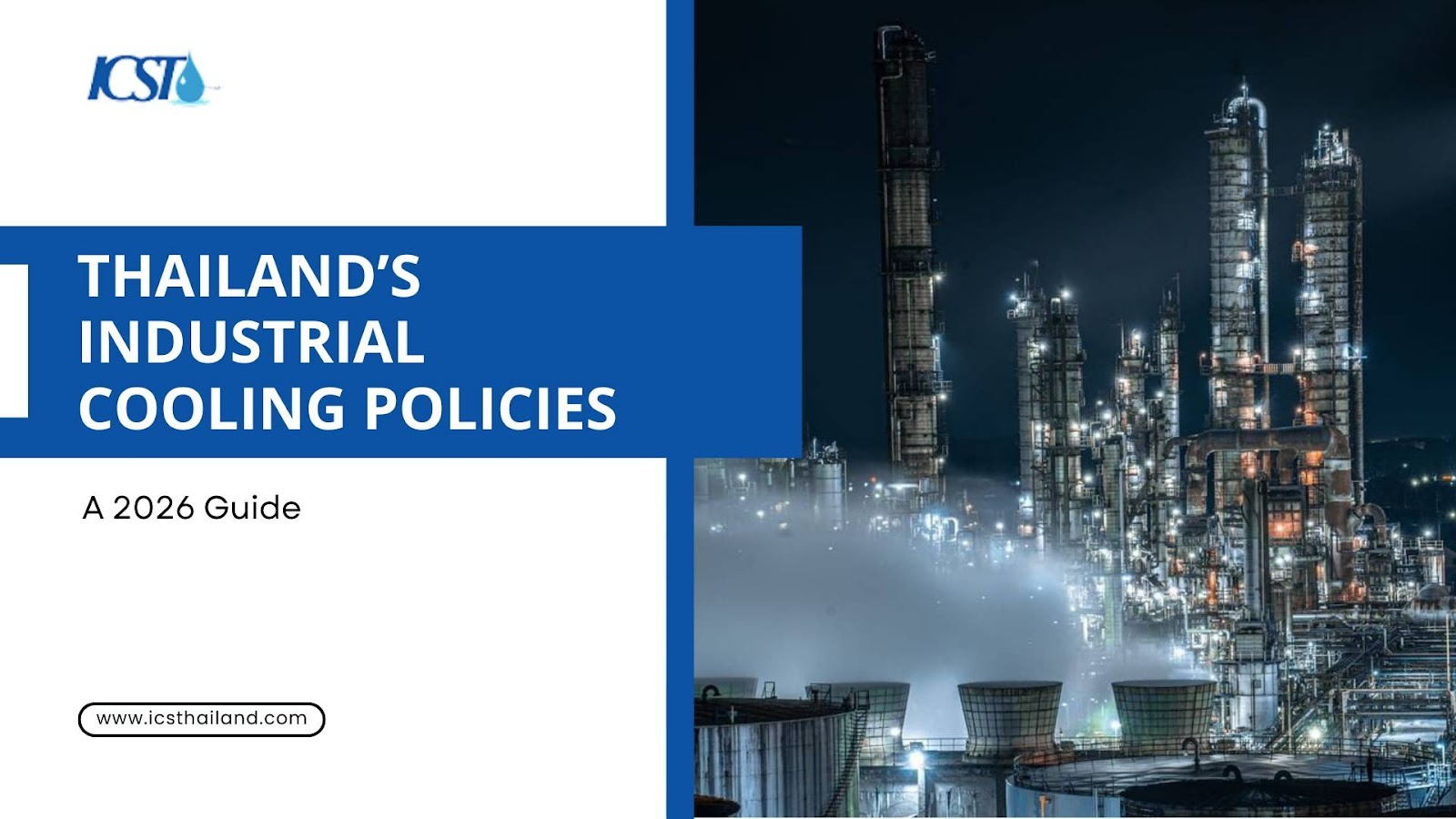
The regulatory landscape for industrial operations in Thailand is undergoing a significant transformation, with Thailand’s industrial cooling policies driving new compliance standards and business opportunities. As the country moves towards a future defined by sustainability and energy efficiency, the government is shifting from voluntary energy-saving programs to mandatory compliance.
For businesses with industrial cooling needs, understanding these new policies is not just about avoiding penalties; it is about unlocking substantial financial incentives and gaining a competitive edge. The Energy Conservation Promotion Act now mandates strict adherence to “Designated Factories,” making policy alignment a critical component of operational success.
The key to thriving in this new environment is to implement systems that maximize financial feasibility through government-backed incentives. This guide provides a strategic overview of the 2026 industrial cooling policies, helping you navigate the complex requirements and capitalize on the opportunities they present.
Energy Efficiency: The TISI 2134-2565 Mandate
A major policy shift impacting the cooling sector is the introduction of the TISI 2134-2565 standard. This new regulation, taking full effect in April 2026, specifically targets room and modular industrial air conditioners. The standard establishes new Minimum Energy Performance Standards (MEPS), which means that previously acceptable equipment may no longer be compliant for new industrial permits.
This mandate has several key implications for businesses:
- Higher Equipment Standards: “Standard” efficiency equipment will not meet the new MEPS. Companies must invest in high-efficiency air conditioning systems to secure legal market access and ensure safety.
- Building Energy Code (BEC) Updates: The 2026 updates to the BEC will require integrated thermal modeling in new industrial building designs. This ensures that energy efficiency is a core component of construction from the ground up, not an afterthought.
- Focus on Energy Consumption: The goal is a significant reduction in overall energy consumption across the industrial sector, contributing to national energy savings targets.
Navigating these complex rules is essential for compliance and achieving optimal performance. The focus is squarely on improving energy efficiency throughout the entire cooling system lifecycle.
Water Usage Regulations: The WUE Factor
Thailand’s focus is expanding beyond power consumption. In drought-prone industrial zones like the Eastern Economic Corridor (EEC), the emphasis is shifting from Power Usage Effectiveness (PUE) to Water Usage Effectiveness (WUE). This pivot reflects a growing concern for the sustainable management of natural resources, particularly water.
Industrial facilities must now contend with stringent effluent standards designed to protect local aquatic ecosystems from harmful discharges. Industrial cooling compliance is mandatory for maintaining operational licenses and achieving the coveted “Green Factory” certification.
Specialized cooling solutions are critical for meeting these 2026 requirements. Systems that feature low-drift and closed-loop designs minimize water consumption and waste, aligning with the country’s environmental policy and goals for sustainable economic growth.
2026 Thailand’s Industrial Cooling Policies Matrix
To provide a clear overview, the following table summarizes the key cooling regulations, their governing bodies, and the associated business incentives. Understanding this framework is crucial for strategic planning and investment.
| Policy / Regulation | Regulatory Body | Who Applies | Primary Requirement | Business Incentive / Impact |
|---|---|---|---|---|
| Energy Conservation Act (ECA) | DEDE | Designated factories & large buildings | Energy audits, energy management plan, annual reporting | Compliance with law, exemption from energy penalties, improved operational efficiency |
| Royal Decree – 150% Tax Deduction | Revenue Dept / DEDE | Companies investing in energy-efficient equipment | Purchase 5-Star certified equipment | 150% tax deduction on eligible Capex, faster project payback |
| 5-Star Energy Label Program | DEDE / EGAT | Equipment manufacturers & users | Meet high-efficiency performance criteria | Eligibility for tax incentives, stronger market positioning |
| BOI Promotion – Category 7.1 | Board of Investment (BOI) | BOI-approved investors | Investment in high-efficiency machinery | Up to 8-year corporate income tax holiday, import duty exemptions |
| BOI Energy & Environment Incentives | BOI | Clean energy & efficiency projects | Meet BOI technical and environmental criteria | Corporate tax exemption/reduction, investment competitiveness |
| TISI 2134-2565 (MEPS) | TISI | Manufacturers, importers, distributors | Mandatory minimum energy performance compliance | Legal market access, product safety, avoidance of fines/seizure |
| Customs Energy Compliance | Customs Dept / TISI | Importers | Pre-import energy certification & labeling | Smooth customs clearance, reduced shipment risk |
| ISO 50001 (Voluntary) | Accredited Bodies | Any organization | Energy management system implementation | ESG credibility, operational efficiency, investor confidence |
Investment Incentives: The 150% Tax Deduction Catalyst
The Thai government is actively encouraging the transition to green technology through powerful financial incentives. A cabinet-approved measure allows businesses a 150% tax deduction on capital expenditures for certified energy-saving equipment. To qualify, this equipment must be operational by December 2028. This presents a time-sensitive opportunity to upgrade your cooling systems while achieving a significant return on investment.
Further support is available through the Board of Investment (BOI). Advanced cooling designs, such as geothermal and seawater-cooled systems, often qualify for promotions under Section 7 (Public Utilities) and Section B (Environment). These promotions can include an eight-year corporate tax holiday, substantially enhancing the financial viability of green projects.
Additionally, the Green Cooling Initiative (GCI III) provides access to funding and technical support. This project aims to help businesses transition to natural refrigerants like Ammonia (NH₃) and CO₂, which have a much lower global warming potential than traditional HFCs.
Environmental Laws: The Path to Net Zero 2065
Thailand has committed to ambitious climate goals, including achieving carbon neutrality by 2050 and net-zero greenhouse gas emissions by 2065. Industrial cooling efficiency is a critical component of the country’s Nationally Determined Contributions (NDC), which aim to reduce emissions by 40% by 2030.
New regulations are being implemented to manage refrigerant use and reduce environmental impact:
- Refrigerant Management: New safety notifications for ammonia usage are being enforced, alongside a structured phase-down of high-GWP hydrofluorocarbons (HFCs).
- Climate Change Department: The Department of Climate Change and Environment (DCCE) is taking a lead role in auditing industrial heat rejection systems to ensure they align with national GHG emissions reduction targets.
- Greenhouse Gas Reduction: The entire cooling industry is being mobilized to adopt climate-friendly technologies and practices, from manufacturing and production to installation and maintenance.
Emergency Support for Policy-Critical Failures
Non-compliance carries significant risks. An equipment failure that leads to an environmental effluent spill or a spike in energy intensity can result in severe legal and financial consequences. The cost of non-compliance far outweighs the investment in reliable, efficient systems.
Maintaining operational continuity within these strict policy frameworks is paramount. In the event of a policy-critical system failure, a rapid response is essential. Having a partner with local expertise and qualified personnel can mean the difference between a minor issue and a major crisis. Prompt on-site technical assistance helps restore compliance quickly, minimizing downtime and mitigating regulatory risk.
Conclusion: Compliance as a Competitive Edge
In 2026 and beyond, Thailand’s industrial cooling policies are more than a set of rules; they are a roadmap to enhanced profitability and sustainability. These regulations are designed to drive innovation, improve energy efficiency, and protect natural resources. For businesses that prepare effectively, compliance becomes a powerful competitive advantage.
Success in this new era requires a partner who understands both the intricate engineering of modern cooling systems and the legal framework that governs them. By implementing solutions that are financially and technically feasible for the modern Thai economy, you can secure long-term success. The future of the industrial sector in Thailand will be led by those who embrace efficiency and sustainability as core business principles.
Is your facility ready for the 2026 TISI mandates? Visit ICST to audit your systems and secure your 150% tax deduction today.
Frequently Asked Questions (FAQs)
What are Thailand’s industrial cooling policies 2026?
Thailand’s industrial cooling policies 2026 include mandatory compliance with the Energy Conservation Promotion Act, TISI 2134-2565 standards, and water usage regulations to enhance energy efficiency and sustainability.
How does the 150% tax deduction work for energy-saving equipment?
Businesses can claim a 150% tax deduction on capital expenditures for certified energy-efficient cooling systems operational by December 2028, as part of Thailand’s green cooling initiative.
What is the TISI 2134-2565 standard?
The TISI 2134-2565 standard mandates Minimum Energy Performance Standards (MEPS) for industrial air conditioners, ensuring higher energy efficiency and compliance for new permits.
Why is water usage effectiveness (WUE) important in Thailand?
WUE is critical in drought-prone zones like the Eastern Economic Corridor, where minimizing water consumption aligns with environmental policies and supports sustainable industrial growth.
How does industrial cooling contribute to Thailand’s carbon neutrality goals?
Efficient cooling systems reduce greenhouse gas emissions, supporting Thailand’s commitment to achieving carbon neutrality by 2050 and net-zero emissions by 2065.