Rapid urbanization and industrial expansion act as primary catalysts for rising global temperatures in developed zones. Planners and engineers often attribute rising heat solely to climate change, yet they frequently overlook the massive heat loads generated by the built environment itself. We must analyze the specific infrastructure impact on cooling demand to understand future energy consumption.
This impact goes beyond simple air conditioning for comfort. It encompasses the thermal management requirements of power grids, digital networks, and industrial clusters. Each new project adds a thermal load to the local environment, which subsequently necessitates more cooling capacity.
This article provides a detailed forecast and breakdown of how infrastructure growth directly dictates cooling requirements.
Understanding the Infrastructure Impact on Cooling Demand
Infrastructure expansion fundamentally alters the thermal dynamics of a region. When developers replace vegetation with concrete and steel, the area absorbs and retains more heat, creating urban heat islands.
At the same time, the operation of these facilities—from factories to transport hubs—generates significant internal heat that must be managed.
These bullet points highlight the key factors influencing the demand for modern cooling systems:
- Climate-driven demand: Fluctuates with the weather.
- Infrastructure-driven demand: Correlates with operational intensity and physical growth.
- Urban densification: As cities grow, cooling systems evolve from simple utilities to core infrastructure, as critical as water or electricity.
- Energy grid stability: The impact of infrastructure on cooling demand sets a baseline that dictates the stability of the energy grid.
Infrastructure Sectors Driving Cooling Demand Growth
Specific sectors contribute disproportionately to the rising need for thermal management. Residential growth drives volume, but industrial and technical infrastructure drives intensity. Understanding these distinctions helps stakeholders predict localized stress on energy grids.
Power and Energy Infrastructure
Power generation facilities require immense cooling capacities to maintain operational efficiency and safety. As nations transition to energy grids, the construction of power plant projects significantly alters local water and air cooling requirements.
Designers must account for the substantial thermal byproducts generated during energy conversion processes.
- Thermal discharge management:
Generation units release massive amounts of heat that operators must dissipate to prevent system failure. - Auxiliary system cooling:
Transformers and control rooms within power plants require precise temperature regulation to ensure grid reliability. - Renewable integration challenges:
Even renewable sites require cooling for inverters and battery storage systems, adding new loads to the grid.
Industrial Development and Manufacturing Zones
Large-scale manufacturing relies on precise thermal control to maintain product quality and machinery health. The establishment of new industrial estates creates concentrated pockets of high cooling demand that regional grids must support.
Process cooling differs significantly from facility cooling. Facility cooling keeps workers comfortable, while process cooling removes heat from chemical reactions, molding, or machining.
- High-intensity process loads:
Manufacturing lines operate continuously, creating a constant, non-seasonal demand for heat rejection. - Waste heat recovery potential:
Industrial zones offer opportunities to capture waste heat, yet the primary need remains active cooling. - Cluster effects:
Grouping factories increases the ambient temperature of the zone, further driving up the load on individual cooling units.
Digital Infrastructure and Data Facilities
The digital economy runs on servers that turn electricity into heat. Consequently, the rapid pace of data center construction has made this sector one of the fastest-growing consumers of cooling technology globally.
High-density computing requires sophisticated thermal management strategies.
- Server rack density:
As chips become more powerful, they generate more heat per square foot, necessitating advanced liquid or airflow cooling. - 24/7 reliability requirements:
Data centers cannot fail, meaning their cooling systems must operate continuously at peak performance. - Location-specific challenges:
Building data centers in warmer climates increases the energy required to reject heat into the atmosphere.
Economic and Regional Development Influence on Cooling Demand
Economic growth rarely occurs in isolation; it follows specific trade and transport routes. These routes create corridors of intense development. The concentration of infrastructure along these paths accelerates the infrastructure impact on cooling demand in specific geographic bands.
Economic Corridors & Regional Cooling Demand Dynamics
Planners group infrastructure to maximize logistical efficiency. This strategy inadvertently groups heat-generating activities. Economic corridors thus become hotspots for energy and cooling consumption.
What Economic Corridors Mean for Industrial & Urban Growth
Trade routes naturally attract logistics hubs, manufacturing plants, and residential developments. This aggregation creates a compounding effect on resource consumption.
- Logistics hub requirements:
Warehouses and cold chain storage facilities along trade routes require massive refrigeration capacities. - Urban densification:
Workers move to these corridors, leading to high-density housing that traps heat and demands air conditioning. - Grid concentration:
Energy transmission lines follow these corridors, concentrating thermal losses and cooling needs in narrow strips.
Cooling Demand Patterns Along Growth Corridors
The linear nature of these developments creates unique challenges for utility providers. As economic corridors expand, they require a spine of reliable infrastructure that can handle peak thermal loads.
- Peak load synchronization:
Industrial and residential peaks often coincide along these corridors, stressing the regional grid. - Micro-climate alteration:
Continuous paved surfaces along the corridor raise ambient temperatures, reducing the efficiency of air-cooled chillers. - Connected infrastructure needs:
Transport hubs like airports and rail stations within the corridor add massive, centralized cooling loads.
Cooling Demand Forecast Based on Infrastructure Growth
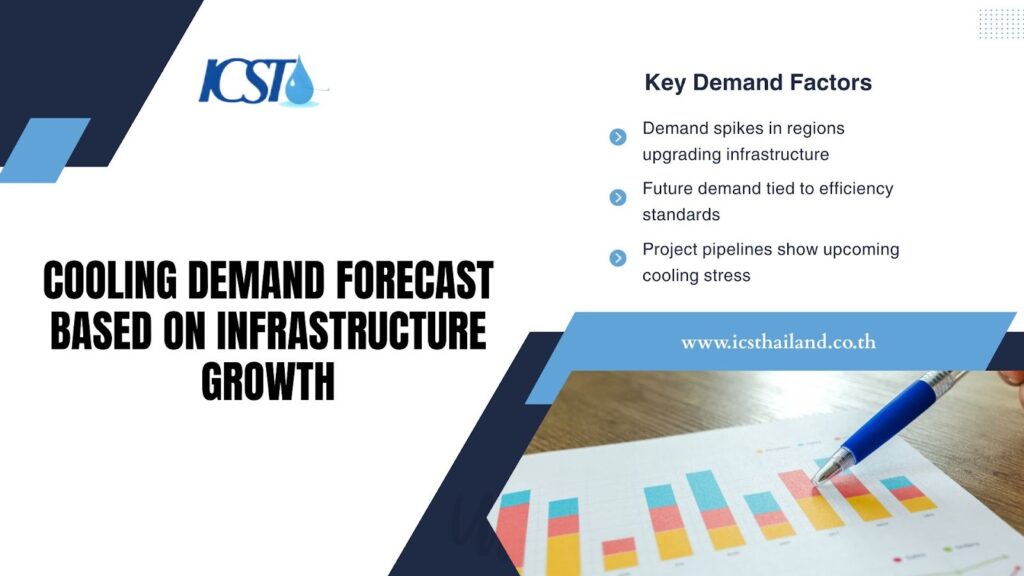
Forecasting models indicate a sharp upward trajectory for cooling requirements over the next decade. This forecast relies heavily on the pipelines for data center construction and new industrial estates, which serve as leading indicators for future energy loads.
Analysts predict that the infrastructure impact on cooling demand will outpace population growth as a driver of energy use.
- Short-term outlook: Immediate demand will spike in regions currently upgrading digital and power infrastructure.
- Long-term variables: Future demand depends on the adoption of high-efficiency standards in construction and industrial processes.
- Pipeline influence: The backlog of approved construction projects provides a reliable roadmap for where cooling stress will occur next.
Challenges Emerging from Rising Cooling Demand
The rapid escalation of cooling needs introduces systemic risks to the built environment. Infrastructure systems face strain when thermal loads exceed design parameters.
Rising demand forces operators to confront difficult trade-offs between reliability and cost.
- Energy consumption spikes: Cooling already consumes a vast portion of global electricity; infrastructure growth threatens to overwhelm existing generation capacity.
- Water scarcity issues: Many industrial cooling systems rely on water; increased demand exacerbates shortages in arid regions.
- Grid instability: Sudden spikes in cooling demand during heatwaves can cause brownouts or equipment failure.
- Equipment degradation: Running cooling systems at capacity shortens their lifespan, increasing maintenance costs and capital expenditure.
Strategic Approaches to Managing Future Cooling Demand
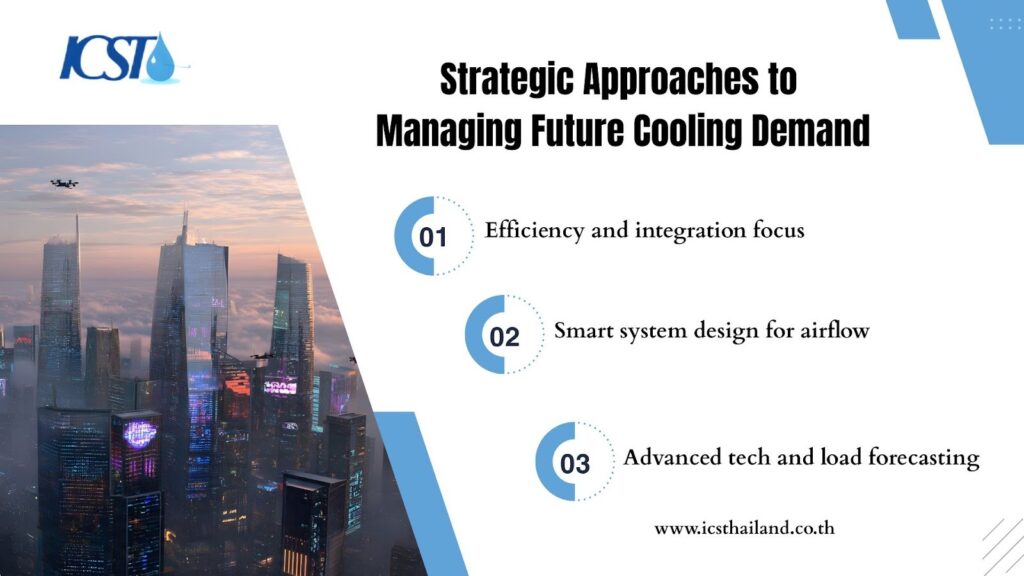
Mitigating these risks requires a proactive and integrated approach to infrastructure design, where every component is carefully planned to work seamlessly together. The infrastructure impact on cooling demand is significant, making it essential to prioritize cooling systems and incorporate them into the design from the start, rather than treating them as an afterthought.
Engineers and policymakers prioritize efficiency and integration.
- Integrated system design: Planners design buildings and utilities together to optimize airflow and minimize solar heat gain.
- Advanced technology adoption: Industries adopt magnetic bearing chillers and AI-driven control systems to maximize cooling efficiency.
- Long-term forecasting: Investors use detailed thermal load projections to right-size infrastructure before breaking ground.
Conclusion
The link between the built environment and energy consumption is undeniable. As infrastructure expands, the rising cooling demand will become a defining challenge for engineers and urban planners. Every new data center, industrial park, and power plant adds to a cumulative thermal load that our energy grids must sustain.
Understanding the Infrastructure Impact on Cooling Demand is crucial for all stakeholders. Those who overlook these projections risk operational failures and soaring energy costs. Conversely, integrating cooling strategies into early infrastructure planning ensures long-term resilience. We must treat cooling as a critical utility, essential for the reliability of our modern world.
Ready to optimize your thermal management? Explore our research and solutions for sustainable cooling at the ICST website today to secure your infrastructure’s future. Together, we can build more resilient, energy-efficient cities for the generations to come.
Frequently Asked Question
How does infrastructure development impact cooling demand?
Infrastructure development replaces natural land covers with heat-absorbing materials and introduces heat-generating machinery. This combination raises ambient temperatures and creates internal thermal loads that operators must actively remove, directly increasing cooling demand.
Which infrastructure sectors create the highest cooling loads?
Data centers, power plant projects, and heavy manufacturing facilities create the highest concentrated cooling loads. These facilities operate continuously and generate significant waste heat that requires sophisticated removal systems.
Why is cooling demand growing faster than expected in some regions?
Cooling demand outpaces forecasts when planners underestimate the compound effect of urbanization and industrial clustering. The rise of digital infrastructure and new industrial estates in previously undeveloped zones also contributes to rapid, unforeseen spikes.
How can cooling demand be forecast accurately?
Accurate forecasting requires analyzing infrastructure project pipelines rather than just historical weather data. Analysts must aggregate the projected thermal loads of all planned construction, transport, and industrial projects in a region.
What role does efficiency play in managing future cooling needs?
Efficiency is the primary lever for keeping energy grids stable. High-efficiency cooling technologies reduce the electricity required to manage heat, allowing infrastructure to grow without collapsing local power systems.