Industrial cooling systems are essential for managing heat loads and ensuring operational safety. However, without a consistent strategy, even the most robust equipment eventually fails, leading to costly downtime and emergency repairs. A structured approach, built around a reliable cooling maintenance schedule template, transforms maintenance from a reactive scramble into a predictable routine.
Implementing a preventive maintenance plan ensures that minor issues like a loose belt or a slight pressure drop are identified before they escalate into catastrophic failures. By adhering to a rigorous schedule, facilities benefit from reduced unplanned downtime, significantly longer asset life, and lower overall repair costs.
This article provides a comprehensive guide and adaptable templates to help you establish a cooling maintenance regimen that protects your equipment and your bottom line.
What Is a Cooling Maintenance Schedule Template?
A cooling maintenance schedule template is a structured plan outlining the specific activities required to maintain the performance and reliability of cooling equipment. It serves as a roadmap for technicians and operators, detailing what needs to be checked, when it needs to be done, and who is responsible for the task.
Utilizing a standardized template improves consistency across maintenance teams. It eliminates guesswork and reduces human error by ensuring that no critical check is overlooked during a shift change or busy period.
These templates apply to a wide range of cooling infrastructure, including:
- Cooling Towers: Essential for heat rejection in large-scale applications.
- Chillers: Critical for precise temperature control in industrial processes.
- Condensers: Vital for heat transfer efficiency.
- Heat Exchangers: Key components for energy transfer between fluids.
- Pumps: The heart of the system, circulating the cooling medium.
How to Use This Maintenance Schedule Template
Effectively applying a maintenance checklist requires more than just printing a document; it demands integration into your daily operations. This section explains how to take the templates provided below and turn them into actionable procedures for your facility.
Who Should Use It:
- Operators: For daily visual checks and gauge readings during rounds.
- Technicians: For hands-on mechanical inspections, lubrication, and repairs.
- Facility Managers: For auditing compliance and planning long-term asset strategies.
How to Adapt It:
Every facility is unique. While the core principles remain the same, you must tailor the template to your specific assets. For cooling towers, prioritize water treatment and fan inspection. For chillers, focus on refrigerant levels and compressor performance. For condensers, ensure airflow and coil cleanliness are top priorities.
How to Track Completion:
A template is only effective if it is used. You can track completion using physical manual logs kept at the equipment site, or by digitizing the template into a Computerized Maintenance Management System (CMMS). Digital tracking offers the added benefit of historical data analysis, allowing you to spot trends over time.
Daily Cooling Equipment Maintenance Checklist
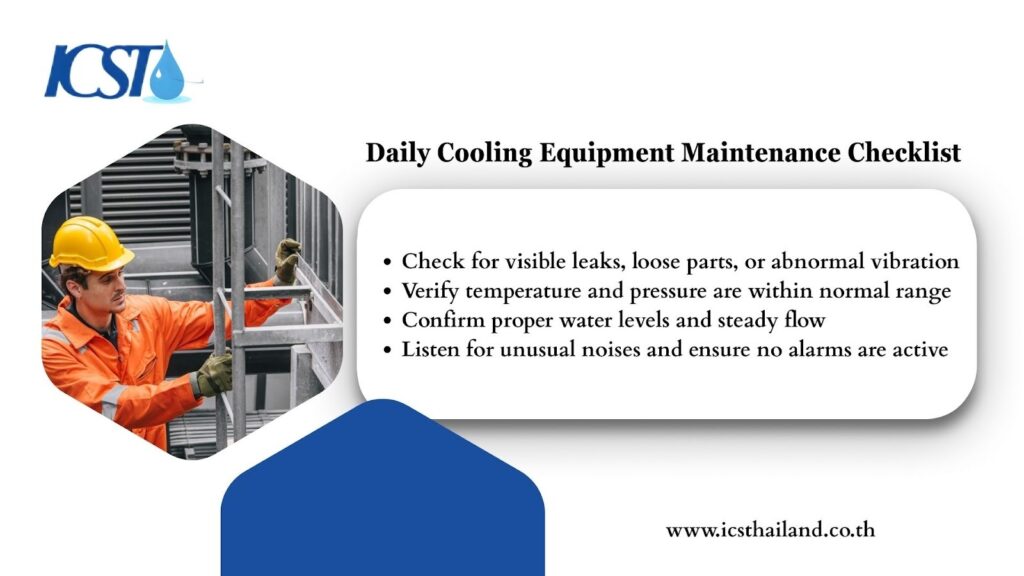
Daily checks are your first line of defense against unexpected failure. These non-intrusive inspections help operators identify obvious abnormalities before they impact production.
Daily Checklist
- Visual Inspection: Walk around the unit to check for visible leaks, loose parts, or abnormal vibration.
- Temperature and Pressure: Verify that operating temperature and pressure gauges are within the specified range.
- Water Levels and Flow: Confirm that water levels in basins are adequate and flow rates are normal.
- Noise Check: Listen for unusual grinding, squealing, or knocking sounds from motors and fans.
- Control Panel: Confirm that all control panel indicators are normal and no alarms are active.
Daily checks prevent sudden breakdowns by catching “soft” failures—like a small leak or a noisy bearing- before they cause hard shutdowns.
Weekly Cooling Maintenance Checklist
Weekly tasks involve a deeper look into the mechanical health of the system. These checks focus on components that wear over time but do not require daily monitoring.
Weekly Tasks
- Belts and Pulleys: Inspect drive belts for tension and wear; check pulleys for alignment.
- Couplings: Check flexible couplings for signs of wear or deterioration.
- Pump Seals: Inspect pump seals for leakage and check lubrication points on accessible bearings.
- Strainers and Screens: Clean suction strainers and intake screens to prevent flow restrictions.
- Electrical Connections: Visually inspect wiring and conduits for damage or loose connections.
- Fan Operation: Verify that fans are rotating in the correct direction and airflow is unobstructed.
Weekly inspections catch issues that daily walkthroughs might miss, such as a belt that is beginning to fray or a strainer that is slowly clogging, allowing you to schedule repairs during planned downtime.
Monthly Cooling System Inspection Checklist
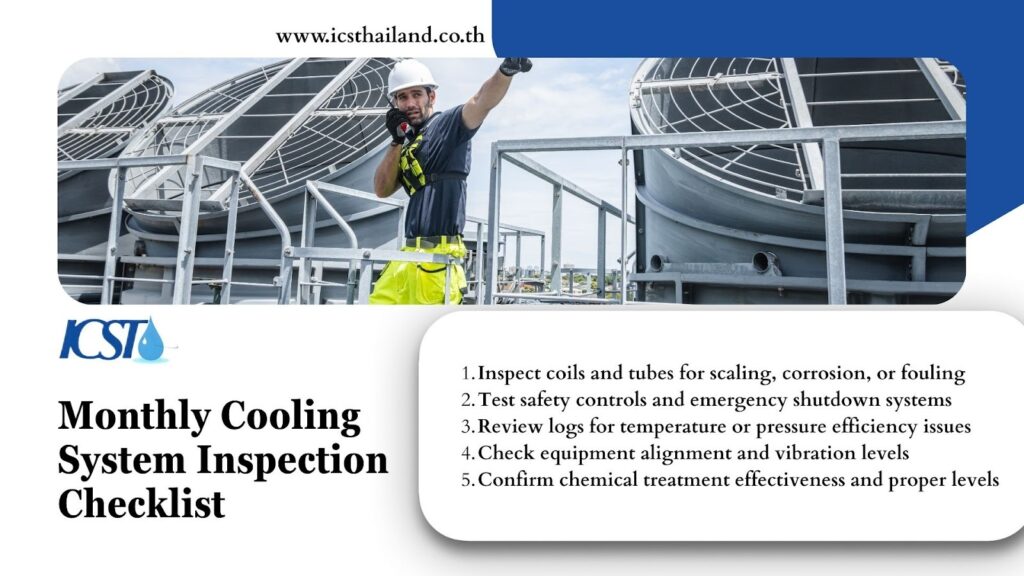
Monthly inspections focus on efficiency and safety. At this interval, technicians verify that the system is not only running but running correctly and safely.
Monthly Checklist
- Heat Exchange Surfaces: Inspect coils and tubes for signs of scaling, corrosion, or biological fouling.
- Safety Controls: Test low-water cutoffs, vibration switches, and emergency shutdown controls.
- Performance Review: Review operating logs to identify trends in temperature or pressure that indicate efficiency loss.
- Vibration Analysis: Check alignment and vibration levels on rotating equipment if specialized tools are available.
- Chemical Treatment: Verify that the water treatment program is effective and that chemical levels are maintained.
Regular monthly checks tie directly to efficiency loss prevention. Detecting scale buildup early preserves heat transfer rates and keeps energy consumption in check.
Quarterly Preventive Maintenance Checklist
Quarterly maintenance involves more intensive tasks that may require partial system isolation. These activities are designed to preserve the structural and electrical integrity of the equipment.
Quarterly Tasks
- Deep Cleaning: Perform a thorough cleaning of cooling tower basins, fill, and drift eliminators.
- Motor Inspection: Check motor insulation resistance (megger test) and verify operating amperage.
- Structural Inspection: Inspect the cooling tower casing, supports, and anchor bolts for corrosion or damage.
- Chemical Review: Conduct a comprehensive review of the chemical treatment program’s effectiveness with a specialist.
- Bearing Inspection: Inspect bearings for play or noise; replace or re-grease as per manufacturer recommendations.
Quarterly tasks reduce long-term damage by addressing the root causes of equipment degradation, such as corrosion, electrical fatigue, and mechanical wear.
Annual Shutdown & Major Maintenance Checklist
The annual shutdown is the most critical event in the cooling maintenance calendar. This is the time for invasive inspections and component replacements that cannot occur while the system is live.
Annual Checklist
- Full System Inspection: Dismantle accessible components for a thorough internal inspection.
- Component Replacement: Replace worn belts, bearings, gaskets, and mechanical seals regardless of apparent condition.
- Surface Cleaning: Descale heat exchangers and thoroughly clean all internal surfaces.
- Record Updates: Update maintenance logs, Standard Operating Procedures (SOPs), and spare parts inventory.
- Benchmarking: Establish new performance baselines after restarting the system to measure improvements.
Planned shutdowns are far less expensive than emergency downtime. This checklist emphasizes the value of scheduled outages to restore the equipment to near-new condition.
Master Cooling Maintenance Schedule Template (All-in-One)
For facility managers looking to consolidate these tasks, a master template is essential. This all-in-one view ensures that no frequency level—from daily to annual—is neglected.
You can adapt the structure below into a spreadsheet or maintenance software to create your own cooling maintenance schedule template.
| Task Name | Equipment Type | Frequency | Responsibility | Tools Required | Completion Status | Remarks |
| Check for Leaks | Chiller | Daily | Operator | Flashlight | [ ] | |
| Check Oil Level | Compressor | Daily | Operator | Visual | [ ] | |
| Clean Strainers | Cooling Tower | Weekly | Technician | Wrench, Brush | [ ] | |
| Check Belt Tension | Fan Motor | Weekly | Technician | Tension Gauge | [ ] | |
| Inspect Coil Scaling | Condenser | Monthly | Specialist | Boroscope | [ ] | |
| Test Safety Alarms | System Control | Monthly | Supervisor | Test Kit | [ ] | |
| Deep Clean Basin | Cooling Tower | Quarterly | Technician | Pressure Washer | [ m] | |
| Replace Bearings | Pump Motor | Annual | Millwright | Bearing Puller | [m ] |
This format provides a clear, at-a-glance view of the maintenance workload. It can be easily copied into Excel, imported into a CMMS, or printed as a physical logbook.
How This Checklist Supports a Preventive Maintenance Plan
A checklist is not just a piece of paper; it is the foundation of a robust preventive maintenance strategy. By formalizing the “when” and “what” of maintenance, you remove ambiguity from the process.
Here is how this checklist strengthens your preventive maintenance strategy:
- Enables proactive maintenance: By following a cooling maintenance schedule, you ensure regular equipment checks, moving away from a “fix-it-when-it-breaks” reactive approach.
- Early issue detection: Using the checklist allows technicians to spot minor warning signs, such as a leaking seal, before they escalate into a major system failure.
- Maximizes equipment lifespan: Routine maintenance ensures optimal lubrication, alignment, and cleanliness, significantly reducing long-term wear and tear.
- Generates historical data: The logs created from these checklists provide a paper trail to help you track recurring failures and analyze performance trends.
- Builds a case for upgrades: Consistent maintenance data provides the evidence needed to justify capital investments or equipment replacements to management.
Using this checklist is a key element of a preventative maintenance plan, helping you avoid costly breakdowns and maximize equipment performance.
Common Mistakes When Using Maintenance Checklists
Even with the best templates, execution failures can undermine your maintenance program. Avoid these common pitfalls to ensure your cooling maintenance schedule template delivers results.
- Skipping Documentation: Performing the work but failing to log it renders the data useless for future analysis.
- Pencil Whipping: Checking off boxes without actually performing the inspection creates a false sense of security.
- Ignoring Early Signs: Noting a small vibration but doing nothing because it is “not that bad” often leads to major failure.
- Static Schedules: Failing to update the schedule after installing new equipment or changing operating parameters leads to gaps in coverage.
Conclusion
Implementing a comprehensive cooling maintenance schedule template turns scattered maintenance efforts into a cohesive, reliable system. By moving from reactive repairs to proactive care, organizations ensure the safety of their personnel and the continuity of their operations. Checklists do more than just list tasks; they improve reliability, enforce safety standards, and provide rigorous cost control.
Well-maintained cooling equipment performs longer, runs more efficiently, and supports the overall success of the facility.
Need help customizing these templates or optimizing your cooling infrastructure? The experts at ICST are here to provide tailored guidance and maintenance support. Visit Industrial Cooling Solutions ( Thailand ) to learn more and get started.
Frequently Asked Questions
What is included in a cooling maintenance checklist?
A standard checklist includes visual inspections, temperature and pressure readings, lubrication tasks, cleaning of heat transfer surfaces, and testing of safety controls. It covers mechanical, electrical, and structural components.
How often should cooling equipment be inspected?
Frequencies vary by component. Operational parameters like pressure and temperature should be checked daily. Mechanical components like belts and strainers typically require weekly or monthly checks, while major internal inspections occur annually.
Can one template work for all cooling systems?
No, a single template cannot cover every nuance. However, a master cooling maintenance schedule template provides a solid framework that you can adapt to specific equipment types, such as cooling towers, chillers, or heat exchangers.
What is a cooling maintenance schedule template?
It organizes HVAC cooling tasks, inspections, and timelines to improve efficiency, prevent breakdowns, improve lifespan, reduce costs.
Why use a cooling maintenance schedule template?
It ensures consistent HVAC servicing, boosts efficiency, lowers repair risks, supports compliance, and helps track maintenance history.