When was the last time you truly assessed the health of your cooling system? In the demanding world of industrial operations, cooling towers are the workhorses that never get a day off, enduring relentless heat cycles, chemical exposure, and constant water contact. But even the toughest machinery has a breaking point.
As corrosion and mechanical wear set in, your system quietly drains your budget through plummeting thermal performance and skyrocketing energy bills. If left unchecked, these aging assets become ticking time bombs for reliability.
These targeted upgrades can restore the unit to its original design specifications or even improve upon them, all without the significant capital expense of a new build. This guide explores the most impactful cooling tower retrofit options and provides a framework for selecting the right approach to extend the life of your infrastructure.
Understanding Cooling Tower Performance Decline
Before selecting a solution, operators must accurately identify the symptoms of failure. Neglecting these early warning signs accelerates the decline of the tower and leads to expensive emergency repairs. If you’re exploring cooling tower retrofit options, look out for common indicators that your system requires immediate attention, such as:
- Reduced cooling capacity forces chillers to work harder, risking production delays.
- Higher energy use as fans and pumps compensate for poor heat transfer, raising costs.
- Increased water usage due to inefficient evaporation, scaling, or leaks.
- Excessive noise or vibration from worn or misaligned components creates hazards.
- Frequent unplanned shutdowns disrupt production and strain maintenance teams.
Deferred maintenance creates a vicious cycle where minor issues compound into major failures. Retrofitting intervenes in this cycle, replacing only the failing components to restore system stability.
How to Choose the Right Retrofit Strategy
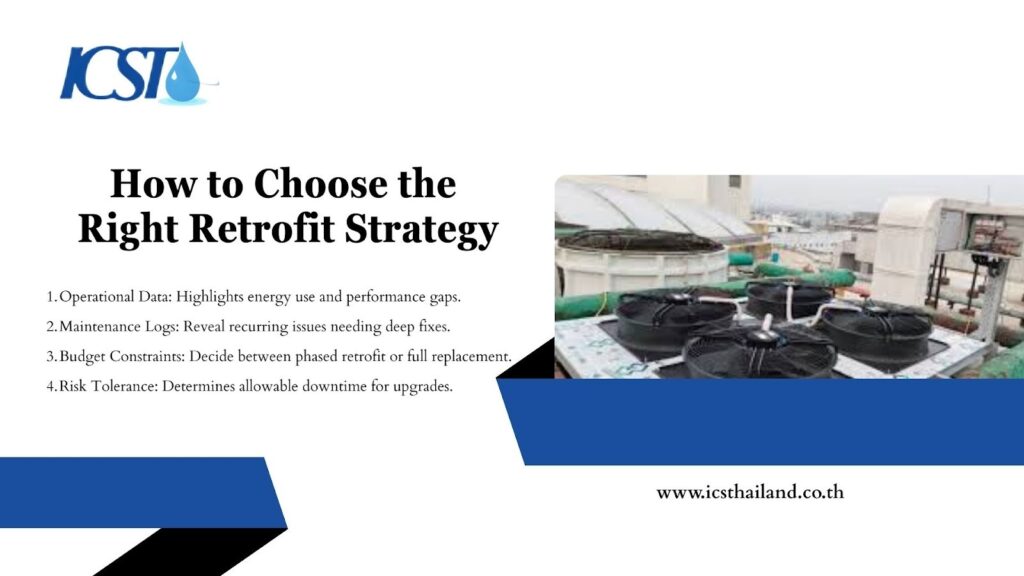
Choosing the best course of action from the available cooling tower retrofit options requires a careful analysis of your specific facility needs. Rushing into a repair without considering the broader operational context often leads to wasted capital. Facility managers should evaluate the following criteria before committing to a project:
- Operational data provides a baseline for current energy use and thermal performance gaps. Comparing current metrics against original design sheets highlights where the biggest efficiency gains lie.
- Maintenance logs reveal chronic issues that simple repairs might not solve permanently. Recurring failures often point to deeper systemic problems that require a comprehensive retrofit.
- Budget constraints often dictate whether a phased retrofit or a complete overhaul is feasible. Facilities can often capitalize retrofit costs over time, whereas replacement requires a large upfront lump sum.
- Risk tolerance levels help decide how much downtime the facility can afford during the upgrade. Retrofits can often occur during short outages, while replacement requires significant downtime.
This decision framework helps categorize potential cooling tower retrofit options. Low-impact projects might involve quick fixes or control updates. Medium-impact projects often include fill and fan upgrades. High-impact interventions involve major structural repairs or partial rebuilds.
Retrofit Option 1: Fill Replacement | Restore Heat Transfer Surfaces
The fill media acts as the heart of the cooling tower by facilitating heat transfer between air and water. Fill replacement involves removing old, clogged, or damaged media and installing new, high-efficiency blocks tailored to the water quality.
When It’s Needed
Operators should look for sagging packs, heavy biological fouling that cleaning cannot remove, or brittle plastic that crumbles upon touch. If the tower cannot maintain temperature despite fans running at full speed, the fill is likely the culprit.
Benefits
- Restored Design Capability: New fill brings the tower back to its original design performance.
- Reduced Fan Energy: It lessens the energy needed by the fan to achieve the same cooling effect.
- Lower Pressure Drop: Decreases the pressure drop across the tower.
- Immediate Thermal Performance Return: This upgrade typically provides the quickest and most significant improvement in thermal performance.
Key Considerations
Engineers must select the correct material, such as PVC or polypropylene, based on the inlet water temperature and quality. They must also decide between field assembly or factory-assembled blocks, which impacts installation time. Furthermore, the new fill design must maintain proper water distribution to function correctly.
Retrofit Option 2: Fan Upgrade | More Efficient Air Movement
Airflow is the second critical half of the evaporative cooling equation. A fan upgrade targets the mechanical drive train, replacing blades, motors, or gearboxes with modern, aerodynamic components.
When It’s Needed
High energy bills often point to inefficient fans. Physical signs include visible corrosion on blades, excessive noise from the motor, or outdated motors that lack variable speed capability.
Benefits
- Significant Electrical Savings: Modern composite fans move more air with less horsepower compared to older aluminum or steel designs.
- Reduced Noise: New fans operate more quietly, reducing the acoustic footprint of the facility.
Key Considerations
The chosen fan must match the tower duty point to avoid stalling or surging. Integrating Variable Frequency Drives (VFDs) offers better control than fixed-speed motors, allowing the fan to ramp up or down based on real-time demand.
Retrofit Option 3: Drift Eliminator Upgrade | Reduce Water Loss

Drift eliminators prevent water droplets from escaping the tower in the discharge air stream. A drift eliminator upgrade involves installing advanced cellular or blade-type eliminators to capture this moisture more effectively.
When It’s Needed
Visible plumes of water exiting the tower indicate failure. Additionally, if the facility faces legal or environmental constraints regarding particulate emissions or water usage, upgrading these components becomes mandatory.
Benefits
- Lower Operational Costs: Retaining water reduces the need for expensive makeup water and chemical treatments.
- Environmental & Safety Control: Improved plume control minimizes the risk of moisture escape.
- Pathogen Prevention: Enhanced capture helps prevent the spread of airborne pathogens, such as Legionella, into the surrounding environment.
Key Considerations
The design must fit the specific tower configuration to ensure a tight seal. Installers must ensure that the new eliminators do not create an excessive pressure drop, which would negatively impact fan performance.
Retrofit Option 4: Controls Modernization | Smarter Operation
As one of the most impactful cooling tower retrofit options, controls modernization replaces outdated analog or manual controls with digital sensors, PLCs, and VFD integration for optimized cooling logic. This is a significant upgrade, as many older towers still operate on simple on/off switches that waste energy during part-load conditions.
When It’s Needed
Facilities that rely on manual adjustments or lack remote monitoring capabilities benefit most. If operators cannot track water temperatures or fan speeds in real-time, the system is likely running inefficiently.
Benefits
- Saves energy: Automated systems adjust fan speeds based on real-time wet-bulb temperatures, preventing over-cooling and saving electricity.
- Improves reliability: Advanced controls offer integrated fault detection, alerting operators to potential issues before they cause a shutdown.
Key Considerations
The new system must integrate seamlessly with the existing Building Management System (BMS) or SCADA. Sensor placement and calibration are critical; poor data input will lead to poor operational decisions.
Retrofit Option 5: Structural Repair | Foundation for All Retrofits
Performance upgrades mean little if the tower framework is unsafe. Structural repair involves reinforcing or replacing damaged casing, support beams, fan decks, and hot or cold water basins.
When It’s Needed
Visible rust on structural steel, leaks in the basin, or unstable access platforms demand immediate attention. Any compromise in the skeleton of the tower poses a safety risk to personnel and equipment.
Benefits
- Ensures the safety of maintenance personnel
- Extends the physical lifespan of the equipment
- Provides a solid foundation for performance upgrades
Key Considerations
Managers must decide between patch repairs or complete structural reinforcement. The impact on operational downtime is a major factor, as structural work often requires the tower to be offline for longer periods than mechanical swaps.
Sequencing Retrofit Work: What Should Come First?
Executing these upgrades in the wrong order can lead to rework or suboptimal results. A logical sequence ensures that each step builds upon the previous one. Most experts recommend the following hierarchy for cooling tower retrofit options:
- Structural repairs must happen first to ensure the vessel is safe and stable enough to house new components. You cannot install heavy mechanical equipment on a corroded fan deck.
- Fill media replacement follows, as this provides the baseline thermal performance for the system. This step dictates the airflow requirements for the subsequent steps.
- Fan and drive upgrades come next to match the airflow requirements of the new fill. The fan pitch and motor speed should be tuned to the pressure drop of the new media.
- Drift eliminator installation ensures that the revitalized airflow does not eject water from the tower. This seals the system after the internal components are in place.
- Controls modernization completes the project by optimizing how the new mechanical components operate together. The digital brain can now manage the efficient new hardware effectively.
Cost vs. Benefit: Practical ROI Considerations
The final hurdle for any capital project is financial justification, where managers must demonstrate that the investment will yield tangible returns. When considering cooling tower retrofit options, it’s important to note they typically cost a fraction of a full tower replacement—often ranging from 20% to 50% of the price of a new unit.
The return on investment typically stems from energy and water savings. Here’s how:
- Fill Replacement: A fill replacement project can often pay for itself within 18 to 24 months due to improved thermal efficiency.
- Fan Upgrades: Pairing fan upgrades with VFDs can slash fan energy consumption by 30% or more.
These operational savings not only address immediate maintenance issues but also free up funds for other facility needs.
Conclusion
Aging infrastructure doesn’t always need a full replacement. Exploring cooling tower retrofit options provides a cost-effective way to restore efficiency and reliability at a fraction of the cost of new equipment.
By targeting specific components, such as replacing fouled fill to improve thermal performance, upgrading fans and motors for better airflow, or integrating VFDs for precision control, facilities can achieve “like-new” performance. These strategic upgrades not only extend the lifespan of your cooling tower but also deliver significant ROI through reduced energy and water consumption.
Whether you are battling scale buildup or rising operational costs, a well-planned retrofit maximizes your asset’s value and keeps your facility running smoothly. Choosing to modernize today ensures long-term sustainability and predictable maintenance for years to come. For expert retrofit planning, part supply, or installation support, contact ICST.
Frequently Asked Questions
What is a cooling tower retrofit?
A cooling tower retrofit involves upgrading specific components of an existing tower to restore or improve performance. It extends equipment life without the high cost of full replacement.
Is retrofitting cheaper than replacing a cooling tower?
Yes, retrofitting typically costs 20–50% less than full replacement. It delivers strong ROI through energy savings, reduced downtime, and extended service life.
What are the most common cooling tower retrofit options?
Common options include fill replacement, fan upgrades, drift eliminator upgrades, controls modernization, and structural repairs. Each targets a specific performance or reliability issue.
How long does a cooling tower retrofit take?
Retrofit timelines vary by scope, but many upgrades can be completed during short outages. This makes retrofitting less disruptive than full tower replacement.
How long can a retrofit extend a cooling tower’s life?
A well-planned retrofit can extend a cooling tower’s lifespan by 10–15 years. The exact gain depends on the condition of the structure and the upgrades performed.