Are you prepared for the rising challenge of water scarcity cooling adaptation in 2026? As climate change accelerates, industries across Asia and the Middle East are no longer constrained by energy or budget, but by water. Traditional cooling methods are facing severe setbacks as drought, population growth, and strict regulations tighten water availability. An innovative, future-proof approach is now essential to keep your operations running efficiently and sustainably.
This guide reveals the proven adaptation strategies that leading organizations are using to convert risk into resilience, ensuring long-term operational success, compliance, and cost control in an unpredictable, water-stressed world.
Advanced Sourcing: Moving Beyond Freshwater
The future of industrial cooling is not just about using less water; it is about using different water. Relying on freshwater is no longer a sustainable strategy. To combat water scarcity, facilities must adapt to utilize alternative, more abundant sources.
- Seawater & Brackish Adaptation: We engineer robust heat exchangers and low-pumphead, low-power pump systems designed to handle the corrosive nature of seawater and brackish water. This unlocks nearly infinite water sources for coastal facilities, though it requires specialized infrastructure to manage high Total Dissolved Solids (TDS) and prevent corrosion.
- Wastewater Mining: Municipal effluent and internal process water represent a valuable, often overlooked, thermal asset. By implementing advanced treatment and filtration, we can “mine” this wastewater, creating a closed-loop system that turns a liability into a reliable source of cooling water. This reduces reliance on external water supplies and minimizes environmental discharge.
2026 Adaptation Matrix: Efficiency vs. Resilience
Choosing the right cooling adaptation technology depends on your facility’s specific needs, location, and operational goals. There is no one-size-fits-all solution. Below is a matrix of leading adaptation measures, highlighting their water recovery potential and ideal applications.
| Adaptation Technology | Water Recovery | Best For… | ICST Specialized Edge |
| Hybrid (Dry-Trim) | 40% – 85% | Data Centers / Power | Low-Plume & Quiet Designs |
| Zero Liquid Discharge | 98%+ | Chemical / Heavy Industry | Acid-Resistant Metallurgy |
| Adiabatic Systems | 70% | High-Ambient Regions | Optimized Footprint / Modular |
| Subsurface Cooling | 100% | Baseload Critical | Geothermal Engineering |
ICST provides specialized engineering for each of these technologies. We develop low-plume and quiet hybrid designs for data centers near residential areas and utilize advanced acid-resistant metallurgy for ZLD systems in harsh chemical environments. Our expertise ensures that your chosen adaptation measure delivers maximum efficiency and resilience.
Sustainable Strategies: The “Zero-Water” Frontier
Achieving near-zero water consumption is the ultimate goal for facilities in high-risk zones. This requires moving beyond efficiency improvements to adopt revolutionary cooling strategies that dramatically reduce water demands.
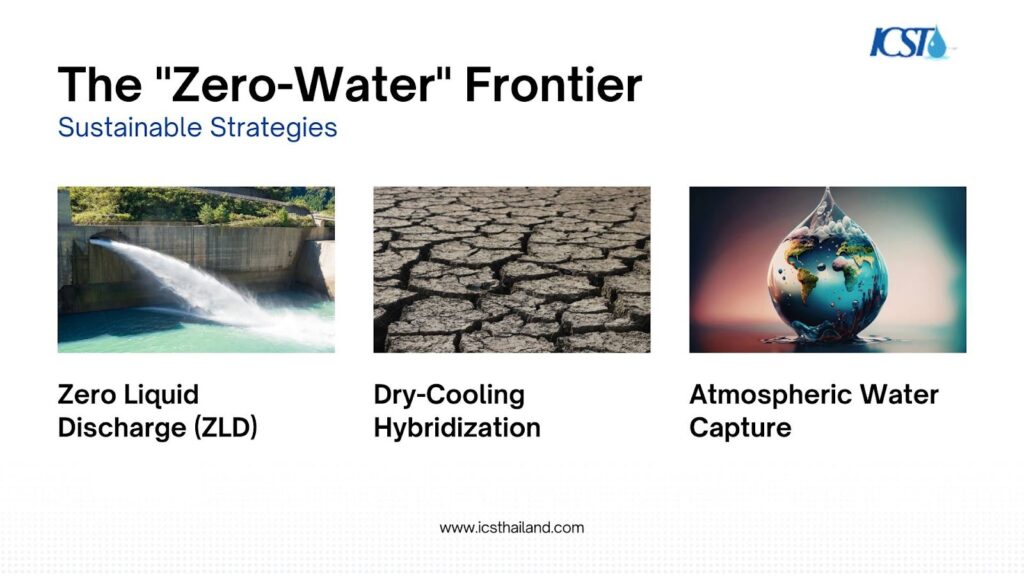
- Zero Liquid Discharge (ZLD): This is a powerful solution for maximizing water reuse. ZLD systems use advanced membrane filtration, like Reverse Osmosis, to process cooling tower blowdown. This process recaptures up to 99% of the water, which is then clean enough for immediate reuse in the cooling loop. It effectively closes the water cycle within the facility.
- Dry-Cooling Hybridization: We champion a “Dry-First” approach for 2026. This strategy uses air-cooled heat exchangers as the primary cooling method. Evaporative (wet) cooling is reserved as a “trim” function, activated only during peak air temperatures or extreme thermal loads. This drastically cuts annual water consumption compared to fully evaporative systems.
- Atmospheric Water Capture: In humid tropical regions, the air itself can become a water source. We design high-efficiency condensate harvesting systems that capture atmospheric moisture. This captured rainwater and condensation can be used as high-quality makeup water for the cooling system, creating a truly sustainable and independent water supply.
Climate-Resilient Infrastructure & Design
Adapting to water scarcity also means preparing your infrastructure for the challenges of a changing climate. This includes designing systems that can handle poor-quality water and withstand supply disruptions.
- “Dirty Water” Management: In water-scarce regions, available water sources often have high levels of silt or Total Dissolved Solids (TDS). We customize filtration and treatment systems specifically for these environments, preventing fouling, scaling, and corrosion that would damage standard cooling equipment.
- Cycles of Concentration (CoC) Optimization: We use AI-driven sensors to monitor water chemistry in real time. This allows us to safely operate cooling towers at higher mineral concentrations (CoC 7+), well beyond the industry standard. Safely increasing CoC can reduce makeup water demand by up to 25%.
- Emergency Water Design: Municipal water supplies are vulnerable to drought-related curtailments, making Emergency Water Design essential. We help facilities implement Emergency Water Design solutions by creating redundant on-site water storage and mobile water treatment units. This specialized infrastructure ensures a reliable buffer, allowing operations to continue seamlessly even when the primary water supply is disrupted.
Smart Systems: AI-Driven Conservation Tech
The most advanced cooling systems use smart technology to optimize water and energy use. Artificial intelligence and autonomous monitoring are essential tools for achieving peak efficiency and meeting strict regulatory requirements.
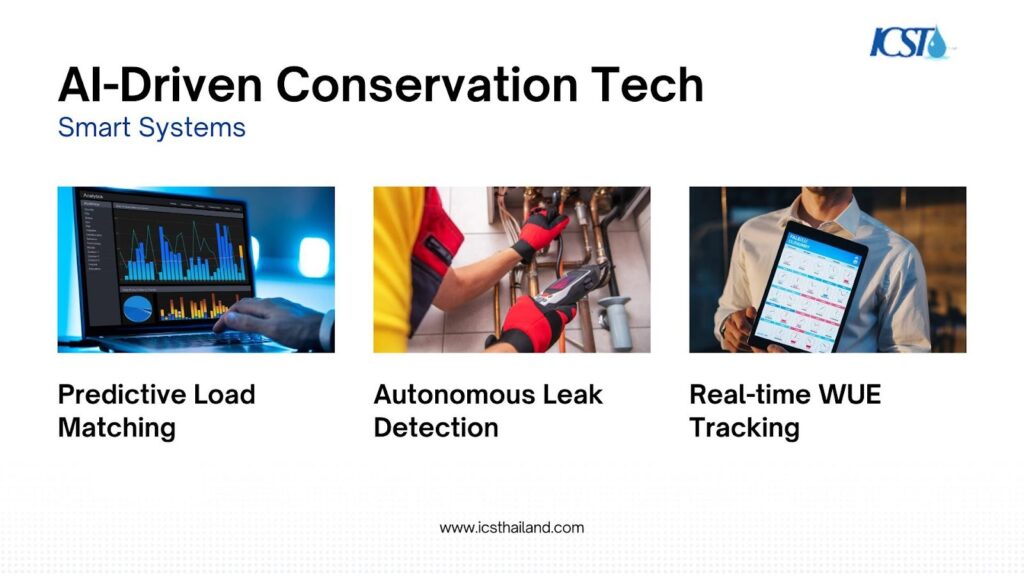
- Predictive Load Matching: Our AI-powered control systems analyze real-time operational loads, weather forecasts, and energy costs. They automatically adjust fan and pump speeds to find the optimal balance in the energy-water cost nexus, ensuring the most efficient use of both resources at any given moment.
- Autonomous Leak Detection: Small, “invisible” leaks can lead to significant water loss over time. We implement acoustic monitoring and pressure sensors that autonomously detect these leaks before they impact the facility’s water balance, enabling proactive maintenance and preventing waste.
- Real-time WUE Tracking: Water Usage Effectiveness (WUE) is becoming a top-tier operational Key Performance Indicator (KPI). We install monitoring systems that track WUE in real time, providing the data necessary to satisfy 2026 regulatory audits and demonstrate a commitment to sustainable water management.
Conclusion: Future-Proofing for 2030 and Beyond
Success in the industrial landscape of 2026 and beyond requires a new mindset. We must evolve from simply “Moving Heat” to practicing “Thermal Orchestration,” a holistic approach that balances performance, efficiency, and resource stewardship. The socioeconomic factors of population growth and climate change are not just an option, but a necessity for survival.
The ICST promise is to bridge the gap between experimental physics and rugged industrial reality. We deliver proven, resilient, and financially sound engineering solutions that protect your operations from the growing threat of water scarcity. By prioritizing water scarcity cooling adaptation, we help you navigate water constraints, reduce economic losses, and secure your future in a water-stressed world.
Is your cooling system rated for the 2026 water reality? Contact ICST for a Water Scarcity Resilience Audit and secure your operational future today.
Frequently Asked Questions
What is water scarcity cooling adaptation?
Water scarcity cooling adaptation refers to innovative strategies and technologies designed to optimize industrial cooling systems in water-stressed environments. These include using alternative water sources, advanced filtration, and AI-driven efficiency measures.
How does climate change impact cooling water availability?
Climate change intensifies water scarcity by increasing droughts, extreme heat, and competition for water resources. This directly affects the availability of cooling water for industries like power generation and manufacturing.
What are the benefits of Zero Liquid Discharge (ZLD) systems?
ZLD systems maximize water reuse by recovering up to 99% of wastewater, reducing water consumption, and ensuring compliance with strict environmental regulations in water-scarce regions.
Why is seawater used for industrial cooling?
Seawater is an abundant alternative to freshwater for cooling. With specialized engineering, facilities can overcome challenges like corrosion and high Total Dissolved Solids (TDS) to utilize this resource effectively.
How can AI improve water management in cooling systems?
AI enhances water management by optimizing load matching, detecting leaks, and monitoring Water Usage Effectiveness (WUE) in real time, ensuring efficient and sustainable cooling operations.