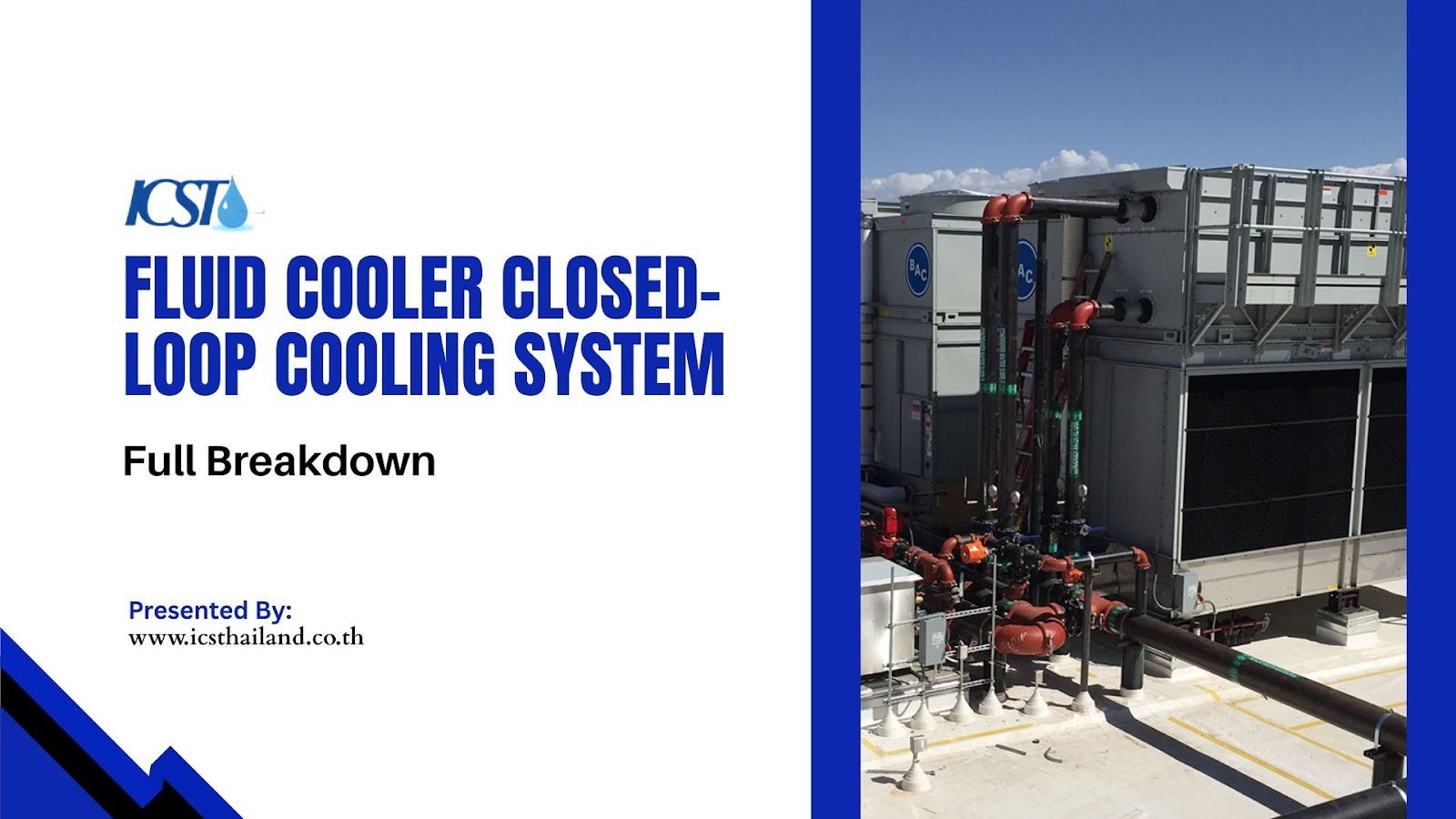
Fluid cooler closed-loop cooling represents a highly efficient method for rejecting heat from industrial processes. This technology utilizes a closed circuit system where the process fluid remains entirely contained within a coil bundle.
By keeping the fluid separated from the outside air, this design ensures complete process fluid isolation and guarantees strict contamination prevention. These coolers easily support glycol cooling applications, making them highly versatile for cold climates. Ultimately, this approach delivers superior operational efficiency and maintains exceptionally clean internal systems.
What Is a Fluid Cooler?
A fluid cooler functions as a hybrid between a traditional cooling tower and a heat exchanger. The process fluid stays entirely inside the coil bundle at all times. This separation prevents environmental debris from entering the internal system.
How Closed-Loop Cooling Works
A fluid cooler uses a dual-action process to achieve efficient heat rejection, combining two heat transfer methods within a single unit. The evaporative process in fluid cooler closed-loop cooling is highly effective because it leverages both air and water to dissipate thermal energy.
Here’s a breakdown of how it works:
- Internal Fluid Flow: The hot process fluid circulates through a closed-loop coil bundle, keeping it completely separate from external elements.
- External Water Spray: Simultaneously, a spray system wets the outside of the coil with water.
- Evaporative Cooling: Fans draw air across the wet coil, causing the water to evaporate. This evaporation pulls heat away from the coil and the internal fluid.
- Combined Heat Transfer: This method combines the sensible cooling effect of the airflow with the powerful evaporative cooling effect, maximizing thermal performance in a compact design.
Key Components of a Closed-Loop Fluid Cooler
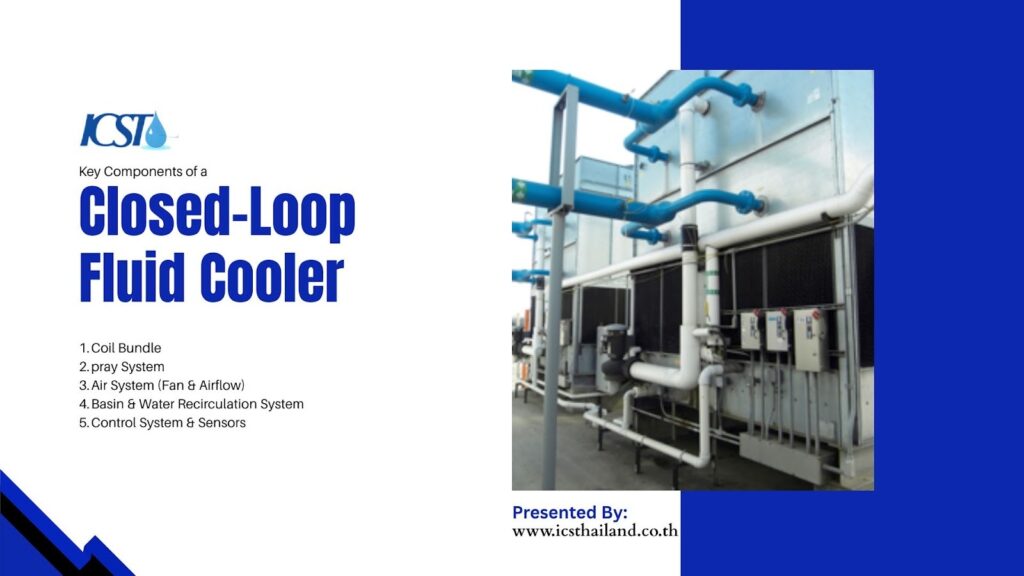
Coil Bundle (Core Heat Exchange Component)
The coil bundle serves as the primary heat transfer surface. Manufacturers typically construct these from galvanized steel or copper. In a fluid cooler closed-loop cooling system, the internal fluid circulates through these tubes to release its heat.
Spray System
The spray system is crucial for efficient heat transfer, as it ensures the coil surfaces are consistently wetted. This continuous film of water is where the magic of evaporative cooling happens. An effective spray system is characterized by:
- Even Water Distribution: It pumps water from the basin and sprays it uniformly across the coils to maximize surface contact.
- Continuous Operation: The system constantly recirculates water over the coil bundle’s exterior.
- Enhanced Heat Removal: This external layer of water absorbs heat from the internal fluid and evaporates, carrying the heat away from the system.
Air System (Fan & Airflow)
Air movement dictates the cooling capacity of the unit. The system uses either forced draft or induced draft fans to move air. This constant air movement impact accelerates the evaporation of the spray water.
Basin & Water Recirculation System
The basin and recirculation system form the backbone of the cooler’s water management, ensuring efficient and continuous operation. This closed-loop design conserves water and maintains consistent cooling performance by constantly reusing the collected water.
- Water Collection: The basin, located at the unit’s base, collects the water that has cascaded over the coil bundle.
- Recirculation Pump: A dedicated pump system draws this collected water from the basin.
- Water Redistribution: The pump then sends the water back up to the spray headers to be redistributed over the coils, completing the cycle.
Control System & Sensors
Modern units rely on advanced temperature control mechanisms. Automation allows the cooler to adjust fan speeds and pump operation. This ensures the fluid cooler closed-loop cooling system only consumes energy when the process requires it.
How Closed-Loop Fluid Coolers Work (Step-by-Step Process)
Step 1: Hot Fluid Enters Coil Bundle
The process fluid, heated by your equipment, is channeled to the cooler where it flows into the primary header of the coil bundle. This initial step is crucial for distributing the fluid evenly, preparing it for the efficient heat exchange process that follows.
Step 2: Water Sprays Over Coil
The recirculation pump starts, spraying water continuously over the coil bundle. This creates a thin film of external cooling water on the tubes, setting the stage for evaporative cooling.
Step 3: Airflow Enhances Evaporation
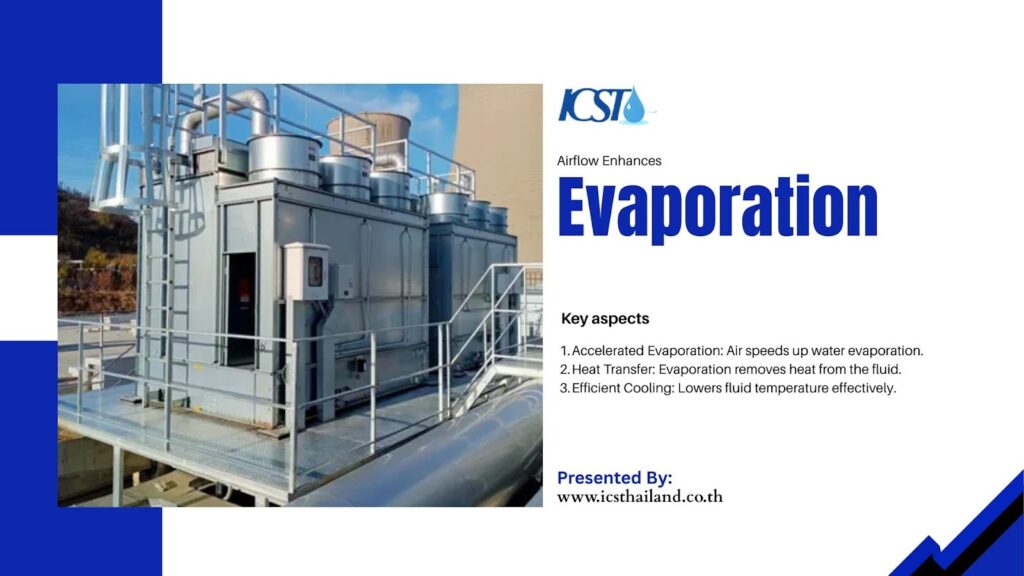
Next, powerful fans draw ambient air into the unit, playing a critical role in the cooling cycle. As this air passes over the water-sprayed coils, it significantly enhances the evaporation rate, which is the key to efficient heat removal. This synergy between air and water maximizes the cooling effect on the process fluid.
Key aspects of this step include:
- Accelerated Evaporation: The airflow speeds up water evaporation from the coil surface.
- Heat Transfer: Each gram of evaporated water removes a significant amount of heat from the internal fluid.
- Efficient Cooling: This process is the primary mechanism for lowering the temperature of the process fluid inside the coils.
Step 4: Heat Is Rejected to the atmosphere
This final step completes the cooling cycle by expelling the absorbed heat, ensuring the process fluid reaches its target temperature efficiently. The design’s efficiency stems from keeping the internal heat transfer surface pristine, a distinct advantage over open cooling systems.
- Heat Expulsion: Warmed, moisture-rich air is discharged from the top of the unit, effectively removing heat from the system.
- Final Temperature: The process fluid is now cooled to the required temperature, ready for its industrial application.
- Enhanced Efficiency: By preventing direct contact with external contaminants, the internal coils remain clean, maximizing thermal performance and system longevity compared to open-loop towers.
Closed Loop vs Open Cooling Towers (Which One Should You Choose?)
When selecting cooling equipment, professionals must understand the differences between these two technologies. Which system offers the best protection for your specific process? Consider the specific operational factors before making a final choice.
- Contamination risk: Open systems expose fluid directly to air, while closed systems protect it entirely.
- Maintenance costs: Closed systems keep internal components clean, reducing overall labor and chemical expenses.
- System longevity: Protected process fluids extend the lifespan of all connected downstream equipment.
| Feature | Closed-Loop Fluid Cooler | Open Cooling Tower |
| Fluid Exposure | Isolated (closed circuit) | Direct exposure |
| Contamination Risk | Very low | High |
| Maintenance | Lower | Higher |
| Water Usage | Moderate | Higher |
| Efficiency | High (controlled) | Variable |
| Chemical Treatment | Minimal | Required |
| Suitable Fluids | Water, glycol | Mostly water |
| Application | Industrial processes | General cooling |
You should choose a closed-loop system when your process requires pure, uncontaminated fluid. Open towers work best for general cooling where fluid quality does not impact downstream machinery.
Key Advantages of Closed Loop Fluid Coolers
Contamination Prevention
The primary benefit centers on total contamination prevention. Process fluid isolation means dirt, leaves, and airborne pathogens never touch your expensive process fluid. This closed environment, a key feature of fluid cooler closed-loop cooling, protects your entire mechanical system.
Reduced Maintenance Requirements
Clean internal fluids result in drastically less fouling inside your heat exchangers. Operators spend less time cleaning tubes and flushing systems. This leads directly to longer equipment life and reduced labor costs.
Support for Glycol Cooling Systems
Many facilities require cooling in sub-freezing temperatures. These units perfectly support glycol cooling applications to provide reliable freeze protection. Industrial applications operating in harsh winter climates rely heavily on this capability.
Improved Operational Efficiency
Clean systems operate exactly as the engineers designed them. Fluid cooler closed-loop cooling delivers highly stable performance year after year. The controlled environment prevents efficiency drops caused by internal scaling.
Longer Equipment Lifespan
Protecting the fluid protects the pipes, valves, and heat exchangers. Reduced corrosion saves companies significant capital replacement costs. Lower wear on internal components ensures the facility runs smoothly for decades.
Common Applications of Fluid Cooler Closed-Loop Cooling
Various industries depend on reliable thermal management to maintain production. How do different sectors utilize this specific technology? These environments demand precise temperature control and clean fluids.
- Industrial process cooling: Manufacturing plants use them to cool plastic injection molds and air compressors.
- HVAC systems: Large commercial buildings use them to reject heat from water-source heat pumps.
- Data centers: Server farms require perfectly clean cooling water to prevent catastrophic hardware failures.
- Power plants: Energy facilities use them to cool auxiliary systems without introducing river or lake water contaminants.
- Chemical processing: Refineries require precise temperature control and complete isolation of hazardous process fluids.
When Should You Use a Closed-Loop Fluid Cooler?
Choosing the right cooling method impacts your entire operational budget. How do you know when to specify a closed system? When deciding on a fluid cooler, closed-loop cooling may be the best option depending on your process tolerances and maintenance capabilities.
- When contamination from airborne debris or water treatment chemicals could damage sensitive process equipment.
- When your process fluid is a specialized glycol solution or a costly chemical that cannot be lost to evaporation or spills.
- When you need to reduce maintenance costs and have a limited workforce for the frequent cleaning required by open systems.
- When tight temperature control and process stability are critical for maintaining product quality and manufacturing tolerances.
- When operating in freezing conditions, a closed loop offers better protection against damage from ice formation.
- When water conservation is a priority, closed-loop systems significantly reduce water consumption by minimizing evaporation.
Common Problems in Fluid Coolers (And How to Fix Them)
Scaling on Coil Bundle
Minerals in the spray water can accumulate on the hot tubes. This cause requires a solution involving proper water chemical treatment and regular mechanical descaling of the exterior tubes.
Reduced Heat Transfer Efficiency
If the internal fluid runs too hot, you might have airflow or spray issues. You must inspect the fan belts for tension and check the spray nozzles for clogs.
Pump or Water Distribution Issues
Spray pumps can fail or lose suction due to basin debris. Routine maintenance fixes include cleaning the basin strainer and checking the pump seal for leaks.
How to Optimize Closed-Loop Cooling Performance
Regular Inspection of Coil Bundle
Operators must visually inspect the exterior tubes weekly. Are there dry spots on the coil? Dry spots indicate clogged nozzles and will lead to rapid scale formation.
- Check for uniform water distribution across the entire tube surface.
- Remove any visible scale deposits before they harden and reduce heat transfer.
- Inspect the galvanized or copper finish for early signs of corrosion.
Maintain Proper Water Chemistry
The exterior spray water requires careful chemical management. What happens if you neglect the basin water? Untreated water causes rapid corrosion and scale buildup.
- Test the water daily for proper pH and conductivity levels.
- Maintain the correct cycles of concentration to prevent mineral precipitation.
- Inject biocides regularly to stop algae and bacterial growth in the basin.
Optimize Airflow System
Airflow drives the evaporative cooling process. How can you ensure the fans operate at peak efficiency? Proper mechanical maintenance keeps the air moving smoothly.
- Lubricate fan shaft bearings according to the manufacturer’s specifications.
- Inspect and adjust fan belts to prevent slipping and loss of RPM.
- Keep the air inlet louvers free of debris, leaves, and trash.
Use Smart Monitoring Systems
Modern technology allows for predictive maintenance. Why rely on manual checks when sensors can monitor the unit continuously? Automation prevents small issues from becoming major failures.
- Install vibration sensors on the fan motors to detect early bearing wear.
- Use automated blowdown valves to control basin water conductivity precisely.
- Monitor entering and leaving fluid temperatures to track real-time efficiency.
Expert Insight: Why Industries Prefer Closed-Loop Cooling Systems
Facility managers prioritize reliability above all other metrics. Fluid cooler closed-loop cooling delivers that exact reliability by protecting the core process. Cost efficiency over time always favors the closed system due to drastically reduced downtime.
Furthermore, the environmental benefits of using less water and fewer internal chemicals make this technology the superior choice for modern industrial infrastructure.
Final Thoughts on Evaporative Cooling Solutions
Understanding fluid cooler closed-loop cooling empowers facility managers to make superior engineering decisions. By utilizing a closed-circuit design and a robust coil bundle, facilities ensure complete process fluid isolation. This ensures strict contamination prevention and allows for safe glycol cooling in cold environments.
Investing in this technology protects your expensive downstream equipment, reduces chemical usage, and drastically lowers long-term maintenance costs. Evaluate your current process temperatures and water quality today to determine if a closed system will optimize your facility operations.
If you need help choosing the right cooling system or need to build a new tower, contact Industrial Cooling Solution Thailand for expert assistance.
Frequently Asked Questions
What is a closed-loop fluid cooler?
It is a heat-rejection device that keeps the process fluid within a tube bundle. The working principle relies on spraying external water over these tubes while drawing air across them to remove heat.
How is a fluid cooler different from a cooling tower?
An open cooling tower exposes the process water directly to the atmosphere. A closed vs open system comparison shows that fluid coolers use a coil to separate the process fluid from the outside air entirely.
Can fluid coolers use glycol?
Yes, they excel at handling antifreeze mixtures. The benefits include complete freeze protection for outdoor units operating in severe winter environments.
Are closed-loop systems more efficient?
Yes, they maintain their efficiency much longer than open systems. The efficiency and control remain high because the internal heat transfer surfaces never accumulate dirt or scale.
When should I choose a fluid cooler?
You should select this technology when your downstream equipment requires clean water. Decision criteria should heavily weigh the cost of fouling your heat exchangers against the initial purchase price of the cooler.