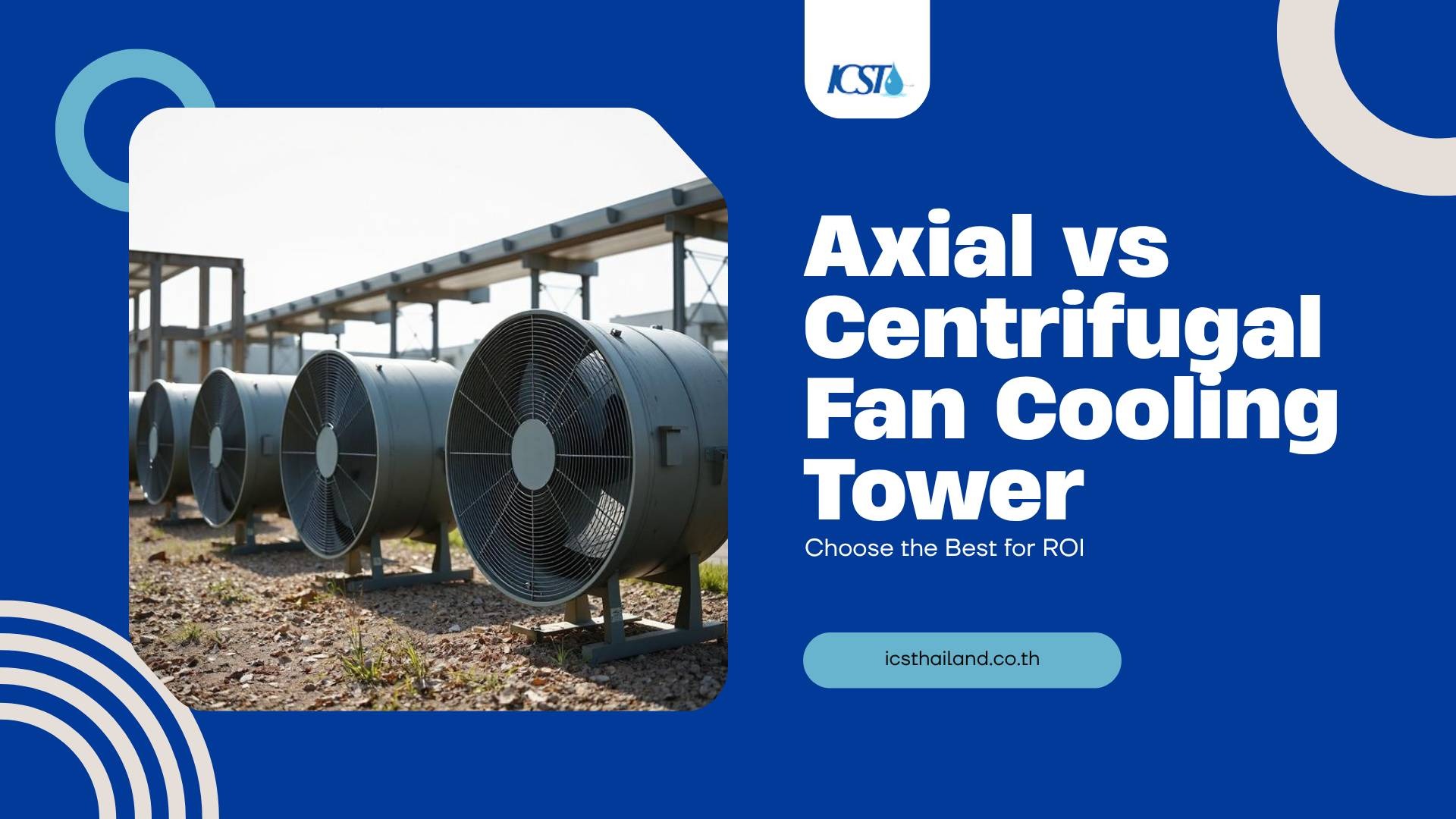
Axial vs centrifugal fan cooling tower systems differ in airflow and efficiency. Axial fans excel in moving large air volumes at low static pressure, making them ideal for cooling towers in tropical climates.
They are energy-efficient, easy to maintain, and deliver superior performance in humid conditions. Centrifugal fans, however, are designed for high-pressure applications like ducted systems but are less energy-efficient for standard cooling towers. For most cooling tower setups, axial fans provide better thermal ROI and operational efficiency.
1. The Physics of Air Movement: Axial vs. Centrifugal
To optimize a cooling tower, you must first understand the fundamental physics of air movement. Industrial fans generally fall into two distinct aerodynamic categories. Each design interacts with airflow in a completely different manner.
Axial Flow: The Propeller Design
Axial fans utilize a propeller-style design. Air is drawn in and forced out parallel to the rotating shaft. This straightforward pathway moves air with minimal internal resistance.
Why does the axial design dominate the cooling tower industry? It excels at moving massive volumes of air at low static pressure. This exact aerodynamic profile is what a standard cooling tower fill-media environment requires to function properly.
Centrifugal Flow: The Blower Design
Centrifugal fans operate differently. Also known as blowers, they draw air into the center of the rotating impeller. The mechanism then expels the air at a 90-degree angle.
The industrial reality restricts centrifugal fans to specialized forced-draft towers. Engineers specify this design only when the system must overcome high static pressure. This resistance typically stems from highly restrictive ductwork or intense sound-attenuation requirements. For standard cooling duties, the centrifugal design introduces unnecessary mechanical complexity.
2. Why Axial Fans are the Tropical Standard for Thailand
Thailand presents a unique challenge for industrial heat rejection. The high heat and intense humidity demand specific engineering solutions. Axial fans meet these environmental demands effectively.
Prioritizing Volume Over Pressure
In a high-humidity climate like Bangkok, airflow volume serves as the primary variable for successful heat rejection. Axial fans move the high Cubic Feet per Minute (CFM) required to maximize evaporation. You need this massive volume to keep your approach temperatures stable, even when the ambient air is fully saturated with moisture.
Ease of Field Support and Maintenance
Axial fan assemblies feature a modular and highly accessible structure. In the Southeast Asian region, monsoon-season debris poses a constant operational threat. Leaves, silt, and airborne contaminants quickly foul cooling tower components.
The open design of an axial fan deck allows for rapid visual inspection and physical cleaning. Maintenance teams can clear debris quickly, which significantly reduces costly system downtime.
Superior Energy Intensity
Energy consumption remains a massive operational expense for any industrial facility. Axial fans deliver superior CFM per kilowatt of consumed power. This mechanical efficiency translates directly to lower monthly electricity bills. Centrifugal blowers waste energy pushing against artificial resistance, making them far more expensive to operate over their lifespan.
3. Strategic Performance Comparison
To clarify the operational differences, we must compare the two designs across critical engineering metrics. This breakdown highlights why the axial design excels in standard applications.
| Metric | Axial Fan (Standard) | Centrifugal Fan (Specialty) |
| Primary Duty | High Volume (Heat Rejection) | High Pressure (Duct/Filter Resistance) |
| Energy Intensity | Optimal (Low Parasitic Load) | Higher (due to pressure loss) |
| Tropical Suitability | Excellent (High Airflow) | Limited (High Resistance) |
| Maintenance | Simple/Fast (ICST Service) | Complex (Housing Access) |
| Static Regain | High (with Velocity Recovery Cones) | Low (due to impeller friction) |
- Primary Duty: Axial fans handle high-volume heat rejection flawlessly. Centrifugal fans manage high-pressure duct or filter resistance.
- Energy Intensity: Axial fans offer an optimal, low parasitic load. Centrifugal fans demonstrate a higher energy demand due to internal pressure loss.
- Tropical Suitability: Axial fans provide excellent high airflow for humid environments. Centrifugal fans offer limited utility due to their high-resistance profile.
- Maintenance Profile: Axial fan service is simple and fast. Centrifugal fan maintenance is complex and requires difficult housing access.
- Static Regain: Axial fans achieve high static regain when paired with velocity recovery cones. Centrifugal fans suffer from low regain due to inherent impeller friction.
4. Technical Gaps: When High Pressure Is Not an Advantage
Many operators mistakenly believe that a “stronger” fan yields better results. This misunderstanding leads to inefficient equipment procurement.

The Static Pressure Fallacy
Centrifugal fans indeed push harder against static pressure. However, in a standard cooling tower, static pressure often represents wasted energy. High resistance usually results from poor system design, restricted intakes, or excessive ducting. Overcoming artificial resistance with a power-hungry centrifugal blower does not improve heat rejection. It only inflates your utility bills.
Finding the Efficiency Sweet Spot
Engineers achieve maximum efficiency by pairing axial fans with modern velocity recovery cones. A recovery cone acts as an aerodynamic diffuser. It smoothly directs the exhaust air upward, reducing the pressure differential across the fan plane. This combination creates an energy efficiency profile that centrifugal systems simply cannot match for large-scale industrial cooling.
5. Engineering for 2026: VFDs and Smart Controls
Modern cooling requirements demand intelligent operation. You can no longer rely on a fan running at maximum speed constantly. Dynamic control systems represent the future of thermal management.

Dynamic Cooling Integration
An axial fan paired with an inverter-duty motor and a Variable Frequency Drive (VFD) constitutes the ultimate solution for a tropical environment. A VFD automatically scales down the motor speed during cooler night hours or during heavy rain. Because axial fan power consumption drops at the cube of the motor speed, reducing fan RPM by just 20 percent cuts energy usage by nearly 50 percent.
Tropical Motor Selection
Humid environments destroy standard electric motors rapidly. We strongly emphasize selecting Totally Enclosed Air Over (TEAO) motors for cooling tower fan decks. These motors must feature specialized Class H insulation. This robust insulation prevents internal short-circuits during the highly humid rainy season, ensuring year-round reliability.
6. ICST Field Authority: Auditing Your Airflow
Selecting the right fan type is only the first step. You must install, pitch, and balance the assembly correctly to achieve the desired performance.
The Bangkok Hub Advantage
Having a local, expert partner is more important than the fan hardware itself. International Cooling Solutions (Thailand) operates directly from Bangkok. Our engineers perform critical vibration analysis and blade pitch optimization on-site. We ensure your aerodynamic engine operates flawlessly within its specific structural environment.
Securing Your Retrofit ROI
Many older facilities still rely on inefficient centrifugal blowers or outdated axial designs. You must evaluate when to consider replacing these aging components. Upgrading to a modern, high-efficiency axial fan assembly can reduce energy consumption by 15 to 20 percent. Our team calculates the exact Return on Investment (ROI) for your retrofit, proving the financial viability of the upgrade before work begins.
Precision Engineering for Maximum Thermal Duty
Industrial cooling towers require precise aerodynamic engineering. When considering axial vs centrifugal fan cooling tower applications, you should never default to a centrifugal fan unless your system architecture strictly dictates high static pressure. For 90 percent of standard cooling tower applications, the axial fan delivers the absolute best thermal ROI. It moves more air, uses less power, and requires less maintenance.
The ICST promise is clear. We provide the specialized procurement and design expertise you need. We guarantee that your cooling tower fan assembly is perfectly sized, accurately pitched, and reliably powered for tropical operation.
Is your cooling tower failing to meet its required thermal capacity? International Cooling Solutions (Thailand) performs comprehensive airflow and thermal audits. Whether you need a simple fan upgrade or a fully performance-matched retrofit, our Bangkok-based engineering team stands ready to optimize your system.
Request a Professional Airflow Audit Today.
Frequently Asked Questions
What is the difference between axial and centrifugal fans in cooling towers?
Axial fans move large volumes of air at low static pressure, making them ideal for cooling towers. Centrifugal fans, on the other hand, are designed for high-pressure applications like ducted systems. Axial fans are energy-efficient and better suited for tropical climates, while centrifugal fans are used in specialized setups requiring high resistance management.
Why are axial fans preferred for tropical cooling towers?
Axial fans excel in tropical climates due to their ability to handle high airflow volumes, essential for effective heat rejection. They are energy-efficient, easy to maintain, and perform well in humid conditions. Their open design also allows for quick cleaning, reducing downtime caused by debris during monsoon seasons.
How do velocity recovery cones improve axial fan efficiency?
Velocity recovery cones optimize airflow by reducing pressure loss at the fan’s exhaust. They act as aerodynamic diffusers, directing air smoothly and enhancing static regain. This setup improves energy efficiency, making axial fans more effective for large-scale cooling tower applications compared to centrifugal systems.
What role does a Variable Frequency Drive (VFD) play in cooling towers?
A VFD adjusts the speed of axial fans based on cooling demand, reducing energy consumption during low-load periods like cooler nights. This dynamic control not only saves energy but also extends the lifespan of the fan motor. It is a key component for energy-efficient cooling tower operations in tropical climates.
When should I replace centrifugal fans with axial fans?
Consider replacing centrifugal fans if your cooling tower operates in a low static pressure environment. Axial fans offer better energy efficiency, lower maintenance, and higher airflow volumes. Retrofitting with modern axial fans can reduce energy consumption by 15–20%, providing a significant return on investment.