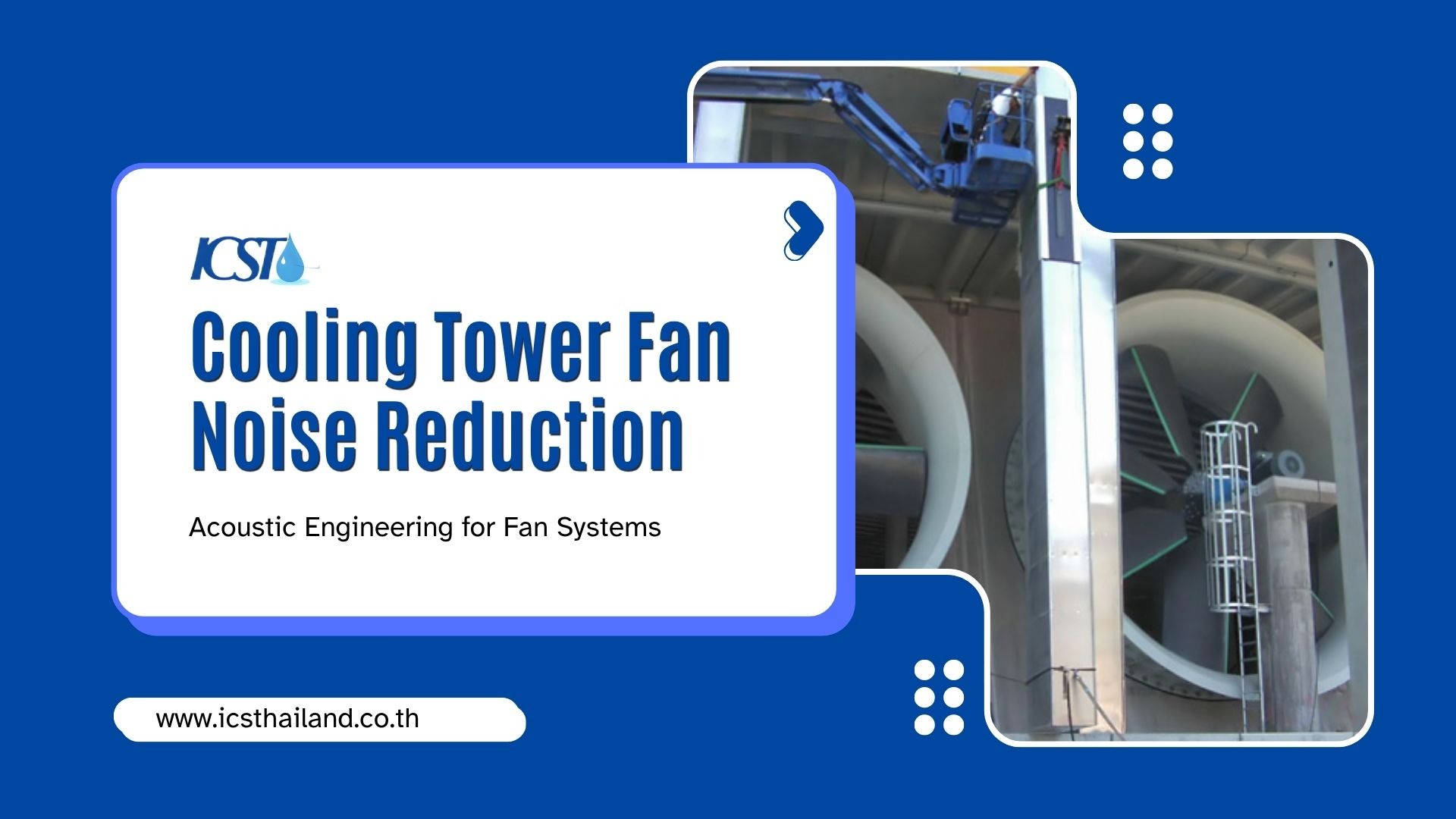
Cooling tower fan noise reduction is achieved by controlling sound from blade tip turbulence, aerodynamic drag, and mechanical vibration. Advanced acoustic engineering methods include optimizing fan RPM, blade geometry, and serrated trailing edge designs.
Since fan noise is mainly caused by airflow turbulence, modern designs focus on reducing noise at the source. Implementing a low RPM fan strategy, installing acoustic barriers, and using vibration isolation systems are key techniques.
These strategies improve sound power levels and energy efficiency, ensuring regulatory compliance and avoiding costly retrofits by addressing blade tip noise early in the design phase.
Why Cooling Tower Fans Generate High Noise Levels
Cooling tower fans are often the loudest components in industrial cooling systems due to aerodynamic and mechanical interactions. When massive fan blades rotate at high velocities, they displace enormous volumes of air.
This displacement creates a complex acoustic environment. Engineers must identify the specific acoustic triggers to apply the correct mitigation techniques.
- Airflow turbulence and pressure fluctuations: Rapid changes in air pressure as the blade passes generate low-frequency rumbling.
- High-speed rotation effects: Faster rotation exponentially increases the velocity of the air leaving the blade, directly amplifying sound output.
- Mechanical vibration from motor and gearbox: Heavy moving parts transmit kinetic energy into the cooling tower structure, radiating secondary noise.
Industrial fans frequently reach 85–95 dB(A) levels without proper acoustic engineering. This volume requires immediate mitigation to protect workers and nearby communities.
Understanding Fan Noise: The Acoustic Physics Behind It
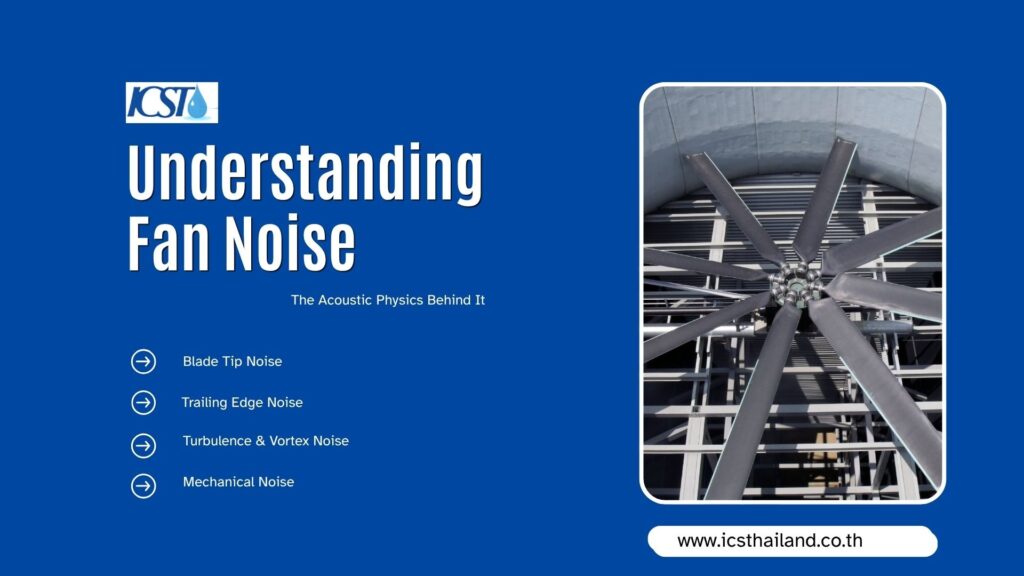
Noise is never random. It is generated by specific aerodynamic mechanisms interacting with the physical environment. By analyzing the physics of sound generation, engineers pinpoint exactly where acoustic energy originates.
Blade Tip Noise (Most Critical Source)
The outermost edge of the fan blade travels at the highest velocity, making it the primary source of aerodynamic sound. As high-pressure air beneath the blade escapes to the low-pressure area above it, a vortex forms. This vortex interacts with the fan cylinder walls.
- Caused by tip vortex formation: The swirling air creates massive pressure differentials that manifest as audible noise.
- Increases with tip clearance and speed: A larger gap between the blade and the casing allows larger vortices to develop.
Addressing blade tip noise significantly reduces the broadband acoustic emissions of the entire system.
Trailing Edge Noise
As air flows over the fan blade and exits the rear edge, it creates a turbulent wake. This wake causes microscopic pressure fluctuations. These fluctuations radiate sound waves outward into the surrounding environment.
- Sound is created by turbulence: As air flows off the trailing edge of the blade, it creates a turbulent wake, which produces sound waves.
- Thicker trailing edges create more noise: A thicker or blunter trailing edge results in a larger and more turbulent wake, increasing noise levels.
- Noise increases with airflow velocity: Higher fan speeds mean faster airflow over the trailing edge, which leads to stronger pressure fluctuations and louder noise.
Trailing edge interaction remains a major noise contributor in high-velocity cooling applications.
Turbulence & Vortex Noise
Airflow entering the fan must remain as smooth as possible. When obstacles disrupt the intake flow, the air hits the blades unevenly. This uneven interaction forces the blades to cut through turbulent pockets.
- Airflow instability around blades: Uneven air distribution causes the blades to flutter aerodynamically.
- Vortex shedding creates broadband noise: The continuous release of small air swirls produces a constant rushing sound.
Mechanical Noise (Secondary Source)
While aerodynamics dominate the acoustic profile, mechanical components also contribute heavily. The physical rotation of the motor and gearbox creates vibrations. These vibrations travel through the rigid supports of the cooling tower.
- Gearbox, motor, and misalignment: Worn gears or improperly aligned drive shafts grind and produce high-frequency whining.
- Vibration transmission: The entire cooling tower basin can act as a giant speaker drum if vibrations are not isolated.
Sound Power vs Sound Pressure: What Engineers Must Measure
Understanding acoustic metrics is critical for proper noise control. Engineers must distinguish between the energy a source creates and the energy a human perceives. This distinction dictates how mitigation strategies are evaluated.
- Sound power (total energy emitted): This metric represents the absolute acoustic energy produced by the fan, independent of the environment.
- Sound pressure (what humans hear): This measures the pressure variations in the air at a specific distance from the source.
- Measurement standards: Engineers use strict ISO and CTI standards to ensure noise data remains accurate and comparable across different equipment.
Effective cooling tower fan noise reduction strategies focus on sound power, not just perceived noise, to guarantee predictable acoustic performance.
Root Causes of Excessive Fan Noise in Cooling Towers
Excessive noise often indicates inefficiency or poor system design. When a fan operates loudly, it wastes energy converting kinetic motion into sound waves rather than airflow.
Effective cooling tower fan noise reduction begins with identifying these root causes, which also prevents long-term equipment degradation.
- High RPM operation: Pushing a fan to spin faster than its optimal design point drastically increases aerodynamic drag and noise.
- Poor blade design: Flat or unoptimized blade profiles chop the air rather than slicing through it smoothly.
- Imbalance or misalignment: Uneven weight distribution on the fan hub causes the entire assembly to shake violently.
- Airflow recirculation: Hot discharge air getting pulled back into the intake creates severe turbulence and thermal inefficiency.
Noise often signals performance inefficiency that requires immediate mechanical correction.
Acoustic Engineering Methods for Cooling Tower Fan Noise Reduction
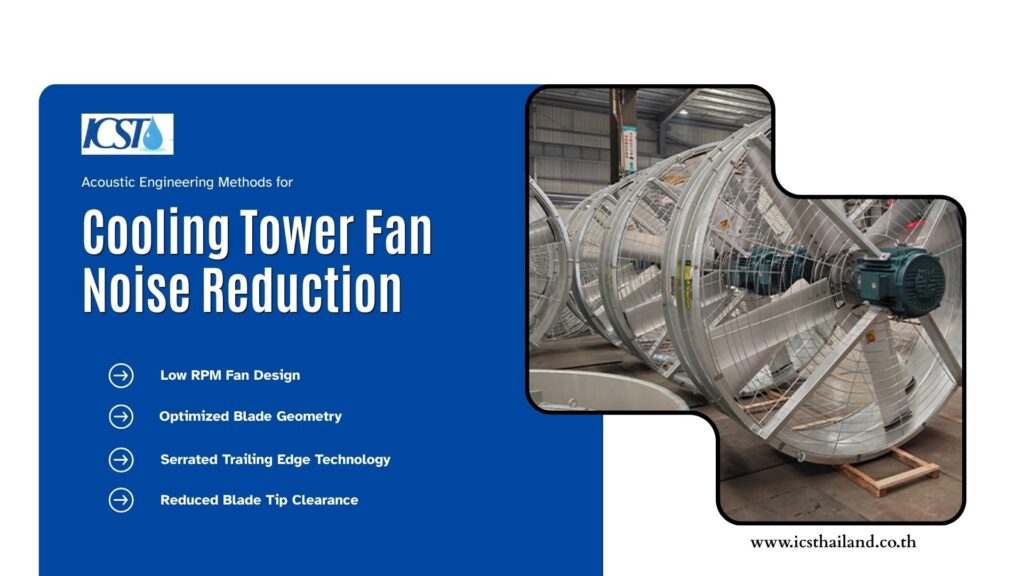
Modern acoustic engineering methods for cooling tower fan noise reduction focus on eliminating sound at the source. Rather than building massive enclosures, engineers manipulate the aerodynamic properties of the fan itself.
This approach yields better efficiency and lower maintenance costs.
Low RPM Fan Design (High Impact)
Slowing down the rotational speed of the fan drastically cuts aerodynamic emissions. A low RPM fan moves the same volume of air by using wider chords and larger diameters.
- Reduces tip speed: Lowering the velocity at the outer edge of the blade prevents violent vortex shedding.
- Significantly lowers noise generation: The acoustic energy drops exponentially as the rotational speed decreases.
Optimized Blade Geometry
The shape of the fan blade dictates how air flows across its surface. Advanced fiberglass and carbon fiber materials allow engineers to mold complex, three-dimensional shapes. These shapes maintain laminar flow across the entire span of the blade.
- Curved blades reduce turbulence: A swept-forward or swept-back design helps the blade slice through the air smoothly.
- Improved aerodynamic efficiency: Better airflow management means the motor works less, reducing overall energy consumption.
Serrated Trailing Edge Technology
Engineers have taken a cue from owl wings for cooling tower fan noise reduction. By adding a serrated pattern to the rear edge of the fan blade, the large, noisy air vortices are broken up into smaller, less disruptive ones.
This small change significantly shifts the acoustic energy into frequencies that are quieter to the human ear.
- Breaks airflow uniformity: The teeth on the trailing edge force the air to mix smoothly rather than shearing violently.
- Reduces vortex shedding noise: Smaller vortices dissipate faster and produce significantly less acoustic pressure.
This modification is proven to reduce broadband noise in modern fan systems.
Reduced Blade Tip Clearance
The gap between the tip of the blade and the inner wall of the fan cylinder acts as a leak path. High-pressure air escapes through this gap, creating a massive noise source. Tightening this tolerance eliminates the leak.
- Minimizes vortex formation: Keeping the air trapped on the working side of the blade prevents the swirling vortex from forming.
- Lowers aerodynamic noise: The elimination of the tip vortex removes the loudest high-frequency component of the fan noise.
Variable Speed Control (VFD Integration)
Cooling demands change based on weather and industrial load. Running a fan at full speed when the cooling demand is low wastes energy and generates unnecessary noise. Integrating a Variable Frequency Drive (VFD) solves this problem.
- Adjusts airflow demand: The VFD slows the fan down during cooler periods or lower production shifts.
- Prevents unnecessary noise spikes: Smooth acceleration and deceleration prevent the sudden roaring associated with direct-on-line motor starts.
Vibration Isolation and Structural Noise Control
Structure-borne noise can amplify sound levels across a facility. The mechanical vibrations from the rotating equipment travel through the steel or concrete supports. Engineers must decouple the moving parts from the stationary structure.
- Anti-vibration mounts: Rubber or spring isolators placed under the motor and gearbox absorb kinetic energy.
- Flexible couplings: Connecting the drive shaft with flexible elements prevents motor vibrations from reaching the gearbox.
- Structural damping: Applying heavy, viscous materials to the cooling tower panels prevents them from ringing like a bell.
Noise Source vs Engineering Solution
Understanding exactly which solution applies to which problem simplifies complex acoustic strategies. Engineers use specific mapping to ensure they do not waste resources on ineffective treatments. This direct correlation guarantees acoustic compliance.
| Noise Source | Root Cause | Engineering Solution |
| Blade tip noise | Vortex formation | Reduce tip clearance, low RPM |
| Trailing edge noise | Airflow turbulence | Serrated trailing edge |
| Turbulence noise | Unstable airflow | Optimized blade design |
| Mechanical noise | Vibration | Isolation mounts, alignment |
| Airflow recirculation | Poor system design | Airflow optimization |
Regulatory Compliance and Noise Limits
Noise is not just technical—it is legal. Facilities face heavy fines and shutdowns if they exceed permitted sound levels at their property lines. Understanding the regulatory landscape is mandatory for industrial operators.
- OSHA limits: Protecting plant workers from hearing loss requires keeping continuous noise exposure below 85 dB(A).
- Environmental noise regulations: Local municipalities strictly govern how much noise can cross into residential or commercial zones.
- Community impact: Excessive noise generates complaints, which lead to costly legal disputes and forced operational changes.
Common Mistakes That Increase Cooling Tower Fan Noise
Many systems fail to meet acoustic targets due to avoidable errors. Maintenance personnel and system designers often overlook basic physical principles. Correcting these mistakes provides immediate acoustic relief.
- Overspeeding fans: Increasing motor speed to compensate for poor cooling performance drastically spikes noise levels.
- Poor maintenance: Failing to lubricate bearings or replace worn belts introduces severe mechanical grinding and slapping.
- Ignoring vibration issues: Leaving unbalance unchecked destroys equipment and radiates low-frequency noise.
- Incorrect fan selection: Installing a fan designed for high pressure in a low-pressure system forces it to operate in a stalled, noisy condition.
Final Insight
The best systems reduce noise through design—not correction. When engineers focus on smooth airflow and mechanical precision, they naturally create a quieter machine. A proactive approach to acoustic engineering yields long-term financial and operational benefits.
Implementing cooling tower fan noise reduction strategies proves that quieter systems are more efficient systems. By utilizing a low RPM fan and adopting a serrated trailing edge, facilities drastically lower their acoustic footprint. Acoustic engineering equals performance optimization.
By reducing sound power at the source and using acoustic barriers, industrial plants ensure regulatory compliance and mechanical reliability. For cooling tower maintenance or repair, contact Industrial Cooling Solutions Thailand today.
Frequently Asked Questions
What causes cooling tower fan noise?
Cooling tower fan noise is primarily generated by aerodynamic factors like turbulence and instability in the airflow. Other major contributors include the formation of vortices at the blade tips and mechanical vibrations originating from the fan’s motor and gearbox, all of which combine to create a significant acoustic footprint.
How can fan noise be reduced in cooling towers?
Fan noise can be effectively reduced by implementing several strategies, such as lowering the fan’s RPM to decrease turbulence. Optimizing the blade design with features like serrated trailing edges and installing physical solutions like acoustic barriers or vibration isolation systems will also significantly mitigate sound output.
What is blade tip noise?
Blade tip noise is a specific type of aerodynamic sound caused by vortex formation in the narrow gap between the moving blade tip and the stationary fan casing. This phenomenon generates high levels of broadband sound, which is a major component of the overall noise profile.
Do serrated fan blades reduce noise?
Yes, serrated trailing edges are highly effective at reducing noise. They work by disrupting the smooth flow of air over the blade, which breaks up the formation of large-scale vortices and vortex shedding. This disruption significantly lowers the aerodynamic noise generated by the fan.
Is low RPM better for noise reduction?
Yes, operating a fan at a lower RPM is one of the most effective methods for noise reduction. Reducing the rotational speed directly decreases the blade tip speed and the intensity of air turbulence, which are primary sources of aerodynamic noise in cooling tower systems.