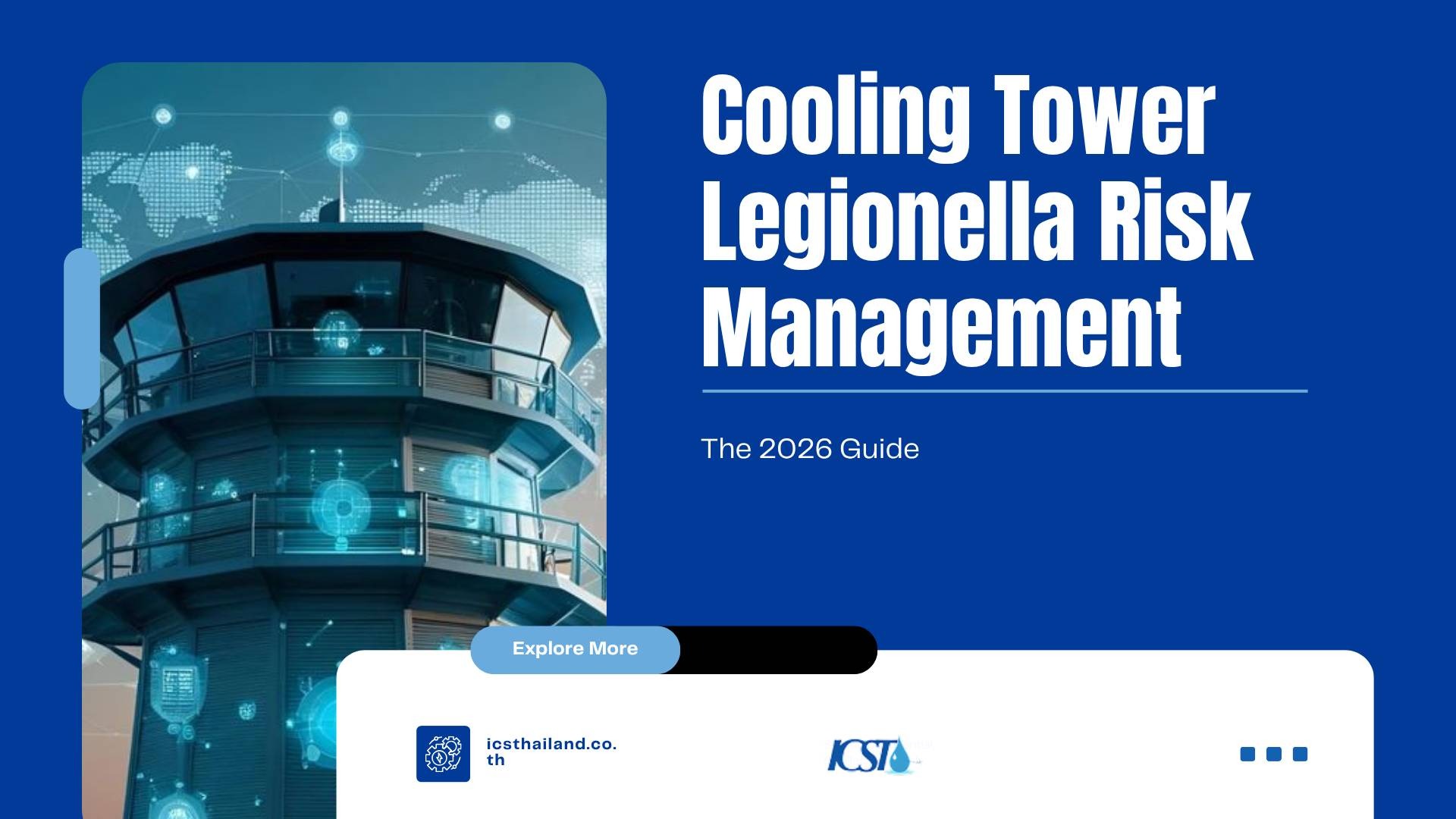
Effective cooling tower Legionella risk management requires continuous automated monitoring and targeted dual-biocide treatments to stop dangerous bacterial outbreaks. In high-humidity environments, traditional manual checks fail to prevent rapid biofilm buildup.
You must implement a data-driven water management plan that actively tracks pH, temperature, and chemical levels in real time. By eliminating stagnant pipe zones and deploying high-efficiency drift eliminators, you guarantee strict industrial compliance. This proactive strategy neutralizes pathogen threats instantly, keeping your employees safe while preventing costly operational shutdowns.
This guide outlines exactly how to protect your facility, your employees, and your community. You will learn why tropical climates require unique strategies, how to engineer a massive safety gap, and what steps to take when you detect an anomaly.
Why Thailand is a “Bio-Incubator.”
Cooling towers operate differently in tropical environments. Standard global protocols often overlook the unique environmental pressures found in regions like Thailand.
The Humidity Penalty
High ambient humidity and year-round temperatures between 25°C and 45°C turn cooling towers into high-growth zones for Legionella. These bacteria thrive in warm water. When the ambient temperature remains elevated throughout the night and winter months, the bacteria never experience a natural die-off period. Your system requires aggressive, continuous management to counter this constant thermal threat.
Nutrient Infiltration
Monsoon-season airborne debris acts as nutrient fuel for biofilm. Strong winds and heavy rains introduce dust, pollen, and silt directly into your cooling water.
- Debris provides a surface for bacteria to attach and multiply.
- Organic matter consumes your oxidizing biocides, leaving the system unprotected.
- Simple filtration is now an industrial necessity, not an optional upgrade.
The Aerosol Vector
Drift eliminators represent your first line of defense against Legionella exposure. These devices capture water droplets before they escape the cooling tower exhaust. If your drift eliminators fail, you are effectively misting your entire site with potential pathogens. Upgrading and maintaining these components prevents contaminated aerosols from reaching human lungs.
Engineering the “Safety Gap”: Beyond Manual Logs
Relying on outdated monitoring techniques leaves your facility vulnerable. Modern risk management requires engineering a safety gap that anticipates problems before they escalate.
The Failure of Quarterly Checks
Relying on manual, periodic testing in the Thai climate is entirely insufficient. A bacterial bloom can occur in a matter of days. Facilities must implement Internet of Things (IoT) technology and real-time monitoring. Tracking Oxidation-Reduction Potential (ORP), pH, and temperature continuously allows operators to adjust chemical dosing the moment water quality degrades.
Designing Against Stagnation
Water must flow continuously to remain safe. You must identify and eliminate “dead legs” in your piping network.
- Dead legs are hidden reservoirs where water stagnates.
- Biofilm blooms rapidly in these undisturbed areas.
- Pathogens eventually migrate from these dead legs into your main cooling loop.
Removing or capping these unused pipe sections eliminates the primary hiding spots for dangerous bacteria.
ASHRAE 188 Alignment
Building a site-specific WMP ensures you meet global safety standards. Your plan must align with ASHRAE 188 guidelines while accounting for your specific environment. The WMP must define clear responsibilities, establish strict control limits, and outline exact corrective actions tailored to your tower’s unique metallurgy and design.
Strategic Risk Management Table
Upgrading your standards requires a clear understanding of the baseline versus the ideal state. The table below outlines the shift from basic compliance to true tropical resilience.
| Component | The “Basic” Standard | The ICST Tropical Resilience Standard |
| Biocide Strategy | Simple Oxidizers (Chlorine) | Dual-Biocide (Oxidizing + Non-Oxidizing) |
| Monitoring | Quarterly Manual Logs | Real-Time IoT Sensors (ORP/Conductivity) |
| Drift Control | Standard PVC Units | High-Efficiency 2026-Spec Eliminators |
| Cleaning | Annual Washout | Bi-Annual “Deep Clean” + Biofilm Analysis |
| Documentation | Paper Logbooks | Centralized Digital Safety Dashboards |
The 2026 Response Protocol: “No Panic, Just Data”
When a water sample tests positive for Legionella, facility teams often react with panic. The 2026 approach replaces panic with a calculated, data-driven response protocol.
Corrective Action vs. Panic
A positive result demands a surgical approach, not an immediate plant shutdown. You must follow a step-by-step technical guide to execute targeted disinfection. This method neutralizes the threat while maintaining critical facility operations. Surgical disinfection saves money and prevents unnecessary operational delays.
System Shocking
Safe offline remediation protocols require precise hyperchlorination. You must elevate halogen levels to penetrate the biofilm and eradicate the bacteria.
- Apply the correct dosage of oxidizing chemicals.
- Circulate the treated water thoroughly.
- Use proper neutralizing agents before discharging the water.
- Conduct secondary testing to confirm complete bacterial clearance.
Root Cause Identification
A positive result should immediately trigger a deeper facility audit. You must determine why the system failed in the first place. Common root causes include biofilm accumulation in heat exchangers, sudden pump degradation, or inconsistencies in biocide residual levels. Identifying the exact failure point prevents the issue from repeating next month.
Liability & Compliance: Protecting Your Assets
Ignoring water safety exposes your company to massive financial and legal risks. Proper management protects your physical assets and your corporate reputation.
TISI & Local Mandates
Navigating the legal landscape of industrial safety in Thailand requires localized knowledge. You must understand and adhere to the Thai Industrial Standards Institute (TISI) requirements. Aligning your protocols with local mandates ensures you pass government inspections without costly fines.
Documenting Longevity
A detailed, digital WMP is your best defense against industrial insurance liability and regulatory scrutiny. Paper logs get lost or damaged. Digital records provide an immutable history of your compliance efforts. If an outbreak occurs in your district, robust documentation proves your facility was not the source.
The ICST Advantage
Choosing the right partner dictates the success of your safety program. Our team combines mechanical expertise in tower repair with chemical expertise in bio-treatment. This combination ensures a holistic safety strategy that standalone water-treatment firms simply cannot match. We fix the physical hardware and optimize the water chemistry simultaneously.
Conclusion: Safety as a Business Metric
Legionella control is not a mere cost center. It is a critical operational investment. A well-managed system minimizes facility downtime, protects your employees, and preserves your company’s reputation.
We provide the auditing, biocide selection, and automated hardware needed to manage your system risk. We ensure full compliance with both global standards and local environmental realities.
Is your cooling tower Legionella risk management plan ready for a 2026 audit? International Cooling Solutions (Thailand) provides comprehensive WMP development, system disinfection, and validation services. Do not wait for a positive test result to take action. Contact our Bangkok team for a risk-mitigation site assessment today.
Schedule Your Legionella Risk Audit
Frequently Asked Questions
What is Legionella risk management for cooling towers?
Effective Legionella risk management prevents dangerous bacterial outbreaks within your facility. We design targeted strategies to monitor and treat water systems, ensuring both safety and industrial compliance. Because cooling towers create ideal conditions for pathogen growth, you must actively manage water chemistry, temperature, and filtration. This continuous oversight keeps your employees safe, minimizes facility downtime, and protects your company from legal liabilities.
Why do cooling towers in a tropical climate need special care?
A tropical climate creates high humidity and year-round warm temperatures, making cooling towers act as continuous bio-incubators. Unlike colder regions, bacteria never experience a natural winter die-off. You must use aggressive biocide treatments and real-time monitoring to stop biofilm growth. Standard maintenance falls short here, requiring specialized plans to maintain industrial compliance and facility safety.
How does a water management plan improve facility safety?
A comprehensive water management plan outlines exactly how to control hazards in your building’s water systems. It defines chemical dosing limits, cleaning schedules, and emergency response protocols. By implementing a data-driven plan, you replace manual guesswork with real-time tracking. This structured approach prevents Legionella outbreaks, extends equipment life, and guarantees strict industrial compliance for your site.
What are the industrial compliance requirements for Legionella control?
Industrial compliance requires facilities to follow strict safety standards like ASHRAE 188 and local regulatory mandates. You must maintain detailed records of your water testing, biocide levels, and overall system maintenance. Upgrading to digital safety dashboards helps you track these metrics accurately. Meeting these legal requirements protects your business from heavy fines while ensuring maximum safety for the community.
What steps should we take if Legionella is detected?
If a test returns positive, immediately consult your water management plan for the surgical disinfection protocol. Do not shut down the plant in a panic. We recommend applying safe offline remediation using precise hyperchlorination to eradicate the bacteria. Afterward, identify the root cause, such as pipe stagnation or biofilm buildup, to prevent future risks and maintain your Legionella risk management goals.