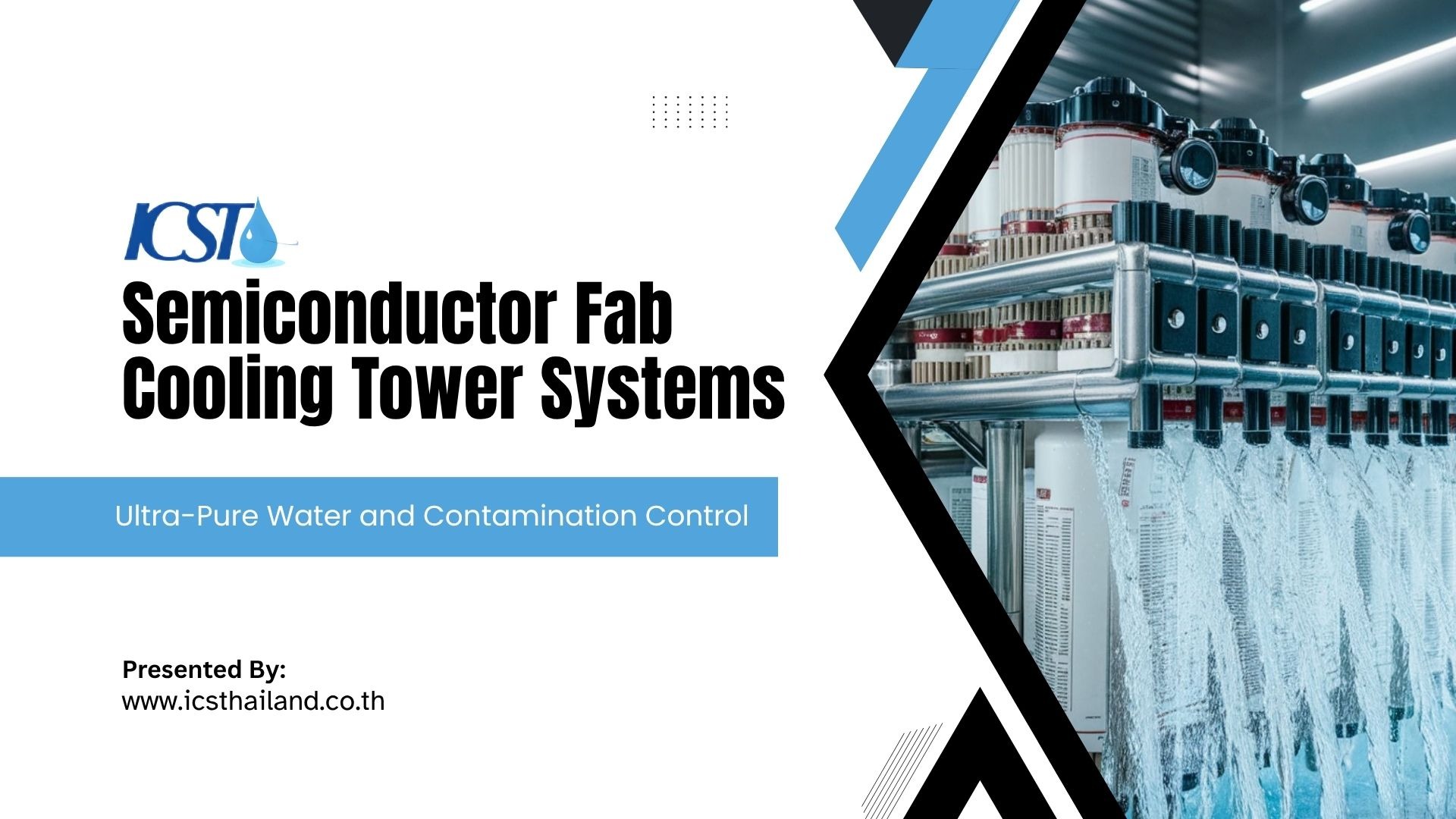
A modern semiconductor fab cooling tower system must deliver highly stable cooling while preventing contamination that could damage semiconductor manufacturing processes. Semiconductor fabs in Thailand and globally rely on strict temperature control, advanced contamination isolation, and reliable fab redundancy systems to protect wafer quality and maintain production uptime.
Unlike standard industrial cooling systems, fabs require isolated cooling loops, ultra-clean heat transfer systems, and continuous monitoring to safeguard ultra-pure water and sensitive process equipment from contamination risks.
Why Semiconductor Cooling Is Different
Precision Manufacturing Requires Stable Cooling
Semiconductor tools run under tight process conditions. Lithography, etching, deposition, cleaning, and metrology steps need predictable temperatures because thermal drift can affect alignment, chemistry, and repeatability.
Wet cooling tower performance also depends strongly on ambient wet-bulb temperature, which means fabs must design control systems that absorb weather changes without disturbing process cooling.
Contamination Can Shut Down Production
A fab treats contamination as a production risk, not a maintenance issue. Particles, minerals, corrosion products, microbes, and silica can disrupt sensitive process tools or contaminate water loops.
Ultra-pure water in semiconductor work often targets extremely low conductivity and high resistivity near 18.18 MΩ·cm at 25°C, which shows how sensitive UPW systems are to ionic contamination.
Downtime Costs Are Extremely High
A single hour of cooling system failure costs a semiconductor facility millions of dollars in lost yield and damaged equipment. Facilities cannot pause production to repair a broken pump or clean a fouled heat exchanger. The cooling infrastructure must run continuously, 24 hours a day, 365 days a year.
Building robust fab redundancy directly into the cooling system prevents catastrophic outages. The most useful strategies include:
- N+1 component design: Facilities install extra pumps and fans to handle sudden mechanical failures.
- Automated failover: Control systems instantly switch to backup units without dropping water pressure.
- Independent power circuits: Backup generators keep cooling systems active during grid power losses.
Ultra-Pure Water Protection: The Core Challenge in Semiconductor Cooling
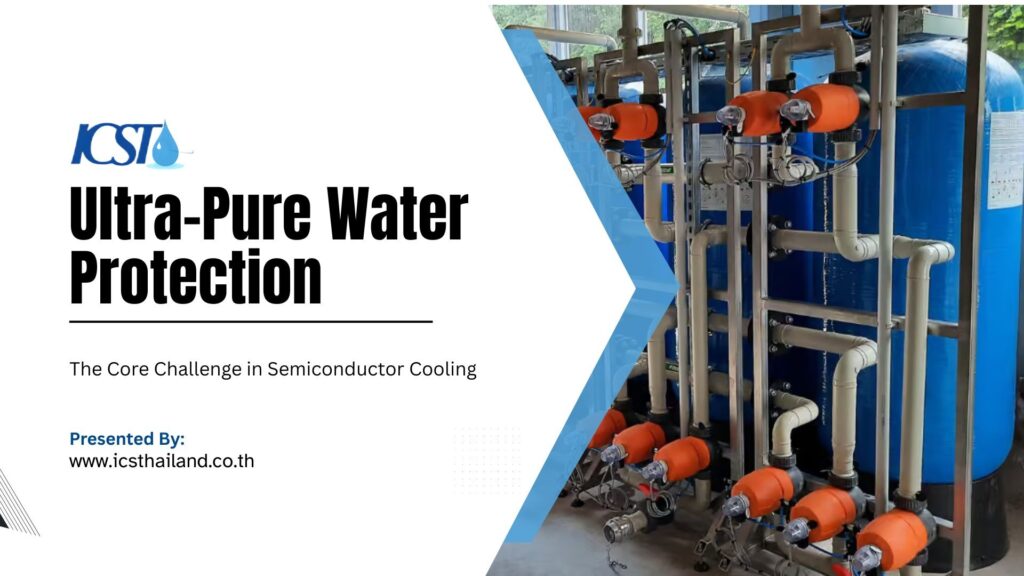
Ultra-pure water protection sits at the center of semiconductor utility design. UPW supports wafer cleaning and other high-purity processes, so it cannot mix with open cooling tower water.
Cooling tower design must protect UPW through physical separation, monitoring, and controlled heat transfer.
What Ultra-Pure Water Actually Means in Semiconductor Fabs
Fabs use ultra-pure water to clean wafers and rinse chemicals during the manufacturing process. This water is an aggressive solvent with no dissolved minerals, organics, or particles. Any contamination, even from treated cooling tower water, can destroy microchip circuits.
Facilities measure ultra-pure water quality using electrical conductivity. The most useful metrics include:
- 18.2 megohm-cm resistance: The theoretical maximum purity level for water used in semiconductor manufacturing.
- Zero particle counts: Laser counters verify the water contains no suspended solids.
- Total Organic Carbon (TOC) limits: Sensors ensure the water remains free from any biological or organic compounds.
Why Ultra-Pure Water Cannot Contact Cooling Tower Water
Cooling tower water contains heavy concentrations of dissolved minerals, dirt, and treatment chemicals. If this water breaches the ultra-pure water system, it instantly destroys the purity levels and ruins the wafer batch. Contamination isolation represents the most critical engineering challenge in fab design.
Fabs employ physical barriers to prevent this mixing. The most useful safety measures include:
- Physical separation: Engineers route tower water pipes far away from cleanroom environments.
- Secondary containment: Double-walled piping catches leaks before they reach sensitive areas.
- Immediate isolation valves: Automated shutoff systems isolate the water loops if sensors detect cross-contamination.
Heat Exchanger Isolation Systems Used in Fab Cooling
Fabs use heat exchangers to transfer heat without mixing fluids. Plate-and-frame systems provide efficient heat transfer and compact size. Double-wall heat exchangers add extra leak protection when cross-contamination risk carries severe consequences.
A good design includes leak detection, pressure management, bypass options, and maintenance access.
Common Ultra-Pure Water Contamination Risks
UPW contamination can come from leaks, poor isolation, tubing issues, instrumentation problems, or maintenance errors. Conductivity or resistivity monitoring helps detect ionic contamination early because resistivity changes quickly when ions enter UPW.
Facilities should monitor corrosion products, silica, biological indicators, particles, total organic carbon, and conductivity/resistivity trends.
Contamination Isolation Strategies Used in Semiconductor Fab Cooling Towers
Multi-Loop Cooling Architectures
In a semiconductor fab cooling tower system, primary, secondary, and tertiary loops are often used. Each loop carries a different contamination risk and cooling duty.
A multi-loop design may separate tower water, condenser water, process cooling water, DI water, and UPW systems through heat exchangers and controls.
Why Closed-Circuit Cooling Towers Are Common in Fabs
Closed-circuit towers keep process fluid inside coils and use external spray water for heat rejection. This reduces contamination risk compared with fully open contact systems.
They still need water treatment and drift control, but they add a valuable physical barrier between process fluid and ambient exposure.
Airborne Contamination Control Around Cooling Towers
Cooling towers discharge moist air and can release drift if eliminators fail or airflow becomes unstable. Semiconductor sites should place towers away from cleanroom air intakes, sensitive exhaust zones, and process-sensitive areas.
Monitoring Systems for Early Contamination Detection
Monitoring must detect contamination before it reaches tools. Fabs should use continuous sensors and alarm thresholds for key water quality values.
Useful monitoring points include:
- Conductivity and resistivity: Detect ionic contamination quickly.
- Particle counts: Track particulate intrusion.
- Silica: Identify scaling and process contamination risk.
- pH: Confirm chemical stability.
- Biological activity: Detect microbiological growth early.
These values help teams act before contamination spreads.
Fab Redundancy: Why Semiconductor Cooling Systems Need N+1 Reliability
Semiconductor Fabs Cannot Tolerate Cooling Downtime
Continuous manufacturing requires a continuous cooling supply. If a fab loses cooling water for even a few minutes, tools overheat, wafers warp, and chemical processes fail. The facility must then undergo a lengthy and expensive restart procedure to recalibrate the cleanroom environment.
Engineers design systems assuming components will fail. The most useful redundancy goals include:
- Zero single points of failure: No single valve, pipe, or pump failure can take down the entire cooling system.
- Concurrent maintainability: Technicians can isolate and repair any piece of equipment without disrupting cooling flow.
- Automated disaster recovery: Systems automatically detect failures and route water through backup infrastructure.
N+1 and 2N Cooling Redundancy Architectures
N+1 adds one extra unit beyond the number required to meet load. 2N creates a fully redundant parallel system. Mission-critical facilities use these models to maintain operation during maintenance or equipment failure.
Fabs choose the level based on process criticality, downtime cost, and risk tolerance.
Backup Pumps, Towers, and Heat Exchangers
A redundant tower without redundant pumps or heat exchangers still leaves weak points. Engineers should review the entire cooling path, not only the tower cells.
Critical redundancy points include:
- Cooling tower cells: Maintain capacity during cell maintenance.
- Condenser pumps: Keep water movement available after pump failure.
- Heat exchangers: Protect process loops during fouling or leakage events.
- Control valves: Prevent single-point flow control failure.
- Instrumentation: Maintain monitoring if one sensor fails.
This system-level approach reduces hidden downtime exposure.
Water Treatment Challenges in Semiconductor Fab Cooling Towers
Why Standard Chemical Treatment Programs May Not Be Acceptable
Standard industrial cooling towers use heavy doses of generic biocides and scale inhibitors. In a semiconductor fab, these harsh chemicals create severe contamination risks if drift enters the cleanroom or a heat exchanger leaks.
Fabs require highly controlled chemical management. The most useful treatment approaches include:
- Non-oxidizing biocides: Chemicals that kill bacteria without accelerating the corrosion of sensitive heat exchangers.
- Traced polymers: Scale inhibitors mixed with fluorescent dyes allow sensors to verify exact chemical concentrations.
- Automated dosing panels: Precise metering pumps inject chemicals based on real-time water conductivity rather than a simple timer.
Controlling Biological Growth Without Risking Process Contamination
Cooling towers act as massive air scrubbers, pulling bacteria and algae spores into warm, oxygen-rich water. If biofilm forms inside the heat exchangers, it severely degrades heat transfer and causes process instability.
Operators must destroy biological growth without using chemicals that could breach the contamination isolation boundaries.
Silica and Mineral Control in Cooling Systems
High evaporation rates concentrate dissolved minerals in the cooling tower basin. Silica, naturally present in many water supplies, forms an incredibly hard glass-like scale inside heat exchangers when it concentrates. Removing silica scale often requires harsh acid cleaning or complete equipment replacement.
Common Cooling Tower Problems That Damage Semiconductor Operations
Drift Carryover and Airborne Contamination
Drift can carry minerals, treatment chemicals, and biological material into nearby air. Poor siting can increase the risk if discharge moves toward cleanroom intake zones.
High-efficiency drift eliminators and proper tower location reduce this risk.
Heat Exchanger Fouling and Reduced Thermal Transfer
Fouled heat exchangers reduce the temperature difference available for process cooling. This can push tools closer to alarm limits and increase chiller energy demand.
Routine cleaning and differential temperature monitoring help detect fouling early.
Biofilm Formation Inside Cooling Loops
Biofilm insulates heat transfer surfaces, restricts flow, and creates microbiological risk. It can also shelter organisms from treatment chemicals.
A strong monitoring and treatment program helps reduce this risk.
Semiconductor Fab Cooling Tower Design Standards and Engineering Practices
ASHRAE and CTI Cooling Standards
Semiconductor engineers design cooling systems using strict guidelines from the American Society of Heating, Refrigerating and Air-Conditioning Engineers (ASHRAE) and the Cooling Technology Institute (CTI). These organizations define the exact testing methods required to guarantee a cooling tower will deliver its rated thermal capacity.
Adhering to standards ensures reliable performance. The most useful compliance practices include:
- CTI Thermal Certification: Engineers only specify towers that have passed independent CTI thermal performance tests.
- ASHRAE 90.1 energy compliance: Facilities design cooling loops to meet strict energy efficiency regulations.
- Standardized vibration limits: Specifications dictate maximum allowable fan vibration to prevent structural fatigue.
Cleanroom Environmental Control Coordination
The cooling tower infrastructure must integrate seamlessly with the cleanroom’s HVAC system. The cleanroom requires massive amounts of chilled water to maintain strict temperature and humidity parameters. The BAS must coordinate the cooling towers, chillers, and cleanroom air handlers as one unified system.
Integrated control prevents environmental instability. The most useful coordination strategies include:
- Chilled water reset scheduling: The BAS adjusts the chilled water temperature based on the real-time humidity load in the cleanroom.
- Bypass valve integration: Air handlers automatically bypass chilled water to prevent over-cooling the cleanroom.
- Centralized alarm management: Cooling tower alarms instantly notify the cleanroom operators of potential temperature deviations.
Water Quality Compliance Requirements
Fabs must comply with strict environmental regulations regarding cooling tower blowdown. The water discharged into the municipal sewer cannot contain toxic heavy metals or excessive biocides. Facilities must design treatment programs that protect the equipment while remaining environmentally compliant.
Compliance protects the facility’s operating license. The most useful compliance practices include:
- Zero Liquid Discharge (ZLD) integration: Advanced fabs treat and reuse their cooling tower blowdown rather than dumping it in the sewer.
- Non-heavy metal inhibitors: Phasing out zinc and molybdate treatments in favor of environmentally friendly polymers.
- Automated discharge logging: The BAS records the exact volume and pH of all water discharged to prove regulatory compliance.
Critical Cooling Parameters in Semiconductor Fabs
Semiconductor facilities maintain much stricter cooling standards than traditional industrial plants. The table below outlines how specific parameters dictate facility reliability and prevent contamination.
| Cooling Parameter | Typical Fab Requirement | Industrial Standard | Monitoring Method | Operational Risk if Uncontrolled |
| UPW Conductivity | 18.2 megohm-cm | N/A | In-line resistivity sensors | Irreversible wafer contamination |
| Approach Temperature | ± 1.0°F stability | ± 3.0°F stability | BAS thermistor trending | Yield reduction & tool alarms |
| Particle Counts | Zero particulate | Varies by application | Optical laser counters | Wafer defects & circuit shorts |
| Redundancy Capacity | N+1 or 2N isolated | N (No backup) | System simulation logic | Complete production shutdown |
| Drift Loss | < 0.001% of flow | 0.005% of flow | Mechanical eliminator checks | Cleanroom HVAC contamination |
Conclusion
A modern semiconductor fab cooling tower system requires more precision, isolation, and reliability than a standard industrial cooling tower. Semiconductor fabs must protect ultra-pure water, stabilize DI water cooling, maintain strict temperature control, and prevent contamination from open cooling tower water, drift, particles, minerals, and biological growth.
Strong contamination isolation, heat exchanger barriers, closed-loop architectures, continuous monitoring, CTI-verified thermal performance, and N+1 or 2N fab redundancy help facilities protect wafer yield and production uptime.
As fabs expand and water pressure increases, the best cooling systems will combine thermal efficiency, water conservation, predictive controls, and ultra-low contamination engineering.
Frequently Asked Questions
What is a semiconductor fab cooling tower system?
A semiconductor fab cooling tower system rejects heat from chillers, condenser water loops, process cooling systems, and facility utilities that support wafer production. It usually works indirectly through isolated loops and heat exchangers. Fab cooling systems need stricter contamination control, temperature stability, monitoring, and redundancy than standard industrial cooling towers.
Why must ultra-pure water stay isolated from cooling tower water?
Ultra-pure water must stay isolated because cooling tower water contains minerals, treatment chemicals, airborne particles, corrosion products, and biological risk. UPW systems often target extremely low conductivity and high resistivity near 18.18 MΩ·cm at 25°C. Even small contamination changes can create process risk in semiconductor manufacturing.
How do cooling towers affect DI water cooling?
Cooling towers affect DI water cooling indirectly through chillers, heat exchangers, and secondary loops. If the tower loses efficiency, condenser water temperature can rise and reduce cooling stability. This can cause tool supply temperature drift, higher chiller energy use, and process control problems.
Why do semiconductor fabs use contamination isolation?
Fabs use contamination isolation to separate open cooling tower water from clean process loops, DI water systems, and UPW systems. Isolation reduces the risk of minerals, biofilm, silica, particles, and chemical contamination entering sensitive loops. Heat exchangers, closed-circuit systems, monitoring, and pressure control support this strategy.
What redundancy level do semiconductor cooling systems need?
Many semiconductor facilities use N+1 or 2N-style fab redundancy for critical cooling systems. N+1 adds one spare unit beyond required capacity, while 2N provides a fully redundant parallel system. The correct level depends on downtime cost, process criticality, maintenance needs, and site reliability goals.