Cooling tower digital twin implementation helps industrial facilities in Thailand create a live virtual model of their industrial cooling towers. Teams compare real operating data against a validated performance curve to ensure continuous efficiency.
This setup allows engineers to execute early fouling detection for scaling, airflow loss, or equipment wear. By using smart sensors, analytics, and machine learning, the digital model flags abnormal performance instantly. It then triggers an automated work order before minor efficiency loss becomes critical downtime, higher energy use, or an emergency repair.
What Is a Cooling Tower Digital Twin?
A cooling tower digital twin is a live digital representation of a physical cooling tower. It uses real sensor data, operating history, weather data, and engineering logic to estimate how the tower should perform under current conditions.
This virtual model mirrors a physical cooling tower regarding thermal, mechanical, and water-treatment performance. It compares actual data with expected performance so operators can catch issues early.
Digital Twin vs Dashboard
A dashboard simply displays data on a screen. A digital twin interprets that data against a mathematical baseline.
A dashboard may show a high-water temperature alarm. A digital twin shows whether that exact temperature is normal for the current wet-bulb temperature, process load, and water flow.
Digital Twin vs Traditional Inspection
Traditional inspection shows the tower condition at one specific point in time. A digital twin tracks the condition continuously every minute of the day.
Inspections still matter greatly because digital models need physical validation. The best maintenance system combines continuous digital monitoring with expert field service.
Why Cooling Tower Digital Twin Implementation Matters in Thailand
Thailand’s industrial base depends on reliable process cooling. Plants in Rayong, Chonburi, Bangkok, the Eastern Economic Corridor, and other industrial zones often run cooling towers for production, utilities, data centers, food processing, electronics, chemicals, petrochemicals, and power systems.
Thailand’s digital direction makes this topic more relevant. The U.S. International Trade Administration says Thailand 4.0 aims to make Thailand a leading digital hub in Southeast Asia and to encourage new technologies and digital innovation.
The Thailand BOI’s smart and sustainable industry material also supports upgrades toward Industry 4.0 and smarter manufacturing systems.
Where Digital Twins Fit in Thai Industrial Sites
Digital twins fit sites where cooling tower performance affects uptime, energy cost, water use, or production quality. Thailand’s climate increases the need for weather-normalized analysis because high humidity can reduce evaporative cooling capacity.
Thailand has also attracted major digital infrastructure investments. Reuters reported that Thailand approved $3.1 billion in data center investments in November 2025, and $2.7 billion.
Digital twin use cases fit many Thai sites:
- Rayong industrial plants: Petrochemical, process cooling, and heavy industry.
- Chonburi manufacturing facilities: Automotive, electronics, and export manufacturing.
- Bangkok commercial campuses: District cooling, large buildings, and mixed-use facilities.
- Eastern Economic Corridor facilities: Smart manufacturing and high-tech production.
- Data centers: Energy-efficient cooling and uptime protection.
- Power and process plants: Predictive maintenance and thermal reliability.
A digital twin aligns with Thailand’s smart industry direction when teams use it to improve uptime, reduce energy waste, and plan maintenance with real performance data.
How a Cooling Tower Digital Twin Works
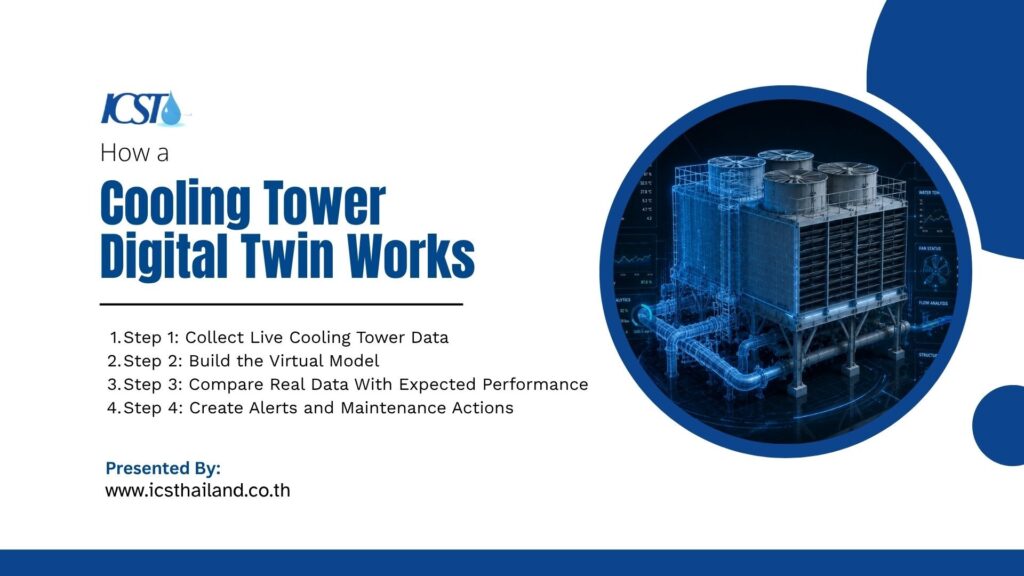
A digital twin works by collecting live operating data and comparing it with a baseline model. It detects abnormal deviation instantly and recommends immediate action.
Step 1: Collect Live Cooling Tower Data
A strong virtual model requires accurate physical inputs from the field.
- Hot water temperature: Measures the heat load entering the tower.
- Cold water temperature: Measures the actual cooling output.
- Ambient wet-bulb temperature: Determines the theoretical cooling limit.
- Water flow rate: Tracks the volume of water moving through the fill media.
Step 2: Build the Virtual Model
The virtual model represents exactly how the tower should perform under perfect conditions. It uses original design data, historical operating data, weather data, load data, and physical inspection findings.
The model relies on thermal equations, manufacturer curves, and historical baselines. Advanced systems also use machine learning predictions to refine accuracy.
Step 3: Compare Real Data With Expected Performance
The model calculates the expected cold water temperature, approach, range, and thermal effectiveness. Operators then compare real tower performance against these calculated expected values.
A gap between real and expected data shows performance loss or an abnormal condition.
Step 4: Create Alerts and Maintenance Actions
Alerts should not only show a generic high-temperature warning. Good alerts explain the most likely root causes.
The system can suggest physical inspection, cleaning, water treatment correction, fan checks, or nozzle inspections. Strong systems push the task directly into a maintenance system as an automated work order.
Using Performance Curves to Detect Cooling Tower Drift
A performance curve shows exactly how a cooling tower should perform under specific flow, load, and ambient conditions. The digital twin uses this curve as a strict mathematical baseline.
When a cooling tower operates outside the bounds of its performance curve, efficiency drops. The system measures approach temperature, range, effectiveness, and fan speed to find discrepancies.
What Performance Drift Looks Like
Performance drift often appears gradually. Operators may not notice it until production complains or the chiller plant consumes more energy.
Common drift signs include:
- Cold water temperature rises above expected values
- Approach temperature increases
- Fan energy rises without better cooling
- Water distribution becomes uneven
- Chemical use increases without production changes
- More cells must run to meet the same load
- High-temperature alarms repeat more often
These symptoms show why digital twin monitoring can catch problems earlier than manual rounds alone.
Why Weather Normalization Matters
A hot day does not always mean poor performance. A tower may produce warmer cold water because the wet-bulb temperature increased, not because the equipment failed.
A digital twin should normalize performance by wet-bulb temperature, load, fan speed, and water flow. This reduces false alarms and helps maintenance focus on real problems.
Fouling Detection With a Cooling Tower Digital Twin
Fouling detection is one of the strongest and most valuable use cases for a cooling tower digital twin. Fouling comes from scale, biological growth, sediment, or blocked water distribution.
Common fouling sources include scale buildup on fill media, biofilm growth, sediment in the basin, and clogged spray nozzles.
Early Signs of Fouling in Digital Data
Catching fouling early prevents massive chemical and mechanical cleaning costs. Watch for these digital indicators.
- Higher approach temperature: Indicates the fill media cannot transfer heat properly.
- Increasing fan energy: Shows the system is forcing more air to overcome blocked fill.
- Uneven cell performance: Highlights that one section of the tower has blocked nozzles.
Why Field Inspection Still Matters
A digital twin shows abnormal performance, but a technician confirms the physical cause. A technician must inspect fouled fill, blocked nozzles, basin sludge, drift eliminator damage, or fan issues.
Digital checks and physical checks must support each other continuously.
How Machine Learning Improves Cooling Tower Digital Twins
Machine learning can improve prediction accuracy when the tower has enough clean historical data. It can find patterns that simple threshold alarms miss.
A 2026 HVAC+R digital twin review identifies performance monitoring, fault detection and diagnosis, and control optimization as key digital twin services, which supports the use of hybrid models that combine engineering logic and data-driven predictions.
Machine Learning Needs Good Data
Machine learning cannot fix broken or poorly placed sensors. The mathematical model needs highly calibrated data to function.
Maintenance events must be logged accurately. False alarms require monthly reviews so the algorithm learns to ignore them.
Physics-Based Model vs Machine Learning Model
Different models serve different purposes depending on the facility capabilities.
- Physics-based model: Uses heat-transfer equations and is very easy to explain and validate.
- Data-driven model: Learns from historical operating data and captures real plant patterns.
- Hybrid model: Combines engineering rules and machine learning for the best real-world results.
Cooling Tower Digital Twin Implementation Roadmap
Implementing a digital twin requires a structured, phased approach. You must walk through these steps carefully.
- Phase 1: Audit the physical cooling tower condition before modeling.
- Phase 2: Identify required data points and map all sensors.
- Phase 3: Clean historical data and remove missing values.
- Phase 4: Build the expected performance baseline using weather normalization.
- Phase 5: Validate the performance curve against real tower checks.
- Phase 6: Add fouling detection rules for early abnormal condition alerts.
Cooling Tower Digital Twin Implementation Comparison Table
Understanding the difference between basic tools and advanced digital twins helps secure management buy-in. Review this table to understand the core differences.
| Factor | Basic Monitoring | Cooling Tower Digital Twin | Best For | Expert Recommendation |
| Data use | Shows live readings | Compares live data with a virtual model | Plants with repeated performance issues | Use digital twins when decisions need context |
| Performance curve | Rarely included | Tracks expected vs actual performance | Towers with variable load and weather | Normalize by wet-bulb temperature and flow |
| Fouling detection | Relies on manual inspection | Detects performance drift early | Towers with scale, sediment, or biofilm risk | Combine model alerts with field inspection |
| Machine learning | Not used or limited | Learns patterns from historical data | Sites with clean, stable data history | Add ML after sensor reliability improves |
| Automated work order | Manual maintenance request | Alert creates CMMS task | Large plants and multi-tower sites | Define action rules before automation |
Common Mistakes in Cooling Tower Digital Twin Implementation
Many digital twin projects fail because teams buy software before fixing data, sensors, inspection routines, and maintenance workflows.
Starting without a physical cooling tower inspection guarantees a flawed baseline model. Using uncalibrated sensors feeds bad data into the algorithms. Ignoring wet-bulb temperature makes accurate load normalization completely impossible. Adding machine learning before collecting clean data causes algorithm failure.
Cost and ROI Factors for Cooling Tower Digital Twins
The cost of a digital twin depends on tower size, sensor coverage, integration complexity, software platform, data quality, and CMMS connection.
Return on investment drivers include reduced downtime, lower fan and pump energy usage, and earlier fouling detection. Better water treatment control lowers chemical costs, and early intervention lowers emergency repair costs.
How ICST Can Support Cooling Tower Digital Twin Projects
A successful digital twin needs cooling tower engineering before software modeling. ICST can support industrial facilities by inspecting the physical tower, identifying performance problems, reviewing components, and validating the performance baseline.
ICST should work as an engineering and service partner for the field side of implementation. The model needs accurate tower condition data, and field technicians need clear findings to act on.
ICST support can include:
- Cooling tower inspection
- Thermal performance review
- Cooling tower maintenance
- Cooling tower replacement planning
- Cooling tower parts support
- Fan, motor, gearbox, fill media, and nozzle inspection
- Disaster recovery and upgrade planning
- Sensor placement recommendations
- Field support across Thailand and Asia
This field support helps connect digital findings with real repairs, upgrades, and maintenance planning.
Conclusion
Cooling tower digital twin implementation creates a highly accurate, live virtual model of your industrial cooling equipment. The model compares real data with the expected performance curve to ensure maximum efficiency. Advanced fouling detection helps catch scale, biofilm, sediment, and water-distribution issues early. Machine learning improves these predictions after data quality becomes strong.
Ultimately, an automated work order turns software alerts into immediate maintenance action. Thailand’s industrial sites benefit greatly from this technology, and ICST provides the necessary field engineering side of implementation.
Frequently Asked Questions
What is cooling tower digital twin implementation?
Cooling tower digital twin implementation is the process of creating a live virtual model of a physical cooling tower. The model uses sensor data, weather conditions, operating history, and design information to compare actual performance with expected performance. It helps teams detect fouling, scaling, airflow problems, and equipment wear early.
How does a cooling tower digital twin use a performance curve?
A cooling tower digital twin uses a performance curve to estimate how the tower should perform under current load, flow, and weather conditions. It compares expected cold water temperature with real-time data. If the actual tower performs worse than the curve predicts, the system flags performance issues.
Can machine learning detect cooling tower fouling?
Yes, machine learning supports fouling detection when the system has clean sensor data and enough historical operating records. It learns normal tower behavior and identifies abnormal patterns linked to scale or biofilm. However, machine learning works best when technicians confirm findings through physical field inspection.
What data is needed to build a cooling tower virtual model?
A cooling tower virtual model needs hot and cold water temperatures, wet-bulb temperature, dry-bulb temperature, water flow, fan speed, and pump status. Strong models also use design data, inspection reports, water-treatment records, and weather data. Better data quality creates far more reliable predictive alerts.
How does an automated work order help cooling tower maintenance?
An automated work order helps maintenance teams act quickly when the digital twin detects abnormal performance. Instead of leaving an alert on a dashboard, the system creates a formal task in the maintenance workflow. The work order tells technicians exactly what to inspect or repair immediately.
Is a cooling tower digital twin useful for industrial facilities in Thailand?
Yes, a digital twin helps Thai industrial facilities improve uptime, energy performance, water control, and maintenance planning. The hot and humid climate makes cooling tower performance highly sensitive to weather changes. Digital twins support power plants, chemical plants, and data centers moving toward smart industry goals.