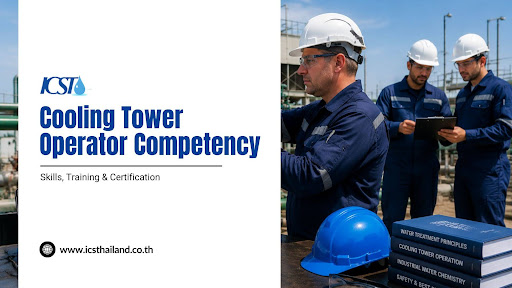
Cooling tower operator competency means an operator can run, inspect, monitor, and document a cooling tower safely under real site conditions. A strong framework combines operator training, field practice, competency assessment, refresher learning, and a complete logbook.
Technical modules may reference CTI training concepts such as thermal performance, testing, and tower terminology. Operators also need mechanical, water-treatment, safety, and Legionella awareness skills. Competency should be proven through observed tasks, records, and supervisor sign-off, not classroom attendance alone.
Why Operator Competency Decides Cooling Tower Reliability
Cooling towers often work in the background until something goes wrong. Performance drops, biological growth appears, noise increases, or a mechanical fault shuts down production. By that point, the cost is already high.
Strong cooling tower operator competency protects the whole facility. It supports uptime, controls water safety, and keeps records clean for audits.
Here is why this skill set matters so much across industrial and commercial sites:
- Plant reliability: A poorly run tower raises process temperature and threatens production uptime.
- Hidden performance loss: Untrained operators miss early signs of fouling, airflow loss, and rising approach.
- Water safety: Poor monitoring lets scale, corrosion, and biofilm grow, which raises Legionella awareness concerns.
- Audit protection: A complete logbook proves monitoring happened and protects the site during reviews.
- Tropical demand: Heat and humidity in Thailand increase biological and maintenance pressure year-round.
For sites across Thailand and Asia, ICST (International Cooling Solutions Thailand) supports inspection, training, parts, maintenance, and upgrades to keep these standards high.
What Does Cooling Tower Operator Competency Mean?
Cooling tower operator competency means the proven ability to operate, inspect, monitor, document, and respond to cooling tower conditions safely and correctly.
Competency is not a certificate on a wall. It is real skill, shown through field tasks and verified by a supervisor.
What a Competent Operator Should Be Able to Do
A competent operator handles routine work and abnormal conditions with the same confidence. The goal is action, not memory. The skills below separate a true operator from a button-pusher.
- Identify the tower: Name the cooling tower type and major components on site.
- Explain the role: Describe how the tower supports the process or HVAC system.
- Read operating data: Record hot water, cold water, and basin readings correctly.
- Spot trouble: Recognize abnormal temperature, vibration, noise, water level, drift, fouling, and leaks.
- Inspect and record: Complete routine inspections and log every reading.
- Escalate fast: Report unsafe or abnormal conditions without delay.
Why Competency Matters for Cooling Towers
Cooling towers serve industrial plants, commercial buildings, data centers, power plants, and process facilities. Each one depends on stable heat rejection. A small problem in the tower can ripple across the whole operation.
Operators act as the first line of defense. They catch issues before they turn into expensive shutdowns. That early action is the core value of strong operator training.
These points show how operator skill connects directly to cost and risk:
- Production impact: Tower performance controls process temperature and uptime.
- Approach signals: A small rise in approach temperature can signal fouling or airflow loss.
- Water risk: Poor water treatment leads to scale, corrosion, biofilm, and biological growth.
- Mechanical risk: Fan, gearbox, motor, and drive faults cause unplanned shutdowns.
- Audit gaps: Poor records make troubleshooting and audits much harder.
The U.S. Centers for Disease Control and Prevention (CDC) notes that scale, corrosion, sediment control, system cleaning, and disinfectant residual monitoring are critical for cooling tower operation and Legionnaires’ disease prevention.
Core Performance Skills Every Operator Needs
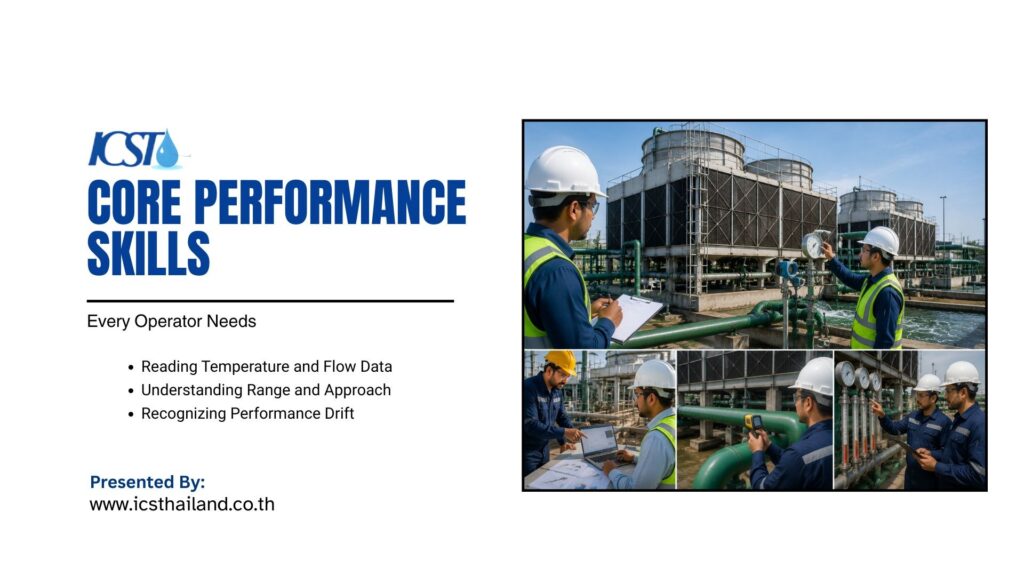
Performance skills turn raw readings into useful decisions. An operator who understands the numbers can flag a problem days before it forces a shutdown.
Reading Temperature and Flow Data
Operators must consistently record data to ensure trend analysis is meaningful. This involves tracking the hot water temperature entering the tower and the cold water temperature leaving the basin. Any readings that drift outside the normal range should be flagged as potential issues.
Understanding Range and Approach
Range and approach are crucial for understanding cooling tower performance and can reveal hidden issues before alarms are triggered. The range is the water’s temperature drop across the tower, while the approach is the gap between the cold water and wet-bulb temperatures.
A rising approach often indicates problems like fouling or poor airflow, so it’s vital to report any increase immediately.
Recognizing Performance Drift
Performance rarely fails all at once; it drifts slowly, and trained eyes can catch the pattern. Key signs of this drift include higher cold water temperatures, a reduced range, a rising approach, and increased fan energy use. Spotting these changes early saves energy and prevents bigger failures down the line.
Mechanical Inspection Skills
Operators do not always repair equipment. They must, however, spot early warning signs and escalate them before a small fault becomes a failure.
What Operators Should Inspect
A weekly inspection route keeps mechanical issues visible. Each item below points to a common failure source that operators can catch early.
- Fan and stack: Blade condition, vibration, and fan stack damage.
- Drive train: Motor noise and temperature, gearbox oil level and leaks, drive shaft alignment, couplings, and bearings.
- Structure: Loose guards or panels, basin leaks, and corrosion.
- Heat transfer: Fill damage, drift eliminator condition, and nozzle spray pattern.
- Air and access: Louvers, air inlets, ladders, and platforms.
Mechanical Warning Signs
Some signs demand fast action. Ignoring them often leads to motor burnout, gearbox failure, or a full shutdown.
- New vibration or unusual noise.
- Oil leaks or a burning smell.
- Fan imbalance or excessive drift.
- Sudden temperature rise or reduced airflow.
- Loose bolts, broken fill, or repeated motor trips.
The Cooling Technology Institute (CTI) publishes resources on cooling tower vibration limits, including mechanical sources such as fan rotational speed and drive motor speed. This reinforces why vibration awareness belongs in every operator training plan.
Water Treatment and Water Safety Skills
Operators usually work alongside water-treatment specialists. Even so, they must understand what they monitor and why it matters.
Water Quality Readings Operators May Track
Water readings reveal scale, corrosion, and biological risk before damage appears. Consistent records help water-treatment partners adjust the program.
- Chemistry: pH, conductivity, makeup water conductivity, and blowdown conductivity.
- Biological control: Biocide residual and signs of biofilm or algae.
- Physical condition: Water temperature, turbidity, basin condition, scale, corrosion, and sediment.
- Dosing system: Chemical tank levels and dosing pump status.
Understanding Cycles of Concentration
Cycles of concentration balance water use against scale and corrosion risk. A low concentration wastes water and chemicals, while a high concentration increases the risk of scale and corrosion..
Why Legionella Awareness Is Essential
Legionella awareness protects people, not just equipment. Cooling towers can support Legionella growth when control measures slip.
- Warm water, sediment, biofilm, and poor disinfectant control raise the risk.
- Operators must know the facility’s water management plan.
- Operators should record readings and report missed control limits quickly.
- Operators should never treat biological risk as a paperwork-only task.
The CDC states that Legionella can grow and spread in open and closed-circuit cooling tower systems. Its guidance highlights disinfectant residual monitoring and system cleaning as important control measures.
Safety Skills for Cooling Tower Operators
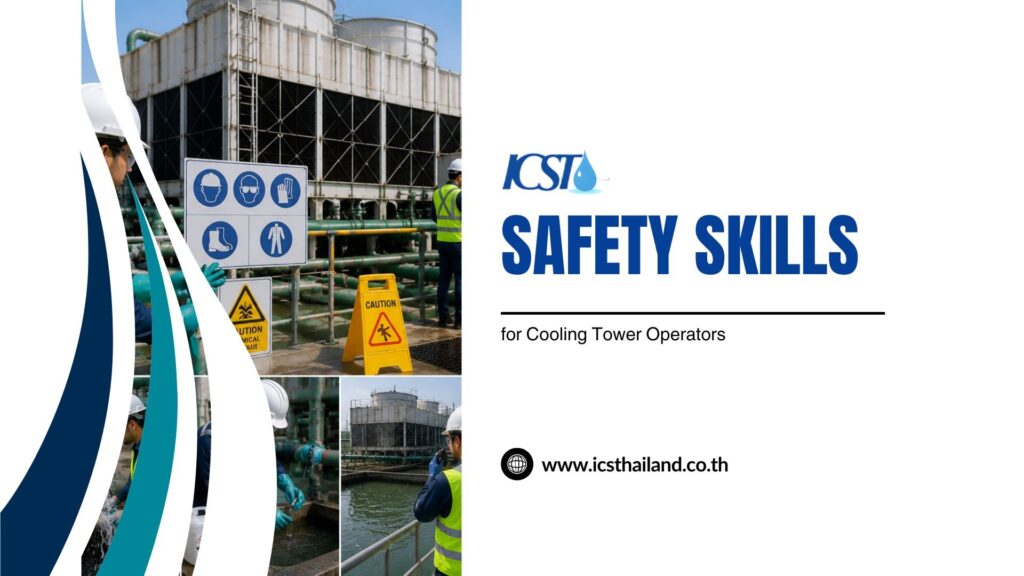
Competency must include personal safety, not only technical knowledge. A skilled operator who ignores safety puts the whole team at risk.
Core Safety Topics
Safety habits protect operators around chemicals, height, electricity, and rotating equipment. These topics belong in every training program.
- Energy control: Lockout tagout before any mechanical work.
- Personal protection: Correct PPE and fall protection for tower access.
- Safe access: Care around the basin, deck, ladders, and platforms.
- Hazard awareness: Chemical handling, confined spaces, hot surfaces, and electrical risks.
- Emergency readiness: Slip and trip control, biological precautions, and emergency shutdown steps.
- Permits: Permit-to-work procedures for higher-risk tasks.
When Operators Must Stop and Escalate
Some conditions mean an operator should stop work and call for help. Quick escalation prevents injuries and major damage.
- Unsafe access or missing guards.
- Severe vibration or a chemical spill.
- Fan failure, basin overflow, or strong biological growth.
- A suspected Legionella risk event or uncontrolled leaks.
- Electrical faults or unusual noise after restart.
Cooling Tower Operator Competency Framework
A framework turns scattered skills into a clear standard. The table below helps managers map each skill to a task, proof of competence, and a refresher trigger. Use it to build a fair and repeatable program.
| Competency Area | What the Operator Must Know | Practical Task | Assessment Evidence | Refresher Trigger |
| Tower fundamentals | Tower type, airflow, water flow, heat rejection | Identify major components on site | Supervisor observation | New tower or system change |
| Thermal performance | Range, approach, temperature trends | Calculate range and flag abnormal readings | Worksheet and logbook review | Repeated high cold water temperature |
| Mechanical inspection | Fans, motors, gearboxes, fill, nozzles | Complete weekly inspection route | Signed inspection checklist | Mechanical failure or abnormal vibration |
| Water treatment awareness | pH, conductivity, biocide, blowdown | Take and record routine readings | Water-treatment log review | Missed control limits |
| Legionella awareness | Biofilm, sediment, residuals, cleaning | Identify risk conditions during inspection | Scenario-based assessment | Plan update or audit finding |
| Safety procedures | PPE, lockout tagout, access rules | Demonstrate safe isolation steps | Practical observation | Incident, near miss, or contractor change |
| Documentation | Logbook, corrective actions, handover | Complete a sample shift log | Record audit | Poor record quality |
How to Build an Operator Training Program
A framework only works when it becomes a real program. Good operator training mixes classroom learning with hands-on field practice.
Training Modules to Include
Each module should map to a competency area. This keeps training focused and easy to assess.
- Cooling tower basics and site-specific layout.
- Thermal performance readings and mechanical inspection.
- Water-treatment monitoring and Legionella awareness.
- Safety procedures and emergency response.
- Logbook and documentation, plus maintenance escalation.
- Contractor coordination and shutdown or restart procedures.
How CTI Knowledge Fits Into Training
The Cooling Technology Institute (CTI) is a major cooling tower technical body known for testing, technical resources, and product certification. Note one key point clearly: CTI training and CTI STD-201 certification apply to cooling tower product thermal performance, not individual operator licensing.
Practical Ways to Use CTI Concepts
CTI concepts strengthen operator knowledge and improve communication with engineers and vendors. Use them as learning support, not as an operator license.
- Cooling tower terminology and thermal performance basics.
- Acceptance testing awareness and certified tower performance understanding.
- Vibration, drift, and sound testing awareness where relevant.
- Clearer communication with engineers, vendors, and testing agencies.
Avoid This Common Mistake
Do not label someone a “CTI certified operator” unless a specific recognized operator certification exists and applies to that person. A safer and accurate phrase is this: operator training should include CTI-aligned cooling tower terminology, thermal performance concepts, and awareness of CTI testing and certification programs.
Training Needs for Thailand and Tropical Climates
Operators in Thailand and other tropical regions face year-round heat, humidity, rainfall, and biological growth. These conditions raise both maintenance and water safety demands.
Topics to Emphasize in Tropical Sites
Tropical climates push towers harder than temperate ones. Training should reflect that local reality.
- High wet-bulb temperature and warm recirculating water.
- Year-round biological control, algae, and biofilm.
- Monsoon debris, basin sediment, and UV degradation.
- Corrosion at coastal or chemical sites.
- Higher inspection frequency during wet seasons.
- Strong coordination with water-treatment providers.
Common Mistakes to Avoid
Many competency programs fail for the same reasons. Spotting these gaps early keeps your program strong.
- One-time training: Training operators once and never again.
- Slides over practice: Using generic slides without field work.
- Skipping water basics: Ignoring water-treatment fundamentals.
- Paperwork mindset: Treating logbooks as paperwork only.
- No abnormal training: Skipping abnormal condition drills.
- No refresher: Missing refresher training after upgrades.
- No sign-off: Calling operators competent without practical assessment.
- Ignoring Legionella: Leaving out Legionella awareness or contractor training.
How ICST Supports Operator Competency
A strong program often needs outside support. ICST (International Cooling Solutions Thailand), based in Bangkok, helps facilities across Thailand and Asia raise operator standards and tower reliability.
ICST can dispatch personnel across Asia quickly to support field work and technical needs. Its services align well with operator competency goals.
- Cooling tower inspection and operator walkdown support.
- Fill, nozzle, fan, gearbox, and basin inspection.
- Thermal performance review and maintenance planning.
- Replacement, upgrade, and spare parts support.
- Water-treatment coordination and documentation-friendly
Final Thoughts
Cooling tower operator competency rests on five pillars: technical knowledge, field skill, safety awareness, water-treatment understanding, and documentation discipline. None works well alone.
Strong operator training must blend classroom learning with hands-on field assessment. A real competency assessment then proves that operators can inspect, monitor, record, and respond correctly. CTI training concepts can support terminology and thermal performance awareness, but CTI product certification is not the same as operator certification.
Start by mapping your operators against the framework table, fix the gaps you find, and contact ICST for inspection, training, and maintenance support across Thailand.
Frequently Asked Questions
What is cooling tower operator competency?
Cooling tower operator competency refers to the knowledge, practical skills, and decision-making ability required to operate, inspect, maintain, and troubleshoot cooling towers safely. Competent operators understand system performance, maintenance requirements, safety procedures, and operational responsibilities that support reliable facility operations.
Why is operator training important for cooling tower performance?
Proper operator training helps personnel understand cooling tower operations, identify developing problems early, perform inspections correctly, and respond effectively to abnormal conditions. Well-trained operators improve equipment reliability, reduce downtime, enhance safety, and maintain efficient cooling tower performance.
Does CTI training improve cooling tower operations?
Yes, CTI training provides industry-recognized education on cooling tower design, operation, maintenance, and performance optimization. These programs strengthen technical knowledge, improve troubleshooting skills, standardize operating practices, and help facilities achieve more reliable and efficient cooling tower performance.
Why is Legionella awareness important for cooling tower operators?
Legionella awareness helps operators understand biological risks associated with cooling towers and the importance of effective water treatment programs. Proper awareness supports bacterial control, regulatory compliance, worker safety, and proactive measures that reduce health risks within facility operations.
What information should operators record in a cooling tower logbook?
A cooling tower logbook should include operating conditions, inspection findings, maintenance activities, water treatment results, equipment observations, and corrective actions. Accurate records support troubleshooting, performance monitoring, compliance documentation, and long-term system reliability throughout the cooling tower lifecycle.