Industrial cooling systems represent a significant capital investment and a long-term operational commitment. Choosing the correct equipment impacts your facility’s energy bills, maintenance schedules, and overall reliability for decades. This guide assists engineers and facility managers in navigating the complex decision of air cooled vs water cooled chillers to ensure optimal system performance.
What Is an Air Cooled Chiller?
An air-cooled chiller is a refrigeration system that removes heat from a process or building and rejects it into the atmosphere using ambient air. These units are popular for their simplicity and independence from a continuous water supply.
How an Air Cooled Chiller Works
Here’s a step-by-step breakdown of how an air-cooled chiller works:
- Heat Absorption: The cycle starts at the evaporator, where liquid refrigerant absorbs heat from the process water or building air. This causes the refrigerant to evaporate into a low-pressure gas, and the newly chilled water is circulated back to cool your facility.
- Compression: The low-pressure gas is sent to the compressor, which “squeezes” it, increasing its pressure and temperature.
- Condensation: The hot, high-pressure refrigerant gas flows into the condenser coils. Fans draw ambient air across the coils, removing heat from the refrigerant. This causes it to condense back into a high-pressure liquid, releasing the heat into the atmosphere.
- Expansion: The high-pressure liquid passes through an expansion valve, which rapidly lowers its pressure and temperature. The cold, low-pressure liquid refrigerant then re-enters the evaporator to repeat the cycle.
Typical Applications of Air Cooled Chillers
Air-cooled units are versatile and serve a wide range of industries where simplicity is a priority. They are particularly effective in locations where water is scarce or expensive.
Common applications include the following scenarios:
- Rooftop Installations: Facilities often place these units on roofs to save internal floor space and ensure unobstructed airflow for heat rejection.
- Small to Mid-Scale Facilities: Commercial buildings, hotels, and smaller industrial plants frequently utilize these systems due to their lower installation complexity.
- Sites with Limited Water: Locations that lack the infrastructure for cooling towers or face strict water regulations benefit significantly from this technology.
Key Advantages and Limitations of Air Cooled Chillers
These systems offer distinct benefits regarding installation and maintenance, yet they face challenges in specific environments. Understanding these trade-offs is essential for proper selection.
Consider the following pros and cons:
- Simplified Maintenance: These units eliminate the need for cooling towers, condenser pumps, and water treatment chemicals, reducing the maintenance burden.
- Zero Water Consumption: They require no water for heat rejection, which lowers operating costs and removes concerns about freezing or legionella.
- Efficiency Variations: The efficiency of these units fluctuates with the ambient temperature, meaning performance often drops during the hottest days of the year.
What Is a Water Cooled Chiller?
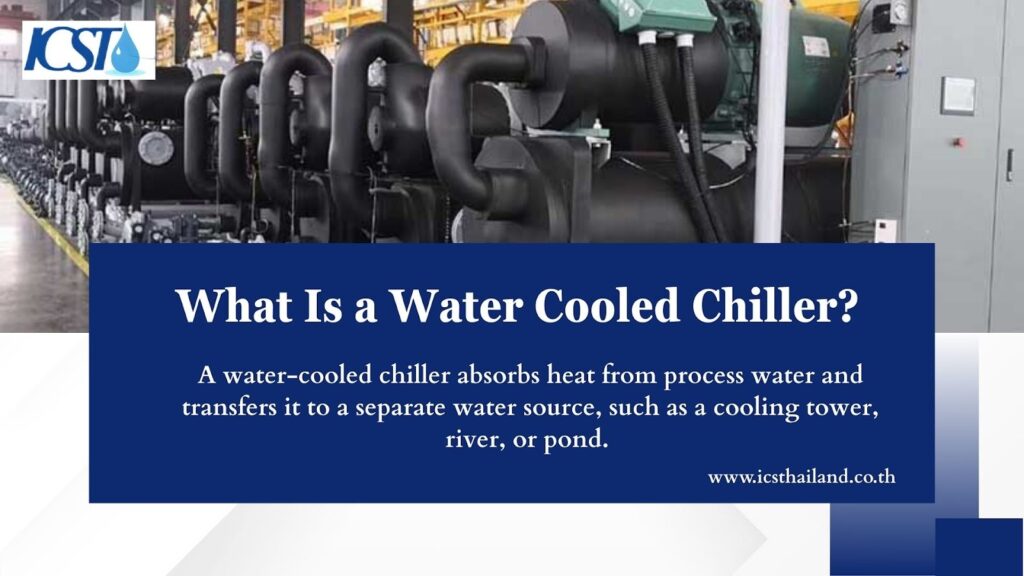
A water-cooled chiller absorbs heat from process water and transfers it to a separate water source, such as a cooling tower, river, or pond. These systems are the standard for large-scale applications where energy efficiency is the primary concern.
How a Water Cooled Chiller Works
This system operates using a shell-and-tube heat exchanger as the condenser, efficiently transferring heat to maintain optimal performance. Here’s how it works step by step:
- Circulation of Warm Water: Water warmed in the cooling tower is pumped through the condenser. This warm water acts as a medium to absorb heat.
- Heat Absorption from Refrigerant: Inside the condenser, the refrigerant releases heat as it transitions from a gas to a liquid. The warm water absorbs this heat, cooling the refrigerant.
- Return to Cooling Tower: After absorbing the heat, the water returns to the cooling tower.
- Heat Dissipation via Evaporation: In the cooling tower, the heated water releases its absorbed heat into the atmosphere through evaporation, allowing the system to continuously operate efficiently.
This setup ensures effective cooling, energy efficiency, and reliable operation for processes requiring heat exchange.
Typical Applications of Water-Cooled Chillers
Due to their superior thermal transfer capabilities, these chillers are dominant in heavy industrial and large commercial sectors. They provide stable performance regardless of ambient air temperature fluctuations.
Primary use cases include the following:
- Large Industrial Plants: Chemical processing, manufacturing, and district cooling plants rely on these units for their high capacity and efficiency.
- Data Centers: Facilities with massive, continuous heat loads prefer water cooled options for their reliability and lower energy consumption per ton of cooling.
- Continuous Operation Facilities: Hospitals and airports that operate 24/7 benefit from the longevity and energy savings these systems provide.
Key Advantages and Limitations of Water Cooled Chillers
Water-cooled systems offer high performance but introduce greater complexity to your facility’s infrastructure. You must weigh the efficiency gains against the operational demands.
Key considerations include:
- Superior Efficiency: Water has better heat transfer properties than air, allowing these chillers to operate at lower condensing pressures and consume less electricity.
- Longer Equipment Life: Because they operate indoors and at lower pressures, these units typically last longer than outdoor air-cooled counterparts.
- Higher Maintenance Requirements: The inclusion of cooling towers necessitates rigorous water treatment, regular cleaning, and mechanical maintenance of pumps and fans.
Condenser Type Comparison | Air vs Water
The fundamental difference between these two technologies lies in how they reject heat. The condenser type dictates not only the mechanics of the system but also the supporting infrastructure required.
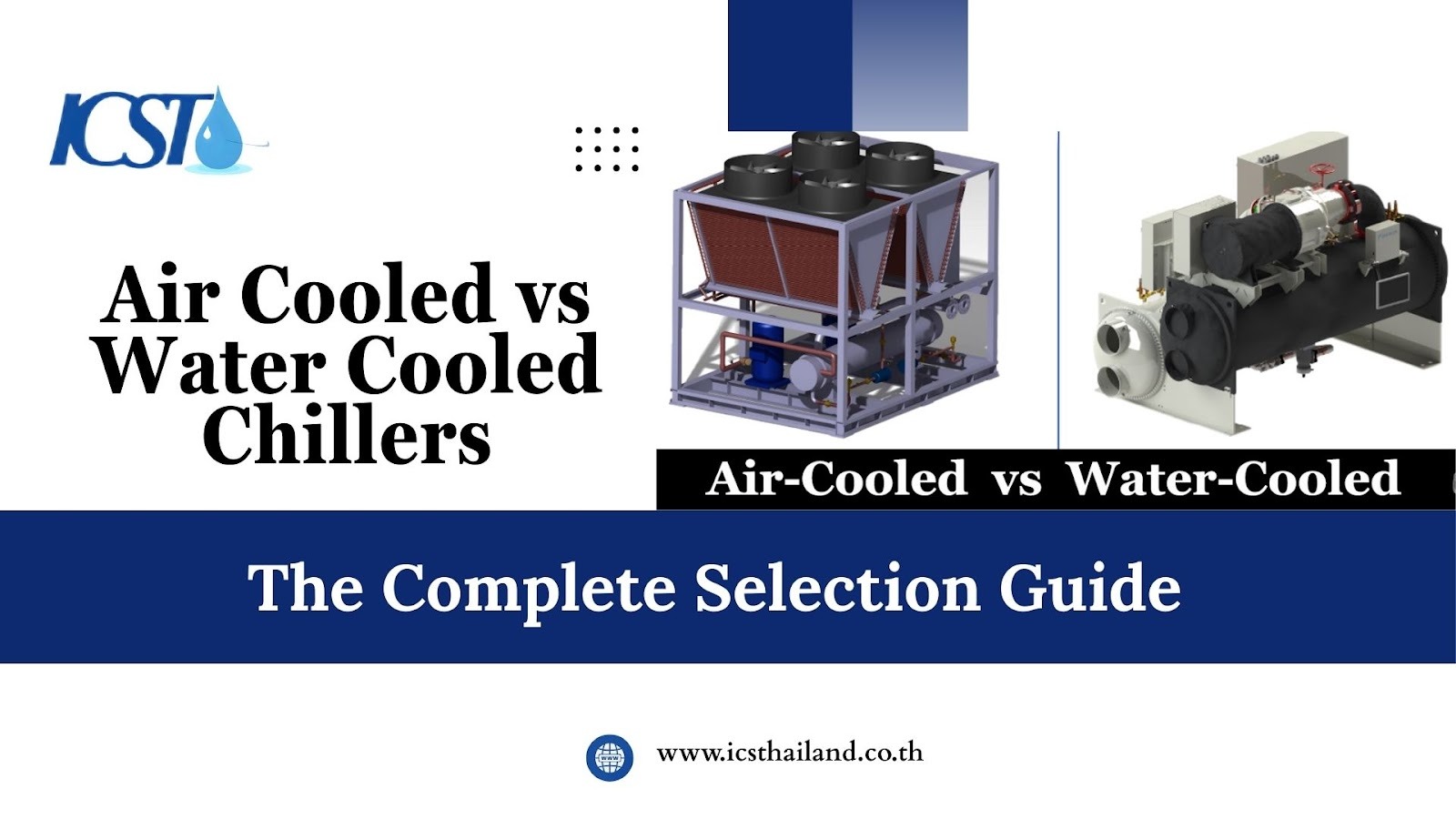
- An air-cooled condenser relies on finned coils and fans to transfer heat to the surrounding air. This process relies heavily on the dry-bulb temperature of the environment.
- In contrast, a water-cooled condenser uses water to absorb heat, relying on the wet-bulb temperature. This allows the water cooled system to reject heat more efficiently, even on hot days, provided the humidity allows for evaporation.
Water Consumption Considerations
Water scarcity and cost are increasingly critical factors in facility management. When evaluating water consumption, the difference between the two systems is stark.
- Air cooled chillers utilize a closed loop for the chilled water but consume zero water for the heat rejection process. This makes them ideal for arid regions or facilities seeking to minimize their environmental footprint.
- Conversely, water cooled chillers rely on evaporation. A cooling tower constantly loses water through evaporation, drift, and blowdown (draining water to remove mineral buildup). This requires a continuous supply of make-up water.
The cost of this water, along with the chemicals required to treat it, must be calculated into the total cost of ownership.
Efficiency Comparison | Real-World Performance
Energy consumption is often the largest variable in the lifecycle cost of cooling equipment. A detailed efficiency comparison reveals distinct behaviors for each type.
- Water cooled chillers are generally more efficient. Because they reject heat into water (which is usually cooler than the ambient air temperature on a hot day), the compressor does not have to work as hard. They typically offer a lower kW/ton rating, translating to significant electricity savings.
- Air cooled chillers have improved significantly in recent years, but generally lag in peak efficiency. Their performance is inversely related to the outdoor temperature; as the day gets hotter, the chiller becomes less efficient. However, at part-load conditions or in cooler climates, the efficiency gap narrows.
Operating Cost Comparison Over Time
Analyzing the operating cost reveals where the money goes over the 20-year life of the system.
- Water cooled systems typically have lower energy costs due to higher efficiency. However, you must add the cost of water, sewage, and chemical treatment to the equation.
- Air cooled systems have higher energy costs but eliminate water and chemical expenses. Additionally, they have fewer mechanical components (no cooling tower fans or condenser pumps), which reduces mechanical maintenance costs.
How to Choose Between Air Cooled vs Water Cooled Chillers
Making the final decision requires balancing the technical data with your site-specific constraints. Use these criteria to guide your selection.
Choose an Air Cooled Chiller If
- Water Availability is Low: You operate in a region with high water costs or scarcity.
- Maintenance Staff is Limited: You do not have a dedicated facilities team to manage chemical water treatment.
- Space is at a Premium: You lack the mechanical room space for an indoor unit but have roof access.
Choose a Water Cooled Chiller If
- Efficiency is the Priority: You have a large load, and reducing electrical consumption is your primary financial goal.
- Large Cooling Load: Your facility requires over 400 tons of cooling capacity.
- Stable Operation: You require consistent cooling performance regardless of extreme outdoor temperatures.
Air Cooled vs Water Cooled Chillers | Side-by-Side Comparison Table
The following table summarizes the critical differences to assist in your decision-making process.
| Criteria | Air Cooled | Water Cooled |
| Condenser Type | Air | Water |
| Water Consumption | None | High |
| Space Requirement | Low (Outdoors) | High (Indoor + Tower) |
| Efficiency | Moderate | High |
| Operating Cost | Lower complexity | Lower energy |
| Maintenance | Low | High |
| Lifespan | 15–20 Years | 20–30 Years |
Making the Right Chiller Selection
Choosing between air cooled vs water cooled chillers requires a holistic view of your facility’s needs. While water cooled units offer superior efficiency for large loads, the simplicity and water savings of air cooled units make them a strong contender for many modern applications.
You must weigh the efficiency comparison against the realities of maintenance and local resource availability. The “best” chiller is the one that aligns with your operational budget, ESG goals, and infrastructure capabilities.
Need expert help selecting the right chiller for your facility? Contact ICST for professional evaluation, design guidance, and optimized cooling solutions.
Frequently Asked Questions
What is the main difference between air cooled vs water cooled chillers?
The main difference lies in how they reject heat. Air cooled chillers use fans to blow air across a condenser coil, while water cooled chillers use water circulated through a cooling tower to remove heat.
Which is more efficient: air cooled or water cooled chillers?
Water cooled chillers are generally more efficient because water is a better heat conductor than air. This allows the system to operate at lower condensing pressures, reducing the energy required by the compressor.
Do water cooled chillers always cost more to operate?
Not always. While they have lower electricity bills, the operating cost increases when you factor in water supply, sewage fees, chemical treatment, and tower maintenance. For smaller loads, these ancillary costs may exceed the energy savings.
How does water consumption affect chiller selection?
If your facility is in a drought-prone area or pays high water rates, the high water consumption of a cooling tower can make a water cooled system financially unviable. In these cases, air cooled is the preferred choice.
Which chiller type is better for hot climates?
Water cooled chillers perform better in extremely hot climates. An air cooled chiller struggles to reject heat when ambient temperatures rise above 95°F (35°C), whereas a water cooled system relies on the wet-bulb temperature, which is typically lower than the dry-bulb temperature.
Are air cooled chillers suitable for hot climates?
Air cooled chillers can operate in hot climates, but their efficiency drops as outdoor temperatures rise. Water cooled systems perform better because they rely on wet-bulb temperature instead of dry-bulb air temperature.