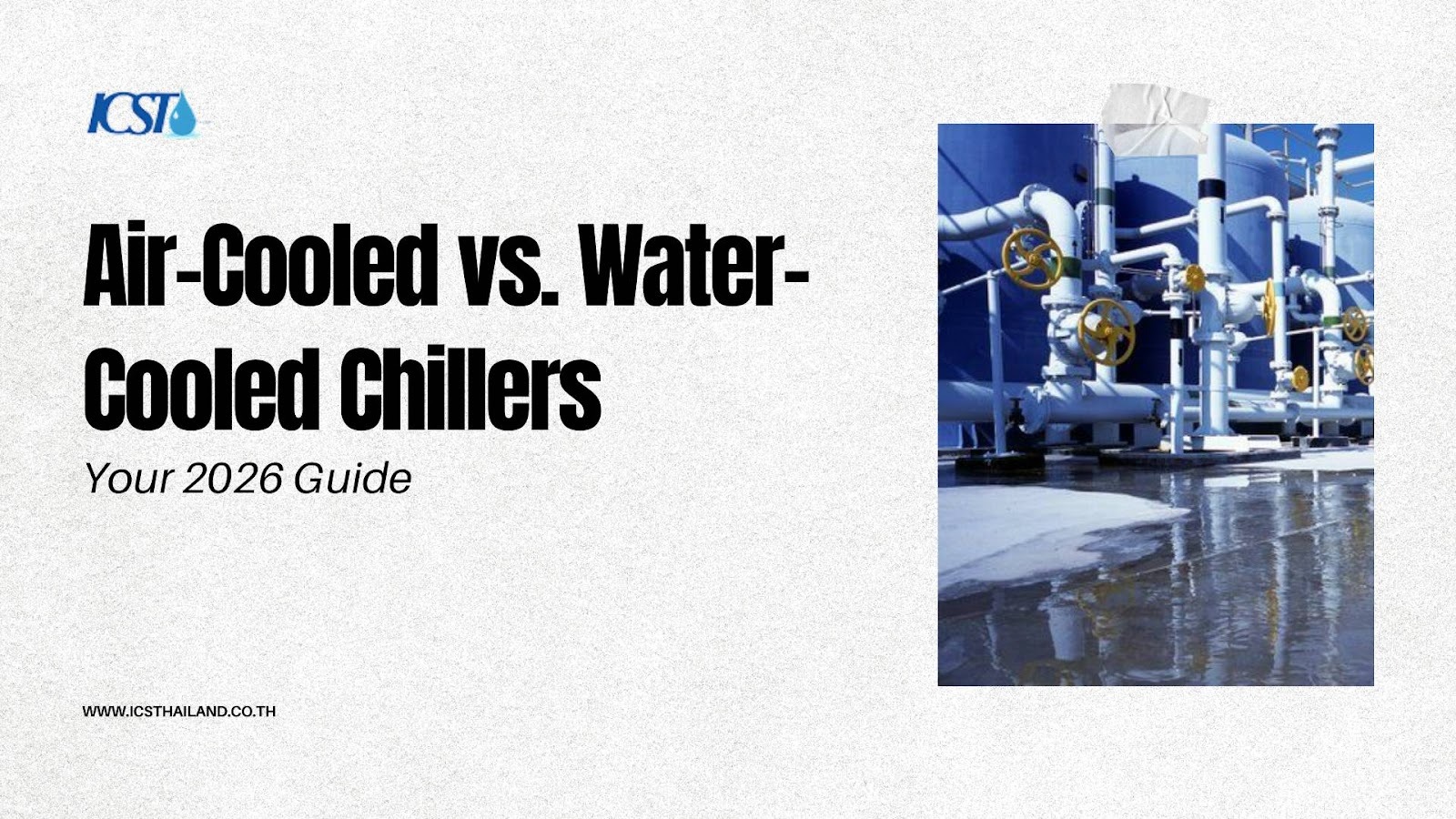
Choosing the right solution in the Air-Cooled vs. Water-Cooled Chillers debate in 2026 is no longer just an operational decision; it is a strategic financial move. New regulations and rising ambient temperatures in Thailand are forcing manufacturers to rethink their cooling strategies.
The choice between an air-cooled and a water-cooled system now directly impacts your bottom line, operational stability, and ability to claim significant government incentives. This guide will help you navigate this critical decision for your facility.
The Changing Landscape of Industrial Cooling
Two major factors are reshaping how Thai manufacturers approach process cooling. First, the Board of Investment (BOI) Notification No. 5/2568 has transformed energy efficiency into a direct tax asset. Investing in high-efficiency systems now yields substantial financial returns.
Second, industrial facilities are facing the “tropical limit.” As peak ambient temperatures in regions like Bangkok continue to rise, older air-cooled systems are experiencing more frequent “thermal tripping.” This leads to production halts and costly downtime. As a result, businesses must consider more robust solutions like hybrid or water-cooled technologies to ensure stability.
Air-Cooled Chillers: The Modular and Flexible Choice
Air-cooled chillers function by rejecting process heat directly into the surrounding atmosphere using high-efficiency fans. This straightforward mechanism offers several advantages, particularly for facilities requiring rapid deployment and operational flexibility.
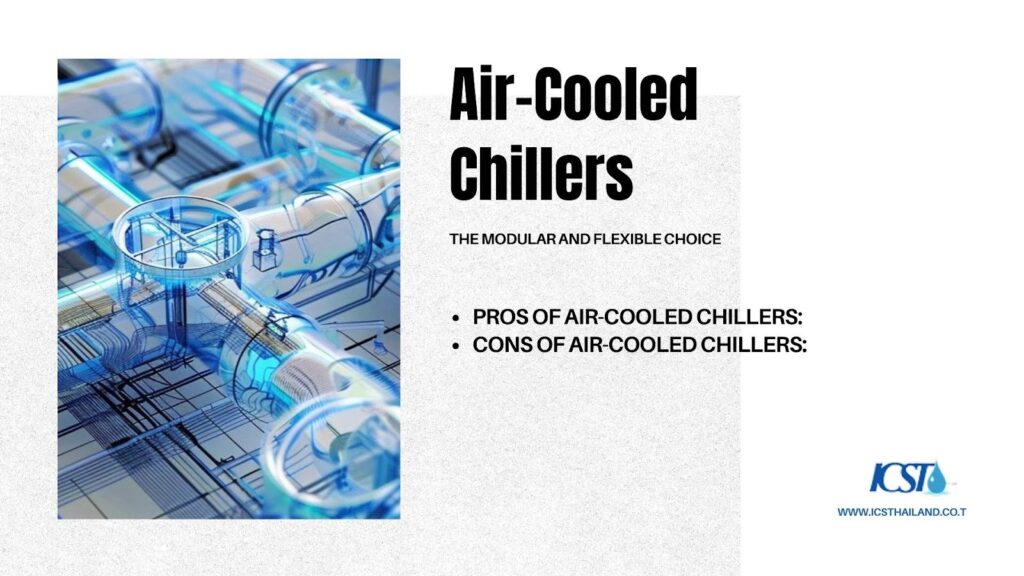
A key advancement for 2026 models is the integration of adiabatic pre-cooling. These systems use fine misting pads to lower the temperature of the air entering the chiller’s coils. This process allows the air-cooled unit to mimic the performance of a water-cooled system during periods of extreme heat, but without requiring a full cooling tower infrastructure.
Pros of Air-Cooled Chillers:
- Zero Water Usage: With a Water Usage Effectiveness (WUE) of zero, these systems are ideal for water-scarce industrial parks, such as those in Rayong.
- Simple Installation: Their standalone design makes installation faster and less complex, which is perfect for rapid expansion projects.
- Lower Initial Cost: Air-cooled systems typically have a lower upfront investment compared to their water-cooled counterparts.
Cons of Air-Cooled Chillers:
- Higher Power Consumption: They exhibit a higher Power Usage Effectiveness (PUE), meaning they consume more electricity to achieve the same amount of cooling.
- Increased Noise Levels: Standard units can produce significant noise, sometimes up to 90 dBA. This can be mitigated with specialized bionic fan shrouds, but it adds to the cost.
Water-Cooled Chillers: The Performance Powerhouse
Water-cooled chillers leverage the superior thermal conductivity of water, which is 23 times more effective at transferring heat than air. The system operates by circulating water through a condenser loop connected to a cooling tower, where the heat is ultimately rejected through evaporation.
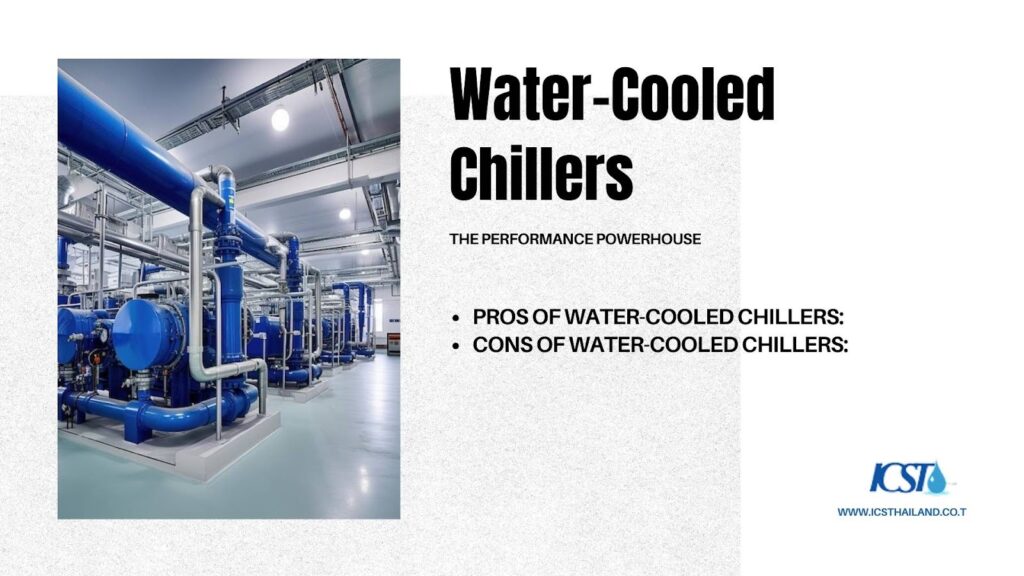
The most significant innovation for 2026 is the widespread adoption of oil-free magnetic levitation (Mag-Lev) compressors. By eliminating friction and the need for oil pumps, these chillers achieve an elite efficiency rating of 0.55 kilowatts per ton (kW/ton). This performance level has become the new benchmark for securing high-efficiency BOI certification.
Pros of Water-Cooled Chillers:
- Unmatched Energy Efficiency: These systems deliver the lowest possible energy bills, often costing 30% to 40% less to operate than air-cooled units.
- Longer Lifespan: A well-maintained water-cooled chiller has an operational lifecycle of 25 to 30 years, offering excellent long-term value.
- Maximum Incentives: Their high efficiency allows facilities to qualify for Tier 1 BOI tax exemptions.
Cons of Water-Cooled Chillers:
- High Water Consumption: These systems have a high Water Usage Effectiveness (WUE) and require a constant supply of makeup water.
- Complex Maintenance: They demand advanced water treatment to prevent scale and corrosion, and must meet strict 2026 discharge standards.
2026 Selection Matrix: Air-Cooled vs. Water-Cooled
| Strategic Metric | Air-Cooled Chiller (2026) | Water-Cooled Chiller (2026) | 2026 Thailand Context |
| Energy Efficiency | Moderate (1.0–1.2 kW/ton) | Elite (0.5–0.6 kW/ton) | A water-cooled system can save over ฿3M annually for large loads. |
| Water Strategy | Winning (WUE < 0.10) | High Demand (WUE > 0.45) | Air-cooled is vital for “Zero Liquid Discharge” sites. |
| Maintenance Scope | Coil and Fan Focus | Tower, Pumps & Water Chemistry | Mag-Lev units reduce chiller-side service needs by 40%. |
| Installation Cost | Lower (Standalone) | Higher (Requires Towers/Pumps) | Air-cooled is best for rapid expansion needs. |
| BOI Incentive | Standard (Efficiency-based) | Tier 1 (Max Tax Exemption) | High-capacity Mag-Lev units deliver maximum CIT breaks. |
The ICST Critical Requirement Engineering Approach
Off-the-shelf solutions often fail to meet the unique demands of modern industrial facilities. As a regional engineering hub, ICST specializes in providing customized designs that standard vendors cannot match. Our approach focuses on tailoring systems to specific environmental and operational challenges.
- The Seawater Chiller: For coastal facilities in locations like Rayong, we design water-cooled units with Titanium heat exchangers. This ensures corrosion-proof operation when using seawater for cooling.
- Low Pumphead Designs: We engineer the complete chiller and tower loop to minimize hydraulic resistance. This strategic design reduces parasitic pumping power by 15–20%, further enhancing overall system efficiency.
- Data Center Optimization: We expertly balance Water Usage Effectiveness (WUE) and Power Usage Effectiveness (PUE) for the new wave of hyperscale AI data hubs emerging in Bangkok, ensuring both sustainability and performance.
Conclusion: Investing for Resilience Beyond 2030
Selecting the right system in the Air-Cooled vs. Water-Cooled Chillers debate is crucial to maximizing efficiency, cost savings, and long-term stability in Thailand’s evolving industrial landscape.
By understanding the latest advancements, BOI incentives, and site-specific needs, you can make a choice that delivers lasting value and sustainability. Whether your priority is energy efficiency, water conservation, or rapid scalability, this guide offers a comprehensive comparison to empower your decision.
Ready to future-proof your facility’s cooling strategy? Contact our expert team, ICST, now for a customized consultation and discover which chiller investment will drive your success through 2026 and beyond!
Frequently Asked Questions (FAQs)
What is the difference between air-cooled vs. water-cooled chillers?
Air-cooled chillers use fans to reject heat into the atmosphere, while water-cooled chillers use water and cooling towers for heat transfer. Water-cooled systems are more energy-efficient but require more maintenance and water resources.
Which chiller is more energy-efficient in 2026?
Water-cooled chillers are more energy-efficient, achieving as low as 0.55 kW/ton with advanced technologies like magnetic levitation compressors.
Are air-cooled chillers suitable for water-scarce areas?
Yes, air-cooled chillers are ideal for water-scarce regions as they have zero water usage, making them perfect for industrial parks like those in Rayong.
What are the benefits of BOI incentives for chillers in Thailand?
BOI incentives in 2026 offer significant tax benefits for high-efficiency chillers, with water-cooled systems qualifying for maximum exemptions due to their superior energy performance.
How do adiabatic pre-cooling systems improve air-cooled chillers?
Adiabatic pre-cooling systems enhance air-cooled chillers by using misting pads to lower air temperature, mimicking water-cooled performance during peak heat without requiring a cooling tower.