An effective ASHRAE 188 implementation cooling tower strategy requires a comprehensive water management plan to reduce Legionella risk within centralized building water systems. Facility managers must establish a multi-disciplinary team, draft precise fluid flow diagrams, and isolate critical control points prone to hazardous conditions.
Compliance mandates continuous monitoring of disinfectant levels, strict pH regulation, and automated temperature monitoring to inhibit Legionella growth. Additionally, building owners must execute bi-annual mechanical teardowns and maintain rigorous documentation for ongoing verification. Ultimately, program success relies on independent laboratory validation testing to ensure the system suppresses waterborne pathogens and successfully protects building occupants.
1. Legal & Regulatory Framework: Why Standard 188 is Enforceable Code
The Power of Mandatory Phrasing
ASHRAE Standard 188 is written in strict, enforceable code language. The document completely replaces permissive choices with explicit commands such as “shall” and “must.”
This deliberate syntax allows municipal building departments, state health boards, and federal agencies to adopt the text directly into statutory law. States like New York and Michigan have already integrated these mandates into their legal frameworks for existing buildings and new construction.
The Multi-Agency Mandates
Healthcare facilities face overlapping regulatory pressure regarding water safety. The Centers for Medicare & Medicaid Services (CMS) directive legally requires an active water management plan to protect vulnerable populations from Legionnaires disease.
Simultaneously, the Joint Commission enforces strict compliance standards during accreditation audits. Both entities look directly to the ASHRAE Standard 188 framework as the baseline for legal execution.
The OSHA General Duty Clause [Section 5(a)(1)]
Federal auditors utilize the OSHA General Duty Clause to penalize facilities that neglect biological hazards. The absence of a documented, active water safety strategy during an inspection serves as evidence of a recognized hazard violation.
Federal authorities will issue willful or repeated violations for these omissions. Regulatory penalty caps reach up to $165,514 per infraction.
The Expansion to ASHRAE Standard 514
Industrial safety requirements continue to evolve beyond a single pathogen. While Standard 188 acts as the core framework for Legionella compliance, ASHRAE Standard 514 extends protection much further.
Standard 514 addresses broader physical, chemical, and non-Legionella microbial hazards within centralized building water systems. Engineering teams must integrate both standards to ensure complete facility safety.
2. The Master ASHRAE 188 Cooling Tower Compliance Matrix
Achieving absolute compliance requires linking each of the seven mandatory components of a water safety program directly to verifiable mechanical and chemical thresholds in the field. The following matrix outlines the necessary engineering actions and targets:
| WMP Core Component | Field Engineering / Maintenance Action | Enforceable Control Limit Target | Compliance Verification Tool |
| 1. Program Team | Assemble a multi-disciplinary committee of facility directors, mechanical air conditioning engineers, and water treatment professionals. | Clearly defined responsibilities and emergency authority sign-offs. | Documented organizational chart |
| 2. Process Description | Draft detailed, isometric fluid flow diagrams tracing the entire loop. | Map all makeup water, sumps, bypass lines, and distribution decks. | Certified plumbing schematic audit |
| 3. Hazard Analysis | Analyze system architecture to pinpoint hazardous conditions prone to stagnation, sediment, and thermal traps. | Locate low-flow sections, variable-load cells, and structural dead legs. | Dynamic physical risk mapping logs |
| 4. Control Measures | Select and deploy automated biocide injection and physical cleaning intervals. | Maintain active, continuous oxidizing halogen residuals. | Inline amperometric chemical sensors |
| 5. Monitoring Schedule | Set up real-world, timestamped data logs for water chemistry, pH, and conductivity. | Track operational metrics against the boundaries specified in the plan. | Automated digital data-loggers |
| 6. Corrective Actions | Define explicit, staged remediation sequences if a control limit is breached. | Hyper-chlorination, mechanical biofilm removal, and cell isolation. | Red Tier emergency response SOP |
| 7. Documentation | Centralize all chemical logs, independent lab cultures, and audit trails. | Retain tamper-proof records for a minimum of 3 years for regulatory review. | Retrievable CMMS database / WMP binder |
3. Building the Flow Diagram: Mapping System Architecture Under ASHRAE 188
The Anatomy of a Compliant Schematic
Generic design layouts fail regulatory audits. ASHRAE 188 requires a dedicated flow diagram that tracks municipal water from the exact point of building entry.
The schematic must trace water as it routes through makeup lines, enters the cooling tower basin, passes across heat exchangers, and discharges via blowdown or evaporation. Every pipe branch requires an explicit graphical representation.
Pinpointing Control Locations (CLs) and Critical Control Points
Engineering teams must graphically identify every single point on the diagram where operators introduce physical or chemical controls. These Control Locations and critical control points mark the precise position of:
- Biocide injection quills
- Scale inhibitor pumps
- Side-stream sand filters
- Automated bleed valves
Delineating Monitoring Points (MPs)
The flow schematic must isolate every point where technicians extract samples or place telemetry probes. Marking these precise physical locations ensures consistency during routine data collection and monitoring procedures.
Properly mapped monitoring points allow auditors to verify that your water chemistry readings originate from representative zones of active circulation.
4. Hazard Analysis: Isolating Hydraulic and Physical Vulnerabilities
The Hidden Threat of Structural Dead Legs
Pipe configurations that have been capped, valved off, or isolated from the main loop represent severe biological hazards. Circulating biocides cannot physically reach these stagnant water zones.
The water within dead legs loses its sanitizer residual completely. Ambient facility heat quickly warms this stagnant fluid into the ideal proliferation zone of 20°C to 50°C (68°F to 122°F), which directly acts to promote Legionella growth.
Biofilm Matrix Insulation on FRP Material
Scale, corrosion byproducts, and organic debris easily accumulate on rough surfaces within basin sumps and fill sheets. Fiber-reinforced polymer (FRP material) requires regular inspection to ensure structural cleanliness.
When debris settles, it forms a dense, protective biofilm matrix. This biological shield insulates deep-seated bacterial colonies from oxidizing biocides, rendering chemical water treatments ineffective.
Aerosol Drift Dispersal Mechanics
Failing drift eliminators allow contaminated water droplets to escape the tower housing. Alignment with ASHRAE Guideline 12-2023 requires drift metrics that strictly limit droplet escape to less than 0.001% of the total circulating water volume.
High-efficiency drift eliminators prevent hazardous mist from migrating toward nearby fresh air intakes, windows, or pedestrian pathways.
5. Implementing Control Measures: Water Chemistry Telemetry
Continuous Halogen Automation
Manual chemical batch-dumping is an unacceptable maintenance practice that violates modern compliance principles. Manual additions create dangerous, volatile swings in biocide concentration and disinfectant levels.
Facilities must implement automated, sensor-driven chemical dosing loops. Continuous telemetry ensures that biocide residuals remain stable and effective 24 hours a day to reduce legionella risk.
The pH Dependency Window
Regulating water chemistry is critical to optimizing biocide performance. For chlorine-treated systems, operators must maintain a tight pH target between 7.0 and 8.5.
Allowing the pH to rise above 8.5 forces the chemical to dissociate from its highly active hypochlorous acid (HOCl) state into the far less effective hypochlorite ion ($\text{OCl}^-$), severely reducing disinfection speed.
Automated Cycles-of-Concentration & Bleed-Off Control
Mineral scale acts as a breeding ground for bacteria and destroys heat exchange efficiency. Inline conductivity sensors must be programmed to trigger automated blowdown valves.
This automated feedback loop purges concentrated dissolved solids before they can precipitate onto fill media sheets.
The process follows a strict operational sequence:
[Inline Conductivity Sensor Exceeds Limit] ──► [Automated Blowdown Valve Opens]
│
▼
[Fresh Makeup Water Entered] ◄── [Automated Chemical Feed Compensates Halogens]
6. Disinfection SOPs: The Mechanical Teardown Sequence (Guideline 12 Rules)
Bi-Annual Maintenance Mandates
Standard operating procedures must schedule full physical cooling tower teardowns at least twice per year. Engineering teams typically execute these operations during spring start-up and autumn winterization.
Systems that run continuously require scheduled cleaning intervals to interrupt biofilm accumulation cycles. This process applies broadly to other potentially hazardous complex water systems, including:
- Potable water systems
- Non-potable water systems
- Evaporative condensers
- Decorative fountains
- Hot tubs and spas
- Large water storage tanks
The 4-Step Physical Remediation Protocol
- Pre-Shutdown Shock Chlorination: Dose the active circulating loop to 5–10 ppm of free residual chlorine. Maintain this level with a stable pH for at least 1 hour to neutralize planktonic cells and loosen bound biofilm matrices.
- Complete Hydraulic Drainage: Drain the cold-water basin completely. Manually clear all heavy sludge, silt, and environmental sediment out of the sump box.
- High-Pressure Mechanical Scrubbing: Use physical pressure washers to clean the basin walls, internal casing components, drift eliminators, and structural water distribution decks.
- Post-Clean Passivation & Disinfection: Refill the system and dose the water back to 5 ppm of free chlorine. Circulate this water for at least 2 hours, verify residual retention, and chemically neutralize the fluid down to safe operational baselines before restarting fans.
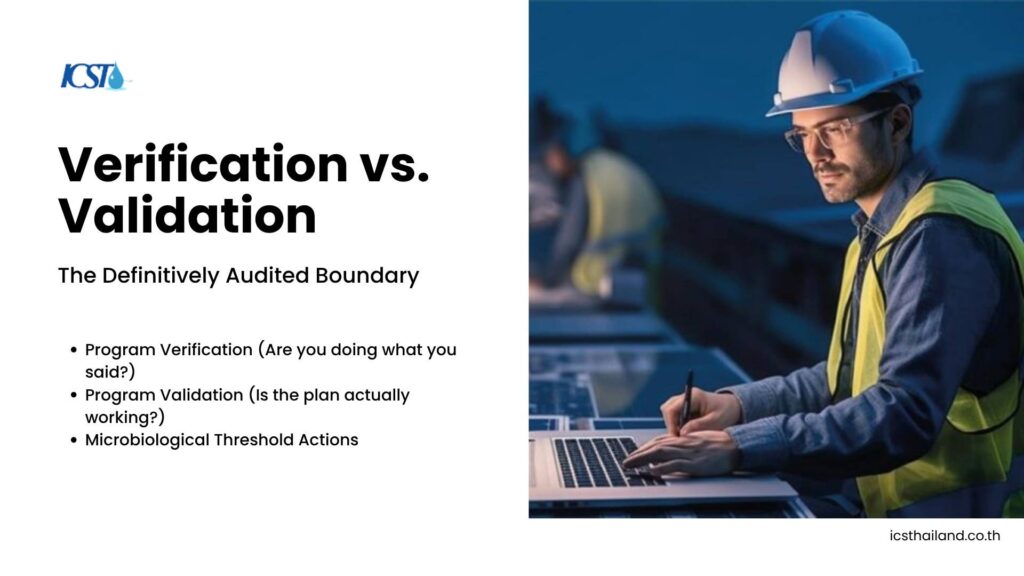
7. Verification vs. Validation: The Definitively Audited Boundary
The Critical Administrative Boundary
Building owners must demonstrate the legal difference between process adherence and biological safety to health auditors. Merely completing maintenance tasks does not prove that a system is safe. A compliant strategy splits documentation into two distinct assessment categories.
Program Verification (Are you doing what you said?)
Ongoing verification confirms that your operational team executes the written management plan precisely as scheduled. Managers satisfy this requirement by compiling:
- Daily water chemistry logs
- Automated telemetry tracking sheets
- Sensor calibration certificates
- Physical maintenance work orders
- Temperature monitoring logs
Program Validation (Is the plan actually working?)
Validation uses biological data to prove that your active control measures successfully suppress pathogen growth. This phase relies entirely on objective laboratory analysis.
Facilities utilize independent laboratories to conduct standardized culture testing. This process verifies that the chemical parameters are achieving the desired biological control against Legionella bacteria and other waterborne pathogens.
Microbiological Threshold Actions
Heterotrophic Plate Count (HPC) Limit
Facilities should maintain a Heterotrophic Plate Count (HPC) below 10,000 CFU/mL. Sudden spikes in general bacterial counts indicate that biofilm is insulating colonies or biocide levels are insufficient. An elevated HPC reading requires a detailed trend analysis and immediate adjustment of chemical feed rates.
Legionella Specific Culture Limits
- <1 CFU/mL (Target Control): This result indicates successful biological suppression. Maintain current chemical treatment parameters and continue routine telemetry logging.
- 1 to 9 CFU/mL (Action Tier 1): Operators must immediately verify chemical pump calibration and elevate biocide target residuals. Inspect the physical plumbing loop for localized stagnation issues and execute validation testing via a re-test within 24 to 48 hours.
- ≥10 CFU/mL (Action Tier 2): Initiate immediate emergency containment protocols and corrective actions. Shut down the tower fan blades to eliminate aerosol transmission risks, isolate the affected cooling cell, and execute emergency hyper-chlorination shock-dosing. Physically clean all basin surfaces and verify complete disinfection via a mandatory culture review before returning the asset to service.
Conclusion: Establish Enforceable Compliance Today
Legionella compliance leaves zero margin for technical or documentation errors. Developing, mapping, and implementing an ASHRAE 188 water management plan requires seamless integration across chemical water treatment, mechanical optimization, and field execution.
At International Cooling Solutions (Thailand), our certified mechanical and water compliance engineers conduct complete, site-specific system reviews. We help you design and deploy fully code-compliant cooling tower networks utilizing advanced structural FRP material configurations. Contact our Bangkok engineering office today to schedule your comprehensive system risk assessment and establish an effective implementation timeline.
Frequently Asked Questions (FAQs)
What are the engineering requirements for an ASHRAE 188 cooling tower water management plan?
An effective water management plan requires a multi-disciplinary team to map centralized building water systems using detailed fluid flow diagrams. Engineers must identify critical control points, analyze structural components for hazardous conditions, and establish continuous automated biocide dosing. The program must define strict control limits, routine monitoring procedures, and clear corrective actions to prevent the growth of waterborne pathogens in complex water systems.
How do facility managers achieve regulatory Legionella compliance under ASHRAE Standard 188?
Building owners achieve compliance by executing a data-driven risk management framework. This process requires maintaining stable disinfectant levels, implementing automated temperature monitoring, and scheduling biocide telemetry adjustments. To satisfy health authorities, facility managers must maintain a retrievable documentation binder containing daily operational logs, sensor calibration certificates, and independent validation testing results to prove continuous system safety.
Why do dead legs and structural stagnant zones increase Legionella risk in cooling towers?
Structural dead legs isolate water from the main circulation loop, causing chemical disinfectant levels to drop to zero. Without active biocide residuals, scale and organic sediment quickly accumulate on surfaces like FRP material. Ambient building heat warms this stagnant fluid into the ideal thermal range to promote Legionella growth, creating a biological matrix that shields bacteria from subsequent water treatment.
What is the difference between ongoing verification and validation testing in water systems?
Ongoing verification acts as an administrative audit to confirm that water treatment professionals execute the maintenance steps outlined in the management plan. Validation testing provides the biological proof that those control measures actually protect building occupants. Validation relies on independent laboratory culture tests to measure specific Legionella bacteria concentrations, ensuring the system successfully suppresses dangerous pathogens.
How should an engineering team respond if a cooling tower exceeds safe microbiological control limits?
When validation testing reveals counts at or above 10 CFU/mL, operators must initiate immediate corrective actions. Technicians must turn off the tower fan blades to prevent aerosol dispersal toward fresh air intakes. The team must isolate the affected cell, execute a hyper-chlorination shock-dosing protocol, perform a complete mechanical teardown with high-pressure scrubbing, and verify safety via a mandatory culture review.