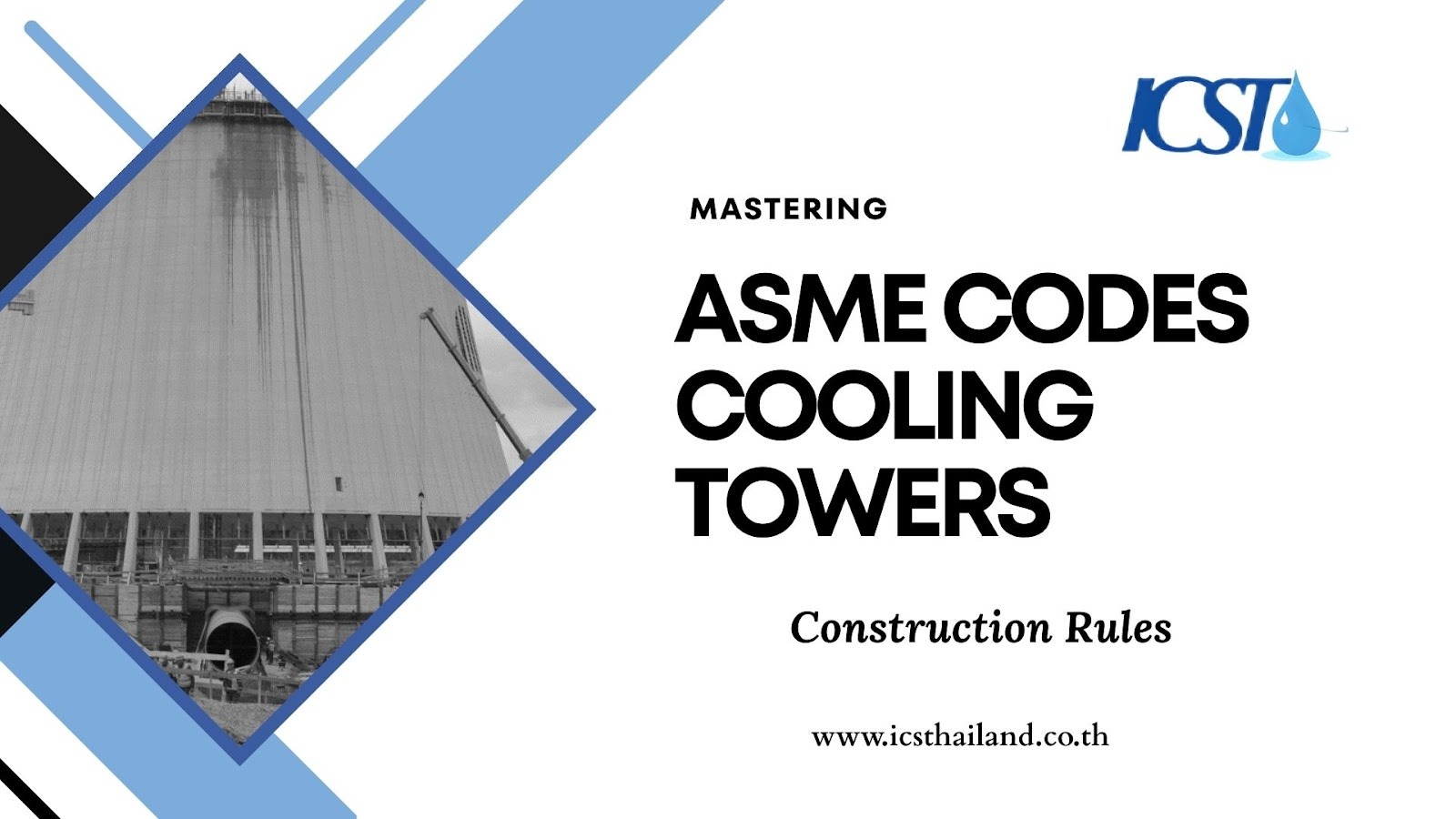
Industrial cooling projects demand rigorous adherence to safety standards. Failing to comply with established regulations exposes facilities to catastrophic risks, insurance liabilities, and costly shutdowns. Understanding the application of ASME codes cooling towers is essential for engineers and project managers who prioritize safety and longevity.
It is important to clarify a common misconception immediately. The American Society of Mechanical Engineers (ASME) codes typically apply to specific pressure-retaining components within the system rather than the cooling tower structure itself. This guide clarifies exactly which parts require attention.
In the following sections, we will explain the specific construction rules, material requirements, and inspection protocols necessary for a compliant and safe cooling system.
What Are ASME Codes?
The American Society of Mechanical Engineers (ASME) sets the global standard for mechanical safety, particularly regarding pressure containment. These codes exist to prevent failures that could result in explosions, leaks, or structural collapses in industrial settings.
- Engineers use these standards in cooling tower projects to ensure reliability under operational stress.
- Cooling towers primarily function as heat rejection devices but often integrate with high-pressure loops.
- Regulatory bodies and insurance carriers often require adherence to these codes.
- Compliance serves as a seal of quality, ensuring the engineering integrity of the system.
- It creates a shared commitment to operational safety among the manufacturer, authorized inspector, and end-user.
Do ASME Codes Apply to Cooling Towers?
Yes, ASME codes apply to cooling towers, but not to the entire structure. The application depends on the specific component and its function.
While the open, atmospheric parts of a cooling tower, such as its fiberglass or concrete casing, are not governed by ASME codes, certain internal components are strictly regulated. The key is to distinguish between the structural frame and the pressure-retaining components.
- ASME PTC 23: This standard focuses on the performance testing of cooling towers, detailing standardized methods to evaluate thermal performance, water usage, and plume abatement. It applies to various tower types, including mechanical draft and natural draft systems.
- ASME BPVC (Section VIII): This section addresses the design, construction, and safety requirements of pressure vessels within cooling systems, such as those found in closed-loop systems or heat exchangers. Compliance ensures these components meet stringent safety standards.
- ASME PTC 19 Series: These supplemental standards provide guidelines for instrumentation and measurement uncertainties, enhancing the accuracy of performance tests outlined in PTC 23.
Understanding these distinctions is essential to avoid over-specifications, which can unnecessarily increase costs, and under-specifications, which may compromise safety.
While structural elements in cooling systems often follow building codes like the IBC or CTI standards, components like pressurized piping and closed-loop systems fall under ASME’s jurisdiction.
Cooling Tower Components Governed by ASME Codes
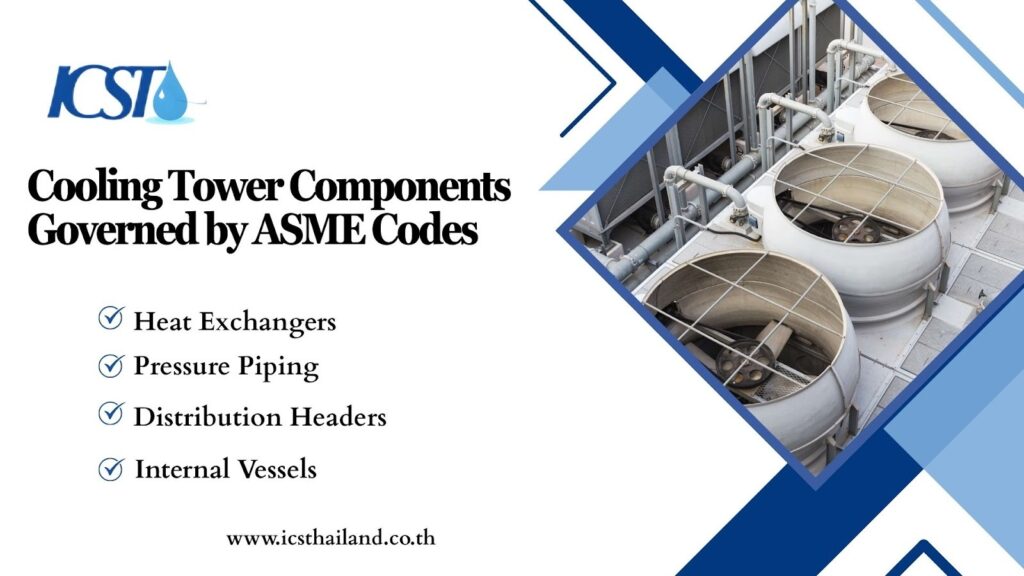
Project managers frequently face challenges in pinpointing where specific codes apply within intricate assemblies. To ensure regulatory compliance, it’s essential to focus your efforts on the areas governed by the appropriate standards.
For instance, the overall cooling tower assembly is primarily regulated by the Cooling Technology Institute (CTI) guidelines, along with construction standards such as ASTM and NFPA 214. However, components involving pressurized systems are subject to ASME Codes.
These components typically require strict adherence to ASME codes for cooling towers:
- Heat Exchangers: Closed-circuit cooling towers utilize internal coils to isolate process fluid, and these coils almost always function as pressure vessels.
- Pressure Piping: Any piping that carries fluid under pressure to or from the tower must meet specific code requirements.
- Distribution Headers: If the water distribution system operates under significant pressure rather than gravity, it may fall under code jurisdiction.
- Internal Vessels: Some specialized towers include internal reservoirs or basins designed to hold pressure, which automatically triggers ASME oversight.
Relevant ASME Pressure Vessel Standards for Cooling Towers
Navigating the ASME Boiler and Pressure Vessel Code (BPVC) requires familiarity with specific sections. Not every volume of the code applies to cooling applications, so knowing which sections matter saves time and resources.
Engineers primarily consult these pressure vessel standards during design and fabrication:
- Section VIII, Division 1: This provides the rules for the construction of pressure vessels and is the most common standard for heat exchanger coils.
- Section IX: This section governs welding and brazing qualifications, ensuring that all joints meet rigorous strength criteria.
- B31.1 or B31.3: These define the requirements for power piping and process piping, respectively, which connect the tower to the facility.
Material Specifications Under ASME Codes
Selecting the right materials is the first step in ensuring a vessel can withstand internal pressure and environmental stress. The code does not allow for random material substitution; every plate, pipe, and flange must appear on an approved list.
Strict material specifications ensure that the steel used offers known chemical and physical properties:
- Carbon Steel: Often used for headers and piping, requiring specific corrosion allowances to account for water contact.
- Stainless Steel: Frequently selected for heat exchanger coils due to its resistance to corrosion and high tensile strength.
- Material Traceability: Every piece of metal must come with Mill Test Certificates (MTCs) to prove its origin and composition.
- Impact Testing: Materials operating in cold environments may require Charpy V-Notch testing to ensure they do not become brittle..
Welding Procedures and Qualifications
Welding serves as the backbone of any pressure-retaining component. A failure at a weld joint represents the most common point of leakage or rupture, which is why the code places immense focus on how welding occurs.
Adherence to welding procedures ensures that the person holding the torch and the method they use produce sound, defect-free joints:
- Welding Procedure Specifications (WPS): This document details the exact parameters, such as voltage, amperage, and travel speed, that the welder must use.
- Procedure Qualification Records (PQR): This record proves that the method described in the WPS actually produces a weld stronger than the base metal.
- Welder Performance Qualification (WPQ): This test verifies that the specific welder has the manual dexterity to execute the weld according to the code.
- Consumable Control: The filler metal and shielding gas must match the specifications exactly to prevent chemical incompatibility.
ASME Stamp Approval: When and Why It’s Required
The “U” stamp is the visible evidence that a vessel meets every requirement of the code. It is not merely a sticker; it is a legal attestation that the manufacturer accepted full responsibility for the design and construction of the vessel.
Obtaining stamp approval involves a rigorous process that goes beyond internal quality checks:
- Mandatory Requirement: Many jurisdictions require stamped vessels by law for insurance coverage to remain valid.
- Authorized Inspector (AI): An independent third-party inspector must witness critical stages of fabrication and sign off on the final product.
- Data Report (U-1 Form): This document serves as the birth certificate of the vessel and must remain accessible for the life of the equipment.
- Code Symbol: The physical stamping of the code symbol onto the nameplate signifies final acceptance.
Inspection, Testing, and Documentation Requirements
Verification does not end with the final weld. The component must prove its integrity through a series of aggressive tests designed to reveal any hidden flaws or weaknesses.
Inspectors perform these tests to validate the safety of the ASME codes’ cooling tower components:
Hydrostatic Testing:
The vessel is filled with water and pressurized to at least 1.3 times its design pressure to check for leaks and structural stability. This test ensures the vessel can safely operate under pressure without failure, making it a critical quality control step in manufacturing. Any detected leaks are addressed immediately, ensuring compliance with safety standards.
Non-Destructive Testing (NDT):
Technicians use radiography (X-ray) or ultrasonic testing to look for internal defects without damaging the part. These advanced methods help identify potential issues like cracks or voids that could compromise integrity, ensuring long-term reliability.
Hold Points:
The Authorized Inspector designates specific points in the schedule where work must stop until they inspect the progress. These inspections help maintain strict quality assurance by allowing critical aspects of the manufacturing process to be reviewed and approved before proceeding.
Manufacturer’s Data Book:
A comprehensive compilation of MTCs, weld maps, and NDT reports is delivered to the client upon completion. This document provides full traceability and evidence of compliance with project specifications. It acts as a key reference for future maintenance and inspections, ensuring transparency and accountability.
Common Compliance Mistakes in Cooling Tower Projects
Even the most skilled engineering teams can sometimes miss critical compliance details, and those small oversights can lead to big problems—costly rework, missed deadlines, or even having your equipment rejected by the site inspector.
Want to avoid these headaches? Stay ahead of compliance issues by integrating thorough checks and expert guidance into your workflow.
Avoid these frequent pitfalls to ensure a smooth project execution:
- Scope Confusion: Assuming the entire cooling tower requires a stamp rather than just the heat exchanger coils.
- Missing Paperwork: Failing to secure MTCs for every component before fabrication begins.
- Unqualified Welders: Allowing a welder to work on a joint for which they lack the specific qualification range.
- Design Pressure Errors: Specifying a design pressure that is too low for the actual upset conditions of the system.
How ASME Compliance Impacts Project Cost and Timeline
Quality and safety come with a premium in terms of both time and money. Do not underestimate the resources required to manage the extensive documentation, third-party inspections, and specialized labor involved in code work.
However, the investment yields significant long-term value:
- Upfront Costs: Expect higher material costs for certified steel and increased labor hours for qualified welders.
- Schedule Implications: You must build time into the schedule for hold-point inspections and potential non-destructive testing delays.
- Lifecycle Savings: Compliant vessels generally last longer and suffer fewer failures, reducing maintenance costs over decades.
- Risk Mitigation: The cost of compliance is minimal compared to the liability of a catastrophic failure.
How ICST Ensures ASME-Compliant Cooling Tower Construction
Industrial Cooling Solutions Thailand (ICST) understands the complexity of code compliance. We do not leave safety to chance; we integrate code requirements into our engineering and procurement processes from day one.
Our approach ensures that clients receive equipment that is safe, legal, and durable:
- Engineering Oversight: Our team reviews all specifications to identify pressure boundaries and code requirements early.
- Vendor Management: We partner exclusively with fabricators who hold valid ASME certificates and have a proven track record.
- Documentation Control: We compile comprehensive data books that satisfy the most stringent insurance audits.
- Inspection Coordination: We manage the relationship with Authorized Inspectors to keep the project moving without compromising quality.
Conclusion
In industrial infrastructure, safety isn’t an afterthought—it’s a choice that starts with clear specifications. Adhering to ASME codes for cooling towers is crucial for ensuring your facility operates within legal and safety boundaries.
This commitment not only protects your personnel but also satisfies insurance requirements and guarantees the structural integrity of your equipment. Navigating these complex regulations demands expertise and meticulous attention to detail.
At ICST, we integrate code compliance into every stage, from engineering and vendor selection to documentation and inspection.
Is your current cooling tower project fully compliant with safety regulations?
Contact ICST today for an expert consultation. Let us review your specifications and guide you toward a safe, durable, and code-compliant cooling solution.
Frequently Asked Question
Which ASME code is most relevant for cooling towers?
ASME BPVC Section VIII is most relevant for pressure vessels, while ASME B31.1 or B31.3 applies to power and process piping connected to the tower.
Does a cooling tower require an ASME U stamp?
Only pressure vessels within the cooling system require a U stamp. Open, atmospheric tower structures do not require ASME stamping.
Are heat exchanger coils in cooling towers covered by ASME?
Yes. In closed-circuit cooling towers, heat exchanger coils are treated as pressure vessels and must comply with ASME Section VIII.
What materials are allowed under ASME codes?
Only ASME-approved materials such as certified carbon steel or stainless steel are allowed, supported by Mill Test Certificates (MTCs).
Why are welding procedures critical for ASME compliance?
Because welds are the most common failure point, ASME requires qualified procedures (WPS, PQR) and certified welders (WPQ) to ensure safety.