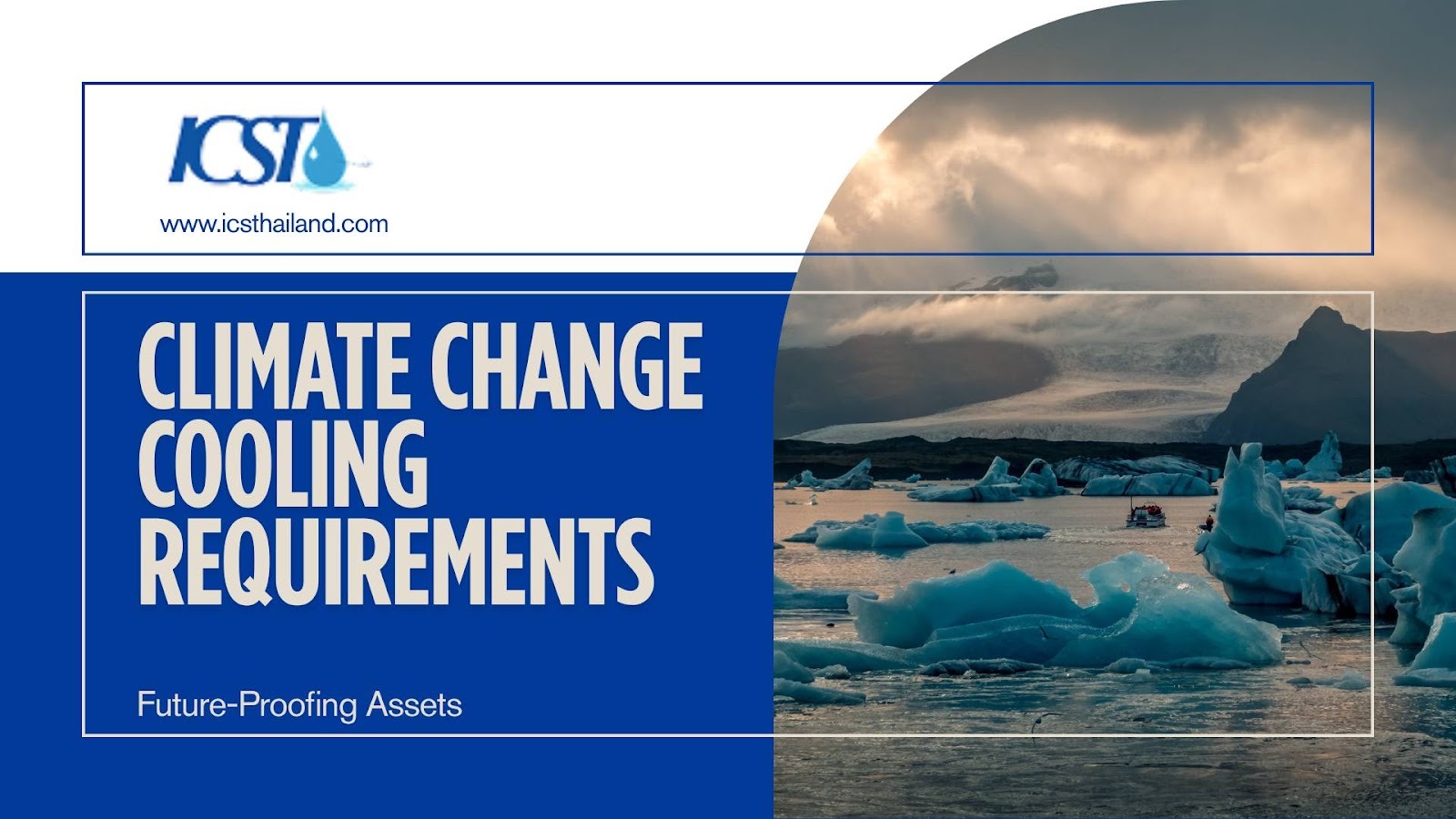
Global temperatures are approaching the critical 1.5°C threshold. “Business as usual” cooling designs are reaching their breaking point. As we move into 2026, static equipment can no longer handle the aggressive thermal shifts we see today. Meeting climate change cooling requirements is now essential as the climate crisis demands a new approach.
We must shift towards Climate-Adaptive Systems. These systems anticipate seasonal extremes rather than reacting to them. At ICST, our mission focuses on providing technically and financially feasible solutions. We ensure your infrastructure withstands the heat stress of the mid-2020s.
This guide will help you navigate the necessary changes. We will explore how rising ambient temperatures affect cooling capacity. You will learn strategies for resilience planning and how to meet new energy efficiency standards.
The Impact of Increasing Ambient Temperatures
Rising temperatures reshape how we design cooling systems. The increase in global warming potential directly impacts equipment performance.
Wet-Bulb Realities
Rising humidity levels are “shrinking” the effectiveness of standard cooling towers.
- Capacity Losses: Standard towers may lose 15-20% capacity during peak hours.
- Inefficient Cooling: High wet-bulb temperatures limit evaporative cooling potential.
- Operational Risk: Systems struggle to maintain set points, leading to downtime.
Higher Cooling Loads
Cooling energy demand is skyrocketing. Analysis shows a significant increase in Cooling Degree Days (CDD).
- 23% Increase: Recent data suggests a 23% rise in CDD.
- Equipment Sizing: Industrial chillers and condensers must be sized for these larger loads.
- Energy Consumption: Higher loads result in increased cooling energy consumption.
Regional Temperature Rise
We are witnessing the “Tropicalization” of temperate zones. Areas once considered mild now experience extreme temperatures. Southeast Asia and the Middle East face a “Heat Boiling” effect. This shift requires robust air conditioning solutions that can handle extreme heat.
2026 Regional Cooling Requirements Matrix
Meeting climate change cooling requirements involves understanding specific stressors. The following matrix outlines the operational impacts and necessary strategies.
| Climate Stressor | HVAC Operational Impact | Adaptive Design Strategy | Resilience Priority |
| Rising Peak Dry-Bulb | Component stress & high-pressure trips | Oversized Condensers / VFDs | Operational Uptime |
| Elevated Wet-Bulb | Inefficient evaporative cooling | High-Efficiency Fills / Low Approach | Thermal Performance |
| Grid Instability | Load shedding / Brownout risks | Smart Controls / Thermal Storage | Energy Security |
| Water Scarcity | Limited makeup water availability | Closed-Loop / Hybrid Systems | Sustainability (WUE) |
Adaptive Design & Resilience Planning
We must close the “Design-Gap.” Reliance on 30-year historical weather averages is dangerous. ICST utilizes 2026-2030 projected weather models and future climate data. This ensures equipment specifications match future climate scenarios.
Optimized Footprints for Urban Density
Urban areas suffer from the Urban Heat Island effect. Dense construction traps heat, raising local temperatures.
- Low-Plume Designs: We prioritize designs that reduce visible plumes.
- Noise Reduction: Low-noise equipment is essential for crowded cities.
- Thermal Spikes: Our designs do not contribute to local thermal spikes.
Building Cooling Needs
High-density environments require advanced cooling technologies. AI-driven data centers generate massive amounts of heat.
- Direct-to-Chip (DTC): This method brings cooling directly to the heat source.
- Liquid Immersion: Submerging components offers superior heat transfer.
- Space Cooling: Traditional air conditioning struggles in these high-load scenarios.
Energy Requirements & The Net-Zero Pathway
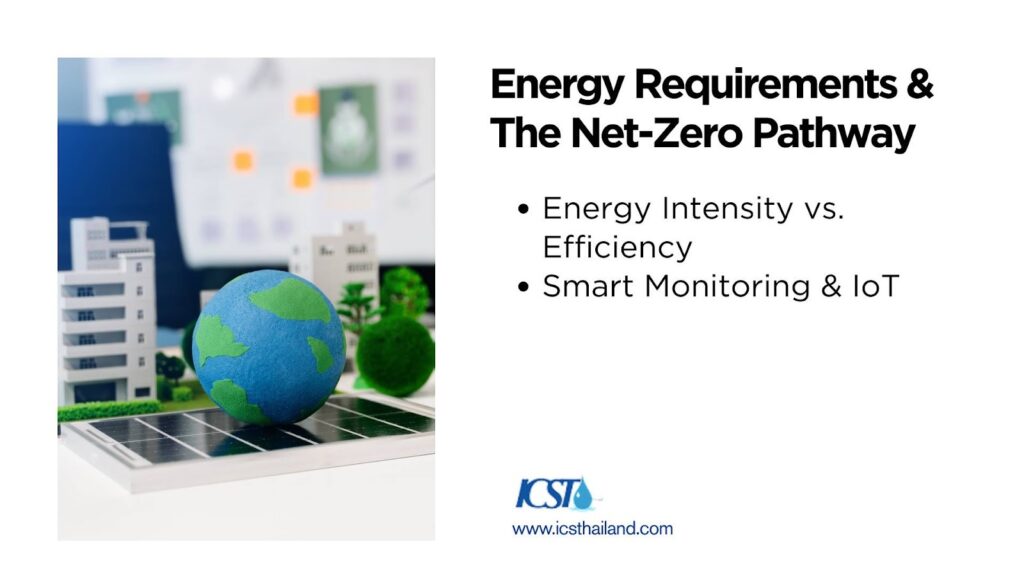
Balancing energy intensity with efficiency is critical. The 2026 mandate calls for a 30% reduction in carbon intensity. We must meet cooling demand without increasing greenhouse gas emissions.
Energy Intensity vs. Efficiency
More cooling often means more power generation. However, we must prioritize energy efficiency.
- Minimum Energy Performance Standards: New equipment must meet strict regulations.
- Energy Savings: Efficient systems reduce operational costs and emissions.
- Climate Friendly Alternatives: We encourage the use of low global warming potential refrigerants.
Smart Monitoring & IoT
Predictive maintenance is a key tool for sustainability. Smart controls and IoT cooling system sensors help us monitor performance in real-time.
- Prevent Efficiency Loss: Detect issues before they cause scaling or fouling.
- Optimize Performance: Adjust operations based on current and future climates.
- Reduce Waste: Minimize energy consumption through precise control.
Resilience in Aggressive & Critical Environments
Standard solutions fail in extreme conditions. We must leverage alternative resources and robust engineering.
Seawater & Geothermal
Terrestrial water sources may reach critical temperature limits. “Infinite Heat Sinks” offer a reliable alternative.
- Seawater Cooling: Utilize the ocean for heat rejection in coastal areas.
- Geothermal Exchange: Use stable underground temperatures for heating and cooling.
- Renewable Energy: These methods align with the energy transition.
Acid-Resistant Engineering
Climate-induced humidity accelerates corrosion. Pollution in heavy industrial zones worsens the problem.
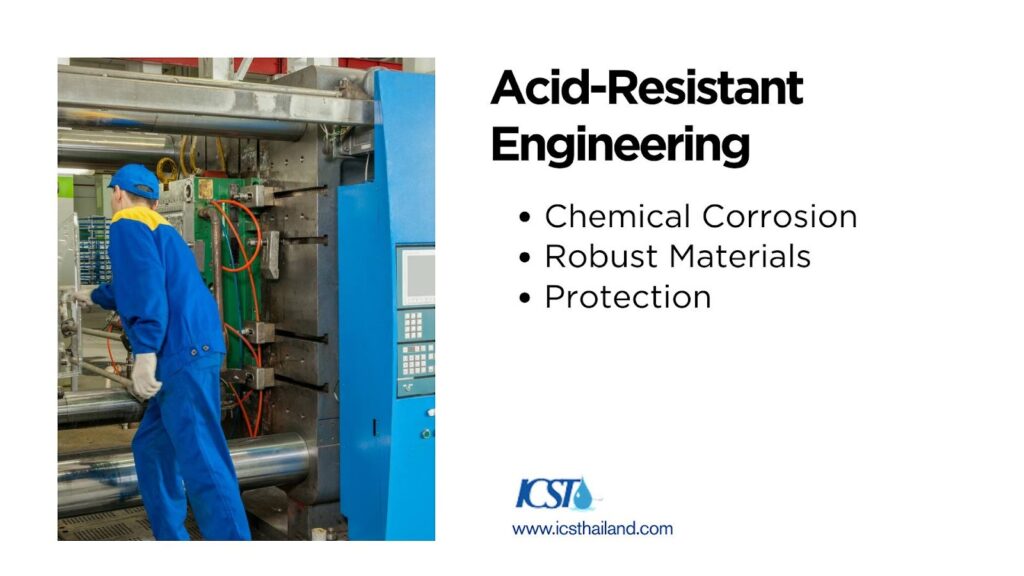
- Chemical Corrosion: Standard materials degrade quickly in these environments.
- Robust Materials: We use acid-resistant engineering to extend asset life.
- Protection: Special coatings protect against aggressive elements.
Bangkok-to-MENA Dispatch
Immediate field support is vital during thermal failures. Our regional hub connects Bangkok to the MENA region. This ensures rapid response times when systems fail under pressure.
Conclusion: Designing for the 2030 Horizon
Meeting climate change cooling requirements in 2026 requires a fundamental shift. We must move from reactive repairs to proactive resilience engineering.
The ICST commitment is clear. We provide the technical assistance and customized designs necessary to keep Asia and the Middle East cool. Do not wait for failure. Prepare your infrastructure for the future climate today.
Is your cooling infrastructure rated for the 2026 thermal reality? Contact ICST for a Climate Resilience Audit and future-proof your facility today.
Frequently Asked Questions
What are the 2026 climate change cooling requirements?
The 2026 cooling requirements address rising temperatures and increased cooling energy demand. They emphasize energy-efficient solutions, climate-adaptive systems, and sustainable cooling technologies to meet future climate projections.
How does global warming impact cooling systems?
Global warming increases cooling loads, reduces system efficiency, and raises energy consumption. It necessitates advanced cooling technologies like high-temperature heat pumps and climate-friendly alternatives.
What is the role of energy efficiency in cooling systems?
Energy efficiency reduces greenhouse gas emissions, lowers energy consumption, and supports sustainable cooling. It is essential for meeting minimum energy performance standards and achieving net-zero goals.
Why is climate adaptation important for cooling systems?
Climate adaptation ensures cooling systems can handle extreme temperatures, water scarcity, and grid instability. It involves using future climate data to design resilient and efficient systems.
What are sustainable alternatives to traditional cooling systems?
Sustainable alternatives include passive cooling strategies, renewable energy integration, and low global warming potential refrigerants. These solutions reduce emissions and improve energy performance.