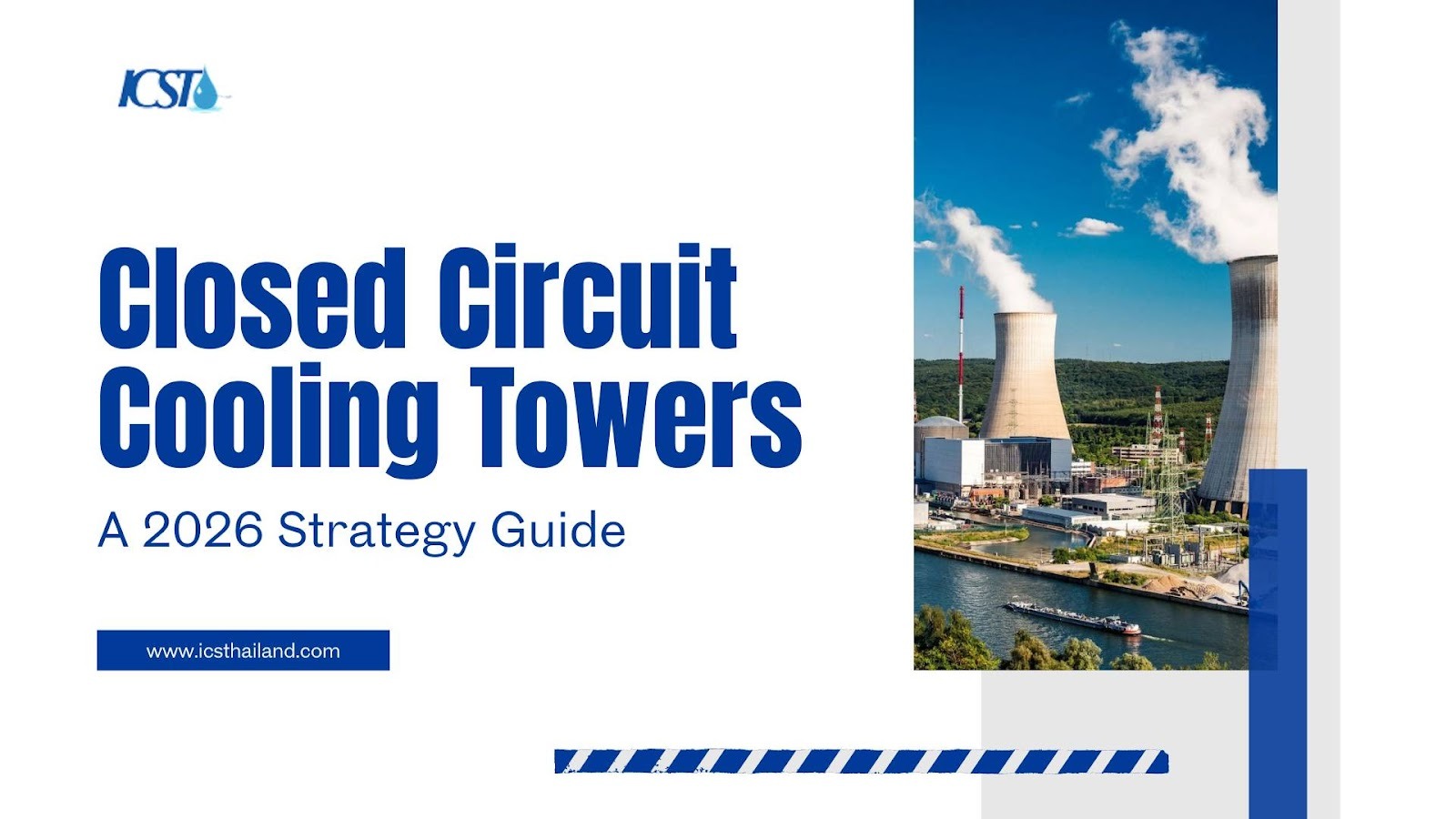
For high-density computing and sensitive manufacturing, traditional open cooling systems present significant risks. The standards for 2026 demand greater precision and protection. Indirect cooling systems, specifically closed circuit cooling towers, are becoming the new benchmark for industries that cannot afford contamination or downtime.
These systems deliver innovative, financially sound cooling solutions that shield your critical process equipment from the external environment. This guide explains when and why to specify a closed-circuit cooling tower for your facility.
What is a Closed-Circuit Cooling Towers?
A closed-circuit cooling tower, often called an evaporative fluid cooler, is an indirect cooling system. It operates by using a sealed loop to completely isolate the process fluid from the surrounding atmosphere. This design prevents contamination and maintains the purity of the fluid, cooling your equipment.
The system is built on a two-circuit architecture:
- Internal Circuit: The primary process fluid, which can be water or a water/glycol mixture, circulates inside a series of high-performance coils. These coils remain sealed from the outside environment. Depending on the application, they can be constructed from materials like Titanium, Stainless Steel 316L, or Copper.
- External Circuit: A separate body of spray water cascades over the exterior surface of the sealed coils. As this water evaporates, it draws heat away from the coils and the internal process fluid. This heat is then rejected into the atmosphere.
This dual-circuit design provides a clean cooling advantage. Open cooling towers function much like large air scrubbers, pulling in dust, pollen, debris, and biological contaminants from the air and mixing them directly into the process water. A closed circuit tower eliminates this effect, ensuring only clean, high-quality fluid reaches your sensitive equipment.
Performance Matrix: Closed vs. Open vs. Dry Cooling
Choosing the right cooling technology depends on your specific goals for system purity, water usage, and performance. Here is a comparison of the three primary types of cooling systems.
| Feature | Closed Circuit Tower | Open Circuit Tower | Dry Cooler |
| System Purity | Laboratory Clean | Exposed to Atmosphere | Laboratory Clean |
| Cooling Limit | Approaches Wet-Bulb | Wet-Bulb Temp | Dry-Bulb Temp (Higher) |
| Water Usage (WUE) | Optimized (Spray-Only) | High (Full Evaporation) | Zero |
| Fouling Risk | Near-Zero (Internal) | High (System-Wide) | Zero |
| Ideal For | AI Data Centers / Pharma | Power Generation | Arid Desert Sites |
Why to Specify a Closed Loop in 2026
The decision to implement a closed-loop system is a strategic one that brings significant operational and financial benefits, particularly as industry standards evolve.
Contaminant Isolation
High-efficiency equipment, such as modern chillers and plate-and-frame heat exchangers, relies on clean process water to function correctly. The scaling and fouling caused by contaminants in an open-loop system degrade performance over time.
This forces your equipment to work harder, increasing energy consumption and raising your Power Usage Effectiveness (PUE). A closed circuit tower isolates the process fluid, protecting your investment and ensuring sustained efficiency.
Operational Flexibility (Free Cooling)
Advanced closed-circuit systems offer multiple operational modes. During cooler months or periods of low humidity, they can run in a “Dry Mode.” In this mode, the spray water pump is turned off, and the system functions like a dry cooler, using only ambient air to reject heat. This adjustment allows facilities to eliminate water and chemical treatment expenses during certain times of the year, resulting in significant cost savings.
Meeting Sustainability Targets
Global regulations around water use and environmental impact are becoming more stringent. Closed-circuit cooling towers directly address these concerns. By recirculating the external spray water and minimizing evaporation, they use significantly less water than open systems.
This leads to a reduction in wastewater discharge and blowdown volume, helping your facility meet Water Usage Effectiveness (WUE) targets and align with new climate change cooling requirements.
When to Use: Specialized Industrial Applications
While beneficial in many scenarios, closed-circuit cooling towers are essential for certain specialized applications where purity and reliability are non-negotiable.
- AI & High-Density Data Centers: The latest direct-to-chip (DTC) cooling architectures require ultra-pure water loops to function. Any contamination could lead to catastrophic failure. Closed-loop systems are the only way to guarantee the required level of fluid purity.
- Pharmaceuticals & Food Processing: In these industries, preventing bacterial or airborne contamination is a matter of safety and regulatory compliance. A closed-circuit tower ensures there is zero risk of the cooling stream introducing contaminants into the production environment.
- Corrosive Environments: Coastal installations or facilities near industrial plants are exposed to salt air or acidic conditions that quickly corrode open systems. Closed towers with specialized coils, such as those made from titanium, provide a robust barrier against these destructive elements.
- Geothermal Heat Exchange: Geothermal systems often deal with water containing high mineral loads from subsurface sources. A closed loop isolates these minerals within a contained circuit, preventing them from fouling and damaging the primary facility equipment.
Selection and Operational Excellence
Properly implementing a closed-circuit system goes beyond the initial purchase. It requires precise engineering and a modern approach to maintenance.
First, accurate sizing is critical for efficiency. You should work with engineering partners who utilize advanced cooling system design software. This allows you to model system performance based on specific environmental conditions, such as the high humidity extremes common in many regions, to ensure the selected tower meets your load requirements under all anticipated scenarios.

Second, your maintenance strategy should shift from a reactive “break-fix” model to one of predictive monitoring. While the internal circuit is protected, the external spray-side can still experience scaling. By monitoring heat transfer performance, you can predict and address potential issues before they impact the system’s efficiency, ensuring it operates at peak performance throughout its lifecycle.
Conclusion: Engineering the Future of System Integrity
In summary, a closed circuit cooling towers delivers unmatched reliability, purity, and efficiency for industries that require strict environmental control and optimal performance.
With its ability to prevent contamination, cut water and energy costs, and meet the latest sustainability standards, this system stands out as the go-to choice for modern data centers, manufacturing, and critical infrastructure. Adopting a closed-circuit cooling tower not only safeguards your equipment but also maximizes your facility’s long-term return on investment and operational excellence.
Ready to future-proof your operations with ICST? Contact our experts today to schedule a custom thermal audit and discover how a closed-circuit cooling tower can transform your facility’s performance and sustainability.
Frequently Asked Questions (FAQs)
What is a closed circuit cooling towers?
A closed circuit cooling towers is an indirect cooling system that uses a sealed loop to isolate the process fluid, preventing contamination and ensuring system purity.
How does a closed circuit cooling towers work?
It operates with two circuits: an internal circuit that keeps the process fluid sealed in coils and an external circuit where spray water evaporates to reject heat into the atmosphere.
Why choose a closed circuit cooling towers over an open system?
Closed circuit towers protect equipment from contaminants, reduce fouling risks, optimize water usage, and align with sustainability goals like Water Usage Effectiveness (WUE).
What industries benefit most from closed-circuit cooling towers?
Industries like AI data centers, pharmaceuticals, food processing, and facilities in corrosive environments or geothermal applications benefit significantly from closed-loop systems.
Can closed circuit cooling towers save water and energy?
Yes, they reduce water usage through optimized spray systems and can operate in “Dry Mode” during cooler months, saving energy and chemical treatment costs.