Winter brings a high-stakes challenge to facility managers and HVAC engineers. The reward? Massive energy savings.
The risk? Catastrophic system freeze-ups. Cold weather cooling operations turn frigid ambient air into an opportunity for free cooling, but only with precise freeze protection and risk mitigation.
A successful cold-weather cooling operation involves using the cooling tower (with techniques such as water-side economization) as the primary heat rejection element.
This approach reduces chiller-dependent energy consumption and enables significant cost savings provided that crucial threats like ice formation, inadequate basin heating, or failed immersion heaters are proactively addressed.
The Cold Weather Cooling Operations Arsenal: 7 Technical Secrets
Achieve energy efficiency and complete freeze protection with these actionable strategies. Implement them to optimize cold-weather cooling operations and protect your assets from ice formation and system failures.
- The Flow/Temp Mandate for Freeze Protection: Always combine temperature sensors with low-flow alarms in your cold-weather cooling operations. Stagnant water is the main cause of ice formation; flow sensors act as an essential safeguard.
- Optimal Changeover Setpoint for Energy Savings: The switchover from mechanical cooling to water-side economization depends on calculated ROI, not a fixed temperature. Assess at what point auxiliary pumps and fans consume less energy than chiller operation.
- Annual Glycol Refractometer Testing: For any system relying on glycol for freeze protection, always verify concentration with a refractometer, not just log entries, to ensure adequate protection during winter.
- Condenser Water Sweet Spot for Ice Prevention: Use fan modulation to hold tower discharge between 40°F–45°F. Maintain efficiency while minimizing the risk of ice formation in your cold-weather cooling operations.
- Enforce 42°F Chiller Shutoff Rule: Protect your chiller with non-negotiable controls that trigger shutdown or inject glycol if outflow drops below 42°F. This provides immediate freeze protection.
- Heat Trace/Insulation Audit for Piping: Physically inspect heat tracing, insulation, and immersion heaters, especially on non-circulating lines and basins. These are vulnerable to freezing when recirculation systems are dormant.
- Comprehensive Pre-Winter Descaling: Clean and descale all parts of your system before the cold season. Scale and debris create perfect spots for localized freezing and can undermine freeze protection.
Phase I: The Pre-Season Playbook Prepare Physical Integrity & Water Chemistry
Pre-season preparation for cold-weather cooling operations is non-negotiable. Focus on physical integrity, correct installation of basin heating, and chemical stability to prevent ice formation and equipment failure.
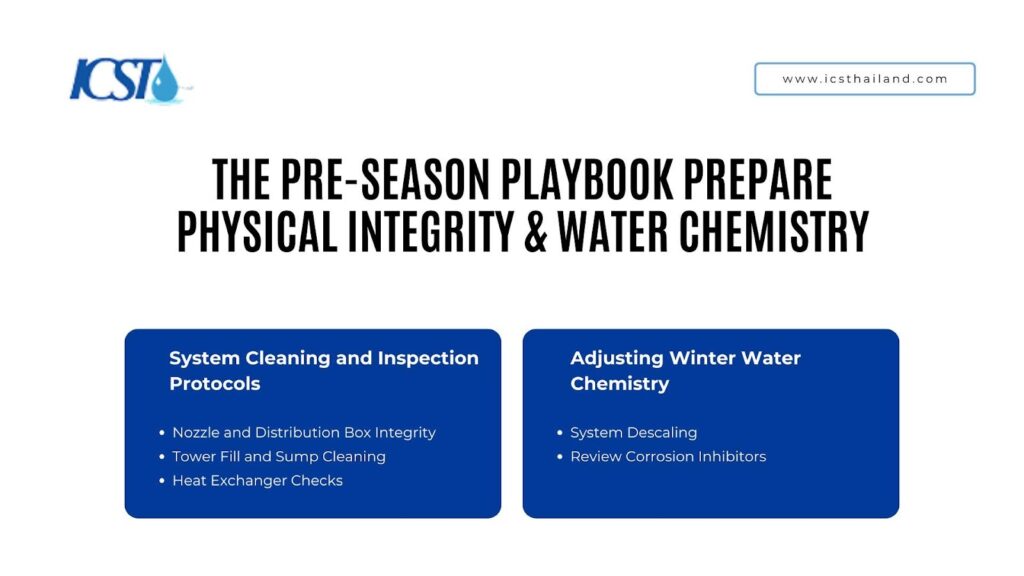
System Cleaning and Inspection Protocols
Routine physical inspection and cleaning minimize weak points.
- Nozzle and Distribution Box Integrity: Keep all nozzles unclogged. Blockages promote uneven flow and rapid ice formation, threatening system stability.
- Tower Fill and Sump Cleaning: Remove debris and biological buildup from sump and tower fill, eliminating entry points for ice in your cooling operations.
- Heat Exchanger Checks: Open plate-and-frame economizers and chiller ends for direct cleaning and integrity verification.
Adjusting Winter Water Chemistry
- System Descaling: Base winterization on thoroughly descaling to protect against trapped water, which can freeze and rupture pipes.
- Review Corrosion Inhibitors: Adjust chemical blends for low temperatures and low flows to ensure corrosion does not compromise freeze protection.
Phase II: Maximizing Energy with Optimized Free Cooling
Leverage cold weather cooling operations to their full potential by switching to water-side economization. This means significant energy savings as the cooling tower and plate heat exchangers handle the thermal load.
The transition setpoint must consider real data. Compare pump and fan loads with chiller demand. When the numbers favor auxiliary equipment, move to free cooling.
Maintaining tower discharge at 40°F–45°Fas in, maximizes energy efficiency and guards against ice formation.
Cooling Control Systems: Modulation & Staging
- VFD Tuning: Variable Frequency Drives allow for smooth, continuous modulation, avoiding stress and sudden freezes from cycling. Integration with Cooling Control Systems enables real-time adjustment for consistent performance.
- Chiller Staging: When mechanical cooling is necessary, follow a lead/lag pattern so no machine drops below its recommended minimum load, preserving both performance and asset longevity. Cooling Control Systems simplify this complex choreography.
Phase III: The Zero-Tolerance Freeze Protection Zone
This phase demands real-time, automated controls and emergency protocols. Risks such as rapid temperature swings make continuous readiness crucial.
Active Freeze Protection Logic
- Flow Guardrails: Deploy advanced control logic for immediate intervention at any low-flow detection in the cooling tower, basin, or piping.
- Chiller Tube Freeze Protection: Use hard-coded, automated logic for immediate shutdown or glycol injection when required.
Basin and Piping Protection
- Basin Heater Audits & Immersion Heater Checks: Ensure every basin heating element is properly sized, tested, and monitored before winter.
- Physical Inspection of Heat Trace and Insulation: Confirm all exposed, non-circulating lines and overflows have working heat trace and intact insulation to prevent freezing.
- Recirculation Systems: Keep water moving in idle times. Dedicated pumps are essential for freeze protection across all areas, including tower basins and ancillary lines.
Glycol System Integrity
- Annual Testing: Test and document glycol concentrations. Protective levels must always be below your facility’s record low.
ROI and Industry Benefits of Zero-Risk Operations
Implementing best practices for cold-weather cooling operations returns high-value benefits:
Comparative Energy Savings Table
| Method | Energy Use | Average Savings | Notes |
| Standard Chiller Operations | High | Baseline | No free cooling |
| Optimized Free Cooling (with Freeze Protection) | Low | 60%–90% reduction | Basin heating, immersion heaters, and controls are mandatory |
| Mixed-Mode (Partial Free Cooling) | Moderate | 30%–50% reduction | Recirculation systems assist |
- Massive Energy Savings: Reduce chiller consumption by up to 90% with optimal free cooling and freeze protection.
- Zero Catastrophe: Avoid unexpected downtime and $50,000–$200,000 repair events from freeze damage.
- Longer Equipment Life: Lower mechanical stress on chillers, fans, and pumps due to controlled operations.
- Precise Chemical Use: Maintain efficient treatment and avoid overuse with close chemical management.
- Utility Cost Reductions: Flexible load management keeps demand charges low during winter.
- Regulatory Compliance: Minimize discharge and prevent environmental breaches from freeze-related failures.
- Asset Value: Well-maintained, efficient systems boost overall facility value and reliability.
Cold Weather Cooling Operations Quick-Start Checklist
| ✓ | Task | What To Do |
|---|---|---|
| ☐ | Verify flow/temp sensors | Check operational accuracy, calibrate if readings drift >2°F |
| ☐ | Audit heat tracing, insulation, immersion heaters | Inspect for damage, test all circuits at full load before winter |
| ☐ | Test glycol levels | Use refractometer—target 25-40% concentration |
| ☐ | Clean tower fill, sump, and nozzles | Remove scale, debris, and blockages |
| ☐ | Confirm basin heater operation | Validate wattage output and thermostat calibration |
| ☐ | Update winter water chemistry | Adjust corrosion inhibitors, set pH 7.5-8.5 |
| ☐ | Document baseline energy consumption | Record kW usage for ROI tracking and comparison |
Conclusion
Optimizing cold-weather cooling operations is essential for protecting assets, maximizing energy savings, and ensuring uninterrupted performance during winter. Implement these proven strategies now to reduce risk, cut costs, and increase reliability across your facility.
Take action today with ICST, review your system, update your protocols, and make cold-weather cooling operations your next efficiency success.
Frequently Asked Questions
What cooling methods work in cold weather?
Air-cooled: No freeze risk, ideal for sub-freezing temps.
Water-cooled: Most efficient, needs 25-40% glycol for freeze protection.
Evaporative towers: 15-20% more efficient per 10°F drop, requires basin heaters and continuous flow.
How does cold weather improve efficiency?
Lower temps increase heat transfer and reduce compressor work:
- 1-2% chiller efficiency gain per degree drop
- 60-80% less fan energy below 40°F
- 15-25% compressor power savings at 30°F
Free cooling saves 40-70% annual costs when outdoor temps meet process needs.
How do cooling towers prevent freezing?
Basin heaters keep water above 40°F.
Heat tracing on all outdoor pipes.
Continuous circulation via bypass loops and VFD fans.
Smart controls cycle fans, isolate cells, monitor temps at 38-40°F.
What temperature defines cold weather operations?
50-40°F: Begin monitoring
40-32°F: Active freeze protection
Below 32°F: Full winterization required
Most facilities activate protocols at 45°F.
What are risks without cold weather protection?
Damage: Cracked equipment, burst pipes ($15K-$250K repairs)
Downtime: 2-5 days, $10K-$50K/hour lost production
Safety: Ice hazards, structural damage
Prevention costs $5K-$25K annually—far less than one emergency repair.