Exporting industrial cooling systems involves more complexity than shipping standard machinery. Navigating cooling equipment export regulations requires a deep understanding of refrigerant laws, structural engineering principles, and environmental impact assessments.
Incorrect handling of these regulations can lead to significant project delays and unforeseen tariff costs, disrupting your supply chain and budget. Trade compliance is not just a requirement; it is a critical framework for success.
Our regional office in Bangkok is strategically positioned to navigate the logistical “Goldilocks Zone” between key markets in Asia and the Middle East. This guide provides a clear framework for trade compliance. We will help you understand customs classification, export controls, and international standards to ensure your cooling equipment reaches its destination without costly setbacks.
Technical Customs Classification: The Foundation
Proper customs classification is the bedrock of successful international shipping. For cooling equipment, this means accurately identifying the Harmonized System (HS) code. An incorrect code can lead to shipment seizure, duty penalties, and significant project delays.
HS Codes for Cooling Towers
Industrial cooling equipment often falls under a complex classification structure. A common point of confusion is between Heading 8415 (Air Conditioning) and Heading 8418 (Refrigerators/Freezers).
For most industrial cooling solutions, the critical classification is 8418.69, which covers “Other” refrigerating or freezing equipment. This distinction is essential for declaring the correct function of the equipment and avoiding misclassification.
2025 Updates to Watch
Global trade regulations are constantly evolving. In 2025, businesses exporting to the Middle East must pay close attention to the Gulf Cooperation Council (GCC). The GCC is moving toward a 12-digit HS code system, demanding greater granularity and precision in customs declarations. Staying ahead of such domestic regulations is vital for uninterrupted market access.
Essential Trade Compliance & Export Controls
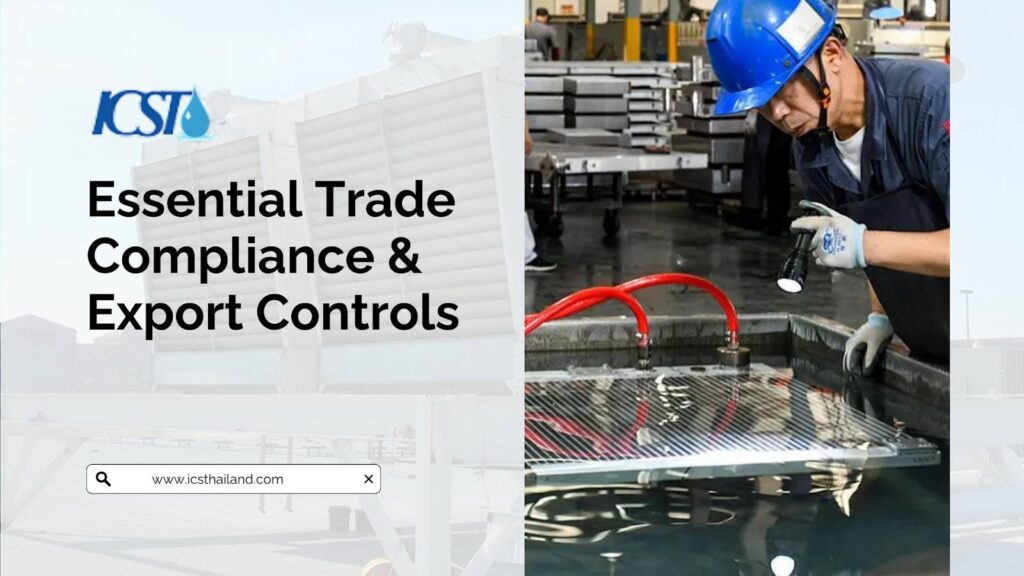
Beyond customs codes, exporting high-performance cooling equipment requires navigating a web of trade compliance and export controls. Certain technologies are considered “dual-use,” meaning they have both commercial and potential military applications.
Dual-Use Technology and Licensing
High-performance cooling systems, such as those designed for large data centers or nuclear facilities, can trigger specific export controls. International frameworks like the Wassenaar Arrangement, the Australia Group, and the Nuclear Supplier Group (NSG) regulate the export of dual-use items.
If your cooling equipment falls into this category, you must secure an export license. An End-User Statement is often required to verify the equipment’s final application, especially for critical infrastructure projects.
The Kigali Amendment and Refrigerants
The Kigali Amendment to the Montreal Protocol mandates a global phase-down of hydrofluorocarbons (HFCs). This has direct implications for cooling equipment. Exporters must ensure that the refrigerants in their systems, such as certain hydrocarbons or nitrogen-based solutions, comply with the destination country’s Global Warming Potential (GWP) limits.
Exporting a system with a banned refrigerant or controlled substances, like some ozone-depleting substances, will result in rejection at the border. You must align with national regulations and implementation plans for HFCs.
Shipping Documentation & Logistics Mastery
Flawless documentation is the key to mastering logistics. A single missing or incorrect document can halt a shipment indefinitely. For industrial cooling equipment, the paperwork must be as robust as the engineering.
Key shipping documents include:
- Commercial Invoice: This must go beyond price and include detailed technical specifications of the equipment.
- Certificate of Origin (COO): Leveraging a COO from a country with favorable trade agreements, like Thailand’s access to ASEAN and RCEP, can significantly reduce tariffs for the importing party.
- Technology Control Plan (TCP): For specialized or dual-use cooling designs, a TCP may be required to outline how sensitive technology is managed and protected during transit and installation.
- Hazardous Materials Declaration: If a system is pre-charged with refrigerants, it falls under the International Maritime Dangerous Goods (IMDG) code. Proper handling and documentation are mandatory to ensure safety and compliance.
Aligning with International Standards (ISO/AHRI/CTI)
In the global market, buyers demand proof of quality and performance. Adherence to internationally recognized standards is no longer optional; it is a prerequisite for market access. These certifications demonstrate that your equipment meets rigorous benchmarks for efficiency, safety, and environmental responsibility.
Performance and Quality Certifications
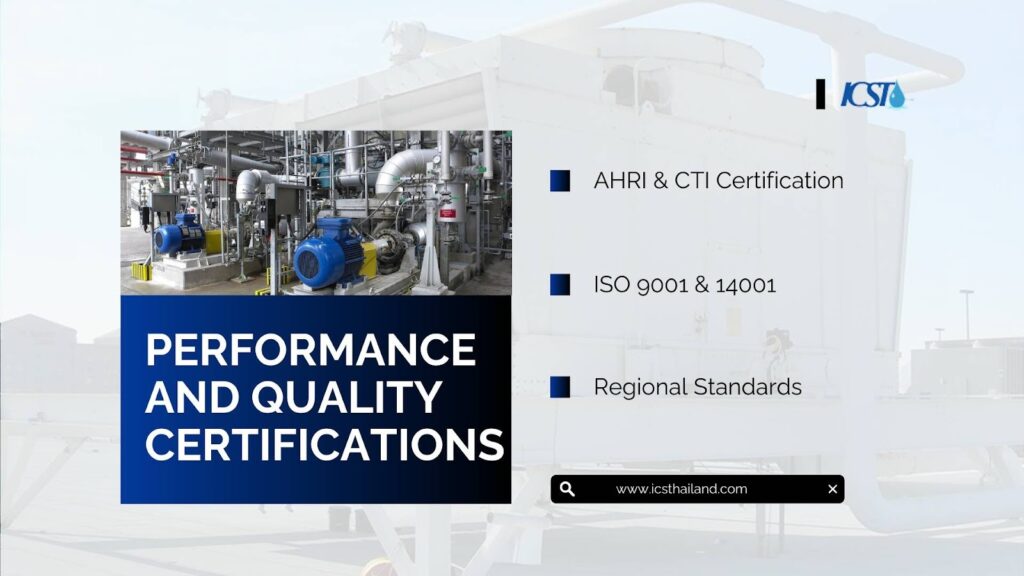
- AHRI & CTI Certification: The Air-Conditioning, Heating, and Refrigeration Institute (AHRI) and the Cooling Technology Institute (CTI) provide performance certifications. CTI STD-201, for example, is a key standard for verifying thermal performance that many international buyers request before finalizing a purchase.
- ISO 9001 & 14001: ISO 9001 demonstrates a commitment to quality manufacturing processes, while ISO 14001 shows dedication to environmental management. These are often essential to compete for “Green Tenders” and large-scale projects.
- Regional Standards: Exporters must also be aware of regional requirements, such as Eurovent in the European Union and SASO standards in Saudi Arabia. The European Commission, for instance, has adopted measures that affect equipment entering the EU market.
ICST Case Study: Regional Speed & Compliance
Our strategic location in Bangkok offers a distinct advantage. We can dispatch personnel and equipment to project sites across Asia within hours and reach the Middle East in under a day. This rapid response capability minimizes downtime and accelerates project timelines.
We specialize in engineering custom solutions for challenging environments, such as systems designed for “dirty water” or corrosive “seawater” applications. Our expertise lies in balancing this customization with strict adherence to the destination country’s environmental laws and import regulations.
Assisting importing parties operating in unique conditions is a core part of our business. We develop a solution involving advanced technologies while ensuring complete compliance.
Future-Proofing Your Cooling Supply Chain
Navigating the complex landscape of cooling equipment export regulations is not a hurdle; it is a competitive advantage. Proactive trade compliance protects your business from risk, reduces costs, and builds trust with international partners.
By mastering customs classification, export controls, and international standards, you can future-proof your supply chain and ensure your solutions reach the global market efficiently.
Ready to engineer a compliant cooling solution for your next project? Visit our ICST for expert technical and regulatory assistance.
Frequently asked questions
What are cooling equipment export regulations?
Cooling equipment export regulations are international trade rules that govern cross-border shipments of refrigeration and cooling systems. These regulations ensure compliance with customs laws, environmental standards, and import requirements for each destination country.
Why is customs classification critical under cooling equipment export regulations?
Accurate HS code classification is required by cooling equipment export regulations to prevent delays, penalties, and incorrect duties. Proper classification ensures your shipments clear customs smoothly and meet all regulatory requirements.
How do cooling equipment export regulations address refrigerant standards?
Cooling equipment export regulations enforce the Kigali Amendment, which phases down HFCs globally. Exporters must use refrigerants meeting specific global warming potential (GWP) limits for each destination market.
Do cooling equipment export regulations require export licenses?
Yes, cooling equipment export regulations may require licenses for high-performance or dual-use systems. Advanced cooling equipment for data centers, military, or nuclear facilities typically needs special export authorization.
What certifications satisfy cooling equipment export regulations?
ISO 9001, CTI STD-201, CE marking, and UL certification help meet cooling equipment export regulations. These certifications prove your equipment complies with international quality, safety, and performance standards required for export.