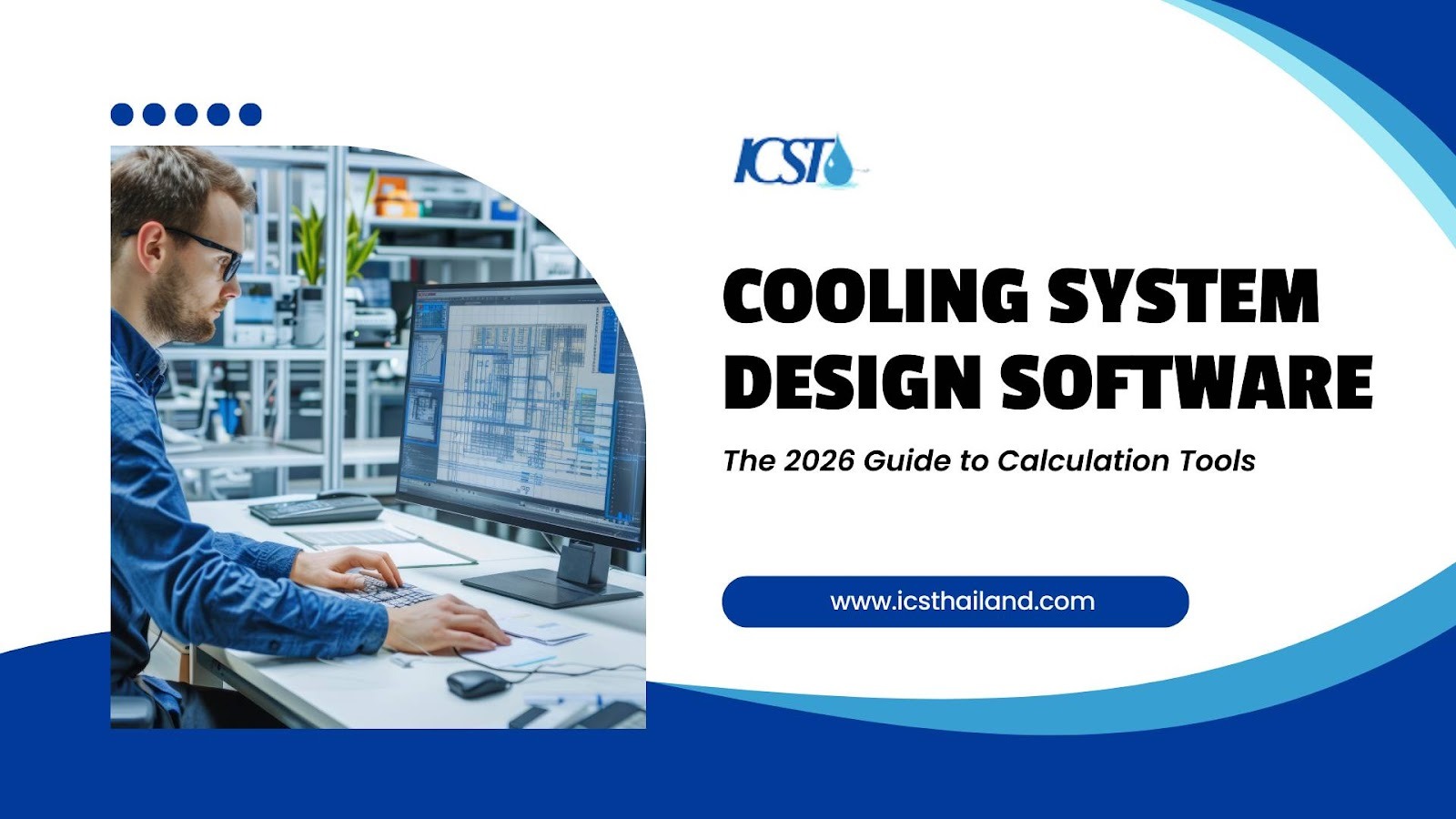
In the evolving world of digital engineering, cooling system design software has become the backbone of high-performance projects. The era of oversized safety margins has ended. In 2026, strict energy mandates drive the market. Regulations regarding Power Usage Effectiveness (PUE) and Water Usage Effectiveness (WUE) require absolute precision. We no longer rely on guesswork. We utilize high-fidelity system simulation to meet these demanding targets.
At ICST, we bridge the gap between financial feasibility and environmental sustainability. We use innovative software to create designs that save cost and power. Our vision centers on optimization. We do not just select equipment; we engineer outcomes.
Our Bangkok Regional Hub operates with a digital-first approach. This strategy allows our team to dispatch customized designs and field support across ASEAN within hours. We ensure every project receives the detailed attention it deserves.
2026 Cooling System Design Software Comparison Matrix
Choosing the right tool is critical for success. Engineers must select software that matches the specific depth of the project. We have categorized the leading tools for 2026 below.
| Software Category | Target LSI Application | Leading 2026 Tools | ICST Critical Advantage |
| Load Calculation | Thermal Load Assessment | Trane TRACE 3D / IESVE | Exact sizing for heavy industrial loads. |
| Psychrometric | Atmospheric Analysis | Hands Down / Akton | Vital for Bangkok’s high-humidity zones. |
| Piping & Hydronics | Fluid Dynamics / Piping Design | Pipe-Flo / Revit MEP | Low pumphead & low power optimization. |
| System Simulation | Performance Prediction | Ansys Fluent (CFD) | Modeling seawater & acidic airflows. |
| Vendor Selection | Component Specification | Danfoss Coolselector®2 | Unbiased performance validation. |
The Core Pillars of Modern Thermal Design
Load Calculation Tools
Modern facilities operate 24 hours a day, 365 days a year. We have moved beyond static peak calculations. We now utilize an 8,760-hour annual energy model. This approach is essential for data centers and industrial plants. It allows us to account for varying operating conditions and optimize system performance over time. Accurate cooling loads prevent energy waste and ensure equipment longevity.
Psychrometric Software
Understanding the science of air-water vapor mixtures is crucial. In 2026, we face strict environmental regulations in urban centers. We utilize psychrometric software to solve Low Plume and Low Drift requirements. This analysis ensures that cooling towers do not negatively impact the surrounding environment. It provides confidence in the design conditions before installation begins.
Piping Design & Fluid Dynamics
Parasitic energy consumption kills efficiency. We focus on engineering for low pumphead pressure. Advanced piping design software allows us to minimize resistance in the loop. We create layouts that require less power to move fluids. This leads to significant long-term savings for the facility owner.
LSI Integration: Vendor Selection
Vendor selection requires rigorous analysis. ICST uses software to evaluate international vendor components. We test against “Dirty Water” and “Seawater” durability standards. We do not accept manufacturer claims at face value. We verify that materials and components will perform under harsh local conditions.
Designing for Critical & Custom Requirements
Geothermal Simulation
Some projects demand specialized solutions. We use subsurface modeling to simulate geothermal applications. This ensures the long-term thermal stability of borefields. Heat pumps rely on this data to maintain efficiency. Without accurate simulation, the ground temperature may shift, causing system failure.
Seawater & Acid Resilience
Standard materials often fail in corrosive environments. We utilize Computational Fluid Dynamics (CFD) to model corrosive flow patterns. Tools like Ansys Fluent help us select appropriate Fiber Reinforced Plastic (FRP) or Titanium materials. This level of detail prevents catastrophic leaks and extends the life of the systems.
Optimized Footprint
Space is premium real estate in dense urban areas like Bangkok or the Middle East. We leverage Building Information Modeling (BIM) to fit high-capacity cooling into tight spaces. This intuitive tool allows us to visualize the equipment in 3D. We ensure access for maintenance is not compromised.
Strategic Safety & Integration Modelling
Hydraulic Validation for Fire Safety
Safety is our top priority. We perform hydraulic validation to ensure piping design supports cooling and emergency fire water integration. The software confirms that the system can handle the demand during a crisis. We verify that water pressure remains stable for both fire protection devices and cooling needs.
Emergency Scenario Simulation
Disaster can strike at any time. We use system simulation to develop disaster recovery protocols before a failure occurs. We model potential breakdowns to see how the system reacts. This allows us to create effective emergency schedules. If your calculations reveal an immediate performance risk, you must act fast.
Competitor Gap Analysis: Tools vs. Expertise
The “Black Box” Risk
Many users rely on free online calculators. This is a mistake. Relying on these simple tools without professional software validation leads to “Performance Drift.” The accuracy of a free program is often low. It does not account for complex variables. Professional engineers know that a “black box” calculator cannot replace detailed engineering analysis.
Localized Dataset Overrides
Standard software often uses US or EU defaults. These presets do not reflect the reality of Asian climates. ICST overrides these defaults. We use field-verified data from local seawater and heavy industrial installations. Our database includes accurate temperature and humidity profiles for the region. This ensures the simulation matches the real world.
Excellence in Execution
A design is only as good as the support behind it. Software provides a plan, but technical assistance ensures success. We validate the design on-site. We compare the reports generated by the software with actual operating data. This feedback loop improves our accuracy for future projects.
Conclusion: Engineering the Future Together
In 2026, software serves as the foundation of every award-winning cooling project. It allows us to simplify complex problems and deliver superior results.
The ICST promise is clear. From our Bangkok hub, we merge the world’s most advanced digital tools with decades of heavy-industrial field experience. We offer more than just a drawing; we offer certainty.
Is your cooling system designed for the 2026 reality? Contact ICST’s Bangkok engineering team today for a Digital Performance Audit. See how our cooling system design software can optimize your next project. Explore the savings and efficiency gains that professional digital engineering provides.
Frequently Asked Questions (FAQs)
What is cooling system design software?
Cooling system design software helps engineers optimize HVAC systems by performing load calculations, piping design, and system simulations. It ensures energy efficiency and precise performance for various operating conditions.
How does load calculation improve HVAC system performance?
Load calculation tools analyze cooling loads over 8,760 hours annually, ensuring accurate sizing of equipment like heat pumps and cooling towers. This reduces energy waste and enhances system efficiency.
Why is psychrometric analysis important in cooling system design?
Psychrometric software evaluates air-water vapor mixtures, crucial for meeting Low Plume and Low Drift requirements in high-humidity areas. It ensures compliance with environmental standards and optimal system performance.
What are the benefits of using piping design software?
Piping design software minimizes pumphead pressure, reducing parasitic energy consumption. It optimizes fluid dynamics, saving power and improving the overall efficiency of HVAC systems.
How does ICST ensure accurate system performance?
ICST uses advanced tools like CFD simulations and localized datasets to validate designs. This approach ensures materials and components meet regional demands, delivering reliable and efficient cooling solutions.