The industrial landscape shifts constantly. The year 2026 marks a pivotal turning point for facility management. The practice of “safe over-sizing” has come to an end. Engineers once selected pumps far larger than necessary to ensure safety. Today, this practice represents a financial liability. Rising energy costs and strict Power Usage Effectiveness (PUE) mandates make efficiency the new standard.
A pump that is too large burns unnecessary capital on electricity. Conversely, machinery that is too small threatens catastrophic process failure. At International Cooling Solutions (Thailand) (ICST), we do not just supply pumps. We engineer hydraulic resilience. We tailor the water pumps to the specific process. Our designs range from low-pumphead models for refineries to vertical turbine systems for geothermal sites.
Our Bangkok Support Hub provides 24-hour rapid dispatch. We perform system audits and technical assistance across Asia and the Middle East. We ensure your cooling system pumps operate at peak performance.
Pump Capacity Calculation: The Flow Rate (Q) Equation
Precise calculation forms the foundation of a successful cooling system. The thermal load dictates the volume of water required. In 2026, we avoid the inefficiencies of estimated sizing. We utilize the Heat Balance Formula. This ensures the flow rate is exact.
The Heat Balance Formula
To determine the required flow, apply this physics equation:
Q = H / (ρ · Cp · ΔT)
- Q: Flow Rate ($m^3/s$)
- H: Heat Load ($kW$)
- ρ: Density of Water ($1,000 kg/m^3$)
- Cp: Specific Heat ($4.187 kJ/kg \cdot ^\circ C$)
- ΔT: Temperature difference between inlet and outlet.
This formula prevents energy waste. You do not move excess fluid. The equipment functions with precision.
Determining Total Dynamic Head (TDH)
Competitors often size a pump based on “lift height” alone. This is a common error. A true Industrial Pump Sizing Guide must account for Total Dynamic Head (TDH). This measures the total resistance the coolant pump must overcome.
You must calculate three distinct factors:
- Static Head: This is the vertical distance. Measure from the basin water level to the tower inlet.
- Friction Loss: Water encounters resistance in the line. Friction comes from pipe walls, elbows, and valves. Note that long-sweep elbows create less friction than sharp 90-degree turns.
- Equipment Pressure Drop: The cooling system acts as a barrier. The pump needs pressure to push water through the condenser bundle or spray nozzles.
The TDH Margin
ICST recommends a 10% safety margin in Thailand. This accounts for future mineral scaling in the pipes. Biofouling decreases pipe diameter. This will increase friction over time. Without this margin, a pump that is suitable today may fail later.
Cooling System Pump Selection Matrix
Selecting the correct architecture is critical. Different applications demand different mechanical designs. Generally, we categorize pumps into four types for 2026.
| Pump Type | Best-Use Case (2026) | Efficiency Advantage | ICST Specialized Value |
| End-Suction Centrifugal | Standard HVAC / Data Centers | High serviceability; Best for Low Noise. | Optimized Footprint designs |
| Vertical Turbine | Seawater Intake / Geothermal | Small footprint; No priming required. | Best for Seawater & Acid loops |
| Horizontal Split Case | Gigawatt Power / Large Refineries | Balanced loads; High flow efficiency. | Heavy Industrial reliability |
| Vertical In-Line | Retrofits / Urban High-Rises | Space-saving; Mounts directly into piping. | Perfect for dense Bangkok sites |
The “Critical Requirement”: NPSH and Cavitation
Cavitation destroys machinery. It occurs when pressure drops below the vapor pressure of the liquid. Bubbles form and implode. This damages the impeller.
The Vapor Pressure Gap
High ambient temperatures in Southeast Asia increase the risk. Temperatures often exceed 35°C. Warmer water has a higher vapor pressure. The air temperature impacts the liquid state. This narrows the safety margin.
NPSHa vs. NPSHr
You must analyze Net Positive Suction Head (NPSH). Ensure the Available head (NPSHa) exceeds the Required head (NPSHr). We recommend a minimum buffer of 0.5m. This protects the system from fluctuations.
Sizing for “Critical Requirements” (ICST Exclusives)
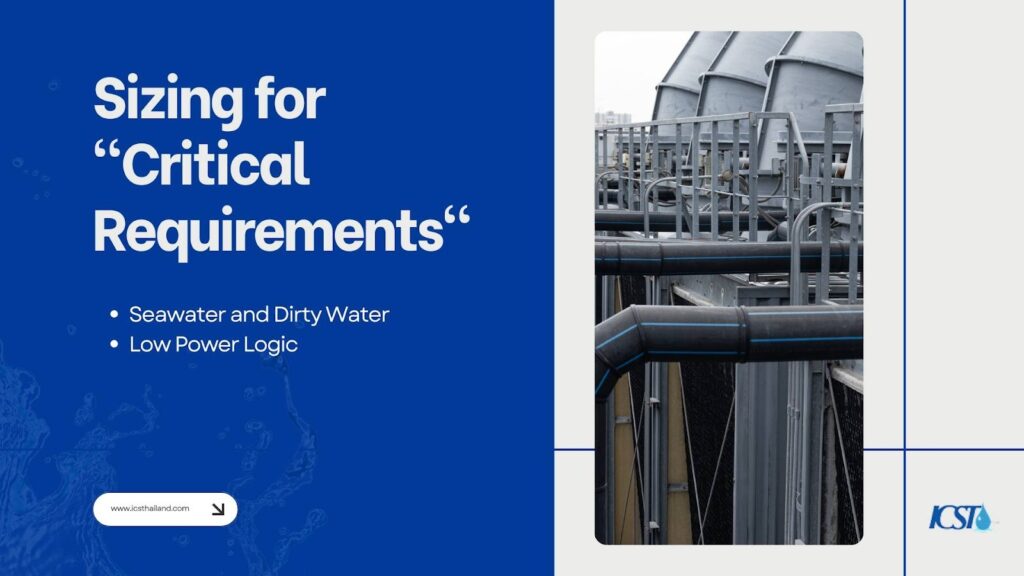
Standard sizing ensures the pump works. ICST sizing ensures it lasts. We look at the chemical and operational reality.
Seawater and Dirty Water
Cast iron pumps fail in high-salinity environments. Salt corrodes the housing. We specify Duplex Stainless Steel or AISI 316L. These products resist chemical erosion. They are suitable for dirty water functions.
Low Power Logic
A pump running at full speed wastes energy if the load is low. We use Variable Frequency Drives (VFDs). This allows for adjusting the speed. We match the pump speed to the real-time thermal load.
For example,
Slowing a pump by 20% can reduce energy use by 50%. This logic is ideal for modern sustainability goals. In addition, it reduces wear on the fans and motors.
Conclusion: Designing for Hydraulic Certainty
In 2026, the right cooling system pumps are a data-driven choice. You must use precise physics. You must understand local environmental challenges.
Do not guess. Accurately calculate TDH. Prioritize NPSH safety margins. International Cooling Solutions (Thailand) ensures your facility remains financially feasible.
Is your current pump wasting energy or suffering from vibration? Contact ICST’s Bangkok engineering hub today for a Hydraulic System Audit. Optimize your flow for the 2026 economy.
Frequently Asked Questions (FAQs)
What is the role of cooling system pumps in industrial applications?
Cooling system pumps circulate water or coolant to regulate temperature in industrial machinery, ensuring efficiency and preventing overheating.
How do I calculate the flow rate for a cooling system?
Use the Heat Balance Formula: ( Q = \frac{H}{\rho \cdot C_p \cdot \Delta T} ), where Q is the flow rate, H is the heat load, and ΔT is the temperature difference.
What is Total Dynamic Head (TDH) in pump sizing?
TDH measures the total resistance a pump must overcome, including static head, friction loss, and equipment pressure drop.
How can I prevent cavitation in coolant pumps?
Ensure the Net Positive Suction Head Available (NPSHa) exceeds the pump’s Required NPSH (NPSHr) by at least 0.5 meters to avoid cavitation.
Which pump type is best for seawater cooling systems?
Vertical turbine pumps are ideal for seawater cooling due to their corrosion-resistant materials and minimal priming requirements.