The definition of Industrial Cooling System ROI has changed fundamentally. In previous years, facility managers looked strictly at the electricity bill. In 2026, a truly comprehensive financial strategy must look beyond simple utility costs.
To calculate the true value of your cooling infrastructure, you must now factor in Tax Incentives (BOI), Carbon Credits, and Water Usage Effectiveness (WUE). The financial landscape has shifted. Sustainability is no longer just a buzzword; it is a primary driver of profit.
Consider the “Heat Tax.” This is a hidden cost that many factory owners in Thailand overlook. An inefficient system does not just cost more to run; it actively leaks money. Current data suggests that inefficient thermal management costs facilities up to ฿650,000 per year in hidden energy waste and thermal downtime.
The 4 Pillars of 2026 Cooling ROI
To build a profitable strategy, you must focus on four distinct areas. These pillars represent the difference between a cooling system that drains your budget and one that contributes to your bottom line.
1. Direct Energy Savings (The 35% Benchmark)
The most immediate return comes from modernization. Legacy systems often rely on fixed-speed motors that run at full capacity regardless of the actual demand. This is a waste of energy.
- VFD and Mag-Lev Efficiency: Technology is essential for meeting 2026 efficiency standards, emphasizing the shift to advanced Inverter systems. Variable Frequency Drives (VFD) and magnetic bearing (Mag-Lev) chillers adjust their output to match real-time needs. This eliminates energy waste during low-load periods.
- The Delta-T Factor: Optimization of heat exchange is critical. The “Delta-T” refers to the temperature difference between water entering and leaving the chiller. For every single degree of improvement in this differential, you can reduce chiller load by 5–8%.
2. Government & BOI Incentives (The 2026 “Cash-Back”)
Thailand’s regulatory environment now heavily favors green technology. Smart financial directors treat these incentives as direct revenue streams.
- 150% Tax Deduction: A significant 2026 Royal Decree allows companies to deduct 1.5 times the actual cost of certified high-efficiency cooling machinery from their taxable income. This effectively subsidizes your upgrade.
- BOI Notification 5/2568: This notification offers substantial benefits. Projects that achieve a “Green Factory” rating or improve Power Usage Effectiveness (PUE) can leverage 100% Corporate Income Tax (CIT) exemptions.
3. Productivity & Human ROI
Cooling is not just about machinery; it is about people. The temperature of your facility directly impacts the output of your workforce.
- The 4% Rule: Studies indicate that human productivity drops by approximately 4% for every degree the ambient temperature rises above 80°F (26.7°C). A hot factory is a slow factory.
- Retention ROI: The labor market in 2026 is competitive. Workers prefer comfortable environments. High-quality cooling is a retention tool that reduces staff turnover by up to 25% in heavy industrial zones.
4. Asset Longevity (CAPEX vs. OPEX)
We often see a hesitation to spend more upfront (CAPEX) even if it lowers operating costs (OPEX). However, the math supports higher-quality materials.
- FRP vs. Steel: Traditional steel towers rust, especially in Thailand’s coastal humidity. This leads to a “5-year rust cycle” where equipment needs major repair or replacement.
- The Pultruded Advantage: Selecting Pultruded Fiber Reinforced Polymer (FRP) requires a higher initial investment. However, it yields a 300% better ROI over 20 years by virtually eliminating corrosion-related failure.
2026 ROI Comparison: Legacy vs. ICST Modernization
The following table illustrates the financial disparity between maintaining an old system and upgrading to an ICST 2026 Modernized System.
| Financial Metric | Legacy System (Typical) | ICST 2026 Modernized System | ROI & Business Impact |
|---|---|---|---|
| Annual Energy Cost | ฿1,500,000 (High consumption due to inefficiencies) | ฿975,000 (Optimized thermal and airflow performance) | 35% reduction in electricity expenses |
| Annual Maintenance Cost | ฿300,000 (Reactive repairs and emergency fixes) | ฿90,000 (Predictive maintenance and monitoring) | 70% lower maintenance spending |
| Water Usage Cost | ฿150,000 (High losses from leaks and drift) | ฿112,500 (Optimized distribution and drift control) | 25% improvement in water ROI |
| Downtime & Production Loss | Frequent unplanned shutdowns | Minimal downtime with planned servicing | Higher operational continuity and revenue protection |
| Compliance & ESG Penalties | Risk of non-compliance and fines | Full alignment with 2026 ESG standards | Reduced regulatory and legal exposure |
| 2026 Tax Incentives | ฿0 (No eligibility) | ฿1,250,000 (150% accelerated deduction) | Direct equity and cash-flow gain |
| System Lifespan Extension | Limited remaining service life | Extended by 15–20 years | Higher long-term asset value |
| Payback Period | Not measurable | 14–19 months | High-speed return on investment |
| Overall Operating Efficiency | Low and declining | High and optimized | Sustainable competitive advantage |
The ICST “Critical Engineering” ROI Advantage
ICST is more than a cooling tower provider—we operate as a regional hub for “Net Profit” engineering. Our focus is on designing solutions that not only optimize performance but also maximize financial returns. Every design decision is aimed at reducing operating costs, extending system life, and delivering measurable ROI.
Low Pumphead Designs
Many facilities overlook the energy cost of moving water through the system. ICST designs minimize pump head pressure, reducing the energy required for circulation. This results in significant savings on secondary energy consumption, lowering electricity bills and improving overall system efficiency.
Seawater and Geothermal Integration
For sites near coastlines or geothermal sources, we harness “free cooling” from seawater or geothermal heat sinks. By leveraging these natural resources, we can cut chiller runtimes by 40–60%, reducing energy costs while maintaining optimal cooling performance year-round.
Dirty Water Capability
Industrial process water often contains debris and particulates, which can quickly foul standard systems and cause up to a 20% efficiency loss. ICST designs are engineered to handle dirty water without performance degradation, maintaining high efficiency and reducing maintenance requirements.
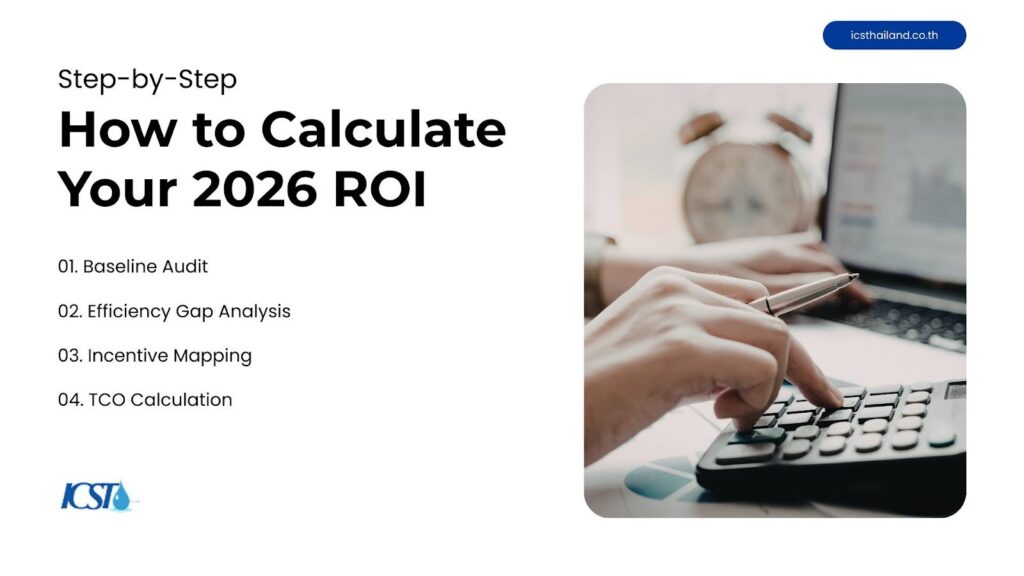
Step-by-Step: How to Calculate Your 2026 ROI
Evaluating the return on investment (ROI) for upgrading your cooling tower system in 2026 doesn’t have to be complicated. Follow this structured framework to quantify potential savings, justify your investment, and make data-driven decisions.
1. Conduct a Baseline Audit
Start by collecting the last 12 months of operational data, including utility bills, maintenance logs, water usage records, and downtime reports. This establishes a clear picture of your current energy, water, and maintenance expenditures. Understanding your baseline costs is essential to measuring the benefits of any upgrade.
2. Perform an Efficiency Gap Analysis
Calculate your system’s current energy efficiency in kilowatts per ton (kW/ton) or another relevant performance metric. Compare this with 2026 high-performance benchmarks for modernized cooling towers. The difference highlights your efficiency gap, revealing areas where upgrades or repairs will have the highest impact on energy savings.
3. Map Incentives and Tax Benefits
Review your system specifications and cross-check them with the criteria outlined in BOI Notification 5/2568 or other applicable 2026 incentives. Identify which tax breaks, accelerated depreciation, or other financial incentives apply to your upgrade. Properly accounting for these benefits can significantly improve your ROI calculations.
4. Calculate Total Cost of Ownership (TCO)
Model your Total Cost of Ownership over a 20-year horizon. Include capital investment, projected maintenance, energy costs, and operational savings. Factor in the 2026 tax depreciation or incentive benefits to see the true net cost. This comprehensive calculation allows you to compare legacy system costs versus a modernized system and estimate your payback period and long-term ROI.
Conclusion: The Smart Money is on Sustainability
In the financial climate of 2026, an inefficient cooling system is a liability on your balance sheet. It drains cash flow through energy waste, excessive maintenance, and lost productivity.
However, the opportunity for correction is significant. By combining ICST’s specialized engineering with the current wave of Thai tax incentives, you can transform a necessary utility into a profit-driving asset. The payback periods are short, and the long-term gains are substantial.
Would you like to develop a “2026 Cooling System ROI Audit Checklist”? This tool will help your team gather the exact data points needed for a professional BOI tax-break application and a 24-month payback model. Contact us today to get started.
Frequently Asked Questions (FAQs)
What is the ROI of upgrading industrial cooling systems in 2026?
Upgrading to modern cooling systems can deliver up to 35% energy savings, reduce maintenance costs by 70%, and qualify for significant tax incentives like the 150% BOI tax deduction.
How do BOI incentives impact cooling system ROI?
BOI incentives in 2026 allow businesses to deduct 1.5 times the cost of high-efficiency cooling equipment and offer 100% Corporate Income Tax exemptions for green-certified projects.
What are the key benefits of modernizing cooling systems?
Benefits include lower energy costs, improved productivity, reduced water usage, extended equipment lifespan, and compliance with sustainability standards.
How does cooling efficiency affect employee productivity?
Productivity drops by 4% for every degree above 80°F (26.7°C). Efficient cooling systems maintain optimal temperatures, boosting workforce performance and retention.
What is the payback period for modern cooling systems?
The payback period for modernized systems typically ranges from 14 to 19 months, thanks to energy savings, reduced maintenance, and tax benefits.
How Can ICST Designs Maximize Your Cooling System ROI?
ICST designs improve cooling system ROI by reducing energy consumption, minimizing maintenance costs, and extending equipment life. Features like low pumphead designs, free cooling integration, and dirty water handling ensure your system operates efficiently and delivers measurable financial returns.
Why Is Calculating Cooling System ROI Important Before Upgrading?
Calculating cooling system ROI helps you understand potential savings from energy efficiency, reduced water usage, and lower maintenance. It allows facilities to prioritize upgrades, justify investments, and ensure payback periods are realistic, supporting smarter financial and operational decisions.