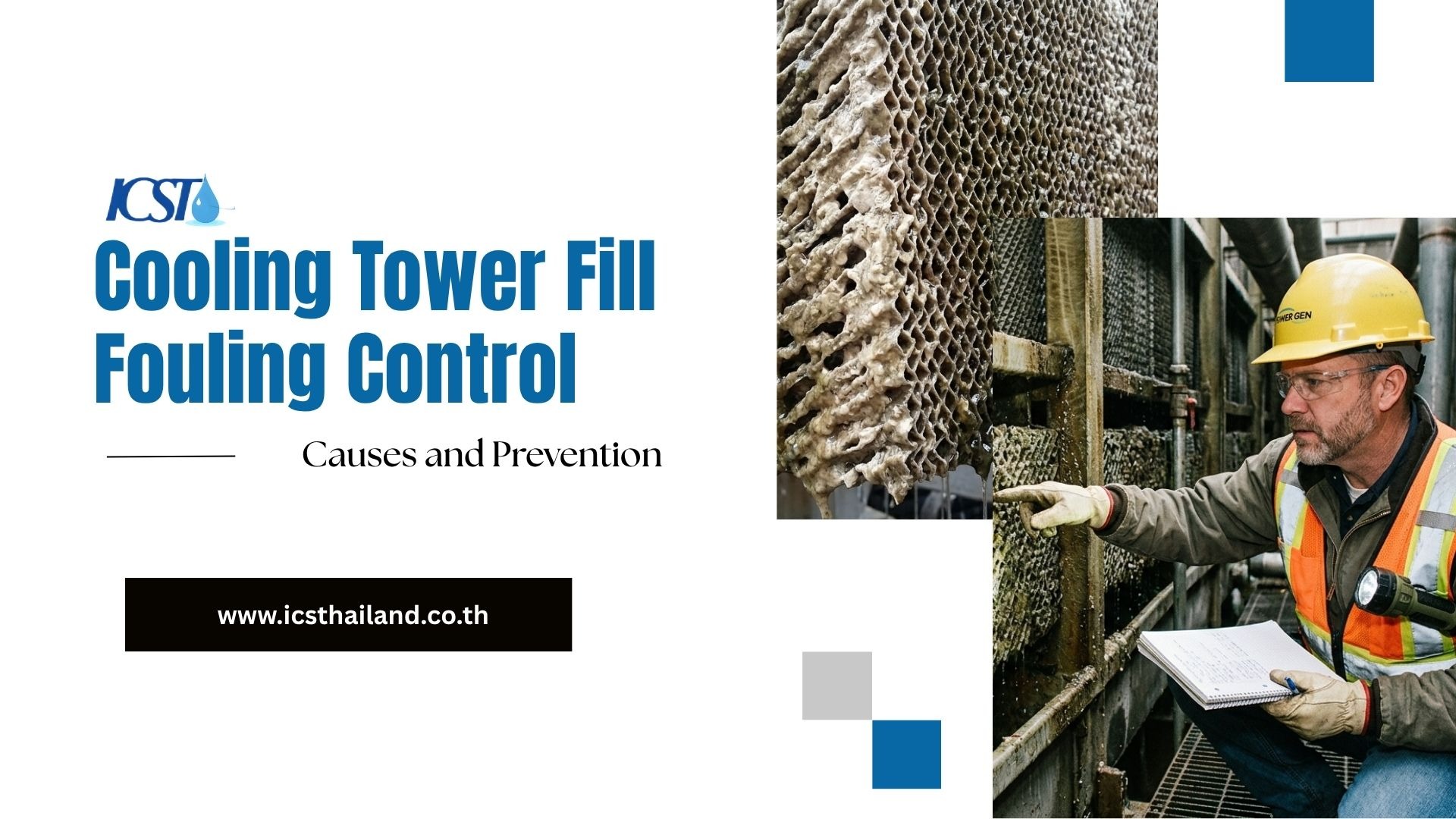
Cooling tower fill fouling control directly impacts thermal efficiency, airflow performance, water distribution, and long-term equipment reliability. When biofilm fouling, scale deposit, or particulate fouling blocks the fill media, the cooling tower loses heat transfer efficiency and consumes more fan and pump energy.
Industrial facilities must control fouling through water chemistry management, side-stream filtration, preventive maintenance, and proper acid cleaning procedures. Operators also need clear fill replacement criteria to determine whether cleaning can restore performance or whether damaged fill media requires complete replacement.
Why Fill Media Becomes the Primary Failure Point in Cooling Towers
Cooling tower fill media creates the large surface area required for efficient evaporative cooling. Water spreads across the fill while air moves through the tower, allowing heat transfer through evaporation.
Because fill media constantly remains wet and exposed to contaminants, it becomes the most vulnerable component inside the cooling tower.
The Function of Fill Media Inside the Cooling Process
Fill media slows water flow and maximizes air-to-water contact time. This process increases evaporation efficiency and improves cooling performance.
Most industrial towers use one of two fill types:
- Film fill
- Splash fill
Film fill creates thin water films for maximum heat transfer efficiency. Splash fill breaks water into droplets and performs better in dirty water environments.
The choice depends heavily on:
- Water quality
- Airborne contamination
- Process load
- Maintenance capability
Film fill delivers excellent efficiency but fouls rapidly under poor water conditions.
Why Fouling Starts Inside the Fill First
Fill media creates low-velocity zones where suspended solids and microorganisms accumulate easily. Warm recirculating water accelerates:
- Bacterial growth
- Mineral precipitation
- Organic slime formation
- Debris entrapment
As deposits increase, airflow resistance rises rapidly. Water distribution also becomes uneven, reducing cooling effectiveness across the entire tower.
Biological Fouling and Biofilm Development Mechanisms
Biological fouling is one of the most aggressive forms of cooling tower contamination, making effective cooling tower fill fouling control a critical maintenance priority. Once biofilm develops inside the fill pack, thermal performance deteriorates rapidly.
How Biofilm Fouling Forms
Bacteria constantly enter the cooling system through the ambient air intake. These microorganisms seek out surfaces to attach themselves and begin their growth cycle.
Once attached, bacteria secrete a protective matrix that forms a dense slime layer. This complex matrix traps additional nutrients, debris, and suspended particles from the water stream.
Nutrient-rich warm water provides the exact conditions needed for rapid biological proliferation. Organic contamination from process leaks further feeds this destructive biological ecosystem.
Impact of Biofilm on Thermal Performance
Biofilm fouling acts as a powerful insulator on the fill media surfaces. This insulation severely reduces the heat transfer efficiency of the entire cooling tower.
This condition causes:
- Reduced evaporation efficiency
- Restricted airflow
- Higher fan energy consumption
- Increased static pressure
- Reduced cooling capacity
Biological growth also accelerates under-deposit corrosion inside metallic components.
High-Risk Conditions That Accelerate Biological Fouling
Certain operational environments practically guarantee rapid biological proliferation. Operators must recognize these dangerous conditions before they compromise system integrity.
Watch out for these specific risk factors.
- Poor biocide control allows initial bacterial colonies to establish strong footholds.
- Dead zones in the piping network provide safe havens for microbial populations.
- Warm stagnant water sitting in offline cells breeds bacteria continuously.
- Poor circulation prevents treatment chemicals from reaching all tower components.
- Inconsistent bleed-off operations allow organic nutrient concentrations to spike.
Engineering Methods for Biological Fouling Control
Successful biofilm fouling prevention requires multiple control strategies working together. Effective programs include:
- Oxidizing biocides
- Non-oxidizing biocides
- Automated dosing systems
- Side-stream filtration
- ORP monitoring
- Regular inspection schedules
Operators should rotate biocide chemistry periodically to prevent microbial resistance. Effective cooling tower fill fouling control also relies on continuous monitoring to detect biological instability before severe fouling develops.
Scale Deposit Formation and Mineral Saturation Problems
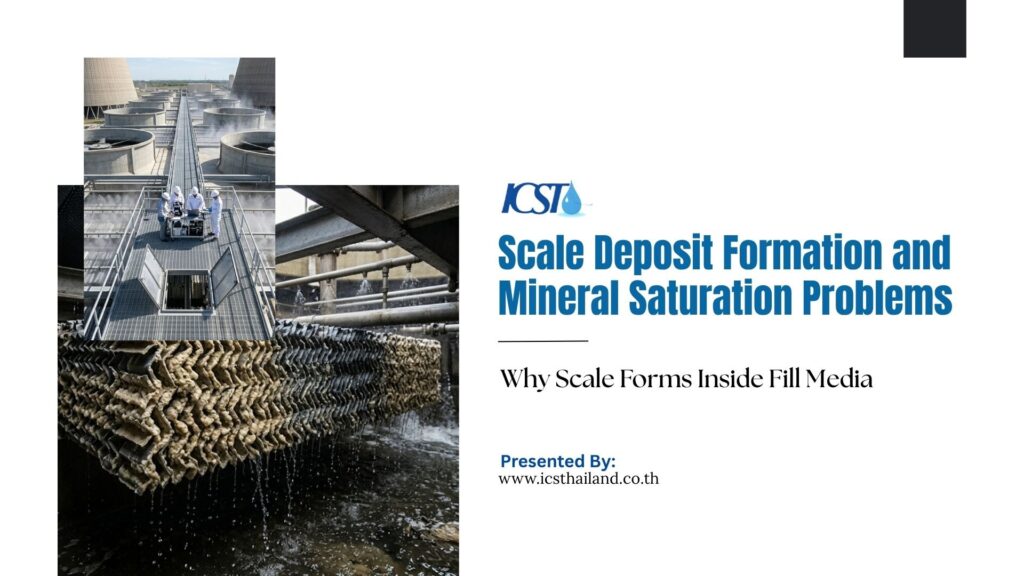
Scale formation represents one of the most expensive cooling tower maintenance challenges. Unlike loose debris, scale bonds tightly to fill surfaces and dramatically reduces heat transfer.
Why Scale Forms Inside Fill Media
Evaporation constantly removes pure water vapor and leaves dissolved solids behind. As concentration levels rise, the water eventually loses its ability to hold dissolved minerals.
- Calcium concentration increases
- Silica concentration increases
- Alkalinity rises
- Saturation limits eventually exceed stability
Once saturation occurs, minerals precipitate onto the fill surface.
The hottest and most turbulent areas experience scaling first because evaporation occurs more aggressively there.
Most Common Scale Types Found in Cooling Towers
Cooling towers experience several distinct types of mineral deposits based on water chemistry. Identifying the exact mineral composition determines the appropriate chemical treatment strategy.
Expect to encounter these primary scale formations.
- Calcium carbonate forms a hard white crust and reacts easily to acid treatments.
- Calcium sulfate creates an incredibly dense deposit that resists most standard chemicals.
- Silica scale acts like permanent glass and requires specialized chemical inhibitors.
- Iron deposits create rusty orange stains and indicate severe upstream corrosion issues.
Water Chemistry Parameters Operators Must Monitor
Predictive water chemistry control prevents scaling long before it damages the fill media. Technicians must track specific parameters daily to maintain a balanced aquatic environment.
Monitor these critical water quality metrics.
- Conductivity indicates the total amount of dissolved solids circulating in the system.
- The pH level directly influences the solubility of calcium and other hard minerals.
- Hardness measurements reveal the exact concentration of scale-forming calcium and magnesium.
- Alkalinity buffers the water and interacts directly with the system pH levels.
- Cycles of concentration dictate exactly how much fresh makeup water the tower requires.
Ryznar Stability Index Formula
Engineers rely on mathematical models to predict how water will behave inside the tower. The Ryznar Stability Index helps operators determine if water will scale or corrode.
Ryznar Stability Index Formula

Low RSI values indicate strong scaling tendencies, while higher values indicate corrosive water conditions.
Most industrial systems attempt to maintain balanced operating ranges that minimize both:
- Scale formation
- Corrosion damage
Facilities also use the Langelier Saturation Index (LSI) to evaluate water stability and treatment performance.
Particulate Fouling and Airborne Contamination Control
Particulate fouling develops when suspended solids accumulate inside the fill pack faster than the system can remove them, making effective cooling tower fill fouling control a critical operational challenge.
Sources of Particulate Fouling
Cooling fans pull massive volumes of air across the surrounding industrial landscape. This air carries dust, sand, and fine dirt directly into the cascading water.
Atmospheric pollution and process debris constantly bombard the open cooling tower basin. Organic debris like leaves, pollen, and insects also find their way into the system.
Why Industrial Facilities Experience Severe Particulate Loading
Heavy industrial environments generate extreme levels of airborne particulate matter. Facilities located in dry, dusty climates face an even greater contamination challenge. Consider the unique challenges of these specific operations.
- Cement plants release fine limestone dust that immediately turns into solid sludge.
- Chemical facilities often vent byproducts that react unexpectedly with cooling water.
- Steel manufacturing generates heavy iron particulate that causes abrasive wear on pumps.
- Mining operations constantly expose cooling systems to highly abrasive rock dust.
Mechanical Effects of Particulate Fouling
Suspended solids pack tightly into the narrow flutes of high-efficiency film fill. This particulate fouling creates solid dams that force water to channel unevenly.
Heavy sludge accumulation in the cold water basin provides a breeding ground for bacteria. Spray nozzles clog entirely and leave large sections of the fill completely dry.
Pumps suffer severe mechanical strain as they attempt to move sludge-heavy water. Impellers degrade quickly when forced to circulate abrasive particulate continuously.
Cleaning Methods for Fouled Cooling Tower Fill
When Chemical Cleaning Becomes Necessary
Even with the best routine maintenance, achieving total cooling tower fill fouling control can be challenging in complex industrial systems. It’s crucial to recognize the exact threshold where chemical intervention becomes necessary to address heavy buildup.
Watch for these undeniable performance triggers.
- Thermal performance degrades beyond acceptable operational safety limits during the summer months.
- Differential pressure across the fill media spikes abruptly above baseline measurements.
- Visual inspections reveal thick biological slime or white mineral crusts completely blocking flutes.
Acid Cleaning Procedures
Acid cleaning dissolves mineral deposits chemically. Technicians commonly use:
- Sulfamic acid
- Hydrochloric acid
- Organic acid blends
Controlled circulation cleaning removes scale while minimizing damage to the fill structure.
However, poor chemical control creates serious risks:
- Corrosion damage
- PVC deterioration
- Environmental hazards
- Worker safety issues
Neutralization procedures must follow every acid cleaning process carefully.
Mechanical Cleaning Methods
Physical cleaning methods offer a safer alternative for removing loose particulate and sludge. High-pressure washing works well on splash fill but can easily destroy fragile film fill.
Vacuum cleaning trucks remove heavy sediment directly from the cold water basin efficiently. Manual debris removal allows technicians to target specific blockages near the water distribution headers.
Facilities often perform offline mechanical cleaning during scheduled annual turnaround events. Combining physical cleaning with targeted biocide shocks yields the best overall results.
Comparing Cleaning Approaches
Choosing the correct cleaning strategy requires a thorough understanding of the fouling type. Engineers must weigh the advantages against the potential risks to system integrity. Review this detailed comparison of accepted cleaning methods.
| Cleaning Method | Best For | Advantages | Limitations | Engineering Insight |
| Acid Cleaning | Mineral scale | Fast scale removal | Corrosion risk | Requires precise chemistry control |
| High-Pressure Water | Loose debris | Non-chemical method | Limited deep cleaning | Effective for particulate buildup |
| Biocide Shock Treatment | Biofilm fouling | Controls biological growth | May require repeat dosing | Best combined with physical cleaning |
| Fill Replacement | Severe fouling | Restores full performance | Higher capital cost | Required after structural degradation |
Select the method that directly addresses your primary operational challenge safely.
Fill Replacement Criteria and Structural Evaluation

Cleaning does not always restore performance successfully. Severe fouling eventually damages the structural integrity of the fill media itself.
When Cleaning No Longer Works
Chemical and mechanical cleaning methods eventually reach their absolute physical limits. Permanent airflow blockage occurs when mineral deposits fuse entirely with the plastic substrate.
Aggressive chemical treatments slowly degrade PVC fill sheets over multiple cleaning cycles. Structural warping happens when heavy fouling loads crush the internal media supports.
When fouling keeps returning, it’s a strong sign that the media geometry is wrong for the environment. Continuing to clean is a waste of the maintenance budget if it doesn’t restore thermal capacity.
Fill Replacement Criteria Used by Engineers
Plant engineers use objective data to justify the high cost of media replacement. Guesswork has no place when making large capital expenditure decisions.
Rely on these specific engineering evaluations.
- Pressure drop measurements confirm exactly how much airflow the media restricts.
- Thermal performance testing verifies the total percentage of lost cooling capacity.
- Physical inspections reveal collapsed sections, broken supports, or permanent blockages.
- Material degradation analysis determines if the plastic has lost its structural integrity.
Signs of Aging PVC Fill Media
PVC fill media naturally deteriorates after years of exposure to harsh operating conditions. Facility managers must look for physical evidence of irreversible material breakdown.
Check the media for these common age-related defects.
- Cracking along the edges indicates that the plastic has lost its flexibility.
- UV degradation turns the exposed top layers brittle and discolors the material.
- Severe brittleness causes the plastic sheets to shatter upon physical contact.
- Biological embedding occurs when microorganisms permanently pit the plastic surfaces.
- Deformation shows that the fill can no longer support its own wet weight.
Engineering Decision — Clean or Replace?
Facility leaders must analyze the total lifecycle costs before choosing a path forward. Fill replacement criteria help you determine the exact return on investment for new media.
Calculate the cost of ongoing chemical treatments against the price of a complete rebuild. Consider the lost production value caused by extended downtime during aggressive cleaning procedures.
New media instantly recovers lost thermal efficiency and reduces fan motor energy consumption. Often, replacement proves cheaper in the long term than constantly fighting severe chronic fouling.
Strategic Review of Fouling Control
Cooling tower fill fouling control remains a non-negotiable requirement for industrial plant efficiency. You now understand how biological, scale, and particulate fouling attack the system differently.
Implementing predictive maintenance and strict water chemistry control prevents irreversible equipment damage. Early intervention consistently reduces the long-term capital costs associated with media failure.
Operators must balance routine acid cleaning frequencies with total operational efficiency. When cleaning fails, you must rely on objective fill replacement criteria to restore performance.
Contact the experts at ICST today to evaluate your current cooling tower performance. We offer comprehensive inspections and advanced treatment solutions to optimize your critical cooling infrastructure.
Frequently Asked Questions
What causes cooling tower fill fouling?
Fouling occurs when contaminants accumulate rapidly inside the narrow passages of the media. Biological growth, mineral scaling, and airborne debris represent the primary sources of blockage. Poor water treatment practices significantly accelerate the buildup of these destructive materials.
How do you remove scale deposits from cooling tower fill?
Removing hard scale requires a combination of precise chemical and mechanical interventions. Operators typically use controlled acid cleaning to dissolve rigid calcium and mineral formations. Correcting the baseline water chemistry prevents new deposits from forming after the cleaning process.
When should cooling tower fill media be replaced?
Replacement becomes mandatory when the plastic media suffers irreversible structural damage. Severe airflow restriction that fails to improve after chemical cleaning justifies immediate replacement. Performance loss that threatens plant production capacity always warrants a complete media rebuild.
How does biofilm affect cooling tower efficiency?
Biological slime acts as an intense thermal insulator on the heat transfer surfaces. This thick layer causes massive airflow blockage and severely reduces overall cooling capacity. The slime also accelerates dangerous under-deposit corrosion on adjacent metal system components.
What is the best way to prevent particulate fouling?
Keeping suspended solids out of the fill requires aggressive mechanical filtration strategies. Installing side-stream filtration systems removes airborne dust before it settles in the media. Routine basin cleaning and sweeping systems prevent sludge from recirculating through the pumps.
Why is water chemistry important in fouling control?
Balanced water chemistry dictates exactly how minerals and biological contaminants behave. Proper chemical control provides accurate scaling prediction and robust corrosion prevention. Stable operation relies entirely on maintaining a healthy aquatic environment for long-term equipment protection.