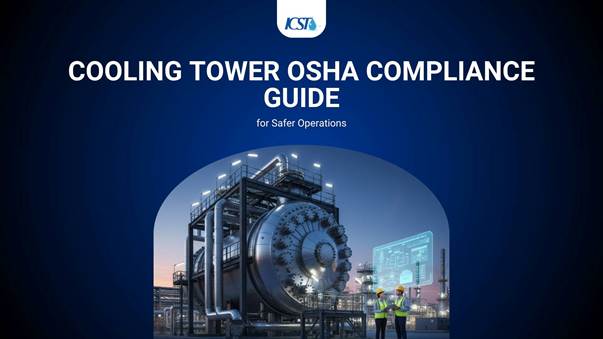
A cooling tower OSHA compliance guide explains how facilities can protect workers and meet core safety regulations during cooling tower maintenance and operation. It focuses on fall protection for elevated platforms and fixed ladders, lockout tagout procedures for hazardous energy, confined space controls for basins and internal sections, and emergency eyewash access near chemical treatment systems.
It also supports regulatory compliance through risk assessment, atmospheric testing, proper documentation, and routine inspections. When applied correctly, it helps facility managers improve workplace safety, avoid penalties, maintain continuous compliance, and strengthen public health protection.
Why Cooling Tower Compliance Requires a System-Based Approach
Cooling tower compliance does not depend on one rule or one checklist. Cooling tower systems combine mechanical, structural, chemical, biological, and environmental risks.
That means your safety program must connect several areas:
- Fall protection on elevated platforms
- Lockout tagout for fans, pumps, and drives
- Confined space procedures for basins and internals
- Chemical safety for water treatment systems
- Respiratory protection during aerosol-generating work
- Emergency procedures for eye and skin exposure
- Proper documentation for regulatory inspections
OSHA does not publish one single “cooling tower regulation.” Instead, inspectors apply multiple OSHA standards based on the task and hazard. They may also consider industry standards, site-specific risks, and whether the employer used reasonable control strategies.
The General Duty Clause matters.
The General Duty Clause requires employers to provide a workplace free from recognized hazards that may cause death or serious physical harm.
For cooling towers, this may include hazards such as:
- Legionella control failures
- Unsafe access to tower systems
- Missing guardrails or toe boards
- Uncontrolled fan startup
- Chemical splash exposure
- Poor confined space planning
- Lack of emergency eyewash access
This is important because some cooling tower risks involve public health, not only worker safety. Poor water treatment can support microbial growth. Aerosols may spread contaminants. Strong tower management helps protect workers, building occupants, and nearby communities.
Regulatory compliance extends beyond OSHA
OSHA focuses on occupational safety and health administration requirements. However, facility managers should also consider the broader regulatory environment.
Depending on the facility, cooling tower management may involve:
- Environmental Protection Agency expectations
- EPA regulations related to environmental protection
- Local regulations for water discharge or chemical storage
- Public health rules for Legionella risk control
- Internal corporate safety regulations
- Insurance and risk management standards
A strong program aligns safety, environmental impact, operational efficiency, and public health protection.
Section takeaway: Cooling tower compliance works best when you treat the tower as an integrated system, not as separate maintenance tasks.
Cooling Tower OSHA Compliance Guide: Core Hazard Controls
A practical cooling tower OSHA compliance guide should translate regulatory requirements into clear field actions. The following hazard areas deserve close attention during routine inspections and regulatory inspections.
Elevated work and fall protection
Cooling towers often require workers to access upper decks, roof-mounted units, inspection platforms, and fan areas. Any elevated work surface can create severe injury risk.
Under 29 CFR 1910.28, general industry fall protection applies when workers face a fall of 4 feet or more to a lower level.
Key control measures include:
- Guardrails around exposed platform edges
- Mid-rails were required
- Toe boards to prevent falling tools
- Safe access gates at ladder openings
- Rated anchor points where needed
- Personal fall arrest systems for specific tasks
- Training on harness inspection and connection
Guardrails should provide passive protection where possible. Personal fall arrest systems can protect workers during tasks where guardrails alone do not remove the hazard.
Fixed ladders and elevated platforms
Fixed ladders on cooling towers need careful review. Older ladder cages may not meet the intent of current safety expectations for new or replacement ladders over 24 feet.
Modern ladder safety may require:
- A ladder safety system
- A cable or rigid rail system
- A trolley connected to a full-body harness
- A personal fall arrest system
- Safe transition points at landings and platforms
Inspect ladder access points during every risk assessment. Many common mistakes happen when workers move from a ladder onto an elevated platform.
Hazardous energy and lockout tagout
Cooling tower fans, pumps, and variable frequency drives can start automatically. Building management systems often respond to temperature, process load, or HVAC system demand.
This creates a serious maintenance safety concern. A fan that appears stopped may restart without warning.
Under 29 CFR 1910.147, employers must control hazardous energy through lockout tagout procedures.
A strong lockout tagout process should include:
- Preparation
Identify all electrical, mechanical, hydraulic, pneumatic, chemical, thermal, and stored energy sources. - Shutdown
Stop the fan, pumps, and related equipment using normal operating controls. - Isolation
Open disconnects, breakers, and valves that feed the equipment. - Lockout and tagout
Apply individual locks and warning tags at each isolation point. - Stored energy control
Block, bleed, restrain, or dissipate stored energy. - Verification
Test the system and confirm a zero-energy state before work begins.
Cooling towers add one special concern: windmilling. Wind can rotate fan blades even when electrical power is off. Use mechanical chocks, blade pins, or hub restraints when workers enter the fan cylinder or work near rotating parts.
Confined space hazards
Cooling tower basins, internal plenums, and sump areas may qualify as confined spaces. Some may become permit-required confined spaces when they contain hazardous atmospheres or other serious risks.
Under 29 CFR 1910.146, confined space safety requires planning before entry.
Common confined space hazards include:
- Low oxygen
- Oxygen enrichment
- Hydrogen sulfide
- Chemical vapors
- Slippery sludge
- Biological contamination
- Poor ventilation
- Restricted rescue access
- Energized equipment inside the space
Before entry, trained staff should complete atmospheric testing with calibrated equipment. Oxygen should remain between 19.5% and 23.5%. Flammable gases should remain below safe limits, often measured against the lower explosive limit. Toxic gases must stay below applicable exposure limits.
A permit-required entry should also include:
- Authorized entrant
- Designated attendant
- Entry supervisor
- Rescue plan
- Communication method
- Ventilation plan
- Isolation confirmation
- Written permit
Never treat basin entry as a routine cleaning task without a formal confined space evaluation.
Chemical exposure and emergency response
Cooling tower water treatment often uses aggressive chemical treatments. These chemicals improve heat transfer, control scale, limit corrosion, and support Legionella control. They can also harm workers.
Common chemicals include:
- Sodium hypochlorite
- Sulfuric acid
- Biocides
- Corrosion inhibitors
- Scale removers
- pH adjustment chemicals
- Anti-fouling agents
Chemical exposure may occur during drum changeout, pump repair, tubing replacement, manual dosing, or spill cleanup.
Employers should provide:
- Chemical-specific PPE
- Eye protection and face protection
- Gloves rated for the chemical
- Splash aprons were needed
- Safety data sheet access
- Secondary containment
- Spill response materials
- Clear labeling
- Emergency procedures
A compliant eyewash station and safety shower should sit close to chemical hazards. Workers should be able to reach emergency flushing equipment within about 10 seconds on the same level, through a clear path.
A garden hose is not a substitute. Emergency eyewash equipment must provide controlled, hands-free, continuous flow to flush both eyes for the required duration.
Section takeaway: Cooling tower safety depends on physical controls, written procedures, trained workers, and fast emergency response.
Building a Field-Ready Cooling Tower Compliance Program
Regulatory compliance improves when your program matches real tower operations. Generic binders rarely protect workers in the field.
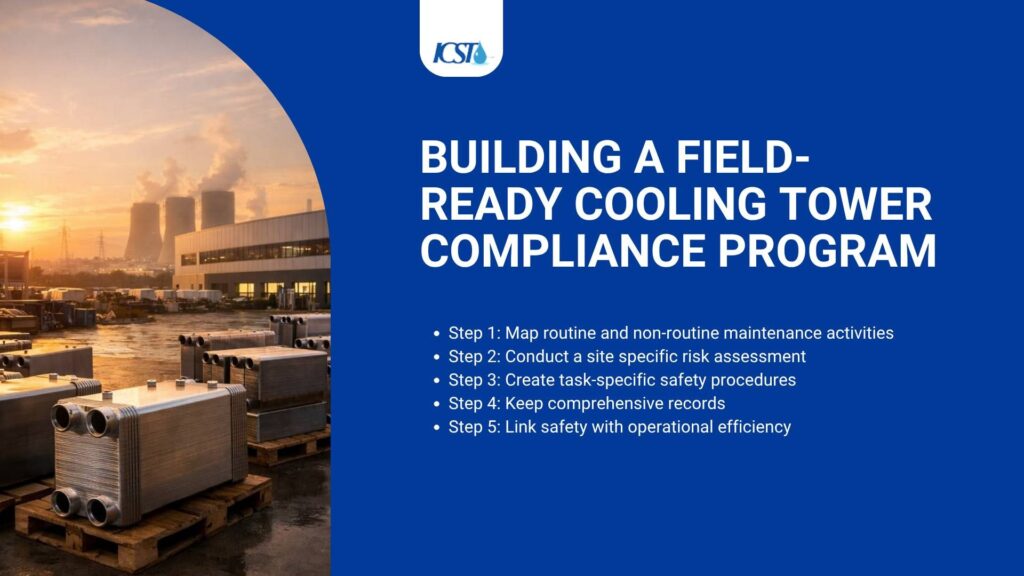
A strong program starts with the actual equipment, actual tasks, and actual hazards.
Step 1: Map routine and non-routine maintenance activities
Start by listing every activity workers perform on or near the cooling tower.
Include tasks such as:
- Routine maintenance
- Basin cleaning
- Fan inspection
- Motor replacement
- Belt or gearbox work
- Fill media replacement
- Drift eliminator service
- Nozzle cleaning
- Chemical dosing pump repair
- Water treatment testing
- Seasonal startup and shutdown
- Emergency leak response
Then identify potential hazards for each task. Ask what could injure a worker, expose them to chemicals, release hazardous energy, or create a public health issue.
Step 2: Conduct a site-specific risk assessment
Every facility has different site-specific risks. A rooftop cooling tower creates different hazards than a ground-mounted industrial unit beside a chemical storage area.
Your risk assessment should review:
- Access routes
- Ladder height
- Platform condition
- Guardrail gaps
- Nearby roof edges
- Electrical disconnect locations
- Chemical storage distance
- Eyewash station placement
- Confined space entry points
- Drainage and slip hazards
- Ventilation limitations
- Rescue access
Do not rely on the tower model alone. Field conditions often create the greatest risks.
Step 3: Create task-specific safety procedures
Safety procedures should tell workers exactly what to do before, during, and after the job.
For example, a fan maintenance procedure should include:
- Notify operations
- Review the lockout tagout procedure
- Isolate fan power
- Isolate related controls
- Apply locks and tags
- Restrain fan blades
- Verify zero energy
- Use fall protection
- Confirm safe access
- Document completion
A basin cleaning procedure should include:
- Confined space classification
- Atmospheric testing
- Ventilation
- PPE selection
- Attendant assignment
- Rescue plan
- Sludge handling
- Chemical exposure controls
- Final inspection
Specific procedures reduce guesswork and help maintenance staff work safely under pressure.
Step 4: Keep comprehensive records
Proper documentation supports continuous compliance and helps during regulatory inspections.
Maintain records for:
- Fall protection inspections
- Harness and lanyard checks
- Guardrail repairs
- Fixed ladder reviews
- Lockout tagout training
- Equipment-specific LOTO procedures
- Confined space permits
- Atmospheric testing results
- Eyewash station inspections
- Chemical safety training
- Water treatment logs
- Legionella control actions
- Corrective actions
- Incident investigations
Records should show what happened, who performed the work, what hazards were found, and how the facility corrected them.
Step 5: Link safety with operational efficiency
Compliance does not have to slow down tower operations. Good design can improve maintenance speed and reduce downtime.
For example:
- Permanent guardrails reduce setup time.
- Clear access platforms improve inspection quality.
- Labeled disconnects speed lockout tagout.
- Nearby eyewash stations improve emergency readiness.
- Better water treatment reduces fouling and microbial growth.
- Organized records reduce inspection stress.
When you optimize performance and protect workers at the same time, compliance becomes part of efficient tower management.
Section takeaway: A strong cooling tower compliance program turns regulations into repeatable field behavior.
Common Cooling Tower Compliance Mistakes to Avoid
Many compliance issues do not come from a lack of effort. They come from assumptions, outdated equipment, or incomplete procedures.
Here are the most common mistakes facility managers should correct.
Mistake 1: Treating a stopped fan as a safe fan
A stopped fan is not always safe. Automated controls, VFD signals, or windmilling can create sudden movement.
Corrective actions:
- Use lockout tagout every time.
- Isolate energy at the source.
- Restrain fan blades when needed.
- Verify zero energy before access.
Mistake 2: Ignoring ladder transitions
Workers often face fall exposure when they move from fixed ladders to platforms. This transition point may lack gates, anchor points, or guardrails.
Corrective actions:
- Install self-closing gates.
- Inspect ladder landings.
- Review fixed ladders over 24 feet.
- Use personal fall arrest systems where required.
Mistake 3: Using a generic confined space permits
A generic permit may miss tower-specific hazards such as chemical residue, poor airflow, sludge, and difficult rescue access.
Corrective actions:
- Classify each space before work.
- Use calibrated atmospheric testing equipment.
- Assign the required entry team.
- Prepare rescue procedures before entry.
Mistake 4: Blocking the eyewash station
Chemical drums, tools, hoses, and temporary storage often block eyewash access. In an emergency, seconds matter.
Corrective actions:
- Keep the pathway clear.
- Mark the eyewash area.
- Inspect flow and access regularly.
- Place the station on the same level as the hazard.
Mistake 5: Separating water treatment from safety planning
Water treatment is not only a performance issue. Poor treatment can increase microbial growth, Legionella risk, chemical handling hazards, and environmental impact.
Corrective actions:
- Coordinate EHS, maintenance, and water treatment teams.
- Review chemical storage and dosing points.
- Track water quality trends.
- Maintain records for public health protection.
Mistake 6: Waiting for an inspection to fix known hazards
Regulatory inspections often reveal problems that workers already knew existed. Delayed corrective actions increase risk and may affect penalties.
Corrective actions:
- Use routine inspections.
- Assign owners and deadlines.
- Track closure.
- Verify the fix in the field.
Section takeaway: Most cooling tower compliance failures are preventable when teams identify potential hazards early and act on them.
Practical Compliance Checklist for Facility Managers
Use this checklist to review your cooling tower systems before the next maintenance shutdown or inspection.
Access and fall protection
- Are elevated platforms protected at exposed edges?
- Do guardrails meet required height and strength expectations?
- Are toe boards installed where tools could fall?
- Are fixed ladders safe and properly maintained?
- Do workers use personal fall arrest systems where required?
- Are anchor points rated and documented?
Lockout tagout
- Does each tower cell have an equipment-specific procedure?
- Are the fan, pump, and VFD disconnects labeled?
- Do workers use individual locks and tags?
- Does the procedure address stored energy?
- Does the team control windmilling?
- Do workers verify zero energy before work?
Confined space
- Has each basin or internal area been classified?
- Are permit required confined spaces clearly identified?
- Does the entry team perform atmospheric testing?
- Is ventilation available?
- Are entrant, attendant, and supervisor roles assigned?
- Is rescue planning complete before entry?
Chemical safety
- Are chemical tanks and feed pumps labeled?
- Are safety data sheets available?
- Do workers have the correct PPE and eye protection?
- Is the eyewash station within a clear 10-second path?
- Does emergency equipment provide tepid flushing water?
- Are spills and leaks documented with corrective actions?
Water treatment and public health
- Does the facility monitor microbial growth?
- Are Legionella control measures documented?
- Are water treatment logs current?
- Does the program support environmental protection?
- Are local regulations and EPA regulations considered where applicable?
- Does the team review trends that affect operational efficiency?
Conclusion: Make Cooling Tower Safety Measurable
A strong cooling tower OSHA compliance guide helps you turn safety regulations into practical field controls. When you combine fall protection, lockout tagout, confined space planning, chemical safety, water treatment oversight, and proper documentation, you reduce risk and strengthen worker safety.
International Cooling Solutions Thailand supports industrial facilities with engineered cooling tower systems, safety-focused design insight, and practical compliance support. Contact our engineering team today to schedule a cooling tower safety review and consult an industrial safety compliance specialist.
Frequently Asked Questions
What does cooling tower OSHA compliance mean?
Cooling tower OSHA compliance means following workplace safety standards that protect workers during operation, inspection, cleaning, and repair. These requirements often involve fall protection, lockout tagout, confined space procedures, chemical safety, and hazard communication. A strong cooling tower OSHA compliance program helps reduce injuries, improve maintenance safety, and support regulatory compliance across industrial and commercial facilities.
Is fall protection required for cooling tower maintenance?
Yes, fall protection is often required when cooling tower maintenance involves elevated work areas, open sides, fixed ladders, or roof access. OSHA rules apply when workers face fall hazards during inspection, cleaning, or repair. Facilities should review guardrails, ladder systems, walking surfaces, and personal fall arrest equipment to improve cooling tower safety and reduce the risk of serious injuries.
Why is lockout tagout important for cooling towers?
Lockout tagout is essential because cooling towers contain fans, pumps, motors, valves, and electrical systems that can release hazardous energy during service. Proper lockout tagout procedures help prevent unexpected startup or energy release while maintenance is in progress. For cooling tower OSHA compliance, hazardous energy control is one of the most important steps for worker protection and safe equipment servicing.
Can a cooling tower be classified as a confined space?
Yes, some parts of a cooling tower may meet the definition of a confined space, especially basins, sumps, or enclosed internal areas with limited entry and exit. In higher-risk conditions, the area may qualify as a permit-required confined space. This means facilities may need atmospheric testing, entry permits, ventilation, attendants, and rescue planning before workers enter the space.
What records help support cooling tower OSHA compliance?
Key records include safety checklists, inspection reports, maintenance logs, training records, hazard assessments, lockout tagout documentation, and confined space permits. These documents help show that cooling tower safety procedures are active and consistently followed. Strong recordkeeping also supports OSHA inspection readiness, internal audits, and long-term compliance management while helping teams identify and correct safety gaps early.