Cooling tower registration requirements in Thailand do not always follow one single national “cooling tower registry” system. Instead, Thai facilities usually manage cooling tower compliance through factory licensing, environmental controls, wastewater discharge rules, health and safety programs, industrial estate requirements, and local authority filings.
Building owners and plant managers should confirm whether their site needs health authority filing, environmental reporting, routine inspection, water treatment records, Legionella risk control, or wastewater compliance documentation before operating, restarting, modifying, or decommissioning a cooling tower.
What Are Cooling Tower Registration Requirements?
Cooling tower registration requirements are rules that require owners or operators to file cooling tower information with a state or local health authority. Registration usually identifies the property, owner, responsible contact, tower location, tower type, water treatment method, operating status, and maintenance responsibility.
Common registration information usually includes the following essential details:
- Property address: Exact physical location of the building or facility housing the equipment.
- Owner or operator contact details: Legal names, phone numbers, and email addresses of the responsible parties.
- Responsible maintenance contact: The person or contractor managing day-to-day water treatment and physical upkeep.
- Cooling tower manufacturer and model: Identifying equipment details that help define system size and design.
- Tower location on the property: Specific placement details, such as roof level or ground installation.
- Cooling tower capacity: Tonnage or cooling load data that indicates the scale of the operation.
- System volume: The total amount of water held within the basin and piping network.
- Operating status: Whether the unit runs year-round, operates seasonally, or sits idle.
- Water treatment method: Details about the chemical or non-chemical program controlling biological growth.
- Biocide feed method: Information on how the system doses bacteria-killing chemicals into the water.
- Inspection and maintenance provider: The registered contractor performing routine service.
- Startup or shutdown status: Dates marking when the system enters or leaves active service.
New York-focused regulatory summaries show that tower registration may require property address, owner contact information, manufacturer, model, serial number, capacity, system volume, and biocide delivery method.
Why Do Health Authorities Require Tower Registration?
Health departments enforce these rules to protect the public from preventable diseases. Cooling towers aerosolize water droplets as part of their normal heat rejection process. If bacteria grow inside the system, the fan can blow those contaminated droplets miles away.
Legionella thrives in warm, poorly controlled water systems containing scale, rust, and biofilm. Registries help health departments locate towers immediately during outbreak investigations. Registration creates direct accountability for maintenance, testing, and reporting. Proper regulatory filing helps authorities contact responsible parties quickly to request test results or order emergency disinfection.
The Centers for Disease Control and Prevention (CDC) explains that water management programs help reduce the risk of Legionella growth and spread by identifying water systems, control points, monitoring steps, corrective actions, and documentation practices.
Are Cooling Tower Registration Requirements the Same?
Many regulated jurisdictions demand formal registration, and some apply stricter rules after Legionnaires’ disease outbreaks occur in their communities. Facility managers must never assume one state’s rules apply to another state.
Review this breakdown of common regulatory expectations across different regions:
| Requirement Area | Common in Regulated Jurisdictions | Best For | Expert Recommendation |
| Tower registration | Often required in strict jurisdictions | Building owners | Review registration before startup and annually |
| Annual certification | Required in places | Commercial sites | Treat certification as a strict legal deadline |
| Routine inspection | Common under maintenance plans | Industrial sites | Use inspection findings to guide repairs |
| Legionella testing | Required in some jurisdictions | High-risk facilities | Use certified labs for all compliance tests |
| Legionella reporting | Required above certain thresholds | Regulated cities | Confirm reporting thresholds before testing |
How the UK’s Notification of Cooling Towers and Evaporative Condensers Regulations 1992 Works
The United Kingdom takes a different regulatory path than Thailand or the United States, and it illustrates just how much registration rules can vary by country.
Who Must Notify Under UK Rules
Anyone with control of non-domestic premises housing a qualifying system carries this duty, regardless of what other health and safety rules already apply to the site.
- Legal trigger: Control of the premises activates the duty, not ownership of the cooling equipment itself.
- Governing law: The Notification of Cooling Towers and Evaporative Condensers Regulations 1992 sets this requirement in UK law.
- Where to notify: Notification goes to the local council, regardless of what other health and safety framework already covers the site.
Why the Framework Exists
The main purpose behind this framework is straightforward: to help environmental health teams prevent legionellosis by knowing exactly where cooling towers and evaporative condensers operate across their district.
- What triggers notification: New installations, equipment removals, and any significant change to an existing system all require notification.
- Scope of coverage: The Evaporative Condensers Regulations apply to every qualifying device in a council’s area, not only new installations.
- Reporting window: Any change must reach the council within one month of occurring.
How Notification and the Public Register Work
Filing the paperwork correctly matters just as much as knowing where it actually goes and who can see it afterward.
- Approved form: Notification happens on a notification form approved by the Health and Safety Executive.
- Submission point: The completed form goes to the council, not to the Safety Executive directly, even where the same premises falls under HSE enforcement for other matters.
- Ongoing record: This keeps every site with towers and evaporative condensers on record before an inspector ever needs to ask.
- Public access: Councils typically keep this information on a public register, so registered premises can be checked and cross-referenced quickly if an outbreak investigation begins nearby.
Who Is Responsible for Cooling Tower Registration and Regulatory Filing?
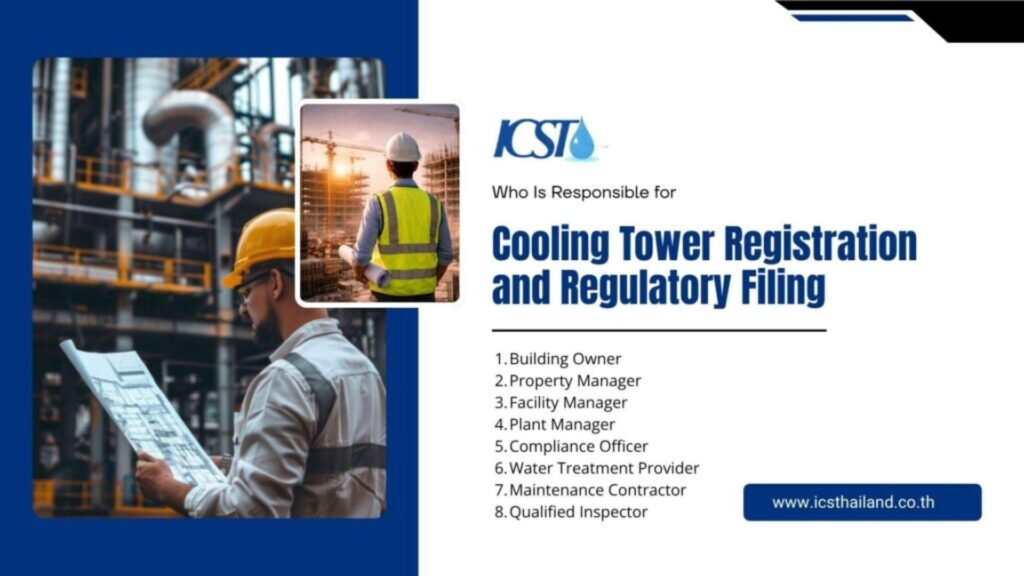
The law usually places the burden of compliance squarely on the property owner. Responsibility usually falls on the owner, building manager, facility operator, or legally responsible party named by the local rule.
The owner may hire a contractor to inspect, test, clean, disinfect, or prepare reports, but the owner often remains responsible for meeting deadlines and submitting regulatory filing documents. Delegating the work does not delegate the legal liability.
Key roles involved in the compliance process include:
- Building owner: Holds the ultimate legal responsibility for safe operation and accurate registration.
- Property manager: Often handles the administrative tasks of filing paperwork with the health authority.
- Facility manager: Oversees the daily operation, mechanical condition, and contractor coordination.
- Plant manager: Directs industrial cooling operations and ensures the water management program functions correctly.
- Compliance officer: Reviews documentation, audit readiness, and regulatory submission deadlines.
- Water treatment provider: Manages chemical dosing, biological control, and routine water quality testing.
- Cooling tower maintenance contractor: Performs deep cleaning, mechanical repairs, and seasonal shutdowns.
- Qualified inspector: Conducts the mandated compliance inspections and signs the official reports.
What Does an Annual Cooling Tower Inspection Usually Include?
An annual inspection confirms that the equipment operates safely and the water management plan works. An inspection should not only check paperwork. A useful inspection also evaluates mechanical condition, water distribution, biological risk, and maintenance records.
Inspectors look for physical deterioration that allows bacteria to hide from biocides. They also verify that the facility actually follows the written procedures.
An annual inspection typically reviews the following critical items:
- Tower basin condition: Checking for accumulated sludge, debris, and structural integrity.
- Fill media condition: Looking for scale buildup, fouling, and broken sections that block airflow.
- Drift eliminators: Ensuring these components correctly trap water droplets to prevent aerosol release.
- Louvers: Inspecting for damage that allows sunlight to enter the basin and promote algae growth.
- Fan, motor, and gearbox: Verifying proper rotation, vibration levels, and lubrication.
- Water distribution system: Checking pipes and headers for leaks or blockages.
- Nozzles and spray pattern: Ensuring water covers the fill media evenly without creating dry spots.
- Scale, corrosion, sediment, and biofilm: Identifying physical conditions that protect Legionella bacteria.
- Biocide feed system: Confirming pumps operate correctly and chemical tanks hold sufficient inventory.
- Water treatment logs: Reviewing daily or weekly chemical test results.
Annual Inspection vs. Routine Compliance Inspection
An annual inspection often supports formal certification and overall program compliance. Routine compliance inspections may occur more frequently depending on the jurisdiction. NYC, for example, currently states compliance inspections should happen once every 90 days to maintain strict oversight.
What Is Legionella Reporting?
Legionella reporting is the process of notifying the proper health authority when cooling tower test results meet or exceed a jurisdiction’s reportable threshold. The required timing, threshold, lab method, and reporting form depend entirely on local rules.
The CDC’s Legionella routine testing guidance recommends creating a sampling plan that represents the building water system and considering risk factors such as sediment, biofilm, temperature, water age, and disinfectant residual.
Cooling Tower Registration, Inspection, and Reporting Workflow
Facility teams need a clear path to manage these obligations without missing deadlines. The exact process depends on the local authority. Still, most facility teams can use this workflow to prepare for registration and inspection effectively.
Follow these practical steps to build a compliant operation:
- Confirm the local health authority: Identify exactly which city, county, or state agency holds jurisdiction.
- Identify every cooling tower: Locate all operational, standby, and decommissioned units on the property.
- Collect tower details: Gather manufacturer data, capacity, owner contacts, and operating parameters.
- Submit tower registration: File new applications or update existing records with current information.
- Build the water management program: Create or update a site-specific plan based on ASHRAE Standard 188.
- Schedule required inspection and testing: Book qualified vendors well ahead of compliance deadlines.
- Clean and disinfect: Follow the maintenance plan to remove sludge, scale, and biofilm.
- Collect Legionella samples: Pull water samples exactly as the local regulations dictate.
- Review lab results: Analyze the data and complete required Legionella reporting immediately if limits exceed thresholds.
- Document corrective actions: Write down every step taken to fix a problem or lower bacteria counts.
- Submit annual certification: Complete the necessary regulatory filing to prove compliance to the state.
- Keep records onsite: Store all logs, reports, and certifications in an organized, audit-ready binder.
Required Records for Cooling Tower Compliance
Inspectors demand proof that facility managers do the work. Proper recordkeeping protects the building owner during audits and investigations.
Review this breakdown of the documents you must maintain:
| Record Type | Why It Matters | Who May Review It | Best Practice | Record Retention |
| Tower registration record | Proves the tower is listed with the correct authority | Health authority or building department | Update within 30 days of changes | Keep permanently |
| Annual certification | Confirms required inspection, testing, and cleaning | Health authority or local agency | File before the legal deadline | 3 to 5 years |
| Inspection reports | Shows tower condition and noted deficiencies | Inspectors, auditors, facility managers | Act on deficiencies immediately | 3 to 5 years |
| Water treatment logs | Shows control measures and chemical treatment | Health authority, water treatment provider | Review logs weekly for trends | 3 to 5 years |
| Legionella test results | Supports reporting and corrective action | Health authority, safety team | Keep chain of custody forms | 3 to 5 years |
Common Mistakes That Lead to Cooling Tower Compliance Problems
Many violations happen because owners treat registration as a one-time task. Cooling tower registration requirements demand ongoing maintenance, testing, inspection, and documentation. Facilities fail audits when they lose focus on daily operational control.
Avoid these common operational and administrative failures:
- Failing to register a new cooling tower: Operating a unit before the health authority approves the paperwork.
- Forgetting annual certification deadlines: Missing the filing date and triggering automatic fines.
- Not updating tower ownership: Leaving old contact details in the registry after selling the building.
- Missing routine inspection dates: Letting quarters slip by without conducting the mandated reviews.
- Keeping incomplete water treatment logs: Leaving blank spaces on daily check sheets.
- Ignoring biofilm, scale, and sediment: Allowing physical conditions that render chemicals useless.
- Delaying Legionella reporting: Failing to notify regulators immediately after receiving high lab results.
- Using non-approved labs: Sending samples to laboratories that lack the specific state environmental certifications.
- Failing to document corrective actions: Fixing a problem but leaving no written proof of the repair.
- Restarting a tower improperly: Turning on a seasonal tower without executing the required cleaning and disinfection protocols.
When Should a Cooling Tower Owner Contact the Health Authority?
Facility managers must know when to proactively reach out to regulators. Silence often leads to suspicion during an audit.
Owners should contact the proper authority when they encounter these situations:
- Installing a new cooling tower: Filing initial paperwork before turning the system on.
- Restarting a seasonal tower: Submitting required pre-startup disinfection records.
- Modifying or replacing a tower: Updating the registry with new equipment specifications.
- Taking a tower out of operation: Notifying the state that the unit no longer poses a risk.
- Receiving high Legionella results: Initiating mandatory Legionella reporting protocols.
- Missing a required filing deadline: Self-reporting the error and submitting the late documents.
- Changing ownership or responsible contact: Ensuring the state contacts the correct person in an emergency.
- Receiving an inspection notice: Coordinating access for the government inspector.
- Responding to an outbreak investigation: Providing all requested records immediately.
- Unsure whether local rules apply: Asking for written clarification on jurisdiction requirements.
Summary
Navigating cooling tower registration requirements protects your facility from legal trouble and protects the public from disease. Tower registration provides regulators with critical data, while strict maintenance keeps the system safe.
They provide a strong example of how tight annual inspection, routine testing, and Legionella reporting rules operate in practice. Building owners must always confirm local rules with their specific health authority.
Keep your records organized, perform your inspections on time, and act quickly when problems arise. For more helpful articles, cooling tower services, or to buy quality products, visit the ICST website today.
Frequently Asked Questions
What are cooling tower registration requirements?
Cooling tower registration requirements are local or state rules requiring owners to file tower details with a health authority. Registration includes the tower location, owner contact, operating status, system volume, and treatment method. These rules help authorities track equipment and respond faster during public health investigations.
Who handles cooling tower regulatory filing?
The building owner, property manager, or facility manager usually handles regulatory filing. A water treatment provider or inspection contractor may perform the testing and prepare the documents. However, the responsible owner must confirm deadlines and submit the final paperwork to the health authority.
What does an annual cooling tower inspection include?
An annual inspection reviews the tower’s physical condition, water treatment program, and compliance documents. Inspectors check the basin, fill media, drift eliminators, fan, and scale buildup. The goal is to confirm mechanical reliability and ensure the facility follows its written safety plan.
When is Legionella reporting required?
Legionella reporting is required when test results meet or exceed a reportable level set by local rules. The exact threshold and reporting form depend on the health authority. A reportable result usually triggers mandatory corrective action, disinfection, retesting, and rapid notification to regulators.
What records should cooling tower owners keep for compliance?
Owners should keep tower registration records, annual certifications, annual inspection reports, water management plans, and water treatment logs. Facilities must also retain cleaning records, Legionella reporting documents, and corrective action reports. Good records prove compliance during audits and show proper response to problems.