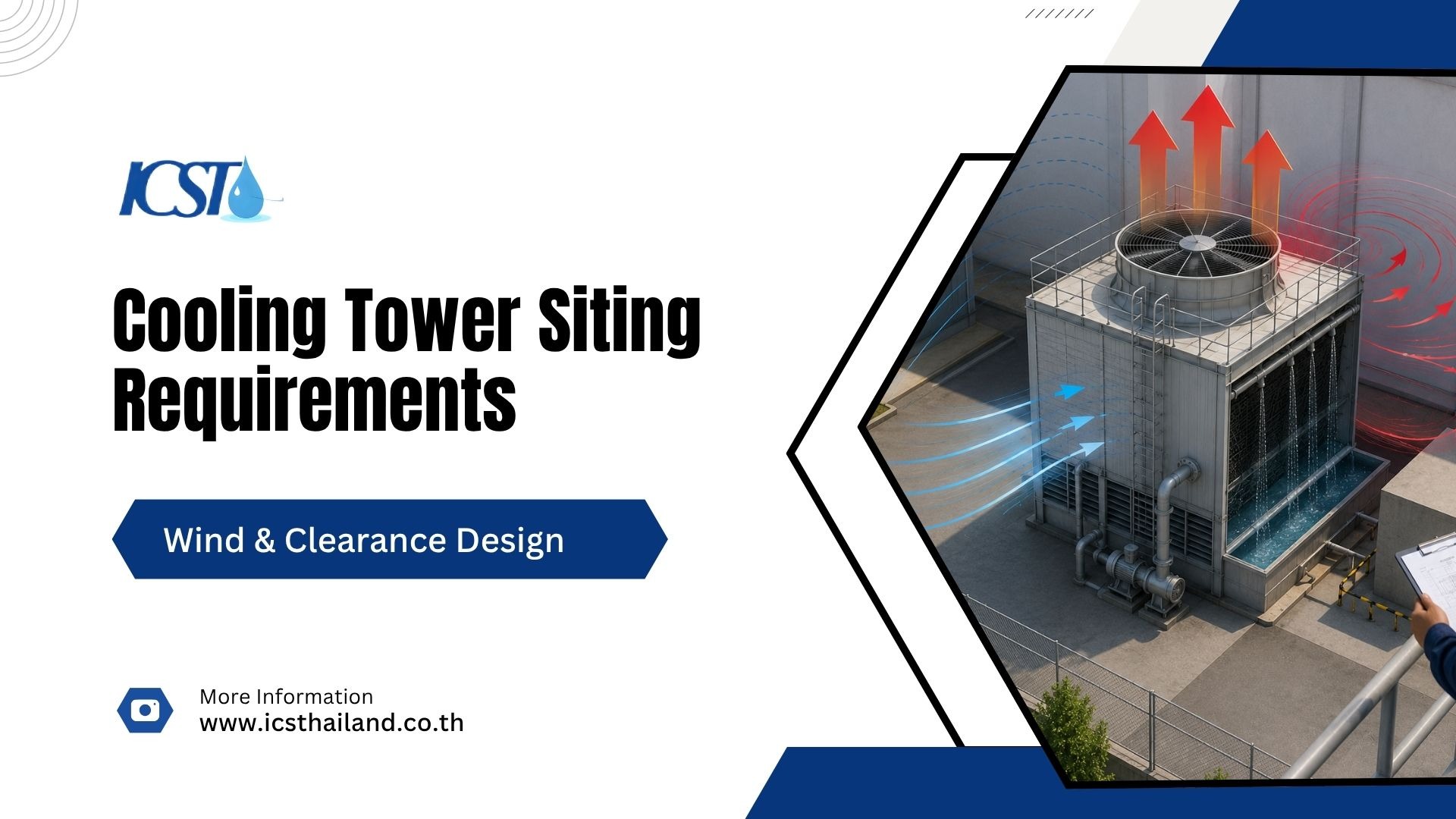
Proper cooling tower siting requirements directly affect airflow stability, thermal efficiency, energy use, and long-term reliability. Poor placement can cause hot air recirculation, restricted intake airflow, higher cold-water temperatures, corrosion exposure, and unnecessary fan energy demand.
Facilities must study wind direction, optimize tower orientation, maintain correct clearance requirements, and evaluate nearby buildings before installation. Modern industrial plants also use CFD analysis and engineered recirculation prevention strategies to avoid airflow disruption and protect cooling performance.
Why Industrial Cooling Towers Fail in Congested Plant Layouts
Industrial facilities often place cooling towers wherever space remains available. This approach creates serious airflow problems because towers need clean intake air and a clear exhaust path to reject heat properly.
A cooling tower may have the right size, motor power, fill media, and fan design. Poor placement can still limit its performance because surrounding structures control how air enters and leaves the tower.
The Airflow Problem Hidden Inside Modern Industrial Facilities
Congested plants contain buildings, pipe racks, tanks, walls, exhaust stacks, and mechanical equipment. These structures interrupt natural airflow and create turbulence around the cooling tower.
Restricted air intake forces the fan to work harder. Hot discharge air can also return toward the intake section and reduce heat rejection efficiency.
Common layout problems include:
- Narrow plant corridors
- Tall adjacent buildings
- Low wall clearances
- Blocked intake sides
- Poor exhaust discharge paths
These issues often remain hidden until summer load increases and cooling performance drops.
Why Mechanical Perfection Cannot Fix Poor Tower Placement
A well-designed cooling tower still needs proper site conditions that meet Cooling Tower Siting Requirements. Mechanical upgrades cannot fully correct poor airflow created by bad placement.
Fans, motors, and fill media can only perform well when the tower receives enough fresh air. If hot discharge air returns to the intake, the system loses efficiency regardless of equipment quality.
Poor siting creates long-term operating penalties. Plants often pay for this mistake through higher energy use, repeated maintenance, and reduced cooling capacity.
How Congested Layouts Trigger Permanent Thermal Inefficiency
When towers operate in cramped spaces, hot discharge air struggles to escape the local environment. This trapped air initiates a cycle of recirculation. The tower pulls its own hot exhaust back into the air intakes, elevating the approach temperature immediately.
To compensate for the warmer intake air, fans work harder and consume significantly more electrical energy.
Understanding the Airflow Physics Behind Cooling Tower Performance
Cooling towers reject heat by moving air through warm circulating water. This process depends on steady airflow, proper air movement, and enough space for hot exhaust air to escape.
When surrounding structures disrupt airflow, the tower loses the clean air supply it needs for stable heat rejection.
How Cooling Towers Actually Reject Heat Into the Atmosphere
Cooling towers rely on the principles of evaporative cooling to remove heat from industrial processes. The system sprays hot process water over a fill media while heavy-duty fans pull ambient air through the water droplets. This direct contact evaporates a small percentage of the water, which rapidly rejects latent heat into the passing airstream.
The Relationship Between Air Velocity and Cooling Efficiency
Air velocity affects how much heat the tower can reject. Too little airflow reduces evaporation, while unstable airflow causes uneven cooling across the fill media.
Operators should protect air movement around the tower. The tower needs both intake clearance and discharge clearance to maintain stable performance.
Important airflow factors include:
- Intake air volume
- Fan-induced draft stability
- Exhaust plume direction
- Wind turbulence
- Surrounding structure height
These factors help engineers evaluate whether a site can support long-term cooling performance.
Why Hot Exhaust Air Must Escape Efficiently
Hot exhaust air naturally rises above the cooling tower. Adjacent structures can block this movement and force the plume downward or sideways.
When the exhaust plume re-enters the tower, the system experiences recirculation. This raises the entering air temperature and weakens the cooling capacity.
Proper cooling tower siting requirements focus heavily on keeping exhaust air away from intake areas.
Wind Direction: The Environmental Variable Most Plants Underestimate
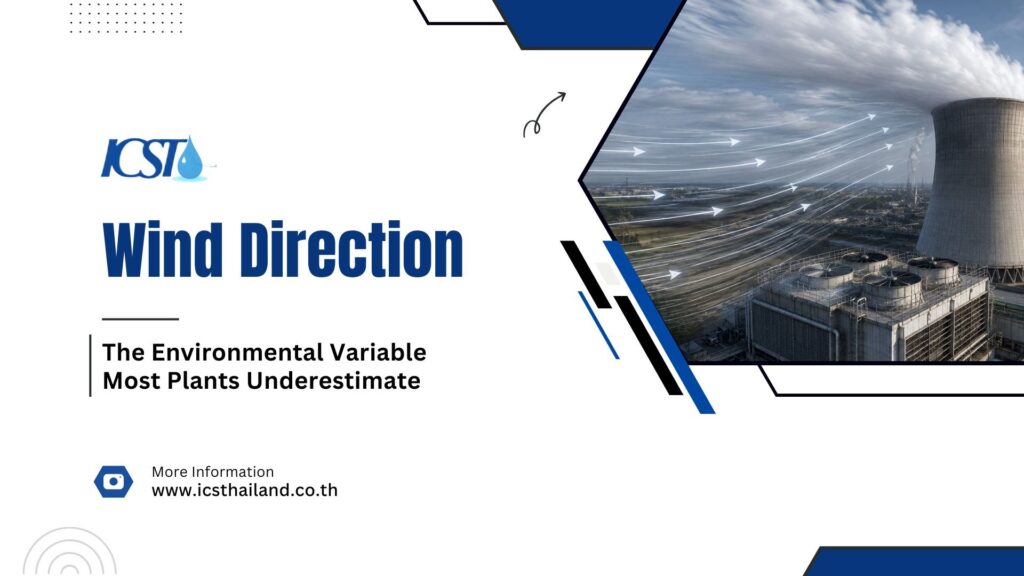
Many facilities evaluate equipment footprint before they study wind direction. This mistake can create long-term airflow instability because wind patterns strongly affect intake air and exhaust plume movement.
The prevailing wind does not stay constant throughout the year. Engineers should study seasonal patterns before finalizing tower placement.
Why Prevailing Wind Direction Must Be Studied
A cooling tower performs best when wind supports clean airflow instead of pushing hot exhaust back into the intake. Seasonal wind data helps engineers identify high-risk orientations.
Summer wind patterns matter most because cooling demand usually peaks during hot months. Poor siting may only reveal itself during maximum load periods.
A proper wind study should review:
- Seasonal wind frequency
- Peak summer wind direction
- Crosswind exposure
- Nearby structure turbulence
- Exhaust plume travel paths
This analysis helps teams avoid avoidable thermal problems.
Crosswind Effects on Cooling Tower Airflow
Crosswinds can create uneven air intake across the tower. One side may receive strong airflow while another side experiences air starvation.
This imbalance reduces thermal performance and may create uneven cell loading in multi-cell systems.
Crosswinds also affect fan performance. Fans may experience unstable loading when wind pressure changes around the tower casing.
Headwind and Tailwind Performance Problems
When the wind blows directly into the fan discharge, it creates severe headwind resistance. This downward pressure forces the fan motor to work against the wind, increasing mechanical stress and fan loading instability.
The resulting thermal efficiency disruption leaves the plant struggling to maintain target cold-water temperatures.
Recirculation Prevention: The Core Objective of Proper Tower Siting
Recirculation prevention sits at the center of every successful cooling tower layout. The goal looks simple: keep hot discharge air away from tower air intakes.
In real industrial plants, this goal becomes complex because buildings, wind, and nearby towers can redirect exhaust air.
What Is Cooling Tower Recirculation?
Recirculation occurs when a tower pulls its own hot, moisture-laden discharge air back into its fresh air intakes. This destructive loop forces the equipment to attempt cooling with air that is already fully saturated.
How Recirculation Destroys Thermal Performance
Recirculation raises the entering air temperature and reduces evaporation efficiency. The tower must work harder to achieve the same cooling result.
Operators may notice higher approach temperature, poor summer performance, and continuous fan operation.
Strong recirculation prevention protects:
- Cold-water temperature stability
- Fan energy efficiency
- Thermal capacity
- Multi-cell balance
- Long-term system reliability
Ignoring recirculation can turn a properly sized tower into an underperforming asset.
The Most Common Causes of Recirculation
Recirculation usually comes from poor spacing, blocked airflow, or improper discharge conditions. These problems often develop during facility expansion when new structures appear around existing towers.
Common causes include:
- Towers are installed too close together
- Poor tower orientation
- Nearby walls trap exhaust air
- Low elevation installation
- Inadequate vertical discharge clearance
These issues require engineering correction, not simple maintenance.
Warning Signs of Recirculation Problems
Understanding the symptoms of airflow restriction helps engineers diagnose layout problems before they cause mechanical failure. Look for these four critical warning signs of poor tower siting.
- Elevated Approach Temperature: The water leaves the tower much warmer than the ambient wet-bulb temperature, indicating reduced cooling performance.
- Fan Energy Consumption Increase: The motors draw high amperage constantly, indicating continuous high-load operation just to maintain baseline cooling.
- Seasonal Thermal Instability: The system meets cooling demands in the spring but suffers a complete summer performance collapse when ambient temperatures rise.
- Uneven Cell Performance in Multi-Cell Towers: Some sections cool perfectly while others fail, exposing a severe airflow imbalance across the layout.
Clearance Requirements That Directly Affect Cooling Efficiency

Why Clearance Requirements Are More Than Maintenance Access
Side clearance protects intake air. Vertical clearance protects exhaust discharge.
If walls, screens, pipe racks, or buildings sit too close, the tower cannot move air efficiently. This raises fan effort and reduces heat rejection.
Proper clearance supports:
- Clean intake airflow
- Safe maintenance access
- Better plume dispersion
- Lower recirculation risk
- Stable thermal performance
Engineers should protect clearance zones even after installation.
Minimum Side Clearance Recommendations
Side clearance allows air to enter the tower evenly. Restricted intake areas create a pressure imbalance and force fans to work harder.
Facilities should avoid placing walls, storage materials, temporary structures, or new equipment too close to intake sections.
Maintenance teams should also check clearance after plant modifications. Many airflow problems appear when facilities add new structures around older cooling towers.
Vertical Clearance Above Cooling Towers
Overhead structures trap exhaust heat and prevent natural plume rise. This can push hot air sideways or downward into tower intakes. Vertical obstruction increases recirculation risk and reduces cooling efficiency.
Common vertical clearance problems include:
- Roof canopies
- Pipe bridges
- Duct structures
- Low platforms
- Adjacent taller buildings
Strong clearance requirements protect the exhaust path and reduce long-term efficiency loss.
CFD Analysis: The Advanced Engineering Tool for Cooling Tower Siting
What Is CFD Analysis?
Computational Fluid Dynamics (CFD) provides a mathematical visualization of airflow movement, heat transfer, and pressure gradients. Engineers use this software to build virtual models of the plant and simulate exactly how air will behave around the new equipment.
Why Modern Facilities Use CFD Before Construction
Predictive airflow simulation removes the guesswork from major capital projects. Instead of hoping a layout works, plant managers use CFD to prove the layout works before approving the installation budget.
What CFD Analysis Can Predict
CFD provides high-resolution data that traditional engineering formulas simply cannot match. Advanced modeling uncovers hidden operational threats by simulating the following four environmental variables.
- Hot Air Recirculation Zones: The software highlights exhaust re-entry mapping in vibrant colors, showing exactly where hot air gets trapped.
- Wind Velocity Distribution: The visual models map turbulence visualization, exposing high-speed corridors and dangerous dead zones.
- Plume Dispersion Behavior: Engineers use the software for exhaust trajectory prediction to ensure the moisture avoids nearby roadways or windows.
- Seasonal Performance Variations: The tool conducts climate-dependent airflow analysis to test the layout against both winter blizzards and summer heatwaves.
Why Rule-of-Thumb Siting Is No Longer Enough
Decades ago, engineers relied on simple spacing multipliers to site equipment. Today, complex industrial environments require advanced modeling. Tight real estate, strict energy codes, and massive building profiles render old rule-of-thumb spacing obsolete.
Cooling Tower Siting Risk Assessment Matrix
Evaluating placement risks requires a structured approach to airflow management. Use the following risk assessment matrix to identify potential hazards and implement corrective actions during the design phase.
| Siting Factor | Operational Risk | Thermal Impact | Mechanical Impact | Recommended Action |
| Poor Wind Alignment | High | Reduced airflow efficiency | Increased fan motor wear | Reorient tower placement |
| Nearby Tall Structures | Critical | Severe recirculation | Basin water overheating | Increase clearance distance |
| Insufficient Vertical Clearance | High | Exhaust air trapping | Accelerated metal corrosion | Improve discharge elevation |
| Towers Installed Too Close | High | Cross-cell interference | Uneven gearbox loading | Optimize lateral spacing |
| No CFD Analysis Performed | Medium | Undetected airflow problems | Unexpected performance drops | Conduct simulation study |
Post-Installation Airflow Testing and Performance Verification
Even well-planned installations need verification after startup. Real-world conditions can reveal issues that drawings did not fully capture. Testing helps teams confirm whether the tower performs as designed.
Useful verification methods include:
- Airflow velocity testing
- Approach temperature testing
- Smoke testing
- Drift monitoring
- Fan performance review
Smoke testing helps operators visualize recirculation patterns. Thermal performance testing confirms whether tower placement supports design cooling capacity.
Conclusion
Proper cooling tower siting requirements help facilities achieve stable airflow, strong thermal performance, and lower long-term operating costs. Poor placement creates air restriction, hot air recirculation, higher cold-water temperatures, and excessive fan energy demand. Facilities that study wind direction, optimize tower orientation, maintain correct clearance requirements, and prioritize recirculation prevention achieve better cooling reliability.
Modern plants should also use CFD analysis when layouts include nearby buildings, multiple towers, rooftop installations, or congested equipment areas. A performance-first siting strategy prevents expensive airflow problems and protects cooling tower efficiency throughout the facility lifecycle.
Frequently Asked Questions
What are cooling tower siting requirements?
Cooling tower siting requirements define where and how a cooling tower should sit to maintain proper airflow, service access, plume discharge, and thermal performance. These requirements consider wind, clearance, nearby structures, tower orientation, exhaust movement, and recirculation risk. Good siting helps the tower operate efficiently and prevents long-term performance problems.
Why does wind direction matter for cooling tower placement?
Wind direction affects how intake air enters the tower and how hot exhaust air moves away from it. Poor wind alignment can push discharge air back into the intake, which raises entering air temperature and reduces cooling efficiency. Engineers should study seasonal wind patterns before installation.
What is cooling tower recirculation?
Cooling tower recirculation happens when hot discharge air returns to the tower intake. This reduces cooling efficiency because the tower pulls in warmer air instead of fresh ambient air. Strong recirculation prevention depends on proper spacing, discharge clearance, tower orientation, and airflow modeling.
How much clearance does a cooling tower need?
Clearance depends on tower design, site layout, air intake needs, and nearby structures. Side clearance protects intake airflow, while vertical clearance allows hot exhaust air to rise and disperse. Engineers should follow manufacturer guidance and site-specific clearance requirements for safe performance.
Why do industrial plants use CFD analysis for cooling tower siting?
Industrial plants use CFD analysis to predict airflow patterns before installation. It helps engineers identify recirculation zones, turbulence, plume behavior, and wind-related risks. Complex sites with tall buildings, multiple towers, or rooftop layouts benefit most from CFD modeling.
Can poor cooling tower siting increase energy costs?
Yes. Poor siting can restrict airflow, increase recirculation, raise cold-water temperature, and force fans or chillers to work harder. These problems increase energy consumption and reduce thermal efficiency. Correct tower orientation and proper clearance can lower long-term operating costs.