Ever wondered how massive industrial and HVAC systems manage to stay cool under pressure? Or why do some cooling towers perform better and last longer than others? Cooling towers are the unsung heroes of temperature regulation, but for facility managers and engineers, choosing the right one is more than just a technical decision—it can affect energy efficiency, operational costs, and long-term maintenance.
So, what should you consider when selecting the perfect cooling tower for your system? Let’s dive deeper into the factors that make all the difference.
The choice between crossflow and counterflow designs impacts far more than just the initial installation; it dictates long-term energy efficiency, maintenance schedules, physical footprint, and operational costs.
This guide provides a comprehensive comparison of crossflow vs counterflow towers. It moves beyond simple definitions to analyze how airflow paths, water distribution, and pump head requirements affect real-world performance.
What Is a Crossflow Cooling Tower?
In a crossflow cooling tower, air flows horizontally across the water as it falls vertically downwards. Think of it as air moving sideways through a waterfall.
Here’s how it works:
- Water Flow: Hot water is distributed from a basin at the top and flows down through the fill media using gravity.
- Airflow: Air is drawn horizontally through the side of the tower, passing through the falling water to cool it.
- Structural Design: This design usually results in a shorter but wider tower, requiring a larger footprint but having a lower overall height.
- Maintenance & Operation: The open, gravity-fed design makes inspections easy and often requires less pump power, which can save energy. It’s also well-suited for systems where the water flow rate might change.
What Is a Counterflow Cooling Tower?
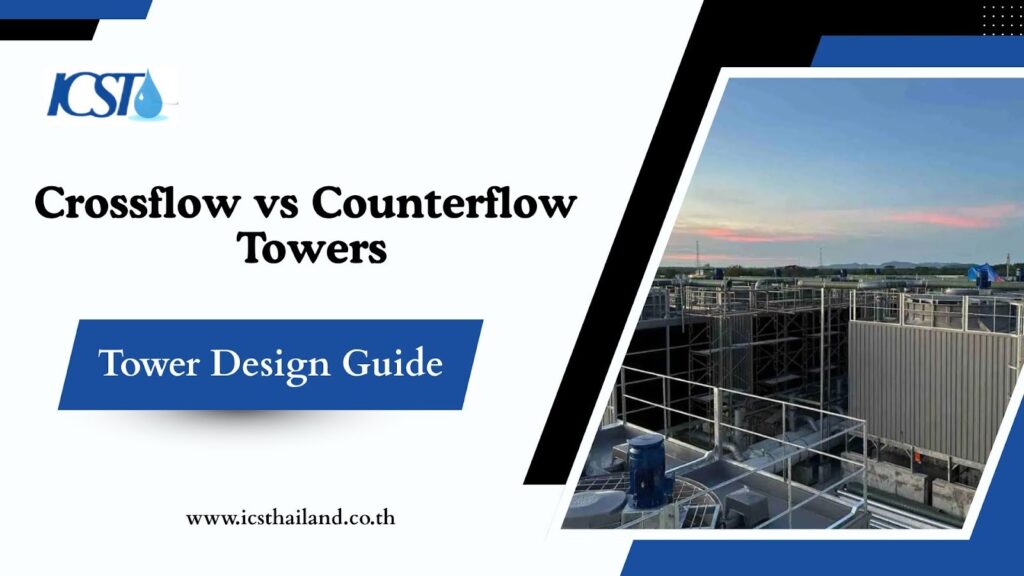
A counterflow cooling tower is a system where water flows downward while air moves upward, directly opposing each other. This design ensures efficient cooling because the coldest air meets the coldest water at the bottom, and the warmest air meets the warmest water at the top.
Key Points:
- Efficient Cooling: The opposing flows maximize thermal contact between air and water for better cooling.
- Spray System: Water is distributed through pressurized spray systems over fill media for even cooling.
- Airflow Design: Air enters from the bottom and is pulled upward by a fan, traveling against the downward-moving water.
- Space-Saving: The vertical design requires less ground space, making it ideal for areas with limited space or high land costs.
- Industrial Use: Commonly used in heavy industries and urban environments where high cooling performance is essential.
Key Differences Between Crossflow and Counterflow Towers
When considering crossflow vs counterflow towers, understanding their mechanical distinctions helps explain why one might be better suited for a specific environment. The following sections break down the critical differences in airflow path, water distribution, pump head, footprint, performance, and maintenance access.
Airflow Path: How Air Movement Affects Cooling Performance
The primary distinction between these technologies lies in how the air intersects with the water. Does the air cut across the water stream, or does it push directly against it?
- Crossflow: The air moves horizontally through the fill while water falls vertically. This perpendicular airflow path reduces the static pressure drop, allowing for potentially lower fan energy consumption in certain conditions.
- Counterflow: Air moves vertically upward against the falling water. This direct opposition creates highly efficient heat transfer but requires fans to overcome higher static pressure.
In real operating conditions, the airflow path dictates how the tower handles potential freezing issues. Crossflow towers can be more prone to ice formation on the louvers during winter operation, whereas the enclosed nature of counterflow intakes often offers better protection against the elements.
Water Distribution Method and Heat Transfer Efficiency
How water enters the system plays a key role in the complexity of the tower’s operation. In comparing crossflow vs counterflow towers, the method of water delivery significantly impacts both reliability and the energy needed to move the fluid through the system.
- Crossflow: These units use gravity-fed hot water basins located at the top of the tower. Water falls through holes in the basin floor onto the fill. This water distribution method is simple and allows for easy cleaning of the basin without shutting down the tower.
- Counterflow: These rely on pressurized spray headers and nozzles. The pressure ensures uniform distribution over the fill, which is critical for the tower’s thermal efficiency.
However, pressurized nozzles can clog with debris, requiring more diligent filtration. The gravity basins of crossflow towers are generally more forgiving of water quality issues and variable flow rates.
Pump Head Requirements and Energy Consumption
Energy costs over the lifecycle of a cooling tower often exceed the initial capital expenditure. A significant portion of this energy goes toward pumping water to the necessary height and pressure.
- Crossflow: Because these use gravity basins, the pump only needs to lift water to the top of the distribution basin. The pump head requirement is generally lower because there is no need to pressurize nozzles.
- Counterflow: The pump must lift the water to the top of the tower and provide enough additional pressure to force the water through the spray nozzles.
Consequently, counterflow towers typically demand higher pump head pressure. Over ten or twenty years of operation, the difference in pumping energy can result in substantial operational cost disparities.
Footprint and Space Requirements
Site constraints are often the deciding factor in cooling tower selection. If a facility has limited ground space but no height restrictions, the choice becomes clear.
- Crossflow: The design necessitates a wider structure to facilitate the horizontal airflow. This results in a larger physical footprint.
- Counterflow: Because the heat transfer is vertically aligned, these towers can be built taller and narrower.
For urban retrofits or industrial plants where every square meter of ground space is valuable, the compact footprint of the counterflow tower offers a distinct advantage. Conversely, if height restrictions exist (due to architecture or city ordinances), the lower profile of the crossflow tower is superior.
Thermal Performance and Cooling Efficiency Comparison
When strictly analyzing the ability to remove heat, the geometric arrangement of the air and water streams plays a major role. The efficiency of the heat exchange dictates how well the tower performs under peak load.
- Counterflow: This design is theoretically more efficient. The coldest air meets the coldest water, creating a consistent temperature gradient throughout the fill. This maximizes performance and allows for a closer approach to the wet-bulb temperature.
- Crossflow: While effective, the crossflow arrangement is slightly less thermally efficient per unit of fill volume.
In high-demand environments where maximizing cooling capacity is paramount, counterflow designs often provide superior thermal performance for a given volume of air.
Maintenance Access and Serviceability
Operational efficiency means nothing if the equipment cannot be maintained. The ease with which technicians can inspect and repair components affects downtime and labor costs.
- Crossflow: These are widely regarded as easier to maintain. The open plenum area allows for easy maintenance access to the mechanical equipment (fans, motors, gearboxes). The distribution basins can be cleaned while the tower is running.
- Counterflow: Access is more challenging. Inspecting the spray system often requires shutting down the unit and entering the tower.
Serviceability is a major selling point for crossflow towers. Facilities with limited maintenance staff often prefer the accessible design of crossflow units to avoid the confined space entry often required by counterflow models.
Crossflow vs Counterflow | Side-by-Side Summary Table
This table provides a quick reference to compare the fundamental characteristics of crossflow vs counterflow towers.
| Category / Criteria | Crossflow Cooling Tower | Counterflow Cooling Tower |
|---|---|---|
| Basic Water–Air Flow Arrangement | Water flows horizontally across the fill; air flows vertically upward | Water flows vertically downward; air flows vertically upward (opposite direction) |
| Contact Mechanism | Air crosses falling water at right angles | Air meets falling water directly head-on |
| Thermal Efficiency | Good | Very high |
| Heat Transfer Effectiveness | Moderate to high | Higher due to true counterflow contact |
| Approach Temperature Capability | Typically larger approach | Can achieve smaller approach temperatures |
| Range Capability | Moderate | High |
| Fill Type | Splash or film fill | Primarily high-efficiency film fill |
| Water Distribution System | Gravity distribution (hot water basins) | Pressurized spray nozzles |
| Water Distribution Pressure | Low | Higher |
| Pump Head Requirement | Lower | Higher |
| Energy Consumption (Pumping) | Lower pumping power | Higher pumping power |
| Fan Power Requirement | Slightly higher due to airflow path | Slightly lower for equivalent duty |
| Airflow Resistance | Lower | Higher |
| Cold Water Basin Location | Beneath the fill | Beneath the fill |
| Hot Water Basin Location | On top, exposed | Internal, enclosed |
| Maintenance Access | Easy access to distribution basins | More difficult due to enclosed system |
| Maintenance Complexity | Lower | Higher |
| Nozzle Clogging Risk | Low (gravity flow) | Higher (pressurized spray nozzles) |
| Water Quality Sensitivity | More tolerant of dirty water | Requires better water quality |
| Drift Loss | Low to moderate | Low |
| Noise Levels | Generally lower | Can be higher due to airflow velocity |
| Operating Stability | Very stable | Stable but sensitive to nozzle condition |
| Cold Weather Operation | Better visibility of icing; easier freeze management | Better freeze protection due to enclosed hot water |
| Structural Height | Shorter | Taller |
| Footprint Area | Larger | Smaller |
| Installation Cost | Generally lower | Generally higher |
| Operating Cost | Lower pumping costs | Higher pumping costs |
| Initial Capital Cost | Lower | Higher |
| Scalability | Easy to scale horizontally | Easy to scale vertically |
| Modularity | High | High |
| Typical Applications | HVAC, commercial buildings, light industry | Power plants, refineries, heavy industrial processes |
| Climate Suitability | Warm climates, moderate loads | Wide climate range, high-load systems |
| Reliability in Harsh Conditions | Good | Very good |
| Overall System Efficiency | Good | Excellent |
Which Cooling Tower Design Is Right for Your Facility?
Selecting the correct tower requires balancing physical constraints against performance goals. Do not base your decision solely on initial price; consider the total lifecycle cost.
You should consider a Crossflow Tower if:
- You have ample ground space but need to keep the tower height low.
- Maintenance ease is a top priority, and you want to clean basins while operating.
- You prefer lower pump head requirements to save on pumping energy.
- Your application requires variable flow rates, which gravity basins handle well.
You should consider a Counterflow Tower if:
- Ground space is extremely limited (tight footprint).
- You require the highest possible thermal performance and approach temperature.
- You need a tower that is less prone to freezing in extremely cold climates (due to enclosed intakes).
- The slight increase in pump head pressure is acceptable for the gain in efficiency.
There is no universal answer. The “best” tower is the one that fits your specific site conditions, water quality, and energy budget.
Common Selection Mistakes to Avoid

Even experienced engineers can misjudge a cooling tower application by focusing on the wrong metrics. Avoiding these pitfalls ensures long-term reliability.
- Ignoring Maintenance Access: Selecting a tower based on efficiency alone can lead to nightmares for the service team. If maintenance access is difficult, routine checks will be skipped, leading to premature failure.
- Overlooking Pump Energy: Focusing only on fan horsepower while ignoring pump head requirements can skew the operating cost analysis. Counterflow towers may save fan energy but cost more in pump energy.
- Sizing by Footprint Only: Forcing a crossflow tower into a space that is too tight can starve the tower of air (recirculation), destroying performance.
- Neglecting Water Quality: If the water source is dirty, the spray nozzles in a counterflow tower may clog frequently. A crossflow gravity basin handles particulates much better.
Conclusion
The debate of crossflow vs counterflow towers is not about finding a winner, but about finding the right fit. Each design offers distinct advantages regarding airflow path, water distribution, and serviceability that solve different engineering problems.
If your facility demands a compact footprint and high thermal efficiency, the counterflow design is likely your answer. If your priorities lie in ease of maintenance and lower pumping costs, the crossflow design stands out.
By carefully evaluating your maintenance access needs, energy budget, and space constraints, you can ensure your cooling infrastructure supports your business goals for decades to come.
Do not leave your critical infrastructure to chance. Reach out to ICST today, and let our technical partners guide you through the selection process to ensure your cooling tower meets your exact operational demands.
Frequently Asked Questions
What is the main difference between crossflow and counterflow towers?
The primary difference lies in the airflow path. In crossflow towers, air moves horizontally across falling water, while in counterflow towers, air moves upward against the downward water flow. This fundamental design difference affects efficiency, footprint, pump head, and maintenance access.
Are counterflow cooling towers more efficient than crossflow towers?
In most applications, counterflow towers are thermally more efficient because opposing air and water flows maximize heat transfer. However, the overall system efficiency must also account for higher pump head and maintenance complexity when comparing crossflow vs counterflow towers.
Which cooling tower type is better for limited space installations?
For facilities with restricted ground space, counterflow cooling towers are typically preferred. Their vertical design allows high cooling capacity within a smaller footprint, making them suitable for urban or retrofit installations.
How do I choose between crossflow and counterflow cooling towers?
To choose correctly, evaluate:
- Available footprint and height limits
- Required thermal performance
- Maintenance access capability
- Pumping and energy costs
- Water quality and climate conditions
Which is more cost-effective: Concrete or FRP cooling towers?
- FRP towers have lower initial cost and faster installation.
- Concrete towers have higher capital cost but may offer lower lifecycle cost for very large, long-term projects such as power plants.