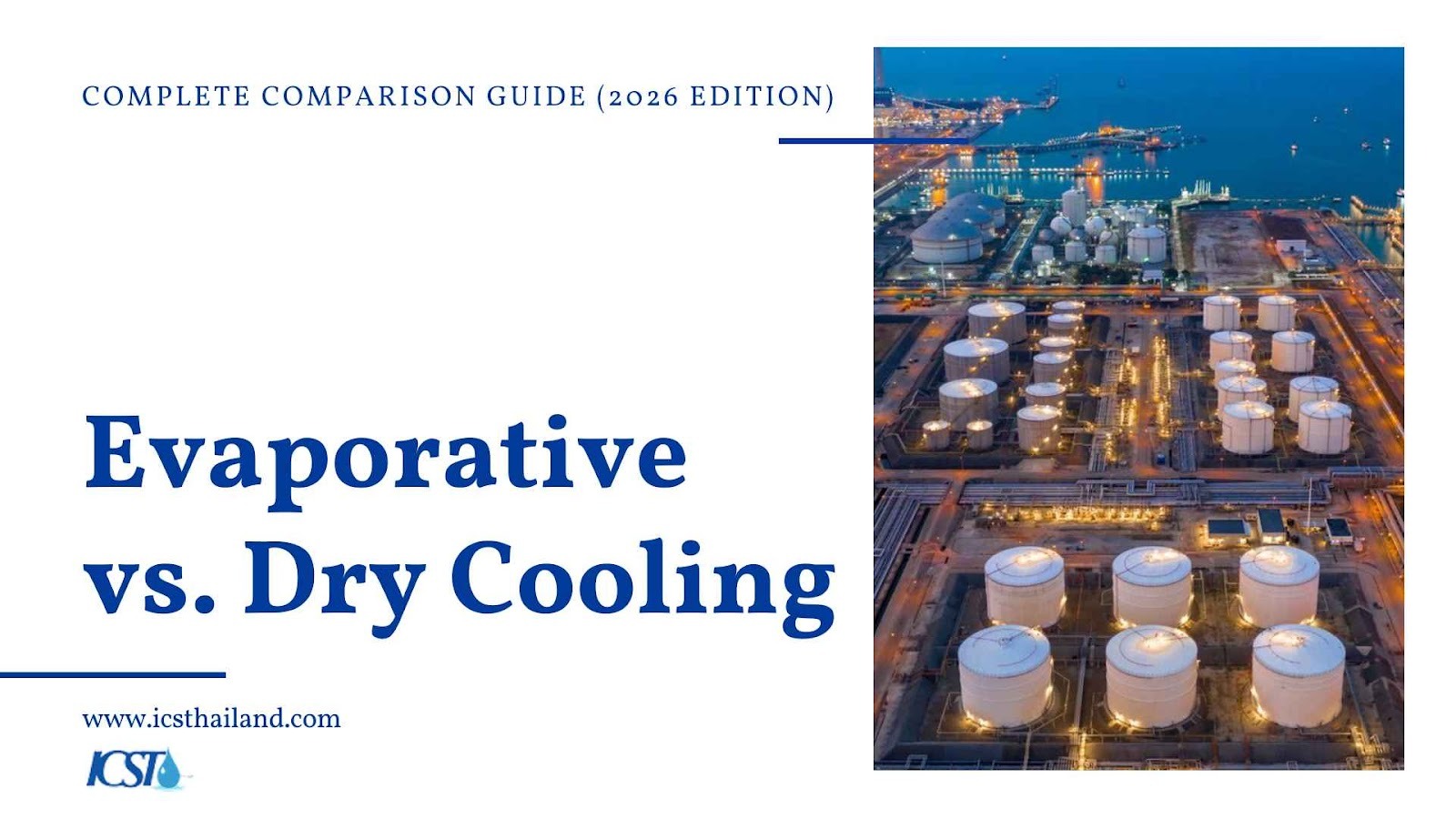
Industrial cooling faces a resource paradox, especially when considering evaporative vs dry cooling solutions. The global push toward Net Zero and Water Neutrality is forcing a reevaluation of traditional cooling methods. Facilities must now engineer solutions that are not only technically rugged and financially feasible but also environmentally responsible. This challenge is especially acute for operations dealing with “Critical Requirements” such as seawater, acid, and high-salinity environments.
From our Bangkok hub, ICST offers rapid deployment of cooling systems to support industrial sites across ASEAN and the Middle East, particularly during critical heat events. This guide provides a comprehensive comparison of evaporative versus dry cooling, helping you navigate the trade-offs and engineer the correct decision for your operational needs in 2026.
Core Mechanism Comparison: Wet vs. Dry
Choosing a cooling system involves balancing power usage, water consumption, and capital expenditure. The optimal choice depends heavily on your climate and resources. Here is how evaporative (wet), dry (air-cooled), and hybrid solutions compare across key metrics.
| Metric | Evaporative (Wet) Cooling | Dry (Air-Cooled) Cooling | Hybrid (Adiabatic) Solution |
| Cooling Limit | Wet-Bulb Temperature (Lowest possible) | Dry-Bulb Temperature (Higher) | Approaches Wet-Bulb on demand |
| PUE (Power) | Superior (Lowest energy draw) | Moderate (High fan power) | Dynamic Optimization |
| WUE (Water) | High (Constant evaporation) | Near Zero | 70-90% Annual Savings |
| CapEx | Lower initial unit cost | Higher (1.5x–2.0x vs. wet) | Premium initial investment |
| Ideal Climate | Arid/Dry (Maximum evaporation) | Water-Scarce/Remote | High-Humidity Urban Hubs |
Evaporative Cooling: The Wet Cooling Tower
How does evaporative cooling work? The system rejects heat through the latent heat of evaporation. As water evaporates from the cooling tower, it carries heat away from the process fluid, providing efficient cooling.
The primary advantage of this natural process in 2026 is its unmatched cooling performance. A wet cooling tower can cool process fluids to within 5–8°F of the ambient wet-bulb temperature. Dry coolers simply cannot achieve this level of precise temperature control. This makes evaporative cooling systems a cost-effective choice for industrial plants in dry climates that need to absorb heat with high efficiency.
However, the water evaporation process requires careful management of water quality to prevent biological growth and scaling. For applications using “dirty water” or acidic fluids, standard galvanized steel components often fail. ICST specializes in using advanced FRP and Titanium components that withstand these harsh environmental conditions, ensuring system longevity and regulatory compliance.
Dry Cooling: The Air-Cooled Condenser
Dry cooling systems, such as an air-cooled heat exchanger, operate on the principle of sensible heat transfer. Cooling occurs as fans move ambient air across finned coils, transferring heat through conduction and convection without any water loss.

The key benefit is water independence. This makes dry cooling towers the gold standard for facilities like data centers in water-stressed regions, such as the Middle East. Eliminating water usage also removes risks associated with water treatment, scaling, and biofouling. This significantly reduces maintenance costs related to water management.
While dry cooling offers lower operating costs in terms of water, it does have a higher capital cost and higher energy consumption due to the powerful fans required. Maintenance, though simpler, still requires regular cleaning of the heat exchanger coils to remove airborne debris and maintain cooling efficiency.
The 2026 Industry Shift: Hybrid Cooling Systems
Hybrid systems represent the “best of both worlds” approach to industrial cooling. These systems are designed to operate as a dry cooler for most of the year, conserving water and reducing operational costs. During periods of peak summer heat (above 35°C), they activate an “adiabatic” evaporative assist. This function sprays a fine mist of water onto the incoming hot air, lowering its temperature before it reaches the heat exchange coils.
This process provides a temporary boost in cooling capacity, allowing the system to approach the efficiency of evaporative cooling without the constant water usage. This results in significant advantages, including annual water savings of 70-90%.
ICST integrates AI-driven sensors that automatically switch between dry and wet modes. This technology optimizes performance based on real-time utility costs, choosing the most cost-effective mode by balancing water and power expenses. As extreme heat events become more common due to climate change, these hybrid systems provide critical adaptation, ensuring thermal reliability where traditional dry cooling might otherwise fail.
Operational Logic & After-Sales Support
A successful cooling system integration extends beyond the initial installation. We ensure long-term performance and reliability through dedicated support.

- “First 100 Days” Performance Audit: We conduct a thorough audit to verify that field performance data matches the initial design simulations, ensuring your system delivers on its promised efficiency.
- Regional Technical Assistance: Our team is prepared for 24-hour personnel dispatch from our Bangkok hub. We are ready to solve critical system failures across Asia and the Middle East, minimizing downtime.
- Specialized Maintenance: We understand the unique needs of hybrid systems. Our maintenance programs are designed to manage and protect these advanced systems, ensuring longevity even in high-salinity or acidic environments.
Conclusion: Engineering the Correct Decision
Choosing between evaporative vs dry cooling is a complex decision that requires careful evaluation of your facility’s climate, water chemistry, and operational budget. In 2026, selecting the right cooling system means finding a solution that meets your thermal reliability needs and supports your organization’s long-term environmental, social, and governance (ESG) objectives. Whether your priorities focus on lower energy consumption, reduced water usage, or a dynamic balance of both, your answer to the evaporative vs dry cooling challenge should be tailored to your unique situation.
Is your facility struggling to balance water mandates with cooling performance? Contact the ICST engineering team today for a Custom Thermal Audit and discover your optimal cooling balance.
Frequently Asked Questions (FAQs)
What is the difference between evaporative and dry cooling?
Evaporative cooling uses water evaporation to absorb heat, offering high cooling efficiency in dry climates. Dry cooling relies on air-cooled heat exchangers, making it ideal for water-scarce regions but with higher energy consumption.
How do hybrid cooling systems work?
Hybrid systems combine dry cooling with evaporative assist during peak heat. They optimize cooling performance by switching modes based on ambient air temperature and utility costs, ensuring energy efficiency and water savings.
Why is evaporative cooling energy-efficient?
Evaporative cooling systems leverage the natural process of water evaporation, requiring less mechanical energy compared to refrigerated cooling systems, making them a cost-effective choice for industrial plants.
What are the benefits of dry cooling systems?
Dry cooling systems eliminate water usage, reducing operational costs and risks like scaling and biological growth. They are ideal for data centers and industrial plants in arid regions.
Which cooling system is best for humid conditions?
Hybrid cooling systems are the most effective in humid areas. They adapt to environmental conditions, providing precise cooling while balancing water and energy consumption.