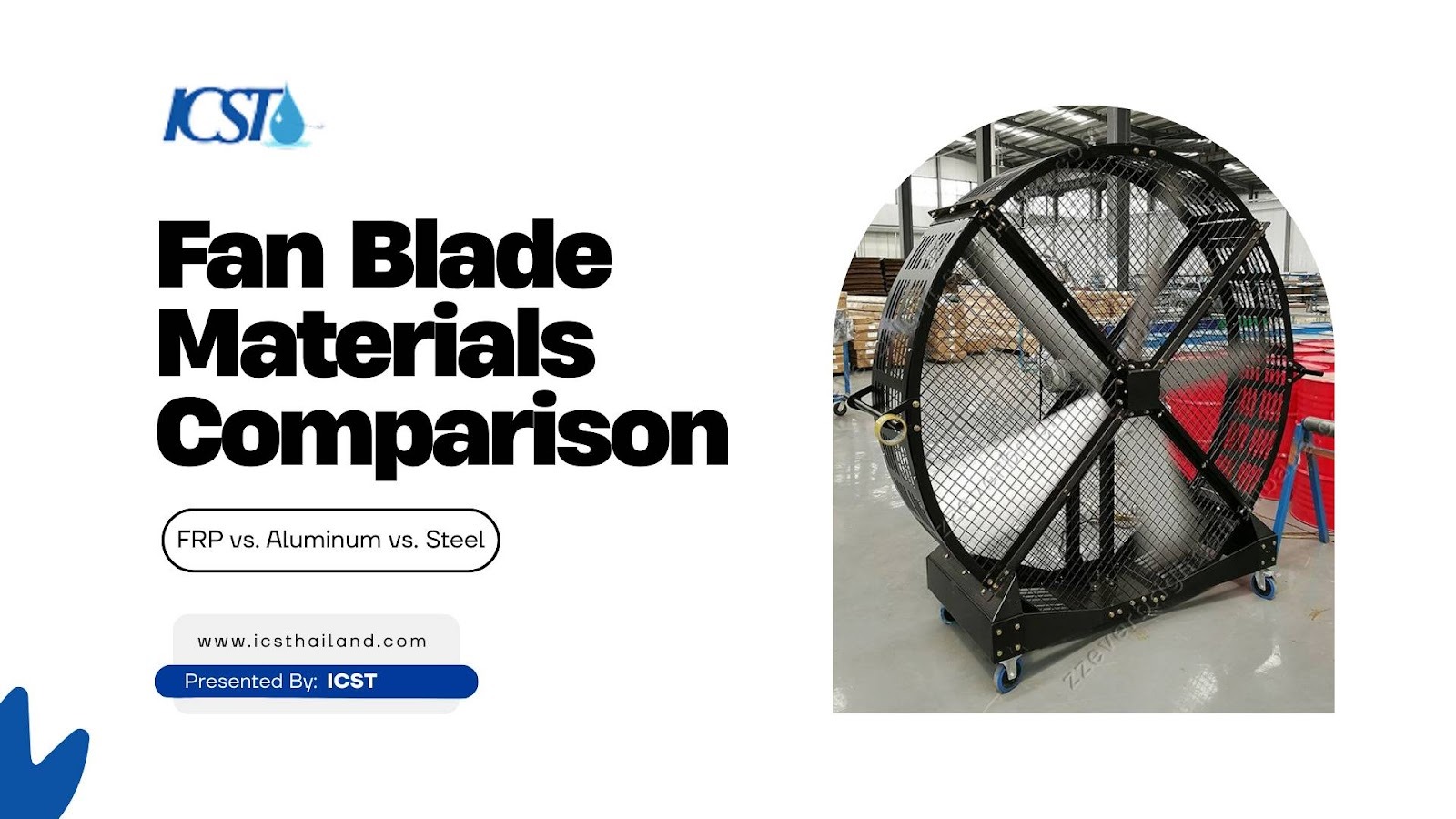
A thorough fan blade materials comparison is essential because the fan blade serves as the engine of your cooling system. It is the component that dictates both power consumption and thermal performance. The physics of airflow are clear: an efficient blade moves more air with less energy.
However, the material used to construct that blade determines its longevity and reliability. Environmental stressors like humidity, salt, and industrial chemicals constantly attack the blade’s mechanical integrity. Over a 10 to 20-year lifespan, the wrong material choice can lead to catastrophic failure and costly downtime.
At ICST, our philosophy is to use materials that are both technically feasible and sustainable. We believe in building components for infinite fatigue life. This commitment leads us to advanced materials like Fiberglass Reinforced Plastic (FRP), which offer performance and durability that traditional metals cannot match.
Comparative Overview: Industrial Fan Blade Materials
When selecting industrial fan blade materials, engineers must weigh several critical factors. The choice is a complex trade-off between initial cost, long-term operational expense, and system reliability. Here is a direct comparison of the three most common materials used in industrial fans.
Fiberglass (FRP)
- Weight: Ultralight, often 50% lighter than steel.
- Corrosion Resistance: Superior. The material is non-reactive and ideal for harsh environments.
- Fatigue Life: Effectively infinite due to its non-metallic composition.
- Noise Levels: Low, thanks to inherent material dampening properties.
- First Cost: Moderate to high.
- Static Efficiency: High (60–70%) due to advanced aerofoil designs.
Aluminum Alloy
- Weight: Lightweight.
- Corrosion Resistance: Moderate, but carries a risk of pitting and galvanic corrosion.
- Fatigue Life: Finite. Metallic fatigue can lead to crack propagation over time.
- Noise Levels: Moderate to high.
- First Cost: Low to moderate.
- Static Efficiency: Low (20–30%) for standard extruded profiles.
Mild/Stainless Steel
- Weight: Heavy.
- Corrosion Resistance: Poor. Mild steel requires protective coatings, while stainless steel offers better resistance at a higher cost.
- Fatigue Life: Moderate, dependent on stress loading and material grade.
- Noise Levels: High, prone to vibration.
- First Cost: Moderate.
- Static Efficiency: Low to moderate.
FRP (Fiberglass Reinforced Plastic): The Modern Engineering Standard
FRP represents a significant leap forward in fan blade technology. Its advantages stem directly from its composite nature and advanced manufacturing processes.
- Single-Piece Construction: ICST’s single-piece FRP profile blades eliminate a common point of failure. Bolted aluminum assemblies, which join different metals, are susceptible to galvanic corrosion and mechanical loosening. Our unified construction removes these risks entirely.
- The “Infinite Fatigue” Advantage: Metals have a finite fatigue life. Cyclic loading from airflow interruptions, startups, and shutdowns causes micro-cracks that eventually lead to failure. FRP, as a non-metallic composite, is not subject to this type of metallic fatigue, giving it a theoretically infinite fatigue life under normal operating conditions.
- Advanced Aerodynamics: Molding technology allows us to create complex, high-efficiency blade profiles. We can design non-symmetrical airfoils with variable chord and twist along the blade’s length. This optimizes airflow across the entire blade span, maximizing performance and minimizing energy use.
- Noise Reduction: The composite matrix of FRP has inherent vibration-damping properties. This allows FRP fans to operate much more quietly than their metal counterparts, with documented sound reductions of up to 12 dB(A).
Aluminum Alloy: The First-Cost Contender
Aluminum is often chosen for its attractive initial price point and good strength-to-weight ratio. It also dissipates heat well. However, these benefits come with significant long-term drawbacks.
The primary weakness of aluminum is its susceptibility to corrosion, especially galvanic corrosion in humid, salty, or chemical-laden environments. This can lead to pitting that compromises the blade’s structural integrity. Furthermore, its finite fatigue limit means that even well-maintained blades are accumulating “invisible” stress cracks over the years of service.
Manufacturing limitations also play a role. Extruded aluminum blades often feature simple, symmetrical airfoils. While inexpensive to produce, these designs have very low static efficiency, often only 20-30%. This translates directly to higher energy bills over the life of the fan.
Steel: The Heavy-Duty Legacy
Steel has long been the traditional choice for industrial applications requiring brute strength. A distinction exists between cost-effective mild steel, which must have an epoxy or galvanized coating for protection, and the more expensive but corrosion-resistant 304/316 stainless steel grades.
The most significant penalty for using steel is its weight. Heavy steel blades place immense torque requirements on the motor and cause increased wear on bearings and support structures. This often necessitates a more robust and expensive system infrastructure.
Despite its disadvantages, steel remains the right choice for specific applications. These include environments with abrasive particles or extreme thermal processes where the resins used in FRP composites might degrade.
Engineering Selection: Matching Material to Mission
The optimal fan blade material is entirely dependent on the application.

- Corrosive Environments: For coastal facilities, chemical plants, and wastewater treatment centers, FRP is the clear winner. Its non-reactive nature prevents the degradation that plagues metal alloys.
- Noise-Sensitive Areas: In settings like commercial HVAC systems, hospitals, and residential zones, the low-noise characteristics of FRP make it the superior choice for maintaining a quiet environment.
- High-Temperature Processes: For certain inducted draft air coolers and industrial furnaces, metal alloys like steel or specialized aluminum may be necessary to withstand extreme temperatures.
Ultimately, the lower operational costs of an efficient system can quickly offset a higher initial investment. As detailed in our analysis of Cooling System Total Cost of Ownership, an upgrade to FRP blades can often pay for itself within 18–24 months through energy savings alone.
The ICST Difference: Regional Logistics & Support
Selecting the appropriate material is just one aspect of the solution. ICST provides unparalleled support to ensure your system achieves peak performance. Our strategic hub in Bangkok allows us to dispatch expert personnel to any site in Asia within hours. We provide on-site services for blade pitch optimization, dynamic balancing, and performance verification.
Our team has mastery over export logistics, navigating complex 12-digit HS codes to ensure rapid customs clearance for high-efficiency fan components across the Middle East and GCC regions. Our after-sales services include comprehensive field support, vibration analysis, and Cooling System Emergency Repair services to address catastrophic fan failures and minimize downtime.
Conclusion: Moving Toward Sustainable Air Movement
When considering a fan blade materials comparison, your choice becomes a critical engineering decision. It represents a trade-off between the initial budget and the 20-year reliability and efficiency of your air movement system. While traditional metals may offer a lower first cost, their vulnerabilities to corrosion and fatigue lead to higher maintenance needs and energy consumption.
In an era of rising energy costs and increasing focus on sustainability, aerodynamic efficiency is no longer optional. Advanced FRP composite blades deliver the performance, longevity, and reduced operational expense that modern industry demands.
Is your fan deck wasting energy? Contact ICST for a Technical Fan Audit and material upgrade proposal today.
Frequently Asked Questions
What Materials Are Commonly Used for Industrial Fan Blades?
In an industrial fan blade materials comparison, the most widely used materials are Fiberglass Reinforced Plastic (FRP), aluminum alloys, and steel. These materials differ in weight, corrosion resistance, durability, efficiency, and maintenance requirements, which directly affect fan performance and operating costs.
Why Are FRP Fan Blades Considered the Best Option?
FRP fan blades are often the top choice in a fan blade materials comparison due to their lightweight construction, excellent corrosion resistance, and infinite fatigue life. FRP allows for advanced aerodynamic airfoil designs, resulting in higher efficiency, lower noise levels, reduced vibration, and longer service life, especially in cooling towers and HVAC systems.
Aluminum vs FRP Fan Blades: What’s the Difference?
When comparing aluminum vs FRP fan blades, aluminum offers lower upfront cost and lighter weight than steel, but it falls short of FRP in corrosion resistance, fatigue life, and aerodynamic efficiency. Aluminum blades typically use simpler blade profiles, which limits airflow efficiency and long-term performance compared to FRP designs.
When Are Steel Fan Blades the Right Choice?
In a practical fan blade materials comparison, steel fan blades are best suited for heavy-duty industrial environments, such as applications involving abrasive particles, high mechanical stress, or extreme temperatures. However, steel’s high weight, increased energy consumption, and higher maintenance needs make it less suitable for energy-efficient or corrosion-prone environments.