Industrial cooling systems are complex, dynamic assets. Optimizing their performance requires a deep understanding of countless variables, from water chemistry to mechanical stress. While traditional maintenance offers a snapshot in time, a Digital Twin provides the entire movie.
By integrating IoT Cooling System Sensors with a high-fidelity virtual model, you can unlock unprecedented levels of efficiency, reliability, and insight. This approach moves beyond simple monitoring into the realm of predictive and prescriptive optimization.
This guide reveals five advanced IoT Cooling System Sensors Secrets that are only possible with a Digital Twin. We will explore the foundational technologies, explain how they work together, and provide a clear roadmap for strategic implementation.
You will learn how to turn sensor data into actionable intelligence, validating system performance and securing a significant return on investment.
The Authority Hook: 5 Digital Twin Optimization Secrets
A Digital Twin is more than just a 3D model; it is a living, breathing virtual replica of your physical cooling system.
It is fed by real-time data from IoT sensors, allowing it to simulate, predict, and diagnose with incredible accuracy. This capability enables optimization strategies that are simply out of reach for conventional methods.
The Top 5 Digital Twin Optimization Secrets
Here are five expert-level IoT Cooling System Sensors Secrets that a Digital Twin makes possible:
Virtual Flow Indexing (VFI):
High-accuracy flow and temperature sensors feed the virtual model, calibrating a precise digital replica of your internal piping and fill media. This allows you to run what-if analyses on chemical dosing and water treatment strategies within the simulation.
You can perfect your approach without impacting the live system, preventing costly mistakes and ensuring optimal water quality.
Dynamic Setpoint Drift Prevention:
Your Digital Twin continuously runs simulations based on your P&ID (Piping and Instrumentation Diagram). If real-world sensor data deviates from the model’s predicted output for a given input, it flags a potential issue.
This early warning can identify sensor drift or component failure before it leads to a drop in cooling capacity or a spike in energy consumption.
Simulated Critical Speed Validation:
IoT vibration sensors map the cooling tower’s current resonant frequencies. The Digital Twin uses this live data to simulate the impact of new Variable Frequency Drive (VFD) settings.
This process validates that the programmed RPM skip bands are still accurate, preventing the motor from operating at a speed that would cause destructive resonance and catastrophic mechanical failure.
Proactive Water Loss Mapping:
By correlating data from interior and exterior IoT humidity sensors and flow rate sensors, the Digital Twin can precisely calculate the expected evaporation rate.
If the measured water consumption exceeds this modeled rate, the system flags a non-evaporative loss. This allows you to identify and repair leaks quickly, conserving water and reducing operational costs.
EER Validation via Operational Twin:
An operational twin calculates the system’s actual, real-time Energy Efficiency Ratio (EER) using live data from motor current and thermal sensors.
This provides continuous validation of system performance against its original design specifications, which is a critical metric for ESG (Environmental, Social, and Governance) reporting and energy audits.
The Foundational Shift: What is IoT and Digital Twin
To fully leverage these advanced IoT Cooling System Sensors Secrets, it is important to understand the core technologies that enable them. IoT sensors and Digital Twins are distinct but synergistic technologies that together create a powerful platform for industrial asset management.
What is an IoT Cooling System Sensor?
An IoT cooling system sensor is a device that measures a physical property of your cooling equipment and transmits that data over a network. These sensors digitize a physical asset’s health, capturing real-time information on key parameters. Common types include:
Vibration Sensors: Monitor the health of motors, fans, and gearboxes.
Temperature Sensors: Track thermal performance and fluid temperatures.
Current Sensors: Measure energy consumption of motors.
Flow Sensors: Monitor water consumption and circulation rates.
These devices work together to provide a constant stream of data, forming the sensory input for the Digital Twin.
Why a Digital Twin is the Ultimate Optimization Tech
A Digital Twin is a virtual model of a physical asset, updated in real-time via IoT sensors. It mirrors the asset’s condition, enabling:
- Design Validation: Test scenarios like fan speed changes or water treatment adjustments in a simulation before live implementation.
- What-If Analysis: Make data-driven decisions to enhance efficiency and extend asset lifespan.Accurate results depend on high-resolution, high-fidelity sensor data during setup.
The Operational Twin: Sensor Data and Virtual Simulation
An operational twin is where raw data becomes actionable intelligence. It achieves this through a process of sensor fusion and by running advanced simulations that predict future performance and diagnose hidden issues.
Sensor Fusion: Turning Raw Data into a Virtual Model
Sensor fusion is the process of combining data from multiple IoT sensors to create a comprehensive and accurate virtual model. Each data stream tunes a specific part of the simulation.
For example,
Vibration analysis data helps refine the virtual health parameters of the motor and gearbox. Meanwhile, thermal and humidity sensor data are used to calibrate the virtual environment and its impact on performance, such as calculating the wet-bulb temperature.
Advanced Simulation: What-If Analysis and Performance Modeling
Once the Digital Twin is accurately calibrated, it becomes a powerful tool for prediction and optimization.
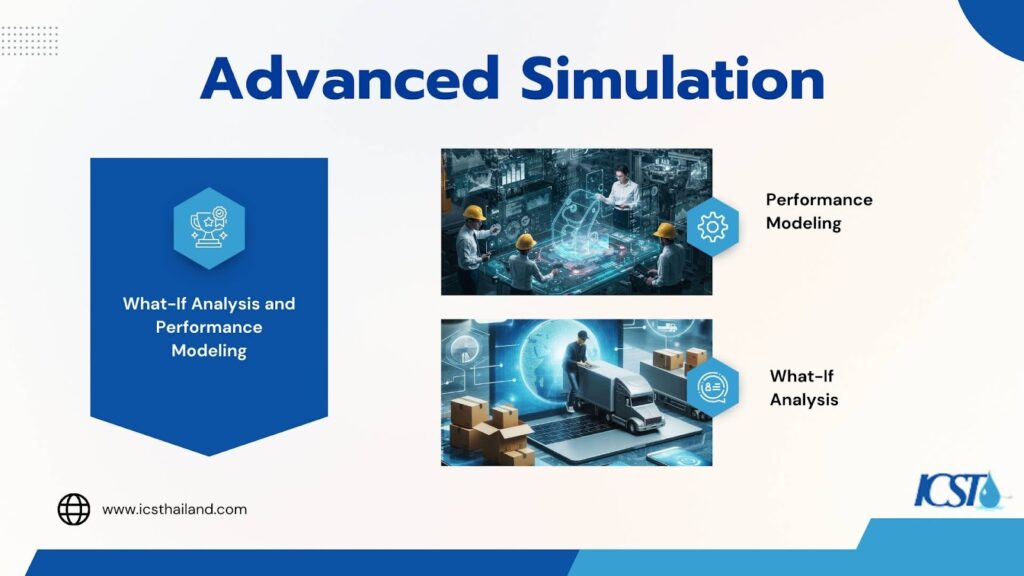
Performance Modeling: The twin can track efficiency degradation over time by comparing current performance against a baseline. This helps you identify when maintenance is truly needed, rather than relying on a fixed schedule.
What-If Analysis: This is the core of strategic optimization. You can simulate the impact of potential actions before you commit to them. For example, you can model how adjusting VFD speeds will affect your EER or how changing the blowdown frequency will impact both water consumption and asset life.
Strategic Implementation: Challenges, Regulations, and ROI
Adopting a Digital Twin strategy involves more than just technology. It requires navigating practical challenges, adhering to regulations, and building a strong business case based on quantifiable returns.
Common Challenges and Risks of IoT Cooling System Sensors
Implementation is not without its hurdles. Key challenges include ensuring robust network security to protect your operational data, managing data latency issues that could affect real-time accuracy, and addressing sensor battery life to avoid data gaps.
Furthermore, integrating the new IoT platform with legacy CMMS (Computerized Maintenance Management System) can be complex.
Environmental Considerations and Regulations
A Digital Twin is a powerful tool for regulatory compliance. By using flow and water quality sensors, you can create an auditable record proving that blowdown discharge meets environmental standards.
The continuous EER modeling also provides the necessary data for accurate ESG reporting, demonstrating a commitment to energy efficiency and sustainability.
Quantifying the ROI: Why IoT Sensors are Important
The business case for IoT sensors and Digital Twins is compelling. The primary benefit is the near-elimination of unplanned downtime. By creating a validated operational twin that mirrors your asset, you can achieve predictive accuracy approaching 99.99%. This allows you to shift from reactive repairs to a truly predictive maintenance model, maximizing uptime and production continuity.
IoT Cooling System Sensor Optimization Table
| Optimization Secret | IoT Sensor Involved | Key Benefit | Application Example |
|---|---|---|---|
| Virtual Flow Indexing (VFI) | Flow, Temperature | Accurate system calibration | Chemical dosing and water treatment optimization |
| Dynamic Setpoint Drift Prevention | All process sensors | Early detection of drift or sensor failure | Prevent unplanned failures and energy waste |
| Simulated Critical Speed Validation | Vibration | Prevent destructive resonance | Tune VFD and safe RPM band validation |
| Proactive Water Loss Mapping | Humidity, Flow | Rapid leak detection and water conservation | Evaporation vs. actual usage tracking |
| EER Validation via Operational Twin | Motor Current, Thermal | Validates energy and operational efficiency | Demonstrates ESG compliance |
The Future: From Predictive Maintenance to Autonomous Cooling
The integration of IoT and Digital Twins is the beginning of a larger transformation. As the technology matures, we will move from predicting failures to prescribing solutions and, eventually, to fully autonomous systems.
Design and Installation Considerations
Successful implementation starts with a solid foundation. This includes planning for sensor redundancy to ensure continuous data flow and isolating sensors from extreme vibration to maintain data integrity.
Strategic placement of network gateways is also critical for robust and reliable data transmission from the sensors to the cloud or on-premise servers.
Future Trends in IoT Cooling Systems
The evolution of IoT cooling system sensors is driving toward full autonomy. Key advancements include:
- AI and ML Integration: Elevating Digital Twins from predictive tools to prescriptive systems that recommend corrective actions.
- Autonomous Cooling Systems: Digital Twins will not only detect and diagnose issues but also implement solutions automatically using advanced modeling.
This shift marks a move toward a data-driven culture, where decisions are based on comprehensive simulations and real-time insights. The Digital Twin is the core enabler of this transformation, unlocking the full potential of your cooling system optimization efforts.
Conclusion
The evolution of IoT cooling system sensors and Digital Twins is transforming performance modeling and operational efficiency across industries.
By integrating real-time data with advanced simulation models, organizations gain the power to predict issues, optimize every facet of cooling operations, and ensure compliance with environmental standards.
This leap from predictive maintenance toward autonomous cooling unlocks new levels of reliability, resource savings, and strategic insight. Embracing these IoT Cooling System Sensors Secrets means more than avoiding downtime; it empowers your team to achieve sustainability goals and maintain a competitive edge.
Ready to maximize your cooling system’s potential with ICST? Start implementing these five IoT Cooling System Sensors Secrets today and lead your industry with smarter, data-driven strategie
Frequently Asked Questions
What are IoT Cooling System Sensors Secrets?
They are smart tricks that use real-time sensor data and a live computer model to find hidden problems, prevent breakdowns, and run your cooling system more efficiently.
How do sensors and a Digital Twin work together?
The sensors collect live data (like temperature and vibration) and send it to the Digital Twin—a virtual copy of your cooling system. The twin uses that data to simulate problems, predict failures, and show you how to fix them before they happen.
What’s the main benefit of using these secrets?
You avoid unexpected breakdowns. This means less downtime, lower energy and water bills, longer equipment life, and reliable cooling when you need it most.
What are the challenges of setting this up?
Common issues include connecting new sensors to old systems, keeping data secure from hackers, making sure sensors have enough battery life, and placing them correctly so the data is accurate.
How does AI help improve these systems?
AI analyzes all the data from the sensors and the Digital Twin. It doesn’t just warn you about problems—it suggests the best actions to take, making your system smarter and moving toward self-correction.