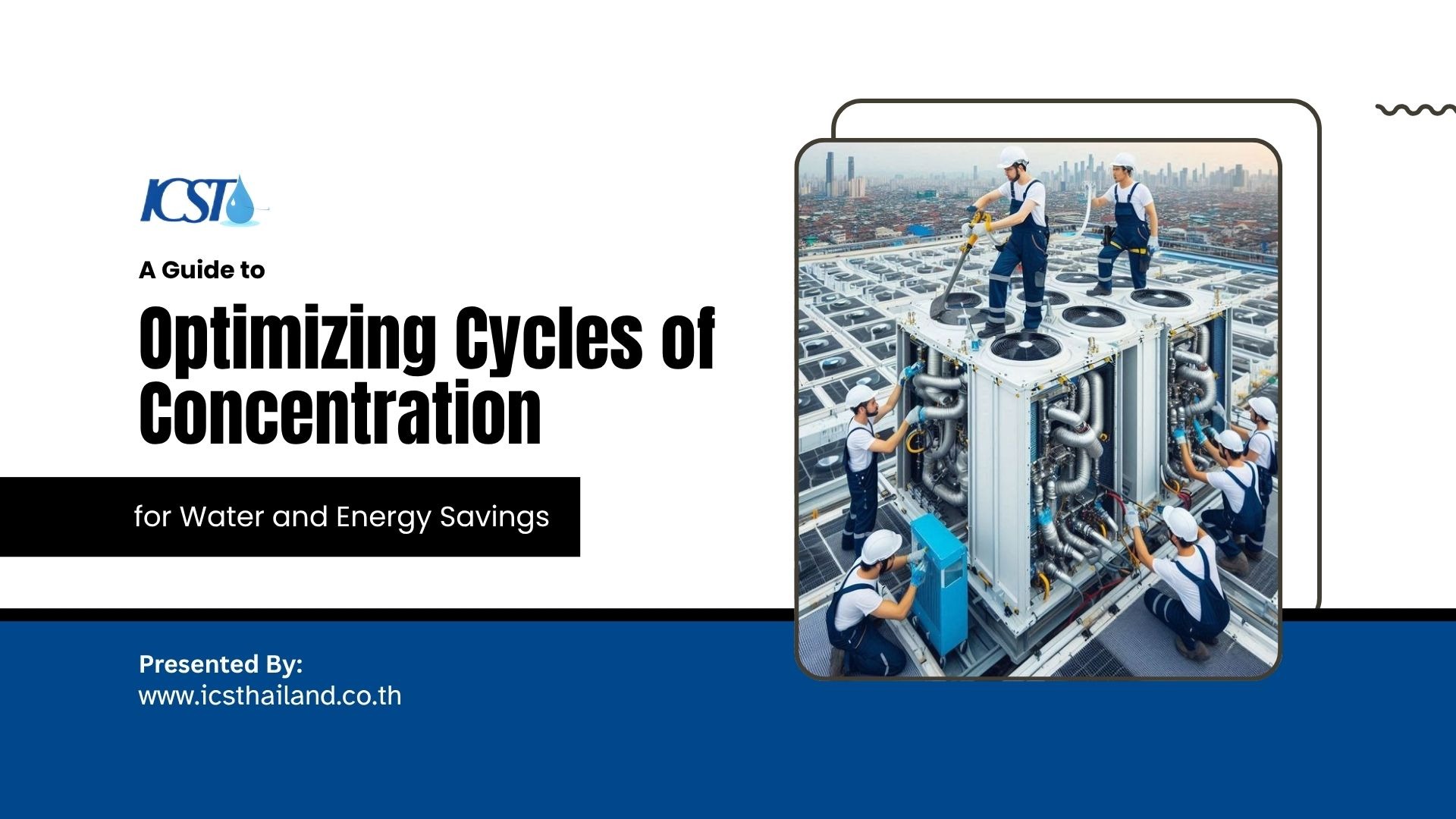
Optimizing cycles of concentration (COC) directly controls water consumption, blowdown volume, and thermal efficiency in cooling towers. Increasing COC from 3 to 6 can reduce blowdown by nearly 50%, but it also raises scaling risk and conductivity levels.
Engineers rely on conductivity controllers, chemical dosing, and the Ryznar Index to maintain safe operating limits. A properly optimized system reduces water cost, stabilizes heat transfer, and prevents fouling-related energy losses.
Maximizing Cooling Tower Efficiency: The Role of Cycles of Concentration
Cycles of concentration define the ratio of dissolved solids in your circulating water compared to your fresh makeup water. This metric serves as a direct indicator of how many times your cooling tower reuses water before discharging it.
Optimizing cycles of concentration is key to managing your operating costs. Higher cycles mean lower blowdown rates, which reduces water and chemical consumption. Conversely, lower cycles lead to excessive blowdown, creating a wasteful and expensive operational environment where scaling and corrosion can occur.
Consider these critical factors when evaluating your system:
- Calculate your exact makeup water volume daily to establish a baseline.
- Measure the circulating water dissolved solids against your incoming supply.
- Monitor blowdown rates to identify hidden leaks or valve failures.
- Evaluate chemical consumption rates to spot overdosing trends.
- Track thermal performance drops that indicate initial fouling.
Water balance equations determine the true cost of your cooling operation. Pumping large volumes of fresh water costs money. Discharging treated water down the drain wastes valuable chemical investments.
Relationship Between COC, Blowdown, and Makeup Water
Cooling towers continuously lose water through evaporation, drift, and blowdown. Blowdown is the intentional discharge of water to control dissolved solids.
Increasing COC reduces blowdown volume significantly. Lower blowdown means less makeup water demand, which directly lowers water consumption and cost.
- Low COC → high blowdown → excessive water waste
- Moderate COC → balanced operation → controlled discharge
- High COC → minimal blowdown → maximum water reuse
Proper control ensures that water savings do not compromise system integrity.
The Trade-Off: Water Savings vs Scaling Risk
What Happens When COC Increases Beyond Safe Limits
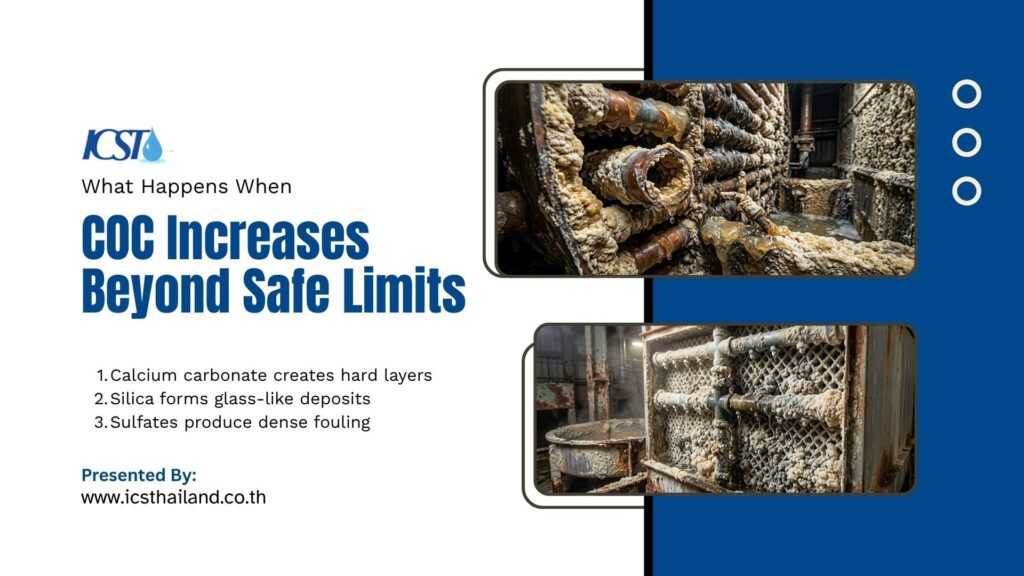
As cycles increase, dissolved minerals such as calcium, magnesium, and silica accumulate. Once solubility limits are exceeded, these minerals precipitate and form scale.
Scaling begins on high-temperature surfaces such as heat exchangers, where it severely restricts heat transfer.
- Calcium carbonate creates hard, insulating layers
- Silica forms glass-like deposits
- Sulfates produce dense fouling
Even thin deposits can reduce efficiency significantly.
Scaling Risk and the Role of the Ryznar Index
Engineers use the Ryznar Index to predict this scaling tendency accurately. A low Ryznar Index value indicates a high scaling risk. A high value warns you of potential corrosion problems.
How do you find the perfect balance for your specific plant? What factors limit your ability to push cycles higher? Review these operational constraints before changing your setpoints:
- Analyze your local makeup water quality for high silica content.
- Check maximum operating temperatures across your heat exchangers.
- Evaluate the metallurgy of your entire cooling loop to prevent corrosion.
When optimizing cycles of concentration, it’s crucial to recognize that sources with high hardness or silica content will require more aggressive chemical management.
Conductivity Control and Chemical Treatment Strategy
Conductivity provides an indirect measurement of total dissolved solids in your cooling water. Higher conductivity indicates a higher concentration of minerals. A reliable conductivity controller serves as the backbone of your COC optimization program.
The automated approach is essential for optimizing cycles of concentration, as it maintains your target range perfectly, prevents over-concentration, and protects your system during sudden load changes.
Implement these critical chemical treatment components:
- Do specific scale inhibitors prevent crystal formation on hot surfaces?
- Apply corrosion inhibitors to protect steel and copper components.
- Maintain strict pH control to keep scaling minerals dissolved.
- Deploy a strong biocide program to eliminate biofouling and slime.
- Use dispersants to keep suspended solids moving toward the basin.
Role of Conductivity Controllers
Modern cooling towers rely on conductivity controllers to automate blowdown. These controllers continuously monitor conductivity and trigger discharge when limits are exceeded.
This automation prevents over-concentration and maintains stable operating conditions without manual intervention.
- Maintains target COC range
- Prevents scaling thresholds from being exceeded
- Reduces operator error
Consistent control ensures predictable performance.
Manual vs Automated Control Systems
Manual systems depend on periodic testing and operator judgment. This approach leads to inconsistent control and delayed response to fluctuations.
Automated systems respond instantly to changes in water chemistry. Industrial facilities prefer automated solutions because they maintain stability under varying loads. Automation transforms COC management from reactive to proactive.
Chemical Treatment Strategy for High COC Operation
Scale Inhibitors and Their Function
Scale inhibitors prevent mineral crystals from forming and adhering to surfaces. These chemicals allow systems to operate at higher cycles without visible deposition.
Without inhibitors, even moderate COC levels can lead to rapid fouling.
Corrosion Control in Concentrated Systems
As dissolved solids increase, water becomes more aggressive toward metal surfaces. Oxygen, pH imbalance, and salts contribute to corrosion.
Corrosion inhibitors create a protective film on metal surfaces, reducing damage and extending equipment life.
Biofouling and Its Impact on COC Stability
Microbiological growth introduces another layer of complexity. Biofilm traps solids and creates localized areas where scaling and corrosion accelerate.
Biological activity also disrupts chemical balance, making COC control unstable.
- Biofilm reduces heat transfer
- Promotes under-deposit corrosion
- Increases chemical demand
Effective biocide programs are essential for maintaining stable operation.
Real Cost Impact of COC Optimization
Water Savings Calculation
Increasing COC reduces blowdown volume dramatically. A system operating at 3 cycles may discharge twice as much water as a system running at 6 cycles.
This reduction translates directly into water cost savings, especially in regions with high water tariffs.
Energy Efficiency Gains
Clean heat exchange surfaces improve thermal efficiency. Reduced fouling allows equipment to transfer heat more effectively. Improved efficiency lowers energy consumption across pumps, chillers, and fans.
Chemical Cost Reduction
Lower blowdown means fewer chemicals are lost through discharge. Optimized dosing ensures that chemicals remain in the system longer, improving cost efficiency.
Balanced treatment reduces both overuse and underperformance.
Low vs Optimal vs High COC Operation
| Parameter | Low COC (2–3) | Optimal COC (4–7) | Excessive COC (8+) | Engineering Insight |
| Water Usage | Very High | Controlled | Low | Optimal COC balances savings and safety. |
| Blowdown Rate | High | Moderate | Minimal | Blowdown reduction drives primary financial savings. |
| Scaling Risk | Low | Managed | High | Risk increases exponentially past saturation points. |
| Chemical Cost | High | Optimized | High (overdosing) | Poor control increases chemical consumption rapidly. |
| System Efficiency | Poor | High | Decreasing | Fouling destroys your thermal transfer efficiency. |
You must calculate these savings accurately to justify equipment upgrades. High water cost regions benefit the most from aggressive optimization. Advanced treatment systems pay for themselves quickly in these areas.
When to Increase or Limit Cycles of Concentration
When Increasing COC Is Beneficial
Higher cycles are effective under controlled conditions.
- Stable water chemistry
- Reliable chemical treatment program
- Automated conductivity control
- High water cost environment
These conditions support safe and efficient operation at higher cycles.
When COC Should Be Limited
Certain conditions require conservative operation.
- High silica or hardness levels
- Inconsistent chemical dosing
- Lack of automation
- History of scaling or fouling
Pushing cycles under these conditions leads to rapid system degradation.
Warning Signs of Over-Concentration
Operators must monitor early indicators of instability.
- Sudden conductivity spikes
- Declining cooling performance
- Visible scale deposits
- Increased chemical consumption
These signals require immediate adjustment to prevent damage.
Best Practices for Stable System Operation
Implement Continuous Monitoring
For stable operation, you need a strategy for continuous monitoring. Modern sensors and automation are essential for tracking the health of your system. Monitor conductivity, pH, and temperature trends daily to identify potential issues early.
Adopt an Integrated Water Treatment Approach
To prevent failures while optimizing cycles of concentration, use an integrated approach. This should include side-stream filtration, precise chemical dosing, and remote monitoring capabilities.
Conclusion
Optimizing cycles of concentration remains the primary control lever for generating significant water and energy savings in industrial plants. You now understand that pushing cycles higher is not always better. Facility operators must balance the desire for water conservation with the exponential scaling risk associated with concentrated minerals.
A reliable conductivity controller combined with a targeted chemical treatment program guarantees operational success. Your best results will always come from data-driven optimization rather than blind adjustments.
Protect your equipment, reduce your utility expenses, and ensure operational success. Contact Industrial Cooling Solutions Thailand today for expert cooling tower repair and maintenance services.
Frequently Asked Questions
What is the ideal cycle of concentration for a cooling tower?
Most industrial cooling systems operate between four and seven cycles of concentration. This target range depends entirely on your local makeup water chemistry and your facility’s chemical treatment capability.
How does COC reduce water consumption?
Higher cycles mean the cooling tower reuses the same water more times before discharging it. This reuse directly reduces your blowdown volume. Consequently, the tower requires significantly less fresh makeup water to maintain operational levels.
What is the role of conductivity in COC control?
Conductivity accurately measures the volume of dissolved solids present in your cooling water. A conductivity controller monitors this value constantly. It opens the automatic blowdown valve when the mineral concentration reaches your programmed maximum limit.
Can high COC damage equipment?
Yes, running excessively high cycles will destroy your equipment if you do not control scaling. Concentrated minerals precipitate onto hot surfaces. This precipitation leads to severe fouling, loss of thermal transfer, and destructive under-deposit corrosion.
How do you increase cycles of concentration safely?
You must improve your chemical treatment program to handle the higher mineral load. Install reliable side-stream filtration to remove suspended solids. Monitor the system continuously using automated sensors to catch chemistry imbalances immediately.