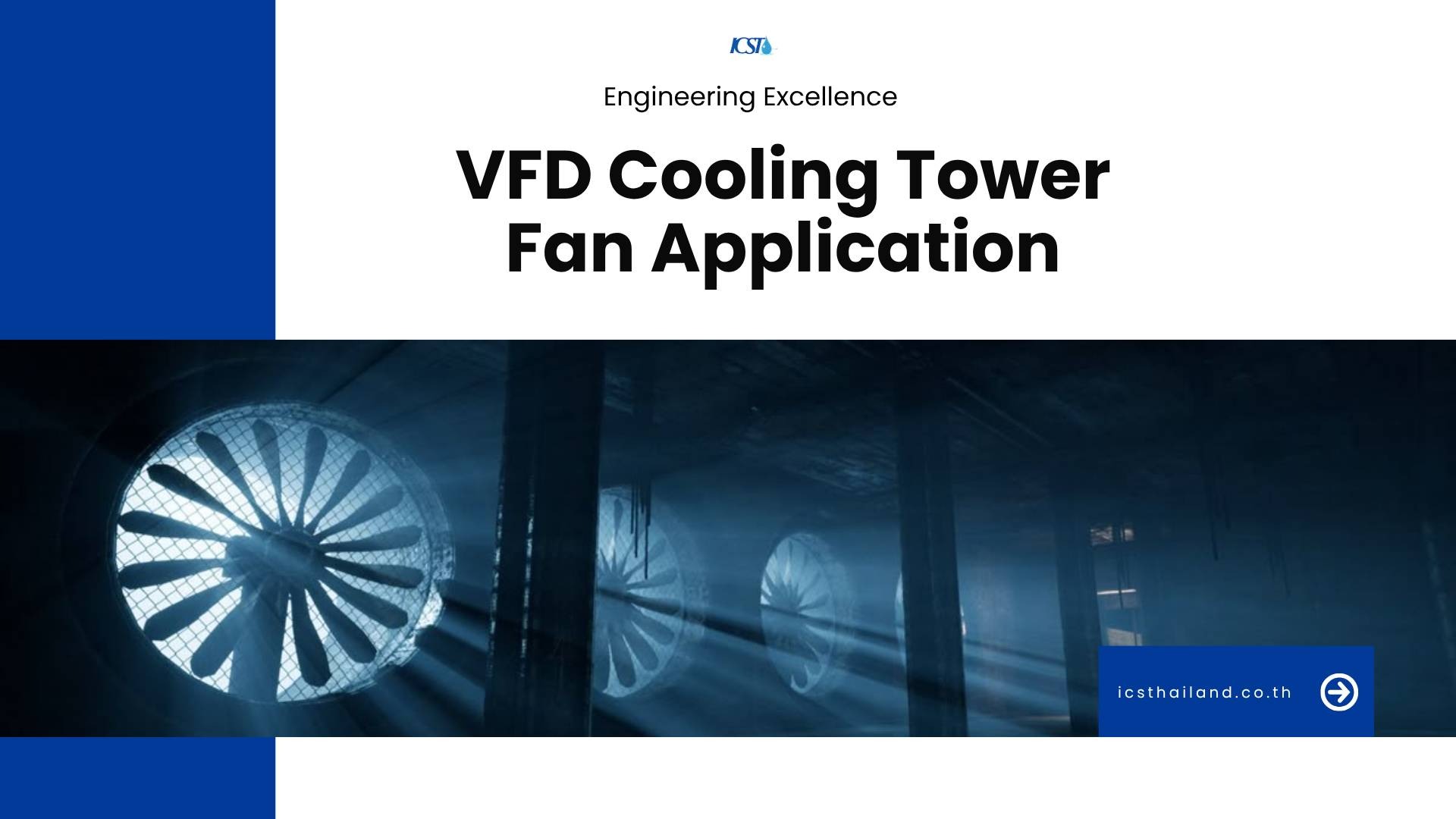
A VFD cooling tower fan application optimizes energy efficiency and system reliability by precisely controlling fan speed in response to cooling demand. Utilizing the cubic law, VFDs significantly reduce power consumption, with a 20% speed reduction saving up to 50% energy.
They also minimize mechanical stress through soft-start capabilities, extend equipment life, and ensure precise temperature control. Additionally, VFDs mitigate harmonic distortion, enhance predictive maintenance with real-time diagnostics, and adapt to environmental challenges like high humidity or load variability, making them indispensable for industrial cooling systems.
This guide explores the technical mechanics behind variable frequency drives in cooling towers. You will learn the exact principles of system sizing, programming, and maintenance. We will cover how to implement these systems to achieve maximum performance and longevity.
The Efficiency Opportunity: Understanding VFDs in Cooling Systems
Cooling tower fans represent ideal candidates for variable speed upgrades. The fundamental physics of air movement make this specific application highly lucrative for energy reduction. Engineers must understand these underlying principles to maximize system benefits.
The Physics of Power and Airflow
The relationship between fan speed and energy consumption follows the Affinity Laws. This principle dictates that power consumption changes with the cube of the fan speed. Engineers refer to this as cubic law savings.
- A 100% fan speed requires 100% power.
- An 80% fan speed requires only 51% power.
- A 50% fan speed requires approximately 12.5% power.
A mere 20% reduction in motor speed yields nearly 50% energy savings. This mathematical reality makes fan speed control highly effective for industrial cooling systems.
Beyond Energy Conservation
VFDs do not just save electricity. They transition cooling systems away from binary, on-or-off operation. Traditional starters slam equipment into full operation immediately. Variable frequency drives introduce intelligent, demand-responsive modulation. The drive accelerates the motor smoothly. This soft-start capability eliminates massive torque shocks to the gearbox, drive shafts, and fan blades.
Technical Comparison Table: VFD vs. Traditional Controls
Understanding the direct differences helps engineers justify the capital expenditure of drive upgrades.
| Feature | Traditional (On/Off/Two-Speed) | VFD-Controlled System |
| Energy Consumption | High (Operates at full load always) | Low (Modulates to exact system demand) |
| Mechanical Stress | High (Direct-on-line start shock) | Low (Soft-start and gradual ramp up) |
| Temperature Stability | Fluctuating (Large temperature swings) | High (Precise PID control capabilities) |
| Equipment Life | Shorter (Due to continuous torque shocks) | Extended (Reduced vibration and stress) |
| Noise Profile | Constant and Loud | Low (Adapts to ambient conditions) |
Strategic Engineering: Sizing and Implementation Best Practices
Proper integration requires rigorous upfront engineering. You cannot simply attach a standard drive to a motor and expect flawless operation. Strategic planning ensures long-term reliability.
Correct VFD Sizing
Selecting a drive based solely on motor horsepower frequently causes system failures. Engineers must base VFD sizing on the motor Full Load Amps (FLA). Environmental factors dictate the final selection.
High ambient temperatures, such as those found in tropical climates, require drive derating. You must oversize the drive to handle the required amperage under extreme heat. Overload capacity also remains a critical determinant for heavy industrial fan loads.
Mitigating Harmonic Distortion
Electrical harmonics present a hidden threat to facility power grids. Variable frequency drives introduce non-linear loads to the electrical system. This causes electrical noise that degrades power quality.
Mitigating harmonic distortion is an absolute requirement for successful projects. Engineers must install AC Line Reactors or Active Harmonic Filters. These components ensure compliance with strict IEEE 519 standards. They also protect sensitive site electronics from interference and premature failure.
Programming for Reliability
The physical installation only represents the first phase of the project. Proper drive programming determines the mechanical safety and efficiency of the cooling tower.
Minimum Speed Limits
You must program strict minimum speed limits into the drive parameters. A common technical rule dictates that you should not operate tower fans below 20 to 25 Hertz. Most large cooling tower gearboxes rely on oil splash lubrication.
The input shaft must spin fast enough to splash oil onto the upper bearings. Dropping below the minimum speed causes immediate friction. Programming a strict speed floor is mandatory to prevent catastrophic gearbox failure.
Resonance and Critical Speed Lockout
Cooling towers consist of complex structural frameworks. Certain fan frequencies will match the natural resonant frequency of the physical structure.
Operating at these speeds causes dangerous vibrations. Engineers must use the drive to “skip” or lock out these specific frequencies. The drive will pass through these speed bands rapidly, preventing structural damage.
PID Loop Tuning
Proportional-Integral-Derivative (PID) loop tuning stabilizes the cooling process. Engineers must balance the reaction time of the drive to changing water temperatures. Improper tuning causes the drive to constantly hunt for the correct speed.
This oscillating fan speed causes premature motor and gearbox wear. Precise tuning allows the fan to reach the target temperature smoothly and hold a steady speed.
Operational Challenges in Tropical Climates
Environmental conditions dictate how the cooling system must operate. High heat and humidity create specific engineering challenges.

High Humidity and Load Variability
Tropical climates experience intense shoulder seasons. Wet-bulb temperatures fluctuate constantly during these periods.
Variable frequency drives manage these performance variations flawlessly. The drive slows the fan during high humidity periods when additional airflow provides diminishing returns. This prevents over-cooling and stops the facility from wasting electrical energy.
Fan Reversal and Icing
Certain industrial processes require fan reversal for maintenance or seasonal management. Reversing traditional motors requires complex reversing contactors. A VFD eliminates the need for reversing starters entirely.
The drive handles reverse rotation through simple programming. This allows operators to run fans in reverse safely. In colder climates, reverse operation pushes warm air down into the tower fill, which provides highly effective ice management.
The ROI and Maintenance Synergy
A proper VFD cooling tower fan application transforms facility maintenance strategies. The system moves operations from reactive repairs to proactive asset management.
Predictive Maintenance
Modern drives function as advanced sensors. They provide continuous diagnostic data regarding vibration, current draw, and torque. Engineers leverage this data to move from scheduled maintenance to condition-based maintenance. If the drive detects an abnormal spike in motor torque, it signals a potential gearbox issue before complete failure occurs.
Payback Assessment
Calculating the Return on Investment (ROI) justifies the project scale. Engineers must conduct a baseline metering study before installation. You measure the exact kilowatt-hour consumption of the existing on/off system. After installation, you measure the modulated consumption. This moves the financial discussion from estimated savings to proven, verified financial returns.
Conclusion
Variable frequency drives represent far more than simple energy-saving devices. A well-designed VFD cooling tower fan application is a comprehensive solution for mechanical reliability, process control, and system stability. Proper implementation protects the entire cooling infrastructure while returning massive electrical dividends.
Optimizing your cooling tower performance requires precision engineering.
At International Cooling Solutions (Thailand), we specialize in the custom integration of VFDs for critical industrial environments. From harmonic analysis to PID tuning and commissioning, we ensure your cooling towers run at peak efficiency.
Frequently Asked Questions
What is a VFD cooling tower fan application?
A VFD cooling tower fan application uses Variable Frequency Drives to control fan speed in response to cooling demand. This approach optimizes energy efficiency, reduces mechanical stress, and extends equipment life. By modulating fan speed, VFDs ensure precise temperature control and lower operational costs, making them ideal for industrial cooling systems.
How does fan speed control save energy in cooling towers?
Fan speed control leverages the cubic law, where power consumption decreases exponentially with speed. For example, reducing fan speed by 20% can save up to 50% in energy. VFDs enable precise speed adjustments, ensuring cooling efficiency while minimizing electricity usage, making them a cost-effective solution.
Why is harmonic distortion a concern in VFD systems?
Harmonic distortion occurs when VFDs introduce electrical noise into the power system, affecting equipment performance. It can lead to overheating, inefficiency, and damage to sensitive electronics. Mitigating harmonics with AC Line Reactors or Active Harmonic Filters ensures compliance with IEEE 519 standards and protects system reliability.
What is the importance of minimum speed limits in VFDs?
Minimum speed limits, typically set at 20–25 Hz, are crucial for cooling tower gearboxes. These limits ensure proper oil splash lubrication, preventing friction and catastrophic gearbox failure. Programming this parameter safeguards the mechanical integrity of the system and extends its lifespan.
How do VFDs improve maintenance strategies?
VFDs provide real-time diagnostic data, such as vibration, torque, and current levels. This data enables predictive maintenance, allowing engineers to address issues before failures occur. By transitioning from scheduled to condition-based maintenance, facilities reduce downtime and repair costs while enhancing system reliability.