The Association of Southeast Asian Nations (ASEAN) is rapidly evolving into a global focal point for industrial and commercial cooling solutions. The ASEAN cooling equipment trade encompasses a diverse range of machinery, including industrial cooling systems, large-scale HVAC units, chillers, and specialized refrigeration equipment.
This region has transitioned from a simple manufacturing base into a strategic global and regional trade hub, driven by aggressive industrial expansion and infrastructure development.
Rapid urbanization and the critical need for robust cold chain logistics further fuel this sector. As populations grow and industries modernize, the demand for precise temperature control systems rises in tandem.
This article provides a detailed analysis of the imports, exports, tariff implications, and logistical realities defining the market today.
Overview of the ASEAN Cooling Equipment Trade Landscape
The ASEAN region is a critical hub for the global cooling equipment market, acting as both a strategic producer and an aggressive consumer. While Thailand and Vietnam have emerged as high-volume manufacturing powerhouses, the entire ten-member bloc drives massive demand for advanced cooling technologies to support its rapid industrial growth.
The import versus export balance within the region varies significantly by country. Manufacturing-heavy nations often export finished units while importing components, whereas service-oriented economies import finished systems for infrastructure projects.
Key cooling equipment categories traded across ASEAN include:
- Industrial Chillers: Vital for manufacturing and data center operations.
- Commercial HVAC: Essential for the booming construction of malls, offices, and hotels.
- Refrigeration: Critical for food processing and the pharmaceutical cold chain.
Distinguishing between manufacturing hubs and consumption markets is crucial. Businesses should note that while products may be assembled in Thailand, the final destination and necessary trade compliance often involve Indonesia or the Philippines.
Major Importers of Cooling Equipment in ASEAN
Identifying the major importers allows exporters to target their efforts effectively. Demand is not uniform; it concentrates in nations with specific economic drivers.
Leading Importing Countries
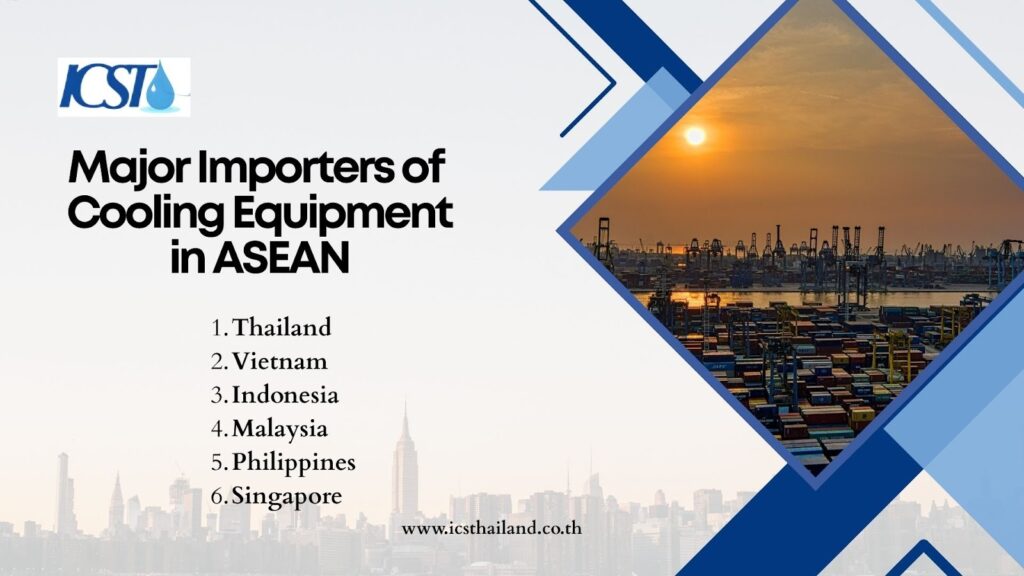
Which nations lead the charge in import volume? The data points to specific economic powerhouses that drive regional consumption.
- Thailand: Despite being a producer, it imports specialized components for its automotive and food processing sectors.
- Vietnam: Rapid industrialization requires massive amounts of cooling for new factories and industrial zones.
- Indonesia: A growing population and expanding data center market drive imports for commercial and industrial cooling.
- Malaysia: The semiconductor industry requires high-precision cooling systems often sourced from abroad.
- Philippines: Urban infrastructure projects create substantial demand for commercial HVAC imports.
- Singapore: As a regional hub, it imports high-tech, energy-efficient systems for district cooling and green buildings.
Types of Cooling Equipment Most Commonly Imported
The specific machinery crossing borders reflects the industrial maturity of the importing nation. Importers prioritize equipment that supports critical infrastructure and operational continuity.
- Industrial Chillers: Heavy industries import these for process cooling and large-scale climate control.
- Cooling Towers: Power plants and manufacturing facilities rely on imported towers for heat rejection.
- Commercial HVAC Systems: Developers import VRF systems and large air handling units for skyscrapers and retail complexes.
- Refrigeration Compressors and Components: Local assemblers import these core parts to build finished units domestically.
Key Drivers Behind Import Demand
Why does this demand persist despite local production capabilities? Several macroeconomic factors force nations to look beyond their borders for equipment. Often, the need for specialized high-efficiency ratings or specific technological certifications exceeds what domestic markets can offer.
- Industrial Manufacturing Growth: New factories require immediate, reliable cooling solutions that local production cannot always supply instantly.
- Cold Storage and Food Supply Chains: The race to reduce food waste drives the importation of advanced refrigeration technologies.
- Commercial Real Estate and Infrastructure Projects: Investors demand high-efficiency imported brands to meet Green Mark or LEED standards.
- Energy and Power Sector Requirements: Power generation facilities need specialized, heavy-duty cooling gear often sourced globally.
Export Opportunities in the ASEAN Cooling Equipment Trade
Beyond consumption, the region offers lucrative export opportunities for manufacturers based within the block. This potential is bolstered by tax exemptions and trade agreements that make regional manufacturing highly competitive against global imports.
By using local production hubs, companies can tap into the high demand for energy-efficient cooling systems in Southeast Asia’s fast-growing industrial areas.
Intra-ASEAN Export Opportunities
Intra-ASEAN trade allows for higher profit margins thanks to lower shipping and logistics costs compared to exporting globally. This regional integration, supported by initiatives like the ASEAN Free Trade Area (AFTA), creates a nearly seamless path for cooling equipment to move between member states.
As a result, businesses can respond more quickly to market demands in neighboring countries while enjoying significant cost advantages.
- Regional Supply Chain Integration: Manufacturers in one country export components to assembly plants in another, creating a tightly knit production web.
- Cross-Border Industrial and Infrastructure Projects: Thai or Malaysian contractors frequently export equipment for projects they manage in Laos or Cambodia.
- Reduced Trade Barriers within ASEAN: Free trade zones encourage the movement of goods within the bloc over sourcing from outside.
Extra-Regional Export Opportunities
When ASEAN equipment is exported outside the region, where does it typically go? Due to competitive pricing and a reputation for quality, ASEAN-manufactured products are particularly attractive to developing markets across the globe.
These nations often require durable and cost-effective machinery to support their growing infrastructure and industrial sectors.
- Middle East: Construction booms require affordable, tropical-rated cooling systems.
- South Asia: Proximity allows ASEAN exporters to serve the growing demand in India and Bangladesh.
- Africa: Developing infrastructure projects seek cost-effective, durable equipment manufactured in Southeast Asia.
- Developed Markets: Western nations increasingly seek manufacturing alternatives to China, favoring ASEAN sourcing.
Competitive Advantages for ASEAN Exporters
What gives these exporters an edge? The combination of strategic assets makes the region a formidable global competitor.
- Manufacturing Cost Efficiency: Lower operational costs allow for competitive pricing on the global stage.
- Skilled Labor and Established Production Bases: Decades of experience ensure consistent product quality.
- Strategic Geographic Location: Central proximity to major shipping lanes facilitates easy global distribution.
Tariff Structures Affecting Cooling Equipment Trade
Understanding tariff structures is key to staying profitable, especially with how complicated global trade has become. Duties, taxes, and other fees can quickly erode margins if traders fail to calculate landed costs accurately.
Grasping the nuances of trade agreements, exemptions, and regional regulations allows businesses to optimize costs and maintain a competitive edge in the market.
General Tariff Framework Across ASEAN
How do tariffs differ across borders? The complexity lies in the specific classification of goods.
- Variation in Import Duties: While some countries impose high duties to protect local industries, others maintain low rates to encourage infrastructure growth.
- Product Classification: The correct HS Code determines the duty; a misclassification of a chiller versus a heat pump can result in significant financial penalties.
Impact of Tariffs on Import Costs and Pricing
Tariffs play a significant role in shaping market strategies by directly influencing sourcing decisions and final market pricing.
Businesses must carefully assess the cost implications of tariffs on imported goods and explore alternative suppliers or local production to mitigate their impact.
- Cost Implications: High tariffs force importers to pass costs to the end-user, potentially affecting project viability.
- Sourcing and Supplier Selection: Buyers often shift suppliers to nations with favorable tariff treatments to control costs.
- Working Capital Strain: Increased upfront tariff payments tie up cash flow, making it more difficult for small to medium enterprises to manage inventory levels.
- Market Competitiveness: Sharp tariff hikes can price imported cooling equipment out of the local market, giving an unintended advantage to domestic competitors.
Tariff Reduction Benefits for Intra-ASEAN Trade
The ATIGA framework provides a strategic roadmap for businesses looking to capitalize on regional financial advantages and streamlined customs procedures.
By leveraging these established trade rules, companies can significantly reduce the cost of cross-border transactions while improving the speed of their logistics operations.
- Lower Duties: Qualifying products often enjoy zero or near-zero tariffs when traded between ASEAN members.
- Regional Sourcing Strategies: Companies restructure supply chains to maximize local value content and qualify for preferential tariff rates.
- Improved Cash Flow: Reduced or eliminated import duties free up capital that can be reinvested into product innovation or market expansion.
- Competitive Pricing: Lower tax burdens allow businesses to offer more competitive retail prices, increasing market share within the region.
Logistics and Supply Chain Considerations
Effective logistics management separates successful traders from those facing constant delays. Moving industrial chillers is far more complex than shipping consumer electronics.
Key Logistics Challenges in Cooling Equipment Trade
The transport of industrial cooling equipment is a highly specialized process fraught with potential pitfalls. The sheer size and weight of these units, combined with their sensitive components, demand meticulous planning and handling.
Here are some common challenges in shipping large chillers:
- Transportation of Heavy and Oversized Equipment: Large chillers require specialized flat-rack containers and heavy-lift capabilities.
- Customs Clearance Complexity: Inconsistent interpretation of regulations across different ports can lead to costly demurrage.
- Documentation and Compliance: Missing energy efficiency labels or safety certificates halt shipments instantly.
Major ASEAN Logistics Hubs
Cargo flows through key ports that serve as vital hubs for regional supply chains, enabling the smooth movement of goods across industries. These ports are strategically located to optimize trade routes, reduce transit times, and support economic growth in their regions.
- Regional Ports: Key hubs like Singapore, Port Klang (Malaysia), Laem Chabang (Thailand), Ho Chi Minh City (Vietnam), and Tanjung Priok (Indonesia) play a vital role in handling the bulk of transshipment and direct exports across Southeast Asia.
- Transport Corridors: Enhanced road and rail networks in the Mekong sub-region, including the East-West Economic Corridor and the North-South Economic Corridor, facilitate smoother cross-border trucking of smaller equipment and goods.
- Cost Control: Using efficient hubs and well-established routes minimizes transit time and enhances supply chain predictability. Evaluate each hub’s proximity to your target markets and align with cost-effective transport solutions to optimize logistics.
Risks and Challenges in ASEAN Cooling Equipment Trade
While the market offers huge growth potential, businesses need smart strategies to navigate the ASEAN cooling equipment trade and stay profitable as the economy shifts. Success in this complex trade environment requires staying ahead of risks and being ready to adapt.
Key risks and challenges include:
- Different Rules and Regulations: Each country has its own laws and compliance standards, making it difficult to run a standardized business across the region.
- Supply Chain Issues: Political tensions and shortages of raw materials often cause delays in production and shipping.
- Changing Material Costs: The prices of essential materials like copper and steel go up and down frequently, which puts pressure on manufacturing budgets.
- Technical Standards: Because energy efficiency ratings and certifications vary by country, companies often have to spend more money customizing products for each specific market.
Conclusion
The ASEAN cooling equipment market is growing rapidly, driven by industrial expansion and food security needs. Indonesia, Vietnam, and Thailand lead this growth, importing significant volumes of cooling equipment for industrial and commercial use.
Regional trade agreements like ATIGA and RCEP are driving growth in the ASEAN Cooling Equipment Trade by reducing tariffs and enhancing global competitiveness. However, success in this sector requires tackling challenges such as navigating complex tariff structures that favor regional sourcing and addressing logistical hurdles, like transporting oversized machinery across island nations
Businesses must leverage trade agreements, build local partnerships, and implement efficient supply chain solutions to thrive. With these strategies, companies can tap into the rising demand for cooling technology across Southeast Asia and seize emerging opportunities in this dynamic market.
Frequently Asked Questions
What is ASEAN cooling equipment trade?
It refers to the import and export of temperature control machinery within Southeast Asia. This includes air conditioners, industrial chillers, and refrigeration units.
Which ASEAN countries import the most cooling equipment?
Vietnam, Indonesia, and the Philippines are among the top importers. Their demand is driven by manufacturing, infrastructure projects, and urbanization.
Which ASEAN nations lead cooling equipment exports?
Thailand and Malaysia are the leading manufacturing hubs. They export a significant volume of air conditioning units to both regional and global markets.
Which ASEAN countries import the most cooling equipment?
Indonesia, Vietnam, and Thailand are major importers due to their large industrial bases and growing commercial real estate sectors.
How do tariff structures impact cooling equipment pricing?
Tariff structures directly influence the final landed cost; high tariffs on non-ASEAN goods make regional sourcing more price-competitive.