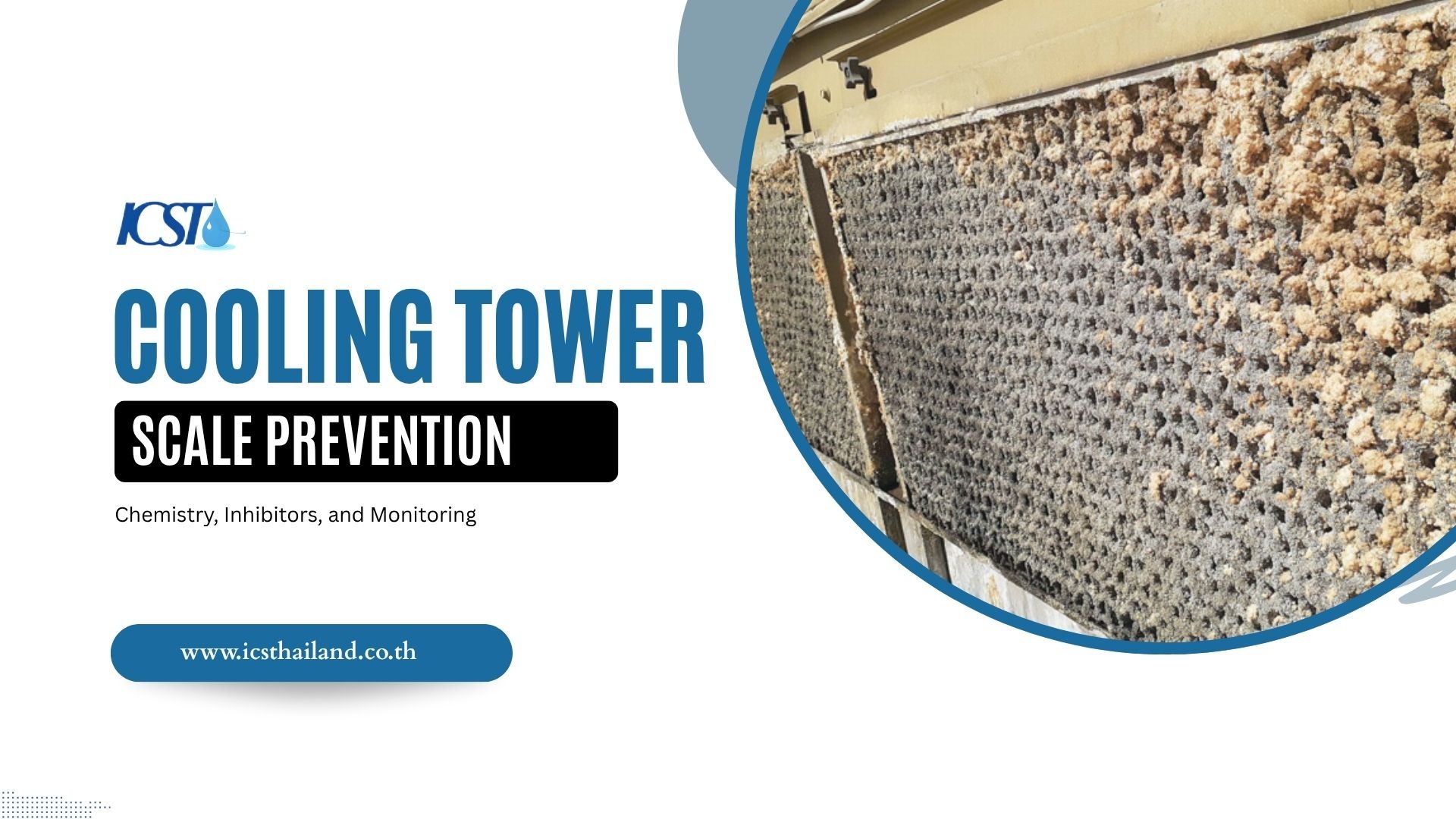
Effective cooling tower scale prevention requires controlling the precipitation of minerals such as calcium carbonate and silica, which form when water becomes concentrated during evaporation. These deposits reduce heat transfer efficiency and increase energy consumption.
Preventing scale involves managing water chemistry, using chemical inhibitors, and continuous monitoring. A crucial parameter for this is the Langelier Saturation Index (LSI), which helps facilities maintain the correct chemical balance to prevent mineral precipitation.
The Chemistry of Scale Formation in Cooling Towers
Scale is not a random occurrence in water systems. It represents a predictable chemical reaction driven by concentration and temperature. Understanding this process helps operators implement better control strategies.
Evaporation Concentrates Minerals:
As water evaporates from the cooling tower, the dissolved minerals, like calcium, magnesium, and carbonate, are left behind. Over time, their concentration in the remaining water increases significantly.
Formation of Hard Deposits:
When the concentration of these minerals reaches a certain point, they can no longer stay dissolved. Calcium and magnesium ions then react with carbonate and other anions to form hard, crystalline deposits (scale) on heat exchange surfaces and other equipment.
Impact of Temperature:
Unlike many substances that dissolve better in hot water, scale-forming minerals have “inverse solubility.” This means that as the water temperature rises, especially on hot equipment surfaces, their solubility decreases, causing them to precipitate out of the solution and form scale more readily. Scale forms precisely when solubility limits are exceeded.
Types of Scale That Impact Cooling Tower Systems
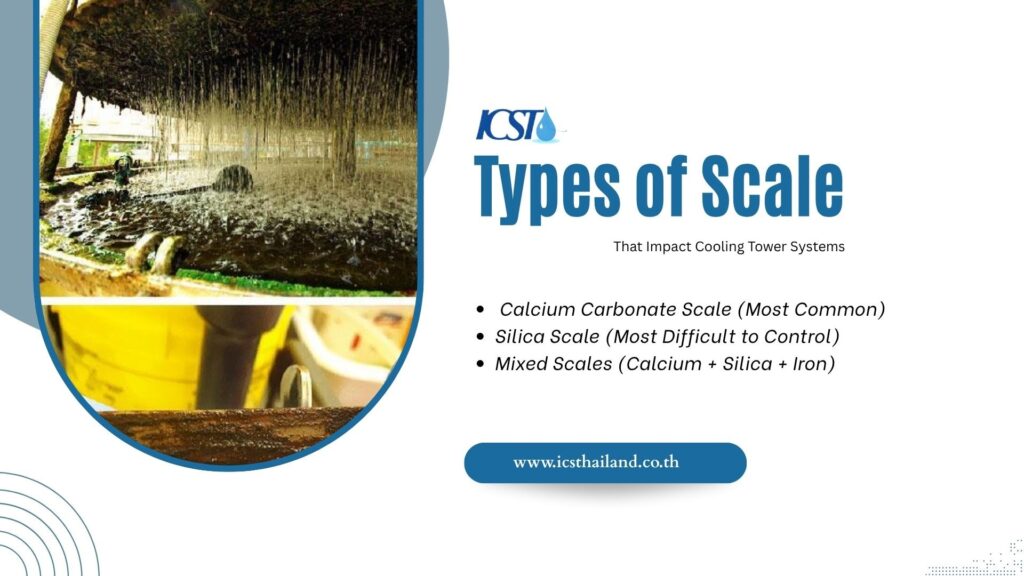
Different types of scale require distinct and targeted control strategies. Operators must identify the specific mineral deposits to select the correct treatment approach.
Calcium Carbonate Scale (Most Common)
Calcium carbonate is the most prevalent type of scale in cooling water systems. Operators must carefully monitor water chemistry to prevent its formation.
- Formation Drivers: Forms readily in water with high levels of calcium hardness and alkalinity.
- pH and Temperature Sensitivity: Its solubility decreases as pH and temperature rise, making it more likely to precipitate onto heat exchange surfaces.
- Control Strategy: Typically managed by controlling system pH levels, often through acid feed, and applying targeted scale inhibitors.
Silica Scale (Most Difficult to Control)
Silica scaling is notoriously difficult to manage and can severely impact system performance. Preventing its formation is critical, as removal is both hazardous and costly.
- Concentration Limits: Tends to form when silica levels become too concentrated in the system water, often limiting the cycles of concentration a tower can achieve.
- Formation Characteristics: Creates a very hard, glassy scale that is resistant to most chemical treatments and often requires aggressive mechanical or chemical cleaning (like hydrofluoric acid).
- Temperature Impact: Higher operating temperatures significantly reduce silica’s solubility, accelerating scale formation on the hottest surfaces and drastically reducing heat transfer efficiency.
Mixed Scales (Calcium + Silica + Iron)
When different minerals precipitate together, they form complex mixed scales that pose unique treatment challenges. These deposits often behave unpredictably compared to pure scale types.
- Complex Composition: Often a matrix of calcium carbonate, silica, iron oxides, and other suspended solids, creating layered, tenacious deposits on heat exchange surfaces.
- Treatment Resistance: These composite scales can be resistant to standard single-purpose scale inhibitors and cleaning chemicals, requiring multi-component treatment programs or specialized cleaning procedures.
- Diagnostic Difficulty: Identifying the precise composition and binding agents within the scale is crucial for selecting an effective removal strategy, often requiring detailed laboratory analysis of the deposit.
Understanding LSI (Langelier Saturation Index) and Scaling Risk
The Langelier Saturation Index (LSI) is a crucial predictive tool used to assess the scaling or corrosive potential of water. This calculated index provides a snapshot of the water’s “balance” by considering factors such as pH, alkalinity, calcium hardness, total dissolved solids, and temperature.
By inputting these parameters into the LSI formula, operators can determine whether the water is likely to form scale deposits, corrode equipment, or remain in a stable, balanced state.
- Scaling Potential (LSI > 0): A positive LSI value signals that the water is oversaturated with minerals, creating a high likelihood of scale formation.
- Balanced Water (LSI = 0): This is the ideal state where the water is perfectly balanced and is neither scaling nor corrosive.
- Corrosive Potential (LSI < 0): A negative LSI value indicates that the water is undersaturated, making it aggressive and likely to corrode metal surfaces.
High LSI values indicate a severe scaling risk that demands immediate action.
Key Control Parameters for Scale Prevention
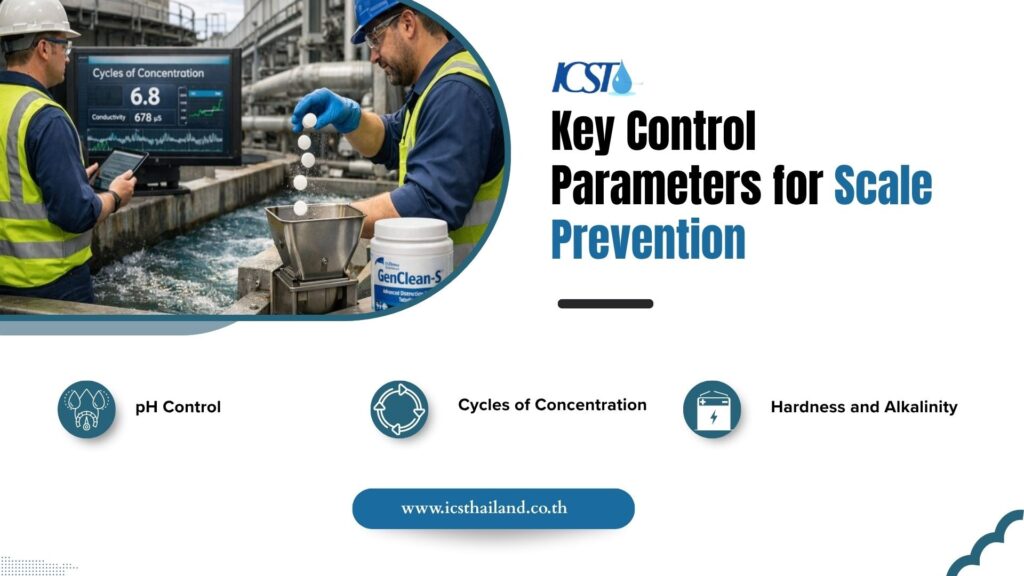
Effective Cooling Tower Scale Prevention hinges on mastering several key water chemistry parameters. By carefully controlling factors like pH, alkalinity, and hardness, operators can prevent mineral buildup that leads to equipment damage and costly downtime.
- pH Control: Operators must maintain pH levels, typically within the 7.0 to 8.5 range.
- Cycles of Concentration (COC): Managing COC is crucial for controlling water usage and scaling potential.
- Hardness and Alkalinity: Controlling these factors is key to preventing the most common types of scale.
- Silica Limits: Strict limits on silica concentration are necessary to avoid glass-like deposits on critical sensors.
Scale Inhibitors: How They Actually Work
For effective cooling tower scale prevention, a scale inhibitor does not remove minerals from the water. Instead, it controls how those minerals behave within the system.
Phosphonates (Primary Inhibitor)
A phosphonate acts as a powerful threshold inhibitor in cooling systems. These chemicals target the microscopic stages of scale development.
- Disrupt the initial stages of crystal formation in the water matrix.
- Prevent calcium from depositing onto heat exchanger surfaces.
- Remain highly effective even at low dosage concentrations.
Polymeric Dispersants (Helper Dispersants)
Polymeric dispersants are like microscopic shepherds for any particles that manage to form in the water. Instead of stopping scale from forming in the first place, they control what happens to it.
- They wrap around tiny scale particles and other solids, keeping them suspended in the water.
- This prevents the particles from sticking to pipes and heat exchanger surfaces.
- They help move these unwanted particles out of the system through the regular blowdown process, keeping surfaces clean.
Polyphosphates (Softeners)
Polyphosphates are an older, more traditional way to deal with hard water. They act like magnets for scale-forming minerals.
- They grab onto calcium and magnesium ions in the water.
- By binding to these minerals, they stop them from being able to form hard scale deposits.
- This effectively “softens” the water within the cooling system, reducing the overall risk of scaling.
Modern water treatment programs often blend these different types of inhibitors together to get the best results.
Silica Limit: The Real Constraint in Modern Cooling Towers
The silica limit often controls the maximum performance capabilities of a system. Facilities must respect this boundary to avoid catastrophic equipment failure.
- Temperature and pH dictate silica limits. The maximum amount of silica that can be dissolved depends on the water’s temperature and pH. In modern cooling towers, the concentration of silica in the circulating water is generally maintained below 150 ppm (mg/L) to prevent hard, glassy scale formation on heat-exchange surfaces.
- Exceeding this limit causes problems. If silica concentration goes above this threshold, it precipitates and creates a hard, glassy scale that is almost impossible to clean. While 150 ppm is a standard conservative limit, modern water treatment programs can sometimes manage levels up to 250 ppm depending on pH, temperature, and specific chemical inhibitors.
- This reduces efficiency and can cause damage. Once formed, these deposits insulate surfaces, drastically reducing heat transfer and potentially leading to equipment failure.
Monitoring and Control Systems for Scale Prevention
Effective Cooling Tower Scale Prevention relies on the principle that you cannot manage what you do not accurately measure. Continuous monitoring is the foundation of any successful strategy.
Key Monitoring Parameters
Operators must track several critical variables to maintain system stability. Automated sensors provide the data needed for precise control.
- Conductivity measurements provide essential Total Dissolved Solids (TDS) control.
- Accurate pH levels dictate the solubility of scale-forming minerals.
- Continuous LSI calculation predicts scaling tendencies in real-time.
- Silica concentration tracking prevents sudden precipitation events.
Real-Time Monitoring Tools
Modern facilities rely on advanced digital tools to maintain water chemistry. These systems react faster than human operators to chemical fluctuations.
- Online sensors and controllers provide constant data streams to operators.
- Automated chemical dosing systems adjust inhibitor levels based on real-time demand.
- Cloud-based monitoring dashboards allow remote oversight of the entire cooling process.
Cooling Tower Scale Control Framework
Use this framework as a practical operational guide for effective cooling tower scale prevention. It outlines the primary parameters operators must control to prevent buildup.
| Parameter | Typical Range | Risk if Exceeded | Control Method |
| pH | 7.0–8.5 | scale or corrosion | acid dosing |
| LSI | 0 to +1.5 | heavy scaling | inhibitor + pH control |
| silica | system dependent | hard deposits | blowdown + dispersants |
| COC | 4–10+ | scaling increase | optimize blowdown |
| hardness | variable | calcium scaling | inhibitors |
Final Insight
Effective Cooling Tower Scale Prevention involves more than just adding a scale inhibitor. It’s a comprehensive process that requires diligent control over the entire water chemistry system. As outlined, maintaining parameters like pH and hardness within their optimal ranges is essential.
Crucially, managing the Langelier Saturation Index (LSI) and adhering to the silica limit are fundamental to avoiding hard deposits that impair efficiency and damage equipment. Facilities that integrate precise monitoring, tailored chemical treatments like inhibitors and dispersants, and strict operational control will see the best results, ensuring maximum efficiency.
Ready to optimize your cooling tower’s performance? Contact the experts at the ICST today for a consultation.
Frequently Asked Questions
What causes scaling in cooling towers?
Scaling happens when dissolved minerals like calcium carbonate and silica build up due to water evaporation. These hard deposits coat surfaces, which reduces heat transfer efficiency.
How does the Langelier Saturation Index (LSI) prevent scale?
The LSI predicts scaling risk. A positive value suggests a high scaling tendency, so maintaining the LSI in a controlled, slightly positive range helps prevent mineral deposits.
What is the importance of managing silica in cooling towers?
Silica can form very hard, glass-like scale that is difficult to remove and severely impacts efficiency. Keeping silica levels below the recommended limit is crucial for preventing damage.
Which chemicals are used for scale prevention?
Common chemicals include scale inhibitors like phosphonates, which prevent crystal growth, and polymeric dispersants that keep mineral particles from settling on surfaces, helping to manage scaling.
Why is controlling pH important for scale prevention?
Higher pH levels can increase the scaling tendency of minerals like calcium carbonate. Maintaining a specific pH range is essential to keep these minerals dissolved in the water.
What is the role of blowdown in controlling scale?
Blowdown removes a portion of concentrated water from the tower, replacing it with fresh water. This process helps control mineral concentrations, preventing them from reaching saturation and forming scale.