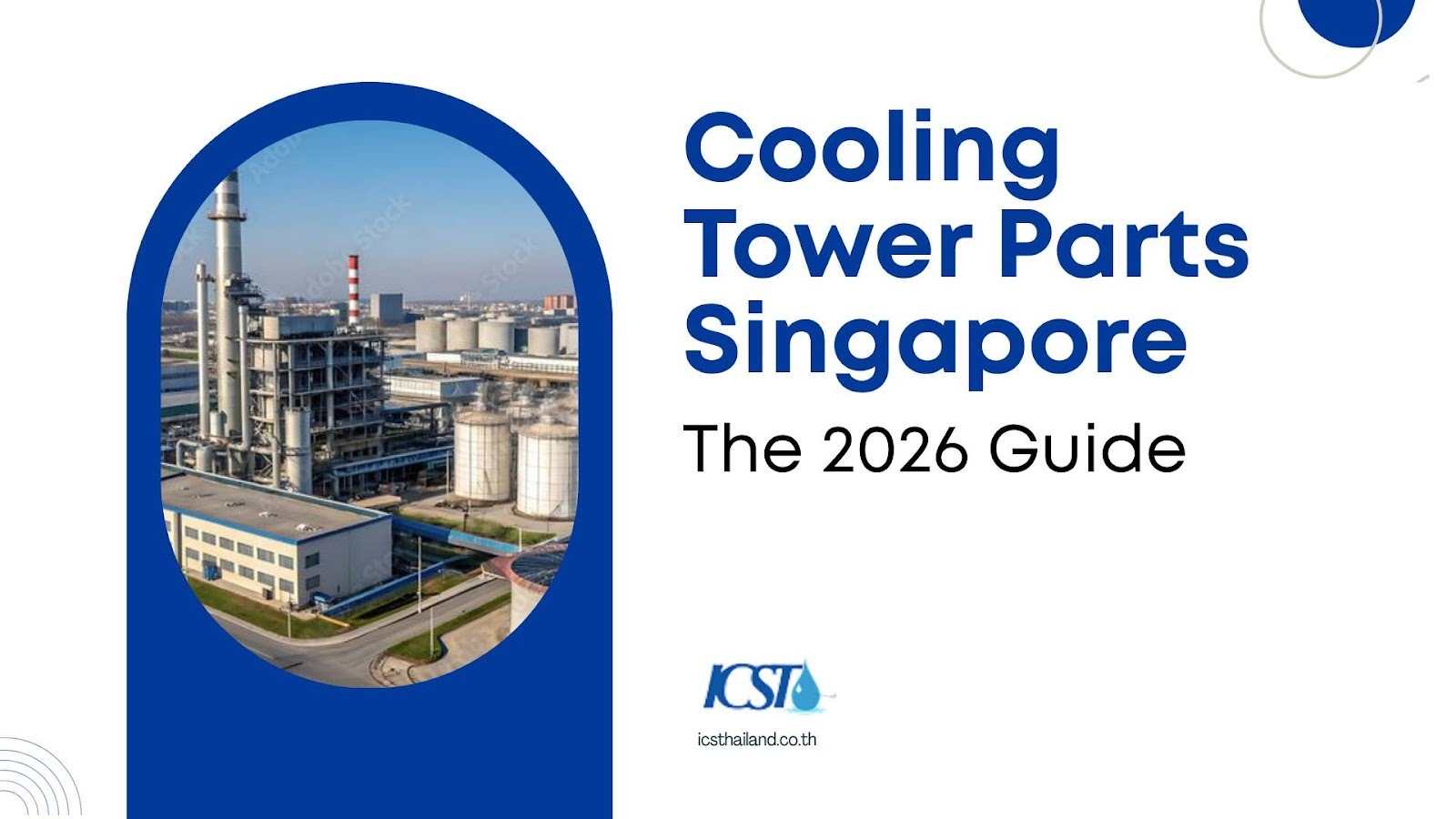
As Singapore enforces the 2026 Mandatory Energy Improvement (MEI) regime, the need for advanced cooling tower parts in Singapore becomes more pressing than ever. Compliance is no longer optional; it is a regulatory necessity.
Facility managers must proactively replace outdated components with cutting-edge, high-efficiency cooling tower parts to meet strict energy reduction targets. These upgrades not only ensure legal compliance but also position your operation for substantial cost savings and energy grant opportunities.
In this guide, discover how investing in modern cooling tower parts Singapore facilities require will help achieve robust energy reductions, support national sustainability efforts, and fully leverage government incentives. Move beyond compliance and transform your cooling system into a model of efficiency for the 2026 standards.
The Cost of Non-Compliance in Singapore
Operating outdated thermal rejection equipment carries significant financial and legal risks. The regulatory landscape requires immediate attention and proactive equipment modernization.
The MEI Mandate
Singapore enforces the 2026 Mandatory Energy Improvement regime to optimize commercial and industrial power consumption. The law requires a 10 percent reduction in Energy Use Intensity (EUI) for underperforming buildings.
Facilities failing to meet this standard face severe penalties. High-efficiency cooling tower parts provide the most direct method to satisfy this legal necessity.
The Sustainability Dividend
Upgrading your system unlocks substantial financial incentives. The government offers the S$100,000 Energy Efficiency Grant to support sustainable transitions.
You can leverage this grant to subsidize up to 70 percent of your high-performance component costs. This funding transforms a mandatory compliance expense into a highly profitable long-term investment.
High-Performance Components for 2026 Standards
Achieving peak efficiency requires specialized hardware engineered for tropical climates. You must replace legacy parts with precision-engineered alternatives designed for modern environmental regulations.
Heat Transfer Media
The internal fill and drift systems dictate the core efficiency of any cooling tower. Upgrading these elements yields massive improvements in heat transfer rates.
- PFAS-Free Film Fill: You must transition to 2026-compliant, high-surface-area media. This material maximizes water evaporation without the restrictive biofilm buildup that causes an “energy tax” on your fans.
- Ultra-Low Drift Eliminators: Singapore enforces a strict 0.0005 percent drift limit. This represents the most rigorous aerosol standard in Asia. Meeting this metric prevents Legionella bacteria from spreading in high-density urban zones.
Mechanical Drive Systems
Motors and fans consume the majority of cooling tower electricity. Optimizing the mechanical drive creates immediate reductions in overall power usage.
- TIS and SS 530-Compliant Motors: Upgrade your drive systems to IE4 or IE5 ultra-high efficiency motors. These advanced units drastically slash your Power Usage Effectiveness (PUE).
- Aero-Acoustic Fan Blades: Noise pollution remains a serious concern in urban centers. Specialized bionic fan geometry helps you meet strict National Environment Agency (NEA) noise emission standards for commercial and residential zones.
Smart Water Distribution
Efficient water flow reduces the workload on your pumping infrastructure. Smart distribution components ensure optimal resource utilization.
- Low-Pumphead Nozzles: These precision parts reduce the parasitic power draw from system pumps. Lowering pump resistance acts as a critical factor in hitting Green Mark Platinum efficiency benchmarks.
- Automated Blowdown Controllers: Modern controllers utilize real-time conductivity sensors. They maintain seven or more Cycles of Concentration (COC), directly supporting Public Utilities Board (PUB) water conservation incentives.
2026 Comparison: Standard vs. Singapore-Spec Parts
Understanding the performance gap between legacy components and modern equivalents helps justify upgrade budgets. The table below illustrates the specific efficiency impacts of modernized hardware.
| Component Category | Generic / Legacy Part | ICST Singapore-Spec (2026) | The Efficiency Impact |
| Drive Motors | Standard IE1 / IE2 | IE4 / IE5 + VFD Ready | Saves 15 to 20 percent in kWh |
| Fill Media | Standard PVC | PFAS-Free Antimicrobial | 100 percent ESG Audit Ready |
| Drift Eliminators | 0.002 percent Drift Rate | Under 0.0005 percent (Ultra-Low) | Zero NEA Compliance Risk |
| Spray Nozzles | Fixed Orifice | Low-Pumphead Precision | Reduces Pumping Energy by 12 percent |
| Monitoring | Manual Gaskets | IoT Vibration/Temp Sensors | 90 percent Fewer Unplanned Stops |
Specialized Accessories for Critical Loads
Standard hardware stores do not stock the specialized items required for heavy-duty industrial applications. You need access to niche components engineered for extreme operational demands.
- Data Center Optimized Components: Digital hubs require continuous-load thermal rejection. Specialized, high-intensity parts guarantee maximum uptime for mission-critical server environments.
- Seawater and Brine Parts: Coastal district cooling plants in Jurong and Tuas face aggressive corrosion. Titanium-grade hardware and Fiberglass Reinforced Plastic (FRP) casings withstand these harsh marine environments.
- Low-Noise Urban Grade Units: Facilities near residential districts require extensive acoustic management. Acoustic louvers and muffled fan systems keep decibel levels below legal thresholds.
How to Audit Your Tower for 2026 Grants
Proper preparation ensures you secure the maximum available government funding. You must follow a structured assessment process before purchasing new components.
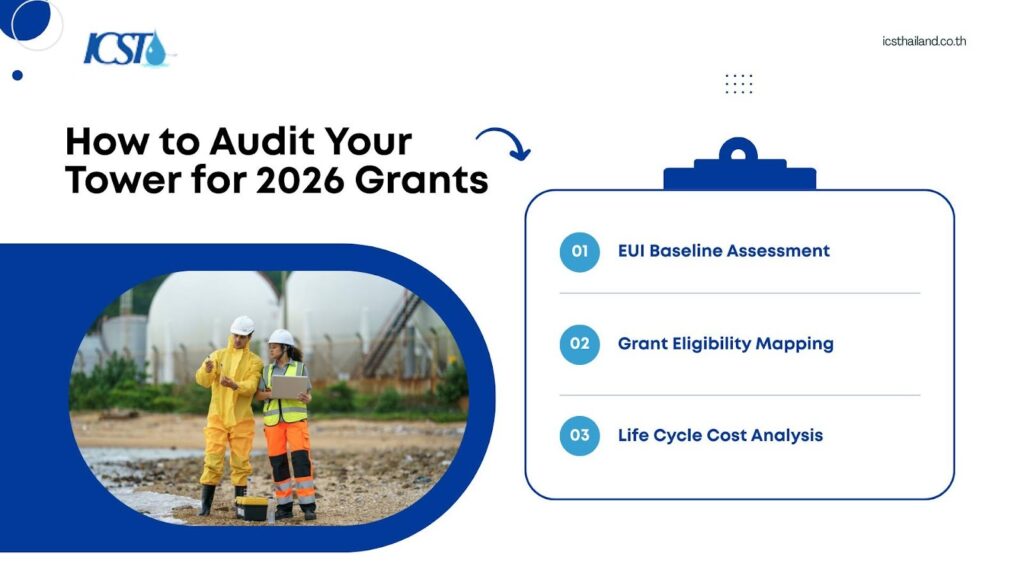
EUI Baseline Assessment
Before initiating any equipment replacement, you must determine your facility’s current energy performance by calculating its Energy Use Intensity (EUI). This baseline measurement records how much energy the building consumes relative to floor area or production output. Establishing a clear starting point is essential for tracking improvements after upgrades. With accurate baseline data, organizations can verify efficiency gains, justify investment decisions, and provide credible documentation when reporting energy performance improvements to regulators, stakeholders, or funding programs.
Grant Eligibility Mapping
Carefully aligning your equipment choices with the Energy Efficiency Grant’s eligibility requirements is a critical planning step. Government subsidy programs typically approve only specific technologies that meet verified efficiency standards. Before purchasing replacement components, compare each option against the official pre-approved equipment list. Emphasize proven high-efficiency motors, variable frequency drives, and advanced smart controllers. Proper eligibility mapping ensures your upgrades qualify for financial incentives while reducing the risk of rejected applications.
Life Cycle Cost Analysis
Government bodies require financial justification for efficiency incentives. You must utilize engineering data to perform a comprehensive Life Cycle Cost Analysis (LCCA). This analysis proves the mandatory three-year financial payback period required for most Singaporean grants.
Conclusion: Your Partner for the Green Transition
The impending 2026 regulations leave no room for delayed maintenance or substandard replacement strategies. Installing the right Cooling Tower parts at the exact right time determines whether your facility remains compliant or becomes a legal liability.
Proper planning ensures your cooling system remains a peak-performance asset in Asia’s greenest city. Take action immediately to secure your supply chain for high-efficiency components before regional demand outpaces manufacturing supply.
Initiate a comprehensive system audit today. Contact an ICST to evaluate your current motor and fill specifications. Ensure your entire thermal rejection system meets the latest SS 530:2024 energy standards for commercial buildings.
Frequently Asked Questions
What are the 2026 cooling tower efficiency standards in Singapore?
The 2026 standards require a 10% reduction in Energy Use Intensity (EUI) and compliance with SS 530:2024 energy benchmarks for cooling towers.
Which cooling tower parts qualify for Singapore’s Energy Efficiency Grant?
High-efficiency components like IE4/IE5 motors, PFAS-free fill media, and automated blowdown controllers are pre-approved for grant eligibility.
How do ultra-low drift eliminators improve cooling tower compliance?
They meet Singapore’s strict 0.0005% drift limit, reducing aerosol emissions and preventing Legionella spread in urban areas.
What is the benefit of upgrading to low-pumphead nozzles?
Low-pumphead nozzles reduce parasitic power draw, helping facilities achieve Green Mark Platinum efficiency benchmarks.
How can I audit my cooling tower for 2026 compliance?
Start with an EUI baseline assessment, map eligible parts to grants, and perform a Life Cycle Cost Analysis (LCCA) to justify upgrades.