Cooling tower filtration systems remove suspended solids from circulating water to protect equipment, maintain thermal efficiency, and reduce operational risks. These systems target physical contaminants such as dust, sand, corrosion particles, and biological debris, but they do not remove dissolved solids like salts.
In industrial environments, poor filtration is one of the leading causes of heat exchanger fouling, increased energy consumption, and unplanned downtime. Facilities typically rely on three main filtration approaches: side-stream filtration, sand filters, and disc filters, each designed for specific solids loads, space constraints, and maintenance capabilities.
Why Cooling Tower Filtration Systems Are Essential
Cooling towers operate in open environments and continuously draw in large volumes of air. This introduces airborne contaminants directly into the water system.
At the same time, internal sources such as corrosion, scaling, and biofilm formation generate additional debris. These undissolved particles are classified as suspended solids, and if not controlled, they create serious operational issues.
Impact of Suspended Solids on Cooling Systems
Suspended solids directly affect system performance and cost:
- Fouling of heat exchangers reduces heat transfer efficiency
- Clogging of fill media disrupts water distribution
- Under-deposit corrosion damages metal surfaces
- Biofilm growth increases microbiological risk
In industrial systems, fouling alone can reduce heat exchanger efficiency by 20–30%, increasing energy consumption and forcing frequent shutdowns for cleaning.
Role of Filtration in System Performance
Cooling tower filtration systems are essential for reducing fouling and extending equipment life. A proper filtration setup captures and removes physical debris before it settles, creating a much healthier operational environment.
The benefits extend to multiple aspects of plant management.
- Cleaner Water: By removing physical solids, filtration keeps the basin significantly cleaner, preventing sludge buildup.
- Better Efficiency: A cleaner system improves heat transfer efficiency, meaning your cooling network operates more effectively and uses less energy.
- Reduced Chemical Use: With physical debris removed, fewer chemicals are needed for water treatment, lowering operational costs and environmental impact.
- Water Savings: Filtration allows for higher cycles of concentration, meaning water can be recycled more times before it needs to be replaced, leading to significant water savings.
How Cooling Tower Filtration Systems Work
Cooling tower filtration systems operate by separating suspended solids from circulating water through mechanical processes such as depth filtration or surface capture.
Suspended vs Dissolved Solids
It is critical to understand the difference:
- Suspended solids → physical particles (sand, rust, debris) → removed by filtration
- Dissolved solids → minerals and salts → controlled by chemical treatment
Filtration and chemical treatment must work together. Filtration removes the cause of fouling, while chemicals prevent scaling and biological growth.
Inline vs Side-Stream Filtration
- Inline filtration treats 100% of the flow but creates high pressure drops and is rarely used
- Side-stream filtration treats 5–15% of flow continuously and is the industry standard
Side-stream systems clean the entire water volume over time without disrupting operations..
Side-Stream Filtration: Continuous System Cleaning
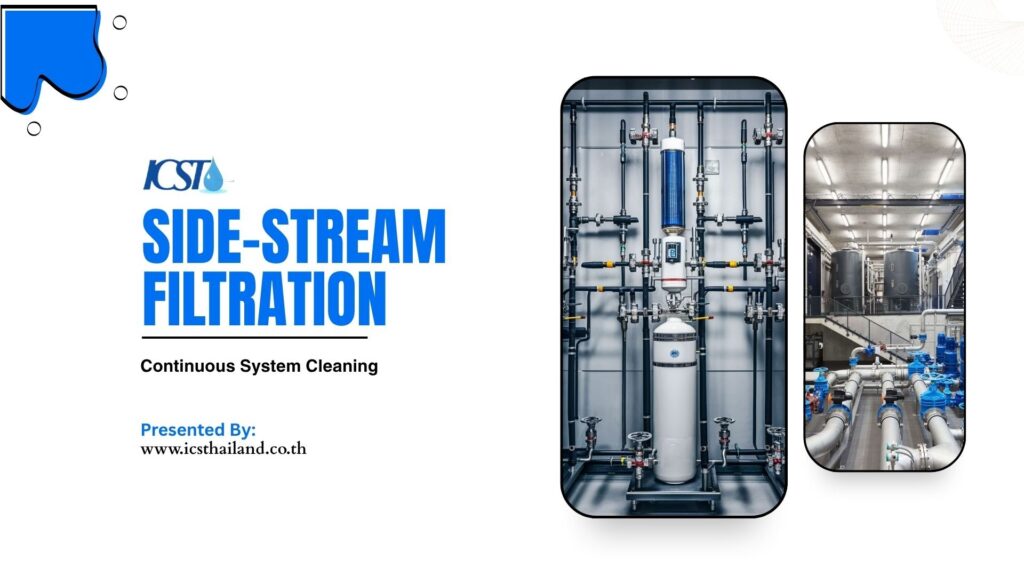
Side-stream filtration is a practical and effective component of cooling tower filtration systems, allowing facilities to manage water quality without the high costs and pressure issues associated with full-flow inline systems.
How Side-Stream Filtration Works
A portion of circulating water (typically 5–15%) is diverted through a filter and returned to the system. Over time, this continuous loop removes suspended solids from the entire system.
- Water is extracted from a basin or a pump discharge
- Passed through the filtration unit
- Clean water returned to the system
This creates a polishing effect, gradually improving overall water quality.
What It Removes
These systems target the most common physical contaminants found in cooling loops. The continuous sweeping action prevents these particles from settling. You will notice a major difference in water clarity.
- Silt and fine dirt are blown in from the environment.
- Sand particles are drawn through the air intake louvers.
- Organic debris, including bugs, leaves, and algae fragments.
- Corrosion products generated from aging pipes and fittings.
Key Advantages
Operators favor side-stream setups for their reliability and ease of use. They deliver consistent results without demanding constant attention. The benefits make them a standard choice for industrial plants.
- Provides continuous cleaning while the cooling tower operates.
- Reduces unexpected downtime caused by fouled heat exchangers.
- Improves basin cleanliness by preventing sludge accumulation.
- Stabilizes the entire cooling system for better chemical performance.
Limitations
- Does not remove dissolved solids
- Requires proper sizing for effective turnover
Real Industrial Example
In cement plants and steel mills, airborne dust continuously enters cooling towers. A properly sized side-stream system prevents sediment accumulation, reduces fouling, and maintains stable operation.
When Not Suitable
Side-stream filtration is not ideal for systems with extremely high solids loads where full-flow filtration may be required.
Sand Filters: Depth Filtration for Fine Particles
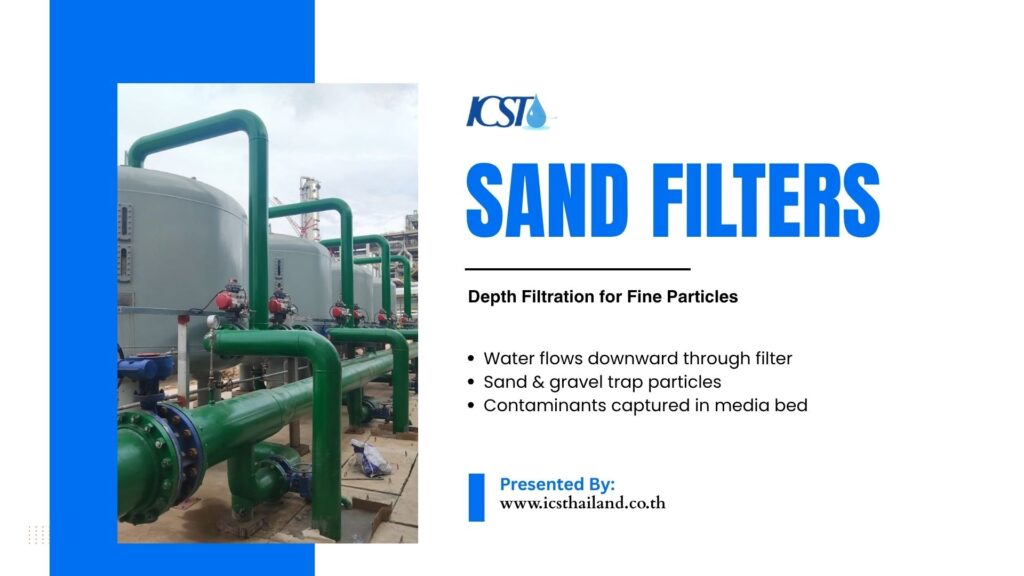
A sand filter uses a deep bed of granular media to trap contaminants. This method mimics natural water purification processes.
How Sand Filters Work
Sand filters trap particles through layered media filtration. Water enters the top of the vessel and flows downward. The media captures particles as the water navigates the tight spaces.
- Water passes through carefully graded layers of sand and gravel.
- Particles become trapped deep within the media bed.
Filtration Performance
Sand filters are efficient for fine particle removal. They excel in environments demanding high water clarity. The depth of the media bed allows for excellent capture rates.
- Removes particles down to 15–20 microns
- Highly effective for fine and low-density particles
Advantages
Many facilities rely on sand media for its robust performance. It offers a reliable way to achieve pristine water conditions. The technology is proven and widely understood.
- Delivers high filtration efficiency for demanding applications.
- Serves as an excellent method for polishing water to a clear state.
- Maintains highly stable performance even during minor flow fluctuations.
Limitations
- Large physical footprint
- Requires frequent backwashing
- High water loss during cleaning
- Risk of biological growth in media
Engineering Insight
Sand filters create higher pressure drops, increasing pump energy consumption. Backwashing also consumes significant water, which is critical in regions with high water costs.
Real Industrial Example
In power plants using surface water, sand filters remove fine silt and organic matter, maintaining condenser efficiency and reducing cleaning frequency.
When Not Suitable
Sand filters are not ideal for facilities with limited space or strict water conservation requirements.
Disc Filters: Compact High-Efficiency Filtration
A disc filter offers a modern alternative to traditional granular media. It combines surface filtration with depth filtration in a small package.
How Disc Filters Work
Disc filters trap particles via grooved stacked discs. These color-coded discs stack tightly together around a central spine. Water flows from the outside of the stack to the inside.
- Utilizes stacked grooved discs compressed tightly together.
- Traps physical particles between the microscopic grooves.
- Initiates an automatic backflush cleaning cycle when pressure drops.
Filtration Performance
These units provide highly targeted particle capture. Operators can select specific micron ratings to match their exact water quality needs. This flexibility is a major asset.
- Features an adjustable micron rating by simply swapping the disc stacks.
- Performs exceptionally well at capturing fine dirt and organic particles.
Advantages
The physical design of a disc filter solves many installation problems. They fit into tight spaces where traditional tanks cannot. They also conserve resources during self-cleaning.
- Features a highly compact design to save valuable floor space.
- Includes automatic cleaning mechanisms to reduce operator labor.
- Experiences very low water loss during the backwash cleaning cycle.
Limitations
- Sensitive to heavy solids load
- Requires periodic disc replacement
Engineering Insight
Disc filters are ideal for retrofit projects where space is limited but may struggle in high-contamination environments due to frequent clogging.
Real Industrial Example
In HVAC cooling systems with moderate contamination, disc filters provide efficient filtration without requiring large installation space.
When Not Suitable
Disc filters are not recommended for systems with heavy solids load, where frequent clogging can disrupt operation.
Side-Stream vs Sand vs Disc Filters: Performance Comparison
| Parameter | Side-Stream Filtration | Sand Filter | Disc Filter | Engineering Insight |
| Filtration Type | Partial loop | Depth filtration | Surface + depth | Defines cleaning method |
| Particle Size | Variable | 15–20 micron | Adjustable | Impacts water clarity |
| Pressure Drop | Low | Medium–High | Low–Medium | Affects energy cost |
| Water Loss | Low | High (backwash) | Very Low | Important for water savings |
| Maintenance | Low | High | Medium | Labor requirement |
| Footprint | Medium | Large | Compact | Space limitation factor |
| Best Use Case | Continuous contamination | Fine solids removal | Space-limited systems | Key decision driver |
Key Takeaways
The data clearly points to specific strengths for each system. You must align these strengths with your plant goals. Consider these main takeaways.
- A sand filter is best for capturing very fine, low-density particles.
- A disc filter provides a compact, water-efficient solution.
- Side-stream filtration delivers a reliable system-level solution for general control.
How to Choose the Right Filtration System
Selecting the correct equipment prevents costly operational failures down the line. You must evaluate several specific facility parameters.
Based on Water Quality
Your specific water conditions dictate the necessary technology. Analyze your contaminant load carefully. Choose the method that handles your worst-case scenario.
- Sand Filtration: Ideal for environments with a high and constant presence of solid particles. This method effectively handles heavy, continuous solids.
- Disc Filtration: Best suited for water with moderate levels of solids and organic contaminants. It offers a balance of efficiency and capacity for these conditions.
- Side-Stream Filtration: The most effective solution for systems dealing with continuous airborne contaminants, like dust and debris, which can enter open systems.
Based on System Size
Physical space and total water volume heavily influence equipment selection. Do not force a large system into a constrained area.
- Large Industrial Cooling Towers: Robust side-stream filtration systems are ideal for large-scale operations where significant water volume and space are available.
- Smaller Plants or Tight Mechanical Rooms: Compact disc filters are a better fit for smaller systems or when space is limited, as they offer efficient filtration in a smaller footprint.
Based on Maintenance Capability
Consider the availability of your maintenance staff. Some systems demand frequent interaction. Others operate mostly autonomously.
- Opt for disc systems to achieve low maintenance through automated cleaning.
- Choose sand media for high performance if you have the staff to manage it.
Engineering Factors That Impact Filtration Performance
Key parameters include:
- Flow rate (GPM)
- Turnover rate
- Pressure drop
- Solids concentration (mg/L)
A poorly designed system fails to remove solids effectively, leading to rapid fouling and operational inefficiency.
Final Thought
Your facility requires a customized approach to cooling tower filtration systems. Summarize your exact system type, total solids load, and specific performance needs before looking at prices. A sand filter, disc filter, or a general side-stream filtration setup will only succeed if matched correctly to your environment.
Emphasize long-term thermal efficiency and basin cleanliness over upfront capital costs to achieve the best return on your investment. For expert cooling tower maintenance services or to build a new cooling tower, visit the ICST website.
Frequently Asked Questions
What is the best filtration system for cooling towers?
The best system depends on solids load, system size, and maintenance capability. Sand filters are ideal for fine particles, disc filters for compact systems, and side-stream systems for continuous contamination control.
How much water should be filtered in a side-stream system?
Typically, 5–15% of the total circulating flow is filtered continuously. This ensures gradual removal of suspended solids and prevents accumulation in the basin.
Are sand filters better than disc filters?
Neither is universally better. Sand filters provide higher filtration efficiency for fine particles, while disc filters offer compact design and lower water loss. The choice depends on application requirements.
Do filtration systems replace chemical treatment?
No. Filtration removes suspended solids, while chemical treatment controls dissolved minerals and biological growth. Both systems must work together.
How often should cooling tower filters be cleaned?
Cleaning frequency depends on solids load and system type. Automated systems clean based on pressure drop, while manual systems require regular monitoring and scheduled maintenance.