Automated chemical dosing systems in cooling towers optimize water treatment by ensuring precise chemical delivery to prevent scale, corrosion, and microbial growth. These systems use real-time sensors, such as conductivity and ORP controllers, to dynamically adjust dosing rates based on water conditions.
This approach reduces chemical waste, extends equipment life, and ensures compliance with environmental standards. In tropical climates like Thailand, automated dosing is essential to counter high evaporation rates and maintain consistent water quality, making it a cost-effective and reliable solution for industrial cooling systems.
This guide explores the essential components of a 2026-ready cooling tower chemical dosing design. You will discover how to optimize chemical usage, ensure environmental compliance, and maximize the lifespan of your cooling tower.
The Anatomy of an Intelligent Dosing Skid
A high-performance dosing system operates as a unified machine. Each component performs a specific function to maintain perfect water chemistry.
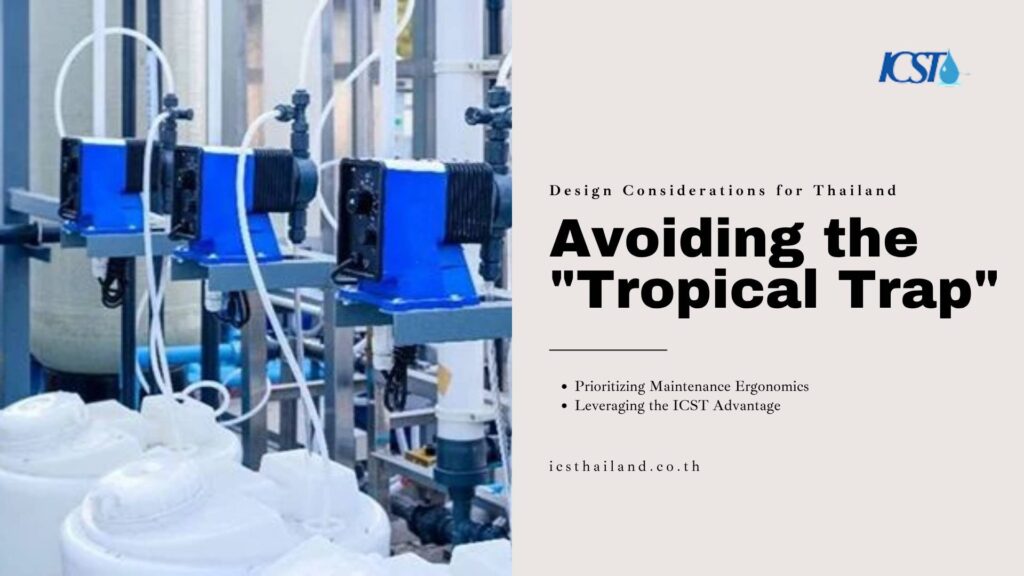
Selecting the Right Metering Pumps
Engineers must select pumping technology based on specific chemical characteristics. Diaphragm pumps and peristaltic pumps serve different roles within the dosing skid. Viscosity and chemical aggressiveness dictate the correct choice.
Tropical biocide and acid loads require robust materials like PVDF or Teflon to prevent premature pump failure. Selecting the exact pump for the specific chemical ensures accurate delivery and reduces maintenance requirements.
The Controller Hub is the System Brain
The Programmable Logic Controller (PLC) functions as the brain of the dosing operation. It continuously processes data from multiple sources. The system integrates conductivity, pH, and Oxidation-Reduction Potential (ORP) sensors.
This integration allows the controller to make dynamic, real-time chemical dosing adjustments. When a heat wave strikes, the controller instantly increases chemical feed rates to match the rising biological threat.
Precision with the Injection Quill
Proper placement of the injection quill remains critical for system longevity. Installers must insert the quill into the exact center of the water flow. This central placement ensures that chemicals mix instantly with the cooling water.
Poor installation allows concentrated chemicals to flow along the pipe walls. This localized concentration causes severe corrosion and will destroy expensive piping infrastructure.
Engineering the “Fail-Safe”: Protecting Your Facility
Safety and reliability form the foundation of proper dosing system design. Catastrophic chemical overdosing destroys equipment and harms the environment.

Redundancy and Automated Safety
Designers must engineer the “Fail-Safe” into every automated skid. Essential safety features include flow-verification sensors, leak detection mechanisms, and automatic pump interlocks. If the primary circulation pump stops, the interlocks immediately halt the chemical feed. This automatic shutdown prevents concentrated acid from pooling in stationary pipes.
Mandating Secondary Containment
Environmental compliance requires strict containment strategies. Facilities must implement bunds and spill trays under all chemical stations. This secondary containment prevents accidental spills from reaching the facility floor or local water drains. Proper containment protects site personnel and ensures immediate compliance with environmental regulations.
Tropical Hardening for Extreme Climates
Industrial environments in Thailand present unique atmospheric challenges. High humidity, monsoon moisture, and corrosive salt air quickly destroy standard electrical equipment.
All electrical enclosures must feature an IP65 rating or higher. This strict rating guarantees that the internal electronics survive the harsh tropical atmosphere without short-circuiting or corroding.
Dosing Design Table (Cooling tower chemical dosing design)
Understanding the function of each component helps engineers build better systems. The table below outlines the core components and the specific ICST engineering strategy for each item.
| Component | Function | ICST Engineering Strategy |
|---|---|---|
| Inhibitor Feed (Scale & Corrosion Inhibitor) | Prevents scale formation and corrosion in piping, heat exchangers, and system surfaces | Dose is automatically proportional to makeup water flow; maintains consistent residual concentration under variable load conditions |
| Conductivity Controller | Controls Total Dissolved Solids (TDS) through blowdown management | Uses continuous conductivity monitoring to trigger automated blowdown, preventing scaling and excessive concentration cycles |
| ORP Controller (Oxidation-Reduction Potential) | Controls oxidizing biocide effectiveness (e.g., chlorine, bromine) | Maintains ORP within target range to ensure microbial control while preventing over-oxidation and material damage |
| Biocide Feed (Non-Oxidizing Biocide) | Eliminates resistant microorganisms and biofilm formation | Applied on timed or shock dosing cycles based on biological activity trends rather than continuous feed |
| pH Controller / Dosing System | Maintains system pH within optimal corrosion control range | Automated acid/alkali dosing based on real-time pH feedback loop to stabilize chemical equilibrium |
| Defoamer / Antifoam System | Prevents foam formation in circulating systems | Dosed only when foam detection thresholds are exceeded to avoid overdosing and process contamination |
| Dispersant Feed System | Keeps suspended solids from aggregating and depositing | Maintains particulate suspension to enhance blowdown efficiency and reduce fouling |
| Oxygen Scavenger (Boiler Systems) | Removes dissolved oxygen to prevent internal corrosion | Controlled dosing based on feedwater oxygen levels and boiler load conditions |
| Phosphate / Alkalinity Controller (Boilers) | Controls internal boiler scale formation and metal passivation | Maintains controlled phosphate residuals and alkalinity balance for metal protection |
| Injection Quill | Ensures proper chemical mixing into main flow | Injects chemicals into high-velocity centerline flow to eliminate wall adhesion and localized corrosion risk |
| Static Mixer (Optional Enhancer) | Improves chemical distribution uniformity | Installed downstream of injection points to ensure homogeneous mixing in large-diameter piping |
| Flow Meter (Makeup / Recirculation / Dosing Lines) | Measures system flow for accurate chemical dosing control | Provides real-time flow data for proportional chemical feed control and system balancing |
| Level Sensors (Chemical Tanks) | Monitors chemical storage levels | Enables automated refill alerts and prevents dry-run of dosing pumps |
| Dosing Pumps (Metering Pumps) | Delivers precise chemical volumes into system | Calibrated for pulse or continuous injection based on control logic from PLC or controllers |
| Controller Panel (PLC / SCADA Interface) | Central automation and control system | Integrates all sensors and dosing equipment for closed-loop automation and remote monitoring |
| Secondary Containment (Bunding System) | Prevents environmental contamination from leaks or spills | All chemical storage and dosing systems are enclosed in chemically resistant bunds with overflow capacity |
| Safety Interlocks (High/Low Flow & Alarm Systems) | Prevents unsafe chemical injection conditions | Automatically shuts down dosing if abnormal flow, pressure, or tank levels are detected |
| Sampling Points | Enables manual verification of water chemistry | Strategically placed for representative sampling before and after treatment zones |
| Filtration System (Side-stream / Full-flow) | Removes suspended solids and particulate matter | Reduces fouling load on chemical program and improves treatment efficiency |
| Corrosion Coupon / Probe Port | Measures real-time corrosion rates | Provides direct validation of inhibitor performance and system health |
| Microbial Monitoring Port | Assesses biological contamination levels | Used for ATP testing or dip-slide sampling to validate biocide effectiveness |
The 2026 Connected Factory: BMS & IoT Integration
Modern industrial plants require seamless data integration. Isolated systems restrict operational efficiency and hide potential problems.
Building the Smart Tower
Connecting your dosing controller to the plant Building Management System (BMS) creates a “Smart Tower.” Centralized logging allows facility managers to monitor water chemistry from the main control room.
Remote alerts notify operators instantly if chemical levels drop or equipment malfunctions. This immediate notification allows maintenance teams to fix minor issues before they cause total system failure.
Automating Compliance and ESG Reporting
Environmental audits demand precise record-keeping. The Thai Industrial Standards Institute (TISI) requires strict proof of chemical usage and water discharge quality. Modern IoT integration automates these logs.
Facilities can shift entirely away from manual, error-prone paperwork. Real-time, data-backed reporting provides unarguable proof of environmental compliance and supports your corporate ESG initiatives.
Avoiding the “Tropical Trap”: Design Considerations for Thailand
Many imported dosing systems fail in Southeast Asia because manufacturers ignore the local operating environment.
Prioritizing Maintenance Ergonomics
Engineers must design the dosing skid with the technician in mind. Technicians need safe access to perform routine calibrations. Workers must swap heavy chemical drums without risking chemical exposure. Proper spatial planning ensures that maintenance tasks remain safe, fast, and completely ergonomic.
Leveraging the ICST Advantage
The ICST “Site-Ready” design philosophy eliminates installation delays. We deliver pre-piped, pre-wired, and fully commissioned skids directly to your facility. This comprehensive preparation minimizes plant downtime. Your engineering team can connect the skid and resume operations on the same day.
Conclusion: Efficiency is in the Details
A well-designed, automated chemical dosing system represents the most cost-effective investment for your cooling infrastructure. Precision engineering extends equipment life, drastically reduces chemical waste, and minimizes unplanned emergency repairs.
We do not just supply generic pumps. International Cooling Solutions engineers the complete immune system of your cooling tower. We design these systems to thrive specifically in the demanding Thai industrial landscape.
Is your cooling tower chemical dosing system failing to maintain steady water chemistry?
International Cooling Solutions (Thailand) provides custom design, precise installation, and ongoing optimization of industrial chemical feed skids. Let us engineer a reliable dosing solution tailored exactly to your system metallurgy and water profile.
Frequently Asked Questions
What is the importance of automated chemical dosing in cooling towers?
Automated chemical dosing ensures precise water treatment, reducing scale, corrosion, and microbial growth. It optimizes chemical usage, minimizes waste, and extends equipment life. By integrating real-time sensors and controllers, facilities can maintain consistent water quality, improve energy efficiency, and comply with environmental standards. This approach is especially critical in tropical climates like Thailand, where evaporation rates are high.
How does a Programmable Logic Controller (PLC) enhance dosing systems?
A PLC acts as the brain of a dosing system, processing data from sensors like conductivity, pH, and ORP. It enables real-time adjustments to chemical feed rates, ensuring optimal water chemistry. This dynamic control prevents over-dosing or under-dosing, protecting equipment and reducing operational costs. PLC integration also supports remote monitoring and IoT connectivity for smarter facility management.
Why is secondary containment essential for chemical dosing systems?
Secondary containment, such as bunds and spill trays, prevents chemical spills from contaminating the environment or harming personnel. It ensures compliance with environmental regulations and enhances site safety. In tropical regions, where humidity and rainfall are high, robust containment systems are critical to managing accidental leaks and maintaining operational integrity.
What are the benefits of connecting dosing systems to a Building Management System (BMS)?
Integrating dosing systems with a BMS allows centralized monitoring and control. Facility managers can track water chemistry, chemical usage, and system performance in real-time. This connectivity enables remote alerts for issues like leaks or equipment failures, ensuring quick responses. Automated data logging also simplifies compliance reporting and supports ESG initiatives by providing accurate, real-time environmental data.
How can tropical climates impact cooling tower dosing systems?
Tropical climates, like Thailand’s, pose challenges such as high humidity, monsoon moisture, and corrosive salt air. These conditions can damage electrical components and accelerate corrosion. To combat this, dosing systems must feature IP65-rated enclosures, corrosion-resistant materials, and robust designs tailored for extreme environments. Proper engineering ensures reliability and longevity in such demanding conditions.