To comply with modern safety standards, facilities must meet strict cooling tower documentation requirements. You must actively maintain and securely store operational records for a minimum of five years. Specifically, keep daily water quality logs that track pH and biocide levels.
You must also retain all Legionella records and biological testing certificates from accredited labs. Finally, update mechanical logs with routine maintenance reports and basin cleaning photos. Using a digital management system ensures your critical data remains immutable, immediately accessible, and fully audit-ready during sudden regulatory inspections.
This guide outlines the critical cooling tower documentation requirements you need to follow. You will learn exactly what data to record, how long to retain it, and why transitioning to digital systems protects your facility.
The “Legal Shield”: Why Retention is More Important Than Logging
Many facility managers focus entirely on collecting data. They neglect the storage and retention of that data. If you cannot produce historical records during an audit, inspectors assume you never performed the work. Your documentation serves as your primary legal shield.
The 2026 Audit Standard
Health inspectors and regulatory bodies take a strict approach to record-keeping. In the event of a disease outbreak, investigators will demand your maintenance history. If a specific water test or cleaning record is missing, the law treats that missing record as an unperformed task. You face immediate liability. Proper documentation proves your diligence and protects your organization from negligence claims.
The Statute of Limitations
Global standards have shifted toward stricter regulatory retention periods. Guidelines like ASHRAE 188-2021 mandate comprehensive tracking of water management activities. Regulators now require a mandatory five-year retention period to cover historical health data. This extended timeframe ensures investigators can trace long-term trends and identify systemic failures. You must keep your records accessible and organized for a minimum of five years to meet these demands.
The Digital Advantage
Paper binders present a massive liability for modern facilities. Pages get lost, ink fades, and employees can alter physical documents after the fact. Digital systems solve these problems. Implementing a CMMS provides complete data sovereignty. Cloud-based storage ensures your records remain secure, backed up, and instantly accessible. Digital platforms prevent unauthorized editing, giving regulators total confidence in your data integrity.
Mandatory Records Checklist: The 2026 Framework
To streamline your compliance process, organize your documentation using the following matrix. This table details the essential record categories, the types of records to include, how often you must update each, and how long you must retain them:
| Document Category | Key Records Included | Required Frequency | Retention Period |
| Strategy Vault | Water Management Plan (WMP), Risk Assessments, System P&IDs | Annual Review | Lifecycle of Asset |
| Action Vault | Maintenance Logs, Cleaning Certificates, Corrective Action Reports | Weekly/Monthly | 5 Years |
| Science Vault | Legionella Lab Results, HPC Bacteria Tests, Chemical Usage Logs | Daily/Quarterly | 5 Years |
To remain compliant with modern standards, you must organize your documentation systematically. Divide your records into three distinct categories. This structure ensures you capture every operational detail required by law.
I. The Strategy Vault
- Key Records Included: Water Management Plan (WMP), Risk Assessments, System Piping and Instrumentation Diagrams (P&IDs).
- Required Frequency: Annual Review.
- Retention Period: The complete lifecycle of the asset.
II. The Action Vault
- Key Records Included: Routine Maintenance Logs, Basin Cleaning Certificates, Corrective Action Reports.
- Required Frequency: Weekly and Monthly updates.
- Retention Period: Five Years.
III. The Science Vault
- Key Records Included: Legionella Lab Results, Heterotrophic Plate Count (HPC) Bacteria Tests, Chemical Usage Logs.
- Required Frequency: Daily and Quarterly tracking.
- Retention Period: Five Years.
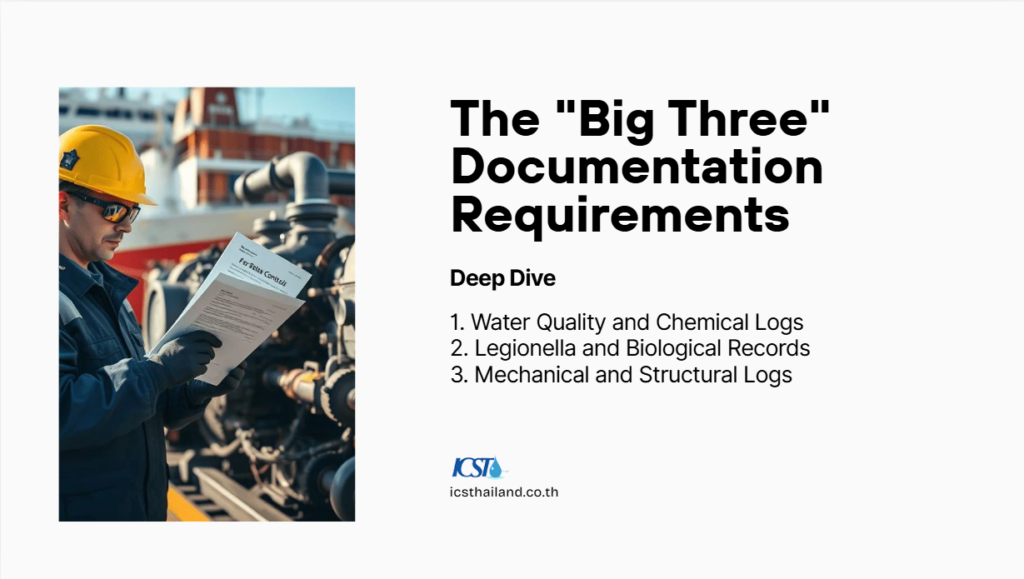
Deep Dive: The “Big Three” Documentation Requirements
Certain records carry more regulatory weight than others. You must pay special attention to the following three categories. They represent the core of your operational safety program.
1. Water Quality and Chemical Logs
Your water quality logs act as the pulse of your cooling tower system. You must capture real-time data regarding pH levels, conductivity, oxidation-reduction potential (ORP), and biocide residuals. Accurate logging prevents corrosion, scaling, and biological growth.
You must follow a critical rule when logging this data. Every entry must include the technician’s full name, the exact time of the reading, and the specific corrective action taken if parameters fall out of the acceptable range. Facilities are rapidly transitioning from manual logbooks to automated Internet of Things (IoT) sensors. Automated logging prevents backdating and ensures the continuous accuracy of your records.
2. Legionella and Biological Records
Legionella records form your primary defense against public health crises. You cannot cut corners when testing for biological hazards. Every Legionella test must undergo processing by an ISO-accredited laboratory. You must retain the official laboratory certificates.
Traceability is mandatory. Your documentation must link every physical water sample to a specific location on your system map, such as a sentinel point or a known dead leg. Modern mandates require you to make five years of testing data available within twenty-four hours of a regulator’s request. Immediate access demonstrates your total control over the facility.
3. Mechanical and Structural Logs
Your mechanical logs establish the physical foundation of your compliance program. Regulators now demand visual proof of your maintenance efforts. You must capture and store “before and after” photographs of all basin cleanings and fill inspections. Photos provide undeniable evidence of your work.
You must also document structural compliance with regional and international standards. For example, maintaining TISI 2134-2565 compliance in Thailand requires strict documentation of energy performance and drift eliminator certifications. You must prove your drift emissions remain below the required threshold to maintain your operational license.
Implementing a Digital Chain of Custody
You must modernize your data collection methods to survive a rigorous audit. A digital chain of custody guarantees the authenticity of your records.
QR-Coded Checkpoints
Install physical QR codes on every cooling tower cell. Technicians must scan these codes with a mobile device to unlock the digital logbook. This process proves the inspector was physically present at the equipment. It eliminates the possibility of technicians filling out logs from a remote office.
Immutable Logs
During a high-stakes investigation, regulators will scrutinize your data for tampering. You must utilize uneditable, cloud-based records. When a technician submits a reading, the system must lock that entry permanently. Immutable logs provide the highest level of legal protection for your management team.
Exception Reporting
Human error happens, but you cannot allow it to compromise your compliance. You must configure your CMMS to generate automated exception reports. If a technician misses a mandatory weekly water test, the system should instantly alert the Facility Manager. Proactive alerts allow you to correct documentation gaps before an auditor arrives.
Secure Your Data Today
Your documentation serves as either your greatest shield or your biggest liability. You must implement rigorous standards to protect your facility, your employees, and your community. Stop relying on outdated paper records that put your operations at risk.
At ICST, we provide the digital infrastructure and engineering expertise required to master your record keeping and meet all cooling tower documentation requirements. We ensure your facility remains completely compliant with current regulations. Contact us to schedule a comprehensive documentation audit and secure your five-year data vault today.
Frequently Asked Questions (FAQs)
What are the primary cooling tower documentation requirements for regulatory retention?
You must maintain comprehensive record-keeping to prove compliance and protect your facility. Global guidelines, including ASHRAE 188-2021, mandate a strict five-year regulatory retention period for all historical health data. If you miss a document during an audit or public health investigation, authorities treat the maintenance task as unperformed. Secure your files properly to avoid severe penalties.
How should our facility manage daily water quality logs?
Your team should track water quality logs daily to monitor pH, conductivity, and biocide residuals. While paper logbooks exist, moving to a Computerized Maintenance Management System (CMMS) offers greater security. A CMMS automates record keeping, prevents unauthorized editing, and stores data safely in the cloud. This digital transition ensures your records remain accurate and instantly accessible during inspections.
What specific Legionella records do we need under ASHRAE 188-2021?
Under ASHRAE 188-2021, your facility must retain official laboratory certificates for every biological test. You need to use an ISO-accredited laboratory and link every water sample to a specific location on your system piping map. You must keep these Legionella records available for five years. Regulators frequently demand immediate access to this data during health investigations.
How does the TISI 2134-2565 standard affect our maintenance documentation?
TISI 2134-2565 mandates strict record keeping for mechanical and structural compliance, particularly for industrial facilities operating in Thailand. You must document energy performance and maintain valid drift eliminator certifications. Keeping accurate logs proves your drift emissions remain below required regulatory thresholds. This specific documentation protects your operational license and demonstrates a strong commitment to environmental safety standards.
Why is comprehensive record-keeping so essential for cooling towers?
Proper record keeping serves as your primary legal shield against negligence claims. Without organized water quality logs, basin cleaning certificates, and Legionella records, you cannot prove your facility meets modern safety standards. Using a reliable CMMS helps you automate regulatory retention and maintain a digital chain of custody. This proactive approach guarantees you stay completely audit-ready at all times.