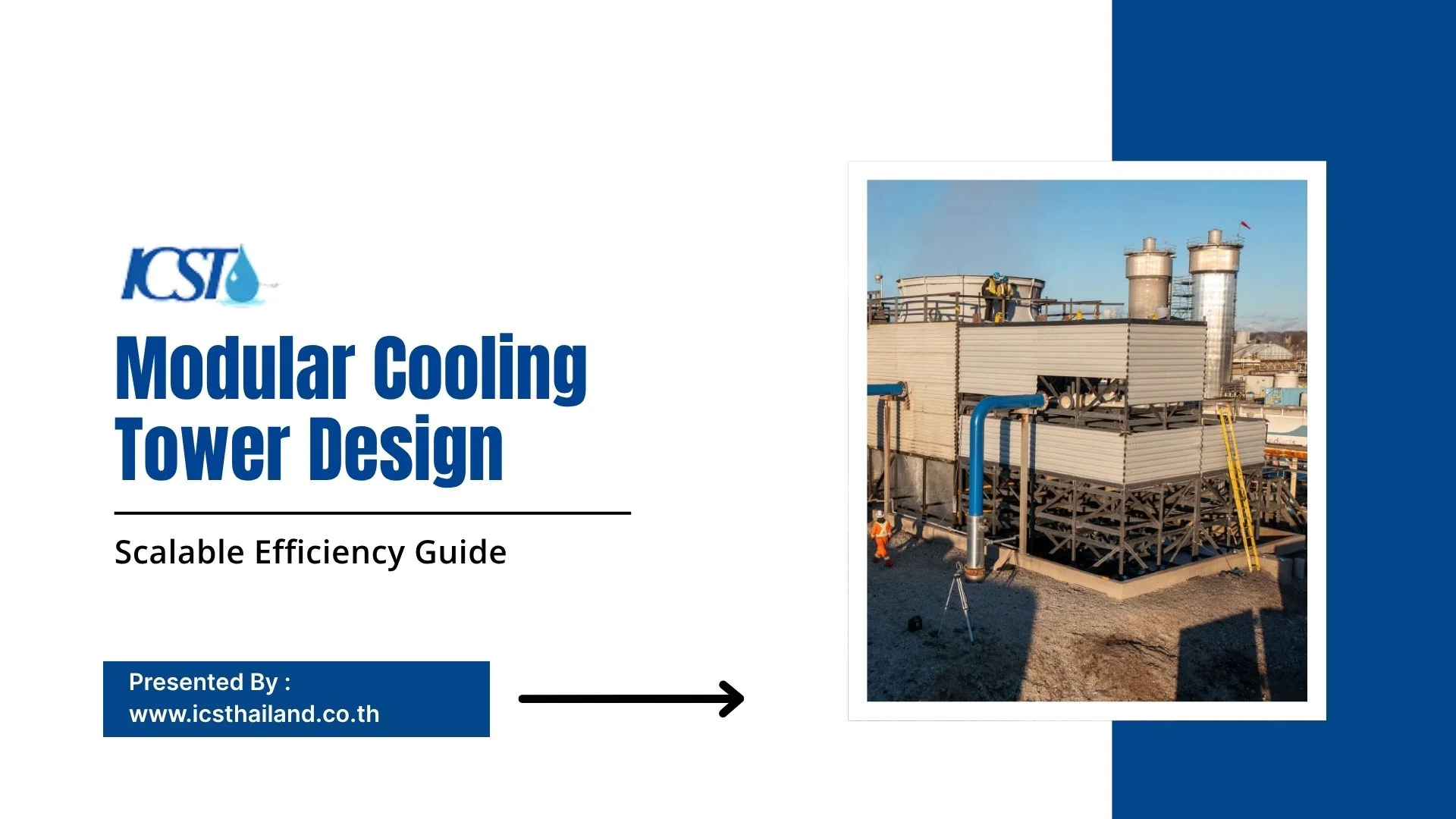
Modular cooling tower design divides total cooling capacity into smaller, independent cells instead of one large monolithic structure. This approach improves scalability, energy efficiency, and operational flexibility, since each cell can run, fail, or scale independently without shutting down the whole system.
Paired with Variable Frequency Drives and N+1 redundancy, modular systems cut part-load energy use through the fan affinity laws while allowing phased expansion as facility demand grows. The result is lower downtime risk and lower long-term operating cost than a single large field-erected tower.
The Cellular Engineering Philosophy: Modular vs. Monolithic
For decades, facilities relied on field-erected towers built as giant, single-cell units. We are now moving away from these monolithic fields toward a matrix of smaller, decoupled cellular modules. These modular components work together in perfect harmony.
Deconstructing the Multi-Cell Tower
A modular design divides the total cooling capacity into manageable sections. Instead of relying on one massive fan and cold water basin, you distribute the load across multiple tower cells. This multi-cell tower approach gives operators granular control over the entire cooling process.
Eliminating the Single Point of Failure
Traditional cooling tower structures carry a severe risk. If a primary motor fails, the entire cooling system shuts down. Standalone, self-contained cells ensure that a failure in one fan motor or structural fill pack does not compromise the heat rejection capabilities of your industrial plant. You maintain critical operations while technicians perform repairs on the isolated cell.
The Logistics Pipeline
Building a cooling tower on a construction site takes months and introduces severe safety hazards. Modular assembly accelerates construction schedules by up to 75 percent.
Manufacturers build these pre-assembled towers in a controlled factory environment. Precision factory-built modules eliminate high-risk, on-site structural fabrication and excessive field welding. You simply lift, set, and connect the modular systems.
Modular Design Sizing and Fluid Management Matrix
A high-performance cellular installation requires balancing changing thermodynamic loads with individual cell fluid dynamics. Proper engineering ensures that your water distribution system operates at peak efficiency.
Here are the core specifications to consider:
- Redundancy Allocation: Designing for N+1 or N+2 cellular balancing guarantees zero-downtime maintenance. This provides high system resilience that meets ASCE and Data Center Tier III and IV standards.
- Hydraulic Framework: Use a parallel supply and return distribution header equipped with isolated two-way control valves. This permits complete cell isolation and active fluid decoupling. Maintain flow velocities between 2.1 and 2.7 meters per second.
- Basin Equalization: Install gravity-driven low-velocity interconnecting flumes or balance pipes. This prevents local sump starvation and multi-module basin overflows. Size these equalization lines for 15 to 20 percent of a single-cell flow.
- Motor Management: Equip individual cells with Variable Frequency Drives (VFDs). VFDs maximize part-load efficiency during off-peak wet-bulb conditions, directly leveraging the fan affinity laws.
Thermodynamic Masterclass: Partial Load Operation and The Fan Laws
Operating a massive traditional cooling tower at full speed during low thermal loads wastes enormous amounts of energy. Modular cooling towers unlock exponential energy savings through partial load operation.
The Fan Affinity Law Advantage
Multiple cellular fans operating at reduced speeds completely outperform a single giant fan operating at full throttle. Fluid mechanics dictate that fan brake horsepower is proportional to the cube of the shaft speed.
If you reduce the fan speed by half, the power consumption drops to exactly 12.5 percent of the maximum load. The mathematical relationship is absolute.
Linear Load vs. Cubic Power Savings
Running four isolated modular cells at 50 percent fan speed rejects approximately the same heat load as two cells running at 100 percent. However, the four modules running at half speed consume only a fraction of the total utility power. You achieve greater energy efficiency while meeting exact cooling needs.
The Part-Load Stagnation Danger
Low air velocity brings specific operational risks. Operating components at low speeds can create stagnant water zones within the cold water basin. Smart building management systems rotate operating cells to prevent these dead zones. This rotation stops biofilms and Legionella bacteria from incubating inside the cooling circuit.
Hydraulic Architecture for Seamless Phased Expansion
Growing manufacturing plants require scalable cooling technologies. You must plan for phased expansion from the initial design phase.
The Future-Proof Header
Always size the initial main condenser water supply and return headers for the maximum ultimate design flow of the completed plant. Terminate these main pipes with heavy blind flanges. When you need to add cooling capacity, the primary piping infrastructure already exists.
True Dynamic Cell Isolation
Utilize specialized positive-shutoff motorized butterfly valves and inline balancing valves on each modular branch. This allows contractors to rig, pipe, and hot-plug new pre-built modules during a phased expansion. You do not drop loop pressure or cause factory downtime. This dynamic cell isolation makes tower replacement or capacity upgrades incredibly simple.
Sump Equalization Dynamics
Multi-cell networks often face the “uneven basin” phenomenon. When cells operate under different fan pressures or clean and dirty states, the water levels fluctuate. Gravity equalizer lines must instantly balance water levels across the entire multi-cell footprint. This equalizes the makeup water and prevents individual tower cells from running dry.
Microclimate Hazards: Micro-Spacing and Recirculation
Clustering factory-assembled modules requires careful spatial planning. Poor spacing creates artificial microclimates that destroy thermal performance.

The Thermal Short-Circuiting Trap
Clustered cells face a unique hazard known as thermal recirculation. A tower cell inhales its own or a neighboring cell’s hot, saturated discharge air. This recirculation artificially spikes the entering wet-bulb temperature and forces the system to work much harder to reject excess heat.
Airflow and Clearance Layout Rules
You must follow strict clearance guidelines to maintain high efficiency:
- Establish a minimum intake clearance distance of three to five times the air inlet height from any solid boundary wall or enclosure.
- Utilize velocity-recovery fan stacks to propel the exhaust plume high above the downwind air-intake velocity profile.
- Ensure drift eliminators and spray nozzles receive clean, unobstructed airflow from all intake sides.
Stop Building Rigid, Unscalable Thermal Infrastructure
Future-proof your industrial output and data center uptime with an agile, high-efficiency cooling loop. Traditional field erected towers restrict your growth and inflate your operating costs. Modular cooling tower design is the ideal solution for modern facilities demanding reliability, fast installation, and lower energy consumption. By embracing modular cooling tower design, you achieve unmatched scalability, energy savings, and operational flexibility for your critical operations.
At International Cooling Solutions (Thailand), our mechanical and structural engineering teams build advanced modular cooling systems optimized for seamless phased expansions. We maximize your part-load power savings through expert hydraulic and aerodynamic planning.
Contact our Bangkok office today to schedule a technical layout consult and upgrade your cooling technology.
Frequently Asked Questions (FAQs)
What is modular cooling tower design?
Modular cooling tower design refers to a system where cooling capacity is divided into smaller, independent modules or cells. This design enhances scalability, energy efficiency, and operational flexibility. Unlike traditional cooling towers, modular systems allow phased expansions, easier maintenance, and reduced downtime, making them ideal for industrial plants and data centers.
How does N+1 redundancy improve cooling tower reliability?
N+1 redundancy ensures that even if one cooling cell fails or undergoes maintenance, the remaining cells maintain full cooling capacity. This design guarantees uninterrupted operation, critical for industrial processes and data centers. It minimizes risks and enhances system resilience, meeting high-performance standards.
Why are modular cooling towers more energy-efficient?
Modular cooling towers use multiple fans with Variable Frequency Drives (VFDs) to optimize energy consumption. By operating fans at reduced speeds during partial loads, they leverage the fan affinity laws, significantly lowering energy use compared to single large towers. This approach ensures efficiency without compromising cooling performance.
What are the benefits of phased expansion in modular cooling towers?
Phased expansion allows facilities to add cooling capacity incrementally without disrupting operations. Pre-assembled modules and dynamic cell isolation enable seamless integration of new cells. This approach reduces upfront costs, supports future growth, and ensures operational continuity during upgrades.
How does modular design reduce installation time?
Modular cooling towers are factory-assembled in controlled environments, ensuring precision and quality. These pre-built modules are transported to the site for quick installation, eliminating extensive on-site fabrication and welding. This streamlined process reduces construction time by up to 75%, saving costs and minimizing disruptions.ns.