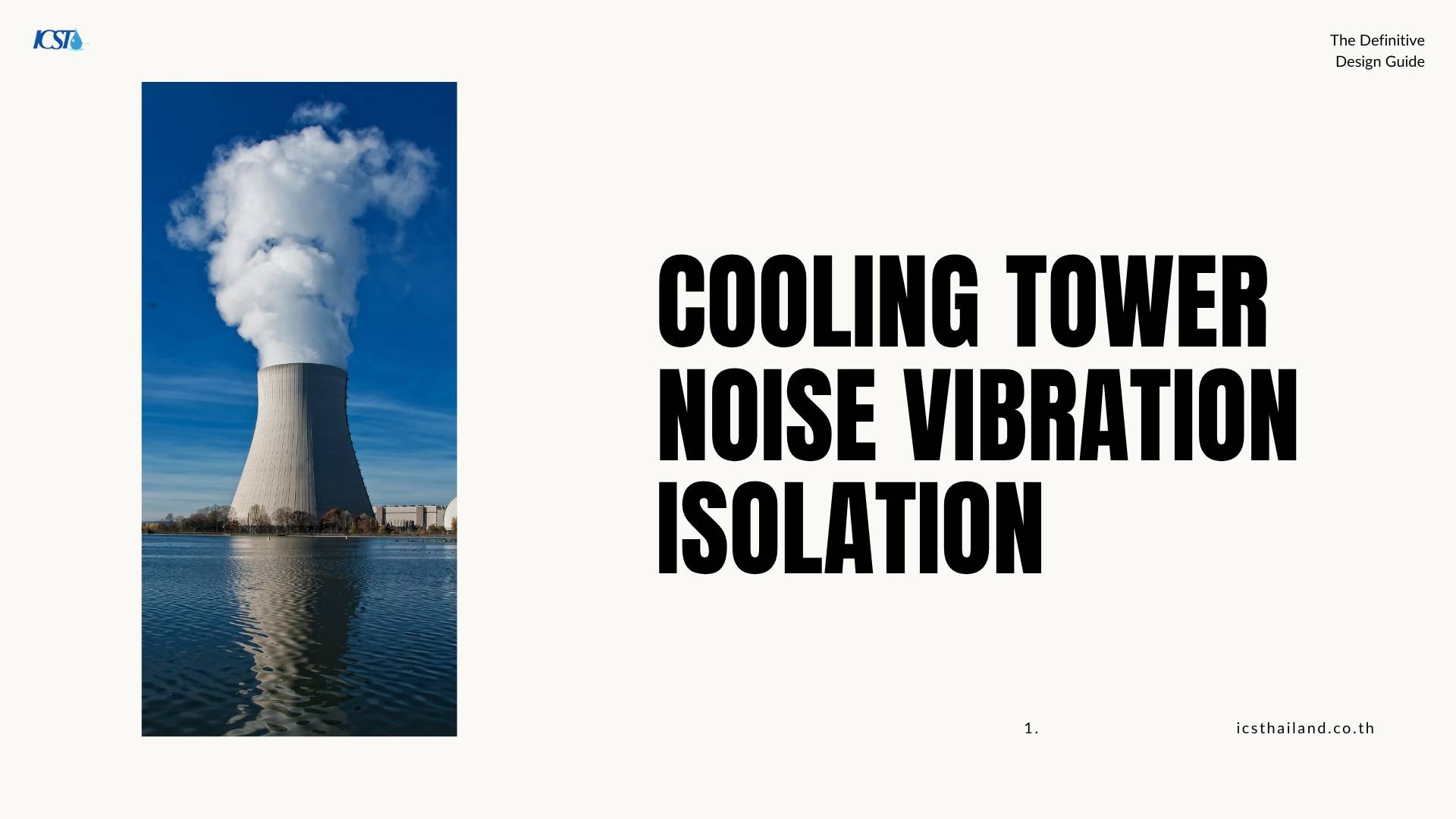
Cooling tower noise vibration isolation minimises mechanical noise and vibrations from cooling towers, ensuring compliance with noise regulations and protecting surrounding environments. This process involves using vibration isolators, acoustic barriers, and flexible pipe connections to address both airborne and structure-borne noise.
Proper isolation prevents structure-borne vibrations from transferring into building frameworks and reduces airborne noise from fan blades and water splashing. By implementing static deflection metrics and eliminating acoustic bridges, cooling tower systems achieve quieter operation while maintaining thermal performance and operational efficiency. This definitive design guide helps you master the modern engineering metrics for cooling towers. By the end of this post, you will know how to specify the correct static spring deflection, engineer effective acoustic barriers, and implement flexible pipe isolation.
The Dual-Path Physics of Cooling Tower Acoustic Energy
To address noise effectively, engineers must map and treat two entirely distinct vectors along the noise path. You cannot apply a single technology to resolve both airborne sound and physical vibrations.
Airborne Acoustic Energy
This high-frequency broadband noise originates from two primary sources. First, you have water noise control issues caused by falling water colliding with the cold-water basin. This water splashing generates a constant sound at roughly 500 Hz. Second, fan blades create aerodynamic turbulence and fan noise as air passes through the unit and discharge points.
Structure-Borne Kinetic Energy
This vector generates a low-frequency tonal hum. The mechanical force from machinery like the motor, gearbox, and fans transfers down into the building support structure. This structure-borne noise requires heavy-duty vibration isolation to protect sensitive receivers below the installation.
You must establish baseline noise levels using Decibel A-weighting and the Equivalent Continuous Sound Level metric. This proper design step guarantees you meet municipal boundary compliance.
Sizing System Isolation Metrics & Equipment Matrix
An isolated cooling tower must balance changing structural weight. The unit shifts from a dry shipping load to a fully loaded wet operating weight during continuous operation. During this shift, the isolation system must neutralise low-frequency driving forces to maintain efficiency.
Focus on these engineering specifications to prevent mechanical failure:
- Low-Speed Motor Vibration: Use vertically restrained, enclosed steel spring isolators. Target a static deflection of 50 mm to 100 mm. This prevents low-frequency structural resonance and seismic damage.
- High-Frequency Motor Ring: Install double-deflection waffle-grooved neoprene pads. Target 15 per cent compression. This stops high-frequency mechanical ticking from passing into structural steel columns.
- Broadband Water-Splash Noise: Deploy floating open-cell polyolefin or PVC basin mats. This water flow absorption layer reduces high-pitched splashing sounds.
- Condenser Pipe Acoustic Bridging: Specify multi-axis twin-sphere elastomeric flex connectors. Match the maximum spring travel parameters to prevent pipe manifold cracking.
Structural Dynamics: Managing Fan Frequencies
Different frequencies require different isolation strategies. You must size springs based on the disturbing frequency of the fan. Engineers calculate this metric as RPM divided by 60. A large device running at 400 RPM will generate an intrusive 6.7 Hz frequency. To achieve 90 percent isolation efficiency, the natural frequency of the spring must remain exceptionally low.

Multi-cell cooling towers present a unique structural hazard. You should not point-load individual cells directly on separate springs. When operators drain one cell for maintenance, it springs upward independently. This tears apart interconnecting basin flumes.
You must force multi-cell systems to anchor to a rigid, shared structural steel rail or a poured concrete inertia base. Place the isolators exclusively underneath the primary beam grid. This common dunnage framework ensures unified movement and a quiet system.
Eliminating the Acoustic Bridge
Even the best vibration isolators fail if kinetic energy finds an un-isolated path back to the building slab. Engineers call this phenomenon vibration short-circuiting. You must eliminate these rigid connections to reduce noise efficiently.
Implement dynamic flexible pipe connections immediately. Specify multi-axis braided steel or elastomeric bellows directly at the suction and return flanges. Next, upgrade the first three to five pipe hangers closest to the tower.
Change them from solid steel rods to a combination of spring-and-neoprene hangers. Finally, replace rigid metal conduit connections with sweeping, liquid-tight flexible electrical loops at the motor junction box.
External Path Control: Engineering Acoustical Barriers
Sometimes internal mechanical isolation falls short. You must control the external noise source using physical structures like partial enclosures or acoustic barriers. Engineers evaluate these structures using Sound Transmission Class for blocking ability and Noise Reduction Coefficient for absorbing ability. A proper barrier must possess a Sound Transmission Class of 30 or higher and a Noise Reduction Coefficient of 0.85 or higher.

Avoid the danger of reflective boundaries. Traditional concrete or smooth metal walls act as acoustic mirrors. They reflect sound waves toward the towers, which can amplify the noise and bounce it toward surrounding properties.
Instead, specify modular boundary enclosures with a perforated face and dense mineral wool cores. These structures absorb sound energy effectively. They create a deep noise shadow behind the wall without restricting necessary airflow to the fill media.
Protect Your Facility and Preserve Thermal Performance
You must isolate the kinetic energy of your HVAC systems before it impacts your neighbours. Left unmanaged, vibration transmission leads to building wear, operational liabilities, and environmental fines.
At International Cooling Solutions (Thailand), our mechanical engineersspecialisee in site-specific cooling tower noise vibration isolation setups that preserve the thermal performance of your equipment. Do not wait for a municipal violation. Contact our Bangkok office today to request an acoustic audit from a premier cooling tower manufacturer.
Frequently Asked Questions (FAQs)
What is cooling tower noise vibration isolation?
Cooling tower noise vibration isolation involves reducing mechanical noise and vibrations from cooling towers to prevent disruptions in surrounding environments. This process uses vibration isolators, acoustic barriers, and flexible pipe connections to address both airborne and structure-borne noise. Proper isolation ensures compliance with noise regulations, protects sensitive receivers, and maintains the system’s thermal performance.
How do acoustic barriers help in noise control?
Acoustic barriers block and absorb sound waves, reducing noise levels around cooling towers. They are designed with high Sound Transmission Class (STC) and Noise Reduction Coefficient (NRC) ratings to minimise sound energy. Unlike reflective barriers, which amplify noise, absorptive barriers convert sound into thermal energy, creating a quieter surrounding environment without affecting airflow.
Why is static deflection important in vibration isolation?
Static deflection measures how much a vibration isolator compresses under load. It is crucial for isolating low-frequency vibrations from cooling tower fans and motors. Proper static deflection prevents structure-borne noise, reduces mechanical wear, and ensures efficient operation. For example, spring isolators with 50–100 mm deflection are ideal for low-frequency noise control.
What causes structure-borne noise in cooling towers?
Structure-borne noise occurs when mechanical vibrations from fans, motors, or gearboxes transfer into the building’s structure. This low-frequency noise can travel long distances, causing disruptions. Effective vibration isolation, such as using spring isolators and flexible pipe connections, prevents these vibrations from reaching sensitive areas.
How can flexible pipe connections reduce noise?
Flexible pipe connections, like multi-axis elastomeric bellows, absorb vibrations and prevent noise transmission through piping systems. They eliminate rigid connections that can act as vibration bridges, reducing the risk of pipe cracking and noise short-circuiting. Upgrading nearby pipe hangers to spring-and-neoprene combinations further enhances noise control.