An injection molding cooling tower removes excess process heat so manufacturers can maintain stable mold temperature, shorter cycle times, better part quality, and higher machine output. Cooling often takes the largest share of the molding cycle, so poor heat removal quickly increases scrap, warpage, dimensional variation, and production cost.
Modern plastic molding plants use cooling towers with TCU systems, closed-loop circuits, smart controls, and strong temperature stability monitoring to protect product quality and keep production consistent.
Why Cooling Often Determines Whether a Molding Process Succeeds or Fails
For plastic manufacturers, cooling isn’t just a utility—it’s a critical process that determines profitability, production speed, and part quality. Since cooling is the most time-consuming part of the molding cycle, optimizing it with an injection molding cooling tower is key to improving production.
Cooling Is the Longest Phase of the Molding Cycle
Cooling often takes the largest portion of the injection molding cycle. Engineering sources commonly describe cooling as the longest phase, often around 60–80% of total cycle time, while another molding example shows cooling-related time reaching 85% of one cycle.
That number matters because every saved second can increase output across thousands of shots.
Faster and more stable cooling can improve production in several ways:
- Shorter cycle time: Parts reach ejection temperature faster.
- Higher machine output: The same press produces more parts per shift.
- Lower cost per part: Fixed machine and labor costs spread across more parts.
- Better scheduling: Stable cooling supports predictable production planning.
- Less bottleneck pressure: More efficient cooling reduces mold waiting time.
Cooling time directly affects profitability because it controls how fast each molded part can leave the tool.
Poor Cooling Creates Quality Defects
Poor cooling creates uneven shrinkage and internal stress. This can lead to warpage, sink marks, dimensional variation, surface defects, and inconsistent strength.
Research on injection molding warpage and shrinkage explains that mold temperature control can improve dimensional accuracy, mechanical properties, and surface quality.
Common cooling-related defects include:
- Warpage: Uneven shrinkage bends or twists the part.
- Sink marks: Thick sections cool slowly and collapse inward.
- Dimensional variation: Parts miss tolerance because cooling changes shot to shot.
- Surface finish issues: Poor mold temperature can affect gloss and texture.
- Internal stresses: Uneven cooling can leave stress inside the molded part.
These defects increase scrap, rework, customer complaints, and inspection time.
How an Injection Molding Cooling Tower Fits Into the Entire Cooling Ecosystem
An injection molding cooling tower does not operate in isolation. It functions as the primary heat rejection mechanism within a complex network of chillers, pumps, and temperature controllers. Manufacturers must understand how water flows from the molding machine to the tower to troubleshoot process issues effectively.
Heat Generation Inside Injection Molding Machines
Injection molding machines generate massive amounts of thermal energy during normal operation. The friction of the spinning screw melts the plastic resin, injecting extreme heat into the metal mold.
If the facility does not extract this heat continuously, the equipment will overheat and shut down. The cooling system captures this energy and transports it away from the production floor.
The primary sources of heat include:
- Molten plastic: Liquid resin transfers immense heat directly into the mold steel.
- Hydraulic systems: High-pressure oil creates mechanical friction that requires continuous cooling.
- Mechanical friction: Moving machine platens and toggles generate localized thermal loads.
The Role of TCU Systems
A TCU (Temperature Control Unit) circulates fluid through the mold to regulate the exact temperature of the tool. While a cooling tower provides bulk heat rejection, the TCU provides localized, high-precision thermal management. These units can both heat the mold before production and cool it during active cycles.
The TCU bridges the gap between the bulk plant water and the specific requirements of the plastic part. It ensures the mold steel remains at the exact temperature required by the resin manufacturer.
The essential functions of these units include:
- Precision regulation: Units maintain the exact fluid temperature required for specific polymers.
- Heating capabilities: Systems pre-heat the mold to prevent premature plastic freezing during injection.
- Zoned control: Multiple units manage different halves or sections of the same mold independently.
How Cooling Towers Reject Process Heat
The injection molding cooling tower removes heat from the facility by evaporating a small portion of the circulating water. Warm water from the production floor sprays over the tower fill media while a fan pulls air across the water droplets.
The key principles of tower heat rejection include:
- Evaporative cooling: The phase change from liquid to vapor removes massive amounts of thermal energy.
- Continuous circulation: Pumps constantly move water between the heat source and the rejection point.
- Atmospheric release: The tower safely exhausts process heat into the outside ambient air.
The Science Behind Mold Temperature Control

The mold’s temperature dictates how plastic molecules behave as they solidify. To meet tight dimensional tolerances, engineers must control this thermal transition, which is where an injection molding cooling tower becomes critical for producing consistent parts that fit together perfectly.
Why Mold Temperature Affects Product Dimensions
Plastic materials shrink as they cool from a molten state to room temperature. The rate at which the plastic cools determines the final crystalline structure and the total amount of shrinkage.
If the mold temperature changes during a production run, the dimensions of the final parts will vary significantly.
The critical factors influencing part dimensions include:
- Plastic shrinkage: Molecules pack closer together as thermal energy leaves the material.
- Cooling rate: Fast cooling freezes the molecules before they can fully organize, affecting final size.
- Dimensional tolerances: Consistent thermal extraction ensures parts meet strict engineering specifications.
Different Polymers Require Different Temperature Ranges
Different plastics need different cooling strategies. Amorphous plastics and semi-crystalline plastics respond differently to mold temperature, cooling rate, and shrinkage behavior.
Semi-crystalline materials often show stronger sensitivity to cooling conditions because crystallization affects final dimensions and mechanical properties.
Material choice should guide cooling design. A plant running PP, PA, POM, ABS, PC, or PET may need different mold temperature and cooling strategies for each resin family.
Temperature Stability: The Hidden KPI Most Molders Ignore
Many manufacturers focus entirely on reaching a target temperature, but they fail to monitor how well the system holds that temperature over time. T
emperature stability serves as a far more accurate predictor of part quality than simple cooling capacity. If temperatures swing wildly up and down, the process remains out of control.
Why Fluctuating Temperatures Create Inconsistent Parts
When the cooling water temperature fluctuates, the mold extracts heat at varying rates throughout the day. A part molded during a cold temperature swing will shrink differently than a part molded during a warm swing.
The direct results of thermal fluctuations include:
- Variable shrinkage: Parts change size randomly based on the exact water temperature during their specific cycle.
- Quality rejections: Customers reject shipments when dimensional consistency falls below agreed standards.
- Process adjustments: Operators waste time constantly changing machine settings to chase a wandering thermal baseline.
Stability vs Cooling Capacity
Cooling capacity tells you how much heat the system can remove. Stability tells you how consistently the system controls temperature.
An oversized tower can still perform poorly if controls swing too much, water flow varies, or heat exchangers foul.
Manufacturers should monitor both capacity and control response. The goal is not the coldest water possible. The goal is the right water temperature at the right stability.
How Manufacturers Measure Temperature Stability
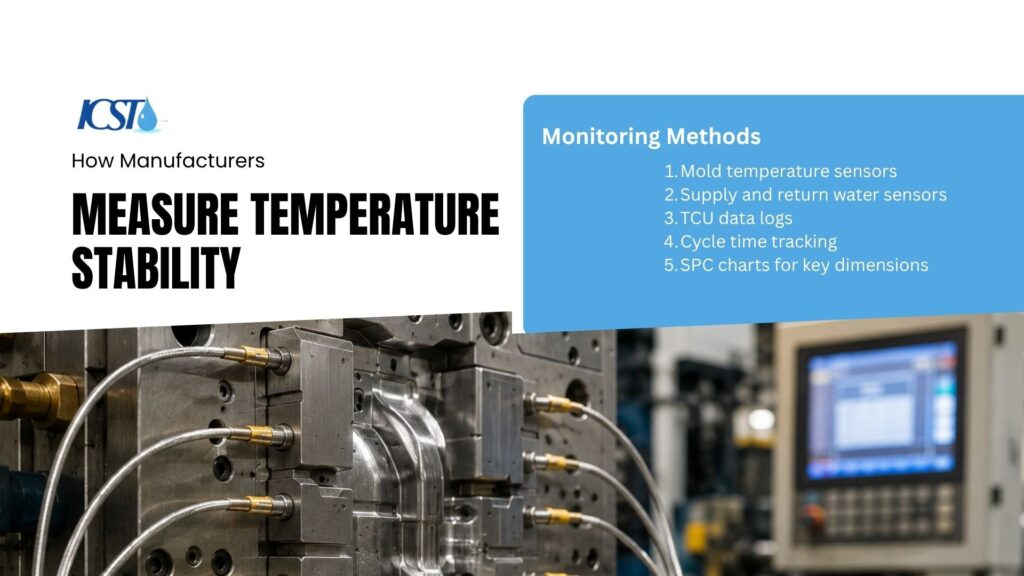
Manufacturers measure stability through sensors, data logging, and statistical process control. Operators should compare cooling water temperature, mold temperature, cycle time, and part dimensions over time.
Useful monitoring methods include:
- Mold temperature sensors
- Supply and return water sensors
- TCU data logs
- Cycle time tracking
- SPC charts for key dimensions
This data helps teams detect drift before scrap increases.
Understanding TCU Systems and Their Connection to Cooling Towers
A TCU relies entirely on the primary injection molding cooling tower to function correctly. The TCU circulates its own internal fluid to control the mold, but it uses the tower water to reject excess heat from that closed loop. If the tower fails to provide adequately cooled water, the unit cannot maintain its target setpoint.
What a TCU Actually Does
A temperature control unit acts as a localized thermostat for a specific plastic mold. It contains an internal pump, a heating element, and a cooling valve. When the mold requires heat, the unit activates its electric heaters to warm the circulating fluid.
When the molten plastic overheats the mold, the unit opens a valve to allow cold tower water into its internal heat exchanger. This action precisely balances the thermal load of the tool.
Water-Based vs Oil-Based TCUs
Water-based TCUs work well for many standard molding temperatures. They transfer heat efficiently and suit many plastic parts.
Oil-based TCUs handle higher temperatures and applications that need hotter mold conditions. They may suit certain engineering plastics or high-temperature processes.
The choice depends on resin, tool design, temperature range, safety, and heat transfer needs.
Why Closed Loop Circuits Dominate Modern Injection Molding Facilities
A closed loop circuit separates the clean process water that flows through the molding machines from the dirty water exposed to the outside air. Precision plastic manufacturing requires perfectly clean water to maintain consistent heat transfer rates. Open systems allow dirt, pollen, and airborne debris to contaminate the process water, which eventually destroys expensive molds and equipment.
What Is a Closed Loop Circuit?
A closed loop circuit circulates controlled water or fluid through machines, molds, TCUs, or heat exchangers without exposing that fluid directly to outside air.
The cooling tower may still reject heat, but a heat exchanger separates tower water from the clean process loop.
This design helps protect small mold channels, TCU heat exchangers, and machine cooling passages.
Open Loop vs Closed Loop Cooling
A comparison helps clarify why molding plants often prefer closed loops for precision applications.
| Cooling Type | Water Contact | Main Benefit | Main Risk | Best Application |
| Open loop cooling | Tower water contacts equipment directly | Lower first cost | Scale, corrosion, contamination | Simple, low-risk cooling |
| Closed loop circuits | Process fluid stays isolated | Cleaner process water | Higher upfront cost | Precision molding |
| Tower plus heat exchanger | Tower water separated from process loop | Good balance of efficiency and control | Heat exchanger fouling | Modern molding plants |
| Chiller-assisted closed loop | Chilled water controls temperature tightly | Strong precision | Higher energy cost | High-tolerance parts |
| Hybrid cooling system | Uses tower and chiller modes | Energy flexibility | More complex controls | Variable production loads |
Water Quality Management for Precision Molding Operations
Water quality acts as the lifeblood of an injection molding facility. If the water chemistry falls out of balance, the entire cooling infrastructure begins to deteriorate rapidly. Implementing a professional water treatment program protects expensive molds, prevents unplanned downtime, and guarantees highly efficient heat transfer.
Scale and Mineral Deposits
When water evaporates in the cooling tower, it leaves its dissolved minerals behind in the basin. As the water cycles, these minerals concentrate until they form hard scale on the heat exchangers and mold cooling channels. This scale acts as a powerful insulator, destroying the efficiency of the cooling system.
Facilities must continuously bleed off this concentrated water and replace it with fresh makeup water to control mineral levels. Chemical scale inhibitors provide a secondary layer of protection against deposition.
The critical strategies for scale control include:
- Automated blowdown controllers: Install sensors that automatically drain mineral-heavy water when conductivity gets too high.
- Chemical inhibition: Feed specific chemicals that prevent calcium carbonate from forming solid crystals.
- Makeup water softening: Pre-treat the incoming city water to remove hardness before it enters the tower.
Biological Fouling Risks
Open cooling towers act as massive air scrubbers, pulling dirt, bacteria, and organic matter into the warm water. This environment breeds algae, bacteria, and destructive biofilms. Biofilms coat heat transfer surfaces and cause severe micro-biologically influenced corrosion (MIC) that eats through steel pipes.
Uncontrolled biological growth also poses severe health risks to factory workers, specifically regarding Legionella bacteria. Aggressive biocide programs are legally and operationally mandatory.
Corrosion Prevention Strategies
Corrosion destroys factory piping, damages mold cooling channels, and fills the water with abrasive rust particles. Water naturally wants to dissolve the metals it touches, especially when oxygen levels are high. Facilities must add corrosion inhibitors to the water to form a microscopic protective film on all metal surfaces.
Conclusion
An injection molding cooling tower supports precise mold temperature control, stronger TCU performance, shorter cycle times, and better product quality. Cooling often controls the longest phase of the molding cycle, so stable heat removal can improve output, reduce scrap, and lower cost per part.
Modern molding facilities gain better results when they use clean closed loop circuits, strong water treatment, accurate sensors, and smart outdoor reset control strategies. Long-term success depends on temperature stability, not just cooling capacity.
For more industrial cooling solutions and services, visit the ICST website today
Frequently Asked Questions
What is an injection molding cooling tower?
An injection molding cooling tower rejects heat from molding machines, chillers, TCUs, and process cooling loops. It helps maintain stable cooling water conditions so molds can remove heat from plastic parts efficiently. Stable tower performance supports cycle time, mold temperature control, part quality, and machine uptime.
Why does mold temperature matter in injection molding?
Mold temperature affects plastic shrinkage, surface finish, dimensional accuracy, and internal stress. If mold temperature changes from shot to shot, parts can warp, shrink unevenly, or miss tolerance. Stable mold temperature helps manufacturers improve repeatability and reduce scrap.
How does a TCU work with a cooling tower?
A TCU controls fluid temperature at the mold level, while the cooling tower rejects heat from the larger plant loop or chiller system. The TCU needs stable cooling water to maintain its setpoint. If tower water temperature rises or fluctuates, the TCU may struggle to control the mold.
Why do injection molding plants use closed loop circuits?
Closed loop circuits keep process water separated from open cooling tower water. This reduces contamination, scale, corrosion, and blockage risk inside molds, TCUs, and machine cooling passages. Closed loops improve temperature control and extend equipment life, especially in precision molding operations.
How does cooling affect injection molding cycle time?
Cooling often takes the largest share of the molding cycle, commonly around 60–80% of total cycle time. Faster and more stable cooling can reduce cycle time when the material and mold design allow it. Shorter cycle time increases machine output and lowers cost per part.
What cooling KPIs should injection molders monitor?
Injection molders should monitor mold temperature consistency, cooling water supply temperature, return temperature, tower approach, tower range, cycle time, energy per part, flow rate, pressure drop, heat exchanger delta-T, and cooling system downtime. These KPIs help teams detect fouling, instability, and capacity issues early.