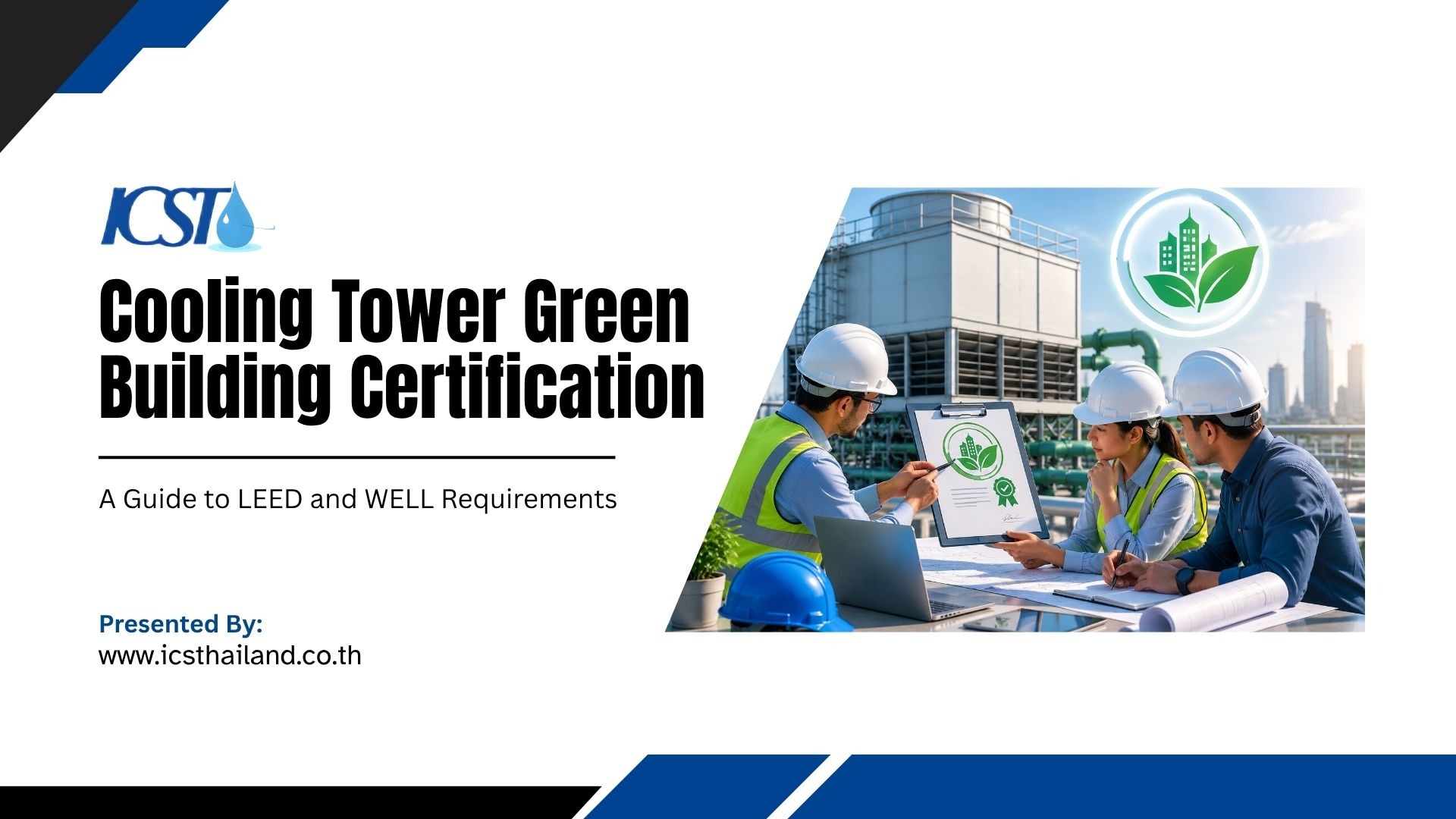
Cooling tower green building certification depends on water efficiency, safe operation, documentation, and long-term system control. Under LEED v4.1, cooling towers may support a water efficiency credit by optimizing cycles of concentration, reducing potable makeup water, and using strategies such as recycled makeup water where appropriate.
The WELL standard focuses more on health-related water management, including Legionella risk control. For any green certification, the tower must be designed, monitored, maintained, and documented correctly.
What Is Cooling Tower Green Building Certification?
Cooling tower green building certification means designing and operating cooling towers to support green building rating goals. This process demands verifiable water savings, reduced potable water use, better maintenance routines, and safe water management. Facility managers must operate systems efficiently and document performance to prove compliance.
Why Cooling Towers Matter in Green Buildings
Cooling towers can use large volumes of makeup water, especially in hot and humid climates. Blowdown can waste water when cycles of concentration are too low or poorly controlled. Poor water treatment can increase scale, corrosion, microbial activity, and fouling.
Cooling towers matter because they can affect:
- Makeup water demand
- Blowdown volume
- Process water efficiency
- Scale and corrosion control
- Biological growth
- Legionella risk
- Heat-transfer performance
- Energy use
- Maintenance cost
- Certification documentation
Certification teams need measurable data, not assumptions. Good records help prove that the tower performs as intended.
LEED vs WELL: Different Certification Focus
LEED v4.1 focuses on sustainable building performance, including water efficiency, energy use, materials, location, indoor environmental quality, and operations. For cooling towers, LEED usually looks at how efficiently the system uses water and how well the project documents process water reduction.
The WELL standard focuses on human health and building performance. For cooling towers, WELL attention often connects with water safety, Legionella risk management, maintenance procedures, and documentation.
LEED asks how efficiently water is used. WELL asks how safely water systems are managed. A strong cooling tower program should support both.
How LEED v4.1 Applies to Cooling Towers
The rating system does not reward a cooling tower just because it exists on the roof. The project must show that the tower actively supports water-efficiency goals and meets specific credit requirements.
According to the U.S. Green Building Council, LEED v4.1 includes an option based on cooling tower and evaporative condenser cycles of concentration. This requires a one-time potable water analysis measuring key condenser water control parameters.
What LEED v4.1 Looks For
LEED cooling tower review focuses on water data, operating limits, and documented control. The goal is to reduce unnecessary potable water use without creating scale, corrosion, or microbial risk.
Project teams should prepare for:
- Potable water analysis
- Cooling tower cycles of concentration
- Conductivity and water chemistry data
- Blowdown control
- Makeup water reduction
- Microbial control
- Scale control
- Corrosion control
- Water metering
- Process water use reduction
- Documentation and calculations
LEED water efficiency requires a careful balance. The project should not chase water savings in a way that damages the tower or creates unsafe water conditions.
Why Cycles of Concentration Matter
Cycles of concentration compare dissolved solids in the cooling tower water with dissolved solids in makeup water. Higher cycles can reduce blowdown and makeup water demand.
However, very high cycles can increase scale, corrosion, and biological risk when water treatment does not control the chemistry. The goal is not maximum cycles at any cost. The goal is safe, stable, and efficient water use.
USGBC states that improving cycles of concentration reduces makeup water inputs and blowdown volume, which is why this measure matters for water efficiency.
Water Efficiency Credit: What Project Teams Should Prepare
A cooling tower can support a water efficiency credit only when the project team can show measurable water savings and safe water management. Design intent alone is not enough.
To achieve cooling tower green building certification, reviewers will need documentation like water analysis, meter readings, and treatment records. Project teams should start collecting these records early to avoid delays during the final submission.
Required or Useful Documentation
Facility managers must collect specific documents long before submitting a certification application. Gathering this paperwork early prevents delays during the final review process.
Useful documents include:
- Cooling tower specifications
- Water-quality analysis
- Makeup water data
- Blowdown data
- Cycles of concentration calculation
- Water-treatment plan
- Control parameters
- Cooling tower water meter data
- Maintenance records
- Commissioning records
- Recycled water calculations if used
- Manufacturer data sheets
- Drift eliminator performance data
- Water balance calculations
A water-efficiency claim should be supported by data, not only by vendor statements.
LEED Cooling Tower Water Efficiency Checklist
This checklist helps project teams organize LEED-related cooling tower records. It also helps operators understand what must stay controlled after commissioning.
| LEED Review Area | What to Check | Why It Matters | Documentation Needed | ICST Support Area |
| Water analysis | Makeup water chemistry and control parameters | Sets safe operating limits | Lab report or water-quality record | Water system review |
| Cycles of concentration | Tower water vs makeup water concentration | Reduces makeup and blowdown | COC calculation and logs | Operational assessment |
| Blowdown control | Conductivity and automatic blowdown | Prevents water waste and scaling | Controller settings and records | Maintenance and inspection |
| Microbial control | Biocide and biological monitoring | Supports safe operation | Treatment reports | Basin, fill, and drift review |
| Scale and corrosion control | Water chemistry and material condition | Protects tower life | Inspection and treatment logs | Mechanical condition review |
| Recycled makeup water | Source, quality, compatibility | Reduces potable demand | Water balance and quality records | Design and material review |
| Metering | Makeup and blowdown measurement | Proves performance | Meter data | Upgrade planning |
Recycled Makeup Water for Cooling Towers
Recycled makeup water can reduce potable water demand, but it must be evaluated carefully before use in a cooling tower. Alternative water sources may contain higher dissolved solids, nutrients, organics, ammonia, chlorides, or suspended solids.
Canada Green Building Council’s LEED v4.1 water-efficiency overview notes that projects can earn process water-use points by using recycled alternative water for process water demand, with thresholds depending on the credit path.
Possible Recycled Water Sources
Depending on local rules and treatment capability, recycled or alternative sources may include:
- Treated wastewater
- Reclaimed water
- Condensate recovery
- Rainwater harvesting
- Process water reuse
- Cooling condensate from HVAC systems
Every source needs a water-quality review before design approval.
Design Questions Before Using Recycled Makeup Water
Recycled water should not be added only for credit points. It must fit the tower chemistry, materials, treatment program, and local regulations.
Ask these questions first:
- What is the water quality?
- Does it increase scaling risk?
- Does it increase corrosion risk?
- Does it increase biological growth?
- Does it affect biocide demand?
- Does it contain nutrients, organics, ammonia, chlorides, or suspended solids?
- Does the tower material support this water chemistry?
- Does local regulation allow this source?
- Does the treatment system need filtration or pretreatment?
- Can the project document the water savings?
These questions protect the project from water savings that create reliability problems.
Why Recycled Water Is Not Always Simple
Recycled water can reduce potable water use, but it can also increase treatment complexity. Poorly controlled recycled water may increase fouling, corrosion, scaling, and microbial growth.
Design teams should balance water savings with reliability and safety. The right solution may require filtration, pretreatment, material review, additional monitoring, or changes in chemical control.
WELL Standard and Cooling Tower Health Requirements
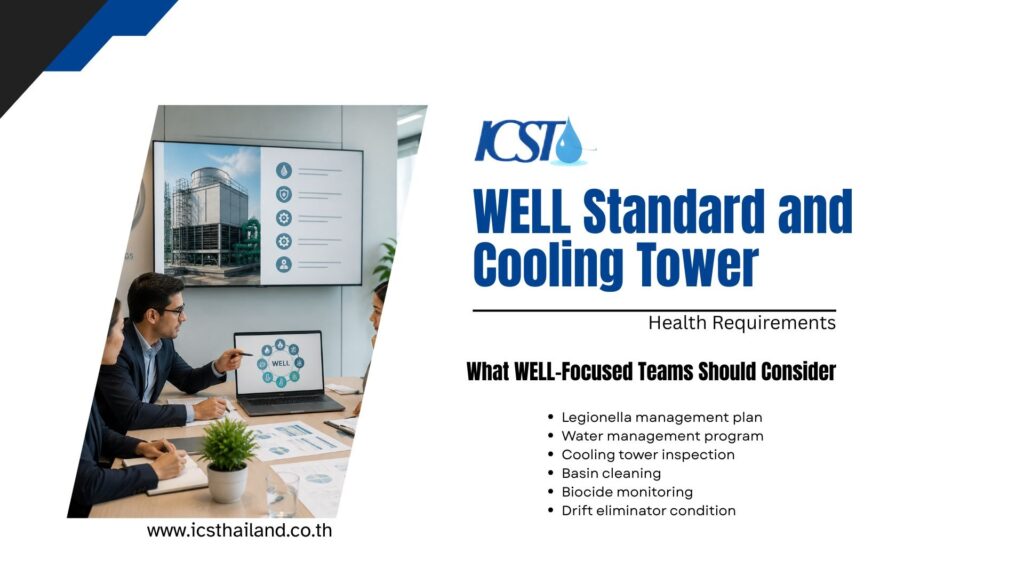
While LEED rewards efficiency, the WELL standard strictly focuses on building occupant health and water safety. Cooling towers matter heavily here because they can support and spread Legionella bacteria if poorly maintained.
What WELL-Focused Teams Should Consider
Securing WELL certification requires proving that the building actively protects the people living or working near it. This demands rigorous safety protocols and strict biological monitoring.
WELL-focused teams should treat cooling tower water safety as an operating responsibility, not only a design note.
They should consider:
- Legionella management plan
- Water management program
- Cooling tower inspection
- Basin cleaning
- Biocide monitoring
- Drift eliminator condition
- Aerosol control
- Shutdown and restart procedures
- Documentation of maintenance
- Corrective action logs
Legionella Management for Green Certification
Achieving cooling tower green building certification should never compromise human health and safety. A truly sustainable cooling tower operates efficiently while maintaining strict biological control.
What to Include
A Legionella-focused cooling tower program should include:
- Water management plan
- Hazard analysis
- Biocide program
- Basin cleaning schedule
- Drift eliminator inspection
- Fill media inspection
- Nozzle inspection
- Shutdown and startup procedure
- Legionella testing where required by standard, local rule, or plan
- Corrective action process
- Documentation and staff responsibilities
A green building team should never trade water savings for unsafe operation.
Thailand and Asia Green Building Context
Projects in Thailand and across Asia face extreme tropical cooling conditions that challenge both water efficiency and biological control. Standard templates from colder climates fail quickly in these environments.
What to Mention
Designing and operating a green cooling tower in a tropical climate requires specialized knowledge. Teams must adapt their strategies to handle intense heat and heavy rainfall.
The most useful points include:
- High wet-bulb: High wet-bulb temperatures drastically increase the baseline cooling demand.
- Humidity impact: High humidity limits evaporation rates and affects overall tower performance.
- Warm water risks: Constantly warm water accelerates biological activity and bacteria growth.
- Monsoon factors: Heavy monsoon rain changes basin water chemistry and overflows chemical treatments.
- Coastal risks: Coastal projects face severe corrosion risks from airborne salt entering the fan deck.
- Continuous demand: Data centers and industrial plants need reliable 24/7 cooling despite the weather.
- Balanced goals: Water savings must never create scale, fouling, or Legionella risks in hot climates.
- Dual needs: Green certification teams need both verifiable sustainability and bulletproof mechanical reliability.
How ICST Can Support Green Building Cooling Tower Projects
Achieving cooling tower green building certification requires expert mechanical and operational support. ICST provides the specialized services needed to meet these strict standards across Thailand and Asia.
ICST can support:
- Cooling tower design review
- New cooling tower construction
- Water-efficiency upgrade review
- Cooling tower replacement
- Thermal performance evaluation
- Fill media selection
- Drift eliminator replacement
- Fan, motor, gearbox, and nozzle support
- Basin and structural inspection
- Maintenance planning
- Documentation support through condition reports and service records
- Field support across Thailand and Asia
This support helps teams prepare stronger green certification submissions and operate more reliable cooling tower systems.
Summary
Cooling tower green building certification depends on efficient water use, safe water management, and proper documentation. LEED v4.1 can connect cooling towers with water-efficiency and process water credits.
A water efficiency credit may require water analysis, cycles of concentration data, metering, treatment records, and operating logs. Recycled makeup water can reduce potable demand, but teams must check water quality, scale, corrosion, and microbial risk. The WELL standard focuses more on water safety and Legionella management.
Frequently Asked Questions
What is cooling tower green building certification?
Cooling tower green building certification means utilizing efficient cooling tower design, precise water management, safe operation, and strict documentation to support green building systems like LEED and WELL. It requires facilities to prove they manage water use, chemical treatment, metering, and routine maintenance effectively to achieve sustainability goals.
How does LEED v4.1 apply to cooling towers?
LEED v4.1 evaluates cooling towers by focusing on water efficiency, process water use, optimizing cycles of concentration, and total makeup water reduction. To earn credits, facilities must provide detailed documentation, including comprehensive water analysis, dedicated metering data, and safe chemical treatment control records over time.
Can recycled makeup water help earn green certification?
Yes, using recycled makeup water drastically reduces potable water demand and strongly supports green certification goals. However, engineering teams must thoroughly check the alternative water source for correct water quality to prevent severe scale, aggressive corrosion, unchecked biological growth, and ensure it meets local municipal approvals.
What does the WELL standard require for cooling towers?
The WELL standard focuses strictly on occupant health and overall water safety. For cooling towers, facilities must implement detailed Legionella risk management plans, maintain rigorous maintenance records, keep drift inspection logs, track corrective actions, and provide thorough water management documentation to prevent dangerous bacterial outbreaks.
What is a water efficiency credit for cooling towers?
A water efficiency credit rewards building projects that successfully reduce cooling tower makeup water demand or optimize process water use. To earn this credit, the facility must prove it achieves significant water savings while safely controlling scale, corrosion, and dangerous microbial growth through active management.
How can ICST support green certification projects?
ICST supports cooling tower green building certification by providing expert design review, maintenance, tower replacement, drift eliminator inspection, and thermal performance review. We also assist with fill media selection, recycled water compatibility checks, parts support, and provide the documentation-friendly service reports required by certification reviewers.